






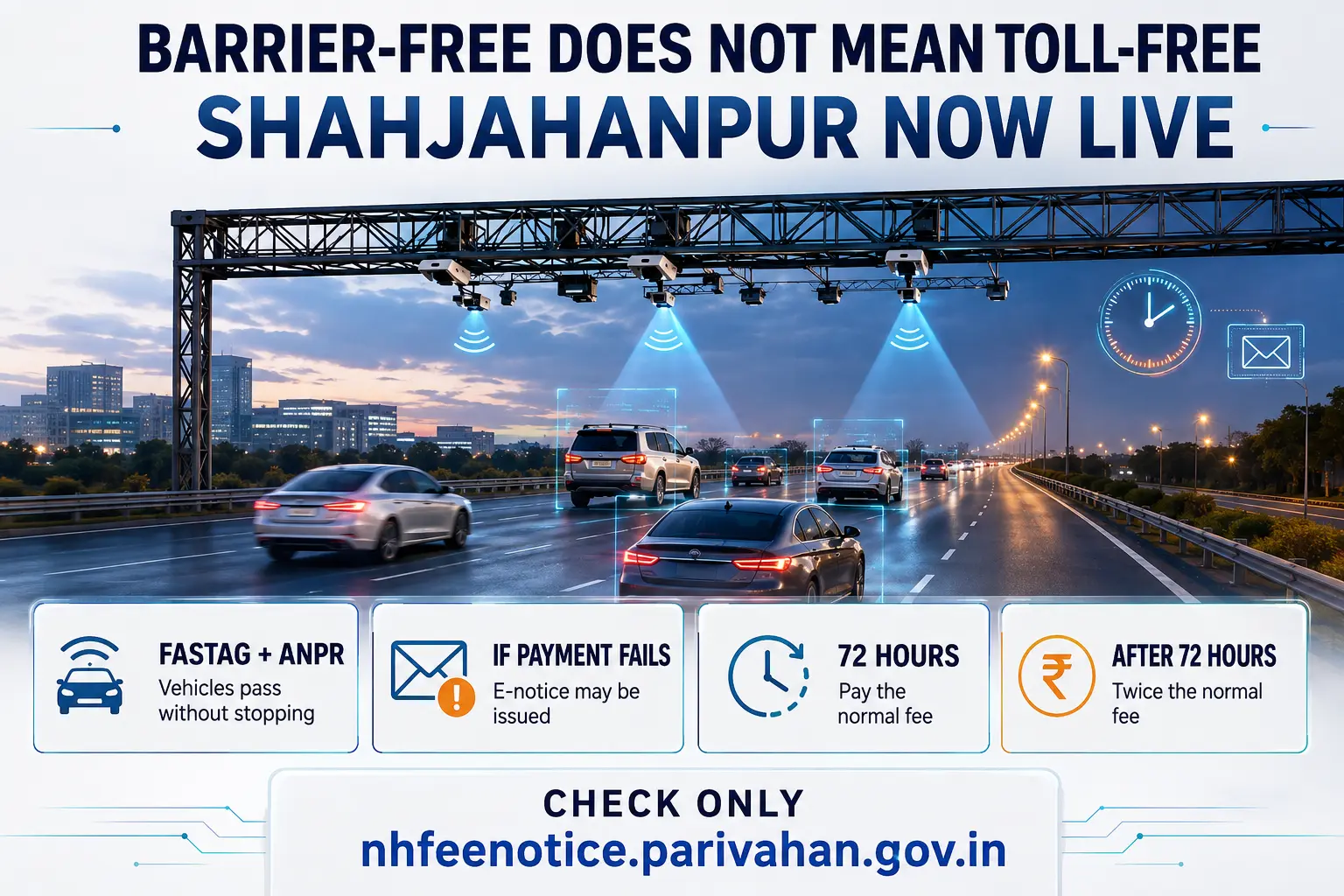
Delhi Jaipur barrier-free tolling is operational at Shahjahanpur Toll Plaza on NH-48, with FASTag and automatic number-plate recognition processing the user fee while vehicles continue moving.
The key rule for drivers is simple: barrier-free does not mean toll-free. If toll payment is not successfully processed, an electronic fee notice may be generated and both payment and dispute deadlines can start from issuance of that notice.
The direct answer
If an e-notice is issued, act within 72 hours.
The normal applicable user fee can be paid within 72 hours from issuance of the e-notice. If it remains unpaid after that period, twice the normal user fee becomes payable.
The official NHAI e-Notice portal also says a grievance or representation should be raised within 72 hours of issuance. It states that users cannot raise a grievance through that portal after the 72-hour window.
Check the official National Highway Fee Notice portal if you suspect a FASTag payment failed. A missing deduction alert or SMS should not be treated as proof that no e-notice exists.
In this guide
- What changed at Shahjahanpur
- How barrier-free tolling works
- When an e-notice may be issued
- How the 72-hour payment and grievance rules work
- Where to check and pay
- How portal login and VAHAN OTP work
- What if no FASTag deduction arrives?
- What if the notice or ANPR record is wrong?
- Annual-pass and exempt vehicles
- Sold, rented or transferred vehicles
- Official grievance routes
- Frequently asked questions
What changed at Shahjahanpur Toll Plaza?
NHAI launched Multi-Lane Free Flow tolling at Shahjahanpur on the Delhi–Jaipur section of NH-48.
Daulatpura and Manoharpura also operate under the MLFF framework, allowing vehicles on these points of the Manesar–Jaipur stretch to move through without the conventional stop-and-pay barrier process.
The removal of the conventional barrier does not remove the legal obligation to pay the applicable National Highway user fee.
How does barrier-free tolling work?
The system combines:
- FASTag RFID: reads the FASTag and attempts the toll transaction;
- ANPR: reads the vehicle registration number through camera-based automatic number-plate recognition;
- electronic processing: matches the crossing with FASTag, vehicle and fee records.
The purpose is to allow users to pass without stopping, slowing for a conventional toll booth or remaining in one physical collection lane.
When can a National Highway e-notice be issued?
NHAI identifies unsuccessful FASTag payment conditions including:
- insufficient FASTag balance;
- inactive or invalid FASTag;
- non-functional FASTag; and
- other tag-related conditions where the applicable toll is not successfully received.
An e-notice is an electronically generated notice informing the road user that the applicable toll remains unpaid under the MLFF framework.
Do not assume every failed transaction has the same cause. Plate recognition, vehicle records, tag status or payment processing may also need checking in an individual dispute.
How do the 72-hour payment and grievance rules work?
The 72-hour period is measured from issuance of the e-notice, not automatically from the moment the vehicle crossed the toll location.
| Stage | Confirmed position | Driver action |
|---|---|---|
| Vehicle crosses | FASTag and ANPR process the crossing | Continue normally; do not stop suddenly or reverse in the MLFF zone |
| FASTag transaction succeeds | Normal toll is collected electronically | Check transaction history if necessary |
| Payment is unsuccessful | An e-notice may be generated | Check the official National Highway Fee Notice portal |
| Within 72 hours of e-notice issuance | Normal applicable user fee can be paid | Pay through the official service and save the receipt |
| Notice appears incorrect | Portal representation/grievance can be raised within the 72-hour window | Submit the dispute with supporting evidence before the deadline |
| After 72 hours without payment | Twice the normal applicable user fee becomes payable | Do not assume the original 1x amount remains available |
| After 72-hour grievance window | The portal states that a user cannot raise a grievance there after the deadline | Use other current official assistance routes where appropriate, but do not assume the portal representation window can be reopened |
Payment escalation and the normal portal grievance window are both tied to the 72-hour period. Preserve your evidence and submit the representation promptly.
Where can the e-notice be checked and paid?
Use the official National Highway Fee Notice service:
National Highway Fee Notice portal
The service can be used to inspect an e-notice, make payment and submit a representation within the applicable grievance window.
Do not pay through an unfamiliar link received in an unsolicited SMS, email, messaging app or call. Open the official government portal yourself and verify the vehicle and notice details before payment.
How does e-notice portal login work?
The official portal says users log in using the Vehicle Registration Number.
An OTP is sent to the mobile number linked with that vehicle registration number in the VAHAN database.
If the mobile number linked to the vehicle is outdated, the portal directs users to the official VAHAN mobile-number update facility.
An old owner’s mobile number or stale VAHAN record can make notice access and verification more difficult. Vehicle-registration and FASTag ownership records should be updated promptly after transfer.
What if there is no FASTag deduction message?
A missing deduction message does not mean the crossing was free.
- Check FASTag transaction history.
- Check the FASTag balance and status.
- Confirm the correct vehicle number is linked to the tag.
- Check the official National Highway Fee Notice portal.
- Review issuer-bank alerts and account records.
- If an e-notice exists and payment appears pending, stuck or already deducted, use the portal’s Payment Status function before making another payment.
Do not repeatedly pay until you establish whether a previous transaction succeeded.
What if the e-notice shows the wrong vehicle, wrong ANPR image or duplicate charge?
Do not ignore an incorrect e-notice, because the normal representation window is time-limited.
Preserve:
- registration certificate;
- e-notice number;
- notice issue time;
- vehicle registration number shown in the notice;
- ANPR image or plate information where displayed;
- FASTag transaction history;
- bank or issuer record;
- actual crossing time;
- existing payment receipt;
- vehicle photographs where relevant;
- sale/transfer documents if ownership changed.
Submit the representation through the official portal within the 72-hour grievance window where the case is eligible for portal review.
NHAI has separately identified vehicle-registration-number mismatches as a data-quality concern in the FASTag ecosystem, so a mismatch should be documented rather than assumed to be impossible.
What about the FASTag Annual Pass and exempt vehicles?
The National Highway Annual Pass operates through FASTag for eligible non-commercial cars, jeeps and vans.
The current MLFF material does not provide a complete special workflow for every:
- annual-pass crossing mismatch;
- local pass;
- exempt vehicle;
- incorrect vehicle classification;
- plate-recognition error.
If an unexpected fee or e-notice appears, preserve the pass details and crossing record and use the official dispute route within the available deadline.
What if the e-notice is for a vehicle that was sold, transferred or rented?
The public Shahjahanpur/MLFF material does not provide a complete liability rule for every sold, leased or rental-vehicle case.
Problems can arise where:
- VAHAN still shows the previous owner;
- FASTag ownership was not updated;
- a rental company receives the notice after the driver’s journey;
- the registered mobile number is outdated;
- the registration-transfer process remains incomplete.
Keep sale or transfer documents and update the registration and FASTag records promptly.
If the notice is disputed, act within the available grievance window rather than waiting for the ownership record to correct itself.
What are the official grievance and support routes?
- National Highway Fee Notice portal: for notice payment and representation during the applicable window
- National Highways helpline: 1033
- RajmargYatra app: highway-user support and MLFF/e-notice access where available
- FASTag issuer bank: for tag/account transaction issues
The official e-notice portal currently lists 1033 for technical/highway assistance.
Contact details and workflows can change, so verify the latest official service before relying on old screenshots or forwarded messages.
Delhi Jaipur barrier-free tolling: frequently asked questions
Is Shahjahanpur Toll Plaza toll-free?
No. Barrier-free means vehicles can pass without the conventional physical toll barrier. The applicable user fee still has to be paid.
Do drivers need to stop at Shahjahanpur?
No conventional stop-and-pay process is required. FASTag and ANPR process the crossing electronically.
What happens if FASTag balance is too low?
If the toll cannot be successfully processed, an e-notice may be issued. The normal applicable user fee may be paid within 72 hours from issuance of that notice.
Does the 72-hour clock start when I cross the toll point?
The official framework states that the 72-hour period runs from issuance of the e-notice.
What happens after 72 hours?
If the fee remains unpaid, twice the normal applicable user fee becomes payable.
How long do I have to dispute an e-notice?
The official e-notice portal says a grievance or representation may be raised within 72 hours from issuance. It states that a user cannot raise a grievance through the portal after that window.
Where can I check or pay a National Highway e-notice?
Use the official National Highway Fee Notice portal at nhfeenotice.parivahan.gov.in.
Why am I being asked for an OTP?
The official e-notice portal uses the vehicle registration number and sends an OTP to the mobile number linked with that vehicle in the VAHAN database.
What if FASTag was already deducted but an e-notice still appears?
Check FASTag history and the portal’s Payment Status function before paying again. Preserve the deduction record and raise a representation promptly if the notice appears incorrect.
What if ANPR shows the wrong vehicle?
Preserve the notice, ANPR image or plate details, RC, FASTag history and crossing evidence, then raise the portal grievance within the available 72-hour window.
What if I sold the vehicle before the crossing?
Preserve the sale and transfer documents and verify the current VAHAN and FASTag ownership records. The public MLFF material does not provide one universal liability answer for every incomplete-transfer case.
Does the FASTag Annual Pass work with barrier-free tolling?
The Annual Pass operates through FASTag for eligible vehicles. If an unexpected notice or deduction appears, check the pass and transaction record and use the official grievance process promptly.
Is every Delhi–Jaipur toll plaza removed?
No. Barrier-free tolling removes the conventional stop-and-pay process at participating MLFF locations; it does not abolish applicable National Highway user fees.
Official sources
- NHAI Shahjahanpur MLFF launch release
- Ministry of Road Transport & Highways — FASTag and MLFF framework
- Official National Highway Fee Notice portal
Verification and editorial limitation
Confirmed: Shahjahanpur is operating under the Delhi–Jaipur MLFF/barrier-free tolling framework, alongside Daulatpura and Manoharpura.
Confirmed: FASTag and ANPR are used together for electronic user-fee processing.
Confirmed: unsuccessful toll payment can generate an e-notice.
Confirmed: the normal applicable fee may be paid within 72 hours from issuance of the e-notice, while payment after that period attracts twice the normal applicable fee.
Important current clarification: the official e-notice portal says users may raise a grievance within 72 hours from issuance and cannot raise a grievance through that portal after the 72-hour period.
Portal access: the service uses the vehicle registration number and an OTP sent to the mobile number linked to the vehicle in VAHAN.
Payment issue: the portal provides a Payment Status function for cases where payment is pending, stuck or appears already deducted.
Not fully resolved: every wrong-ANPR scenario, sold/rental-vehicle liability case, annual-pass mismatch, post-72-hour escalation route and delayed notice-appearance case.
Last verified: August 18, 2026.
Limitation: This guide explains the published MLFF/e-notice baseline. A specific disputed crossing should be resolved using the official notice record, vehicle data, FASTag transaction evidence and current NHAI/portal grievance procedure.