



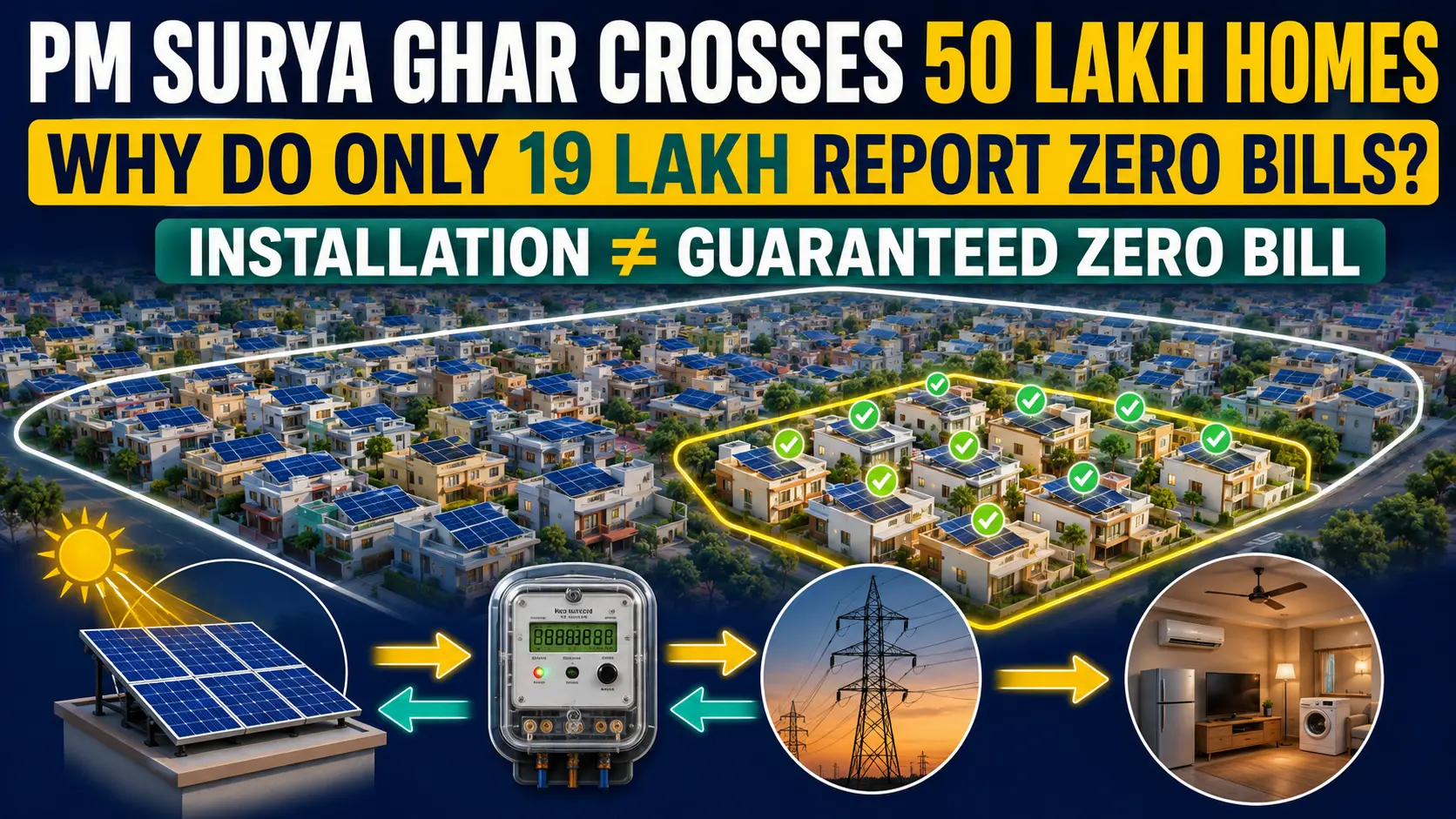
PM Surya Ghar zero electricity bill claims do not mean every rooftop-solar beneficiary will automatically receive a final bill of ₹0. The government says the scheme has crossed 50.06 lakh beneficiary households, while nearly 19 lakh households are receiving zero electricity bills.
The final amount still depends on rooftop generation, household consumption, system size, commissioning, net-meter activation, the billing period and the tariff rules applied by the local electricity distribution company.
Direct answer: A PM Surya Ghar installation can reduce or eliminate electricity energy charges, but installation alone does not guarantee a zero final bill every month.
A household may continue receiving a payable bill when consumption exceeds generation, the net meter is not active, export credits have not appeared, fixed charges remain or the billing period includes electricity used before commissioning.
Confirmed milestone: More than 50.06 lakh beneficiary households, 14.8 GW commissioned, ₹28,024 crore released through subsidy DBT and nearly 19 lakh households receiving zero bills.
Implementation pace: The Ministry says July 2026 recorded the scheme’s highest-ever monthly rooftop-solar installations, approximately one lakh beneficiary households were being added every six days at the reported pace, and more than 25,000 Central Government buildings had been solarised.
Not established: That every other household has a failed system, pending subsidy, defective meter or incorrect electricity bill.
- What does PM Surya Ghar zero electricity bill mean?
- What did the government announce?
- Why are 50 lakh homes not the same as 50 lakh zero bills?
- Does the scheme guarantee 300 free units?
- Why might a solar household still receive a bill?
- Installation, commissioning and net-meter stages
- Can fixed charges remain?
- Can households sell surplus power?
- What should a household check?
- How subsidy and loans relate to the bill
- How this was verified
- Limitations and unresolved facts
- Frequently asked questions
What does PM Surya Ghar zero electricity bill actually mean?
A PM Surya Ghar zero electricity bill generally means the household’s rooftop-solar generation and applicable credits have offset the electricity charges covered by the billing framework for that period.
It does not automatically mean that every possible bill component disappears. State tariffs may include fixed charges, duties, meter-related charges, previous arrears or other adjustments.
The outcome can also change between months. Solar generation varies with weather, season, panel condition and shading, while household consumption can rise or fall.
Important: A zero energy charge and a final payable amount of ₹0 may not always be the same thing under every state tariff.
What did the government announce about PM Surya Ghar?
On August 4, 2026, the Ministry of New and Renewable Energy announced that PM Surya Ghar: Muft Bijli Yojana had crossed 50.06 lakh rooftop-solar beneficiary households.
Beneficiary households covered by rooftop-solar installations
Households reported as receiving zero electricity bills
Subsidy released through direct benefit transfer
Rooftop-solar capacity commissioned
Applicants with concessional loans sanctioned
Reported surplus-power earnings by more than 12 lakh households during FY 2024–25
The milestone shows rapid adoption, but the installation count and zero-bill count measure different outcomes.
How to read the new scale figures: The one-lakh-every-six-days figure describes the reported national expansion pace. It does not establish how quickly an individual application, inspection, net meter, subsidy or electricity bill will be processed.
Why do 50 lakh beneficiary households not mean 50 lakh zero bills?
The beneficiary figure reflects households covered by rooftop-solar installations under the scheme. The zero-bill number reflects a reported billing result for nearly 19 lakh households.
An earlier official parliamentary reply said zero bills were reported for some months and depended on household self-consumption. The result can therefore change from one billing period to another.
The difference is not an official failure count. The government has not said that every household outside the nearly 19-lakh figure has a defective, incomplete or inactive rooftop-solar system.
Possible household-level reasons include higher electricity use, smaller solar systems, seasonal generation, net-meter delays, commissioning timing, billing-cycle timing and tariff charges that are not offset by solar credits.
Those are possible explanations. They are not an official breakdown of the approximately 31-lakh numerical difference.
Does PM Surya Ghar guarantee 300 free electricity units every month?
The scheme aims to help households obtain up to 300 units of free electricity each month through rooftop-solar generation.
That should not be understood as an unconditional allocation of 300 grid-supplied units to every applicant.
The household’s actual result depends on how much electricity its system generates and how much electricity it consumes during the billing period.
Example: A household that consumes more electricity than its rooftop system generates may receive a reduced bill rather than a zero bill.
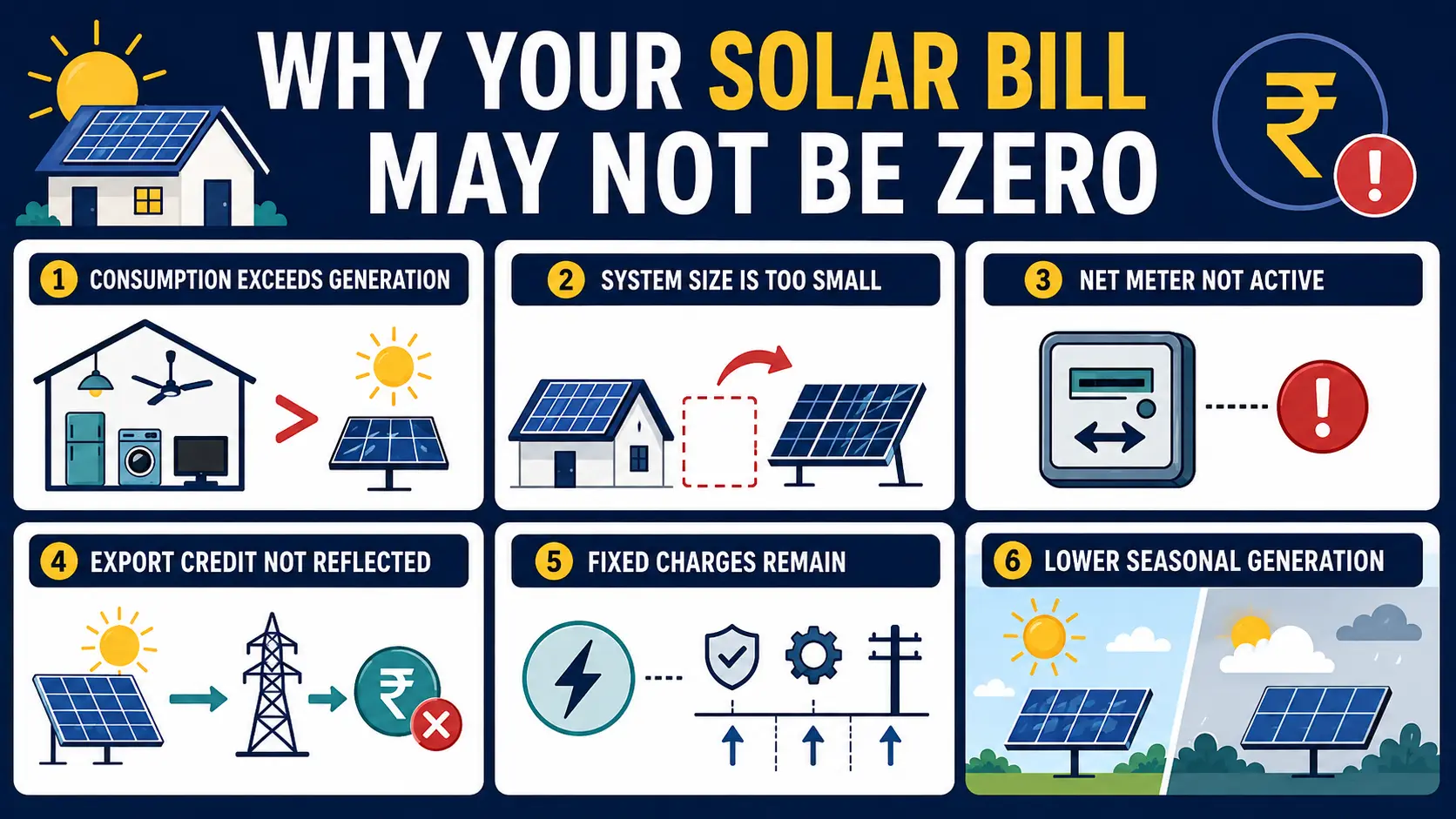
Why might a PM Surya Ghar household still receive an electricity bill?
A non-zero bill does not automatically prove that the scheme, subsidy or rooftop system has failed.
- Consumption exceeds solar generation: The household uses more electricity than the rooftop system generates or exports.
- The system is smaller than household demand: A lower-capacity system may reduce the bill without eliminating it.
- Solar production changes: Cloud cover, season, dust, shading and equipment performance affect output.
- The net meter is not active: Exported electricity may not yet be recorded or credited.
- The bill includes pre-commissioning consumption: Part of the billing period may cover days before the system became operational.
- Export credits have not appeared: The first bill after commissioning may not yet show the correct export reading.
- Fixed or non-energy charges remain: Tariff rules may include charges that solar credits do not fully offset.
- Previous arrears or adjustments are included: The bill may contain amounts unrelated to the current month’s consumption.
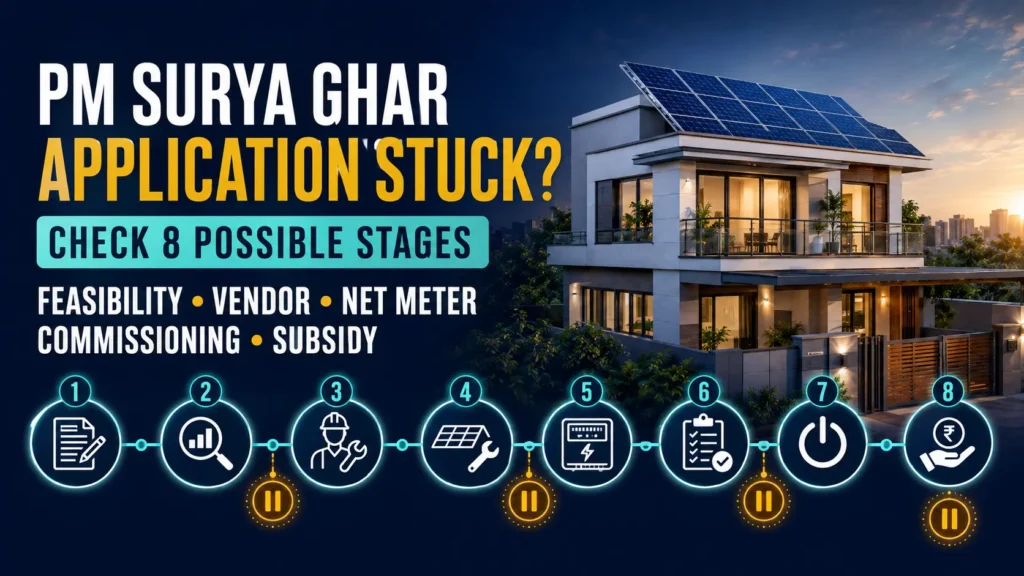
Installation, commissioning and net-meter activation are different stages
| Stage | What it establishes | What may remain pending |
|---|---|---|
| Application submitted | The household entered the portal workflow. | Technical approval, vendor selection and installation. |
| Vendor selected | A registered installer has been chosen. | Contract, payment, system design and physical work. |
| Panels installed | Rooftop equipment has been physically placed. | Inspection, net meter, commissioning and portal completion. |
| Net meter installed | The meter can record grid imports and solar exports. | Activation, testing and correct bill integration. |
| System commissioned | The installation completed the applicable approval process. | Subsidy redemption, DBT and bill-cycle reflection. |
| Subsidy credited | Central financial assistance reached the beneficiary’s bank account. | Loan repayment, maintenance and future electricity bills. |
| Zero or reduced bill | Generation and credits offset some or all applicable charges. | Future bills may vary with usage, generation and tariff components. |
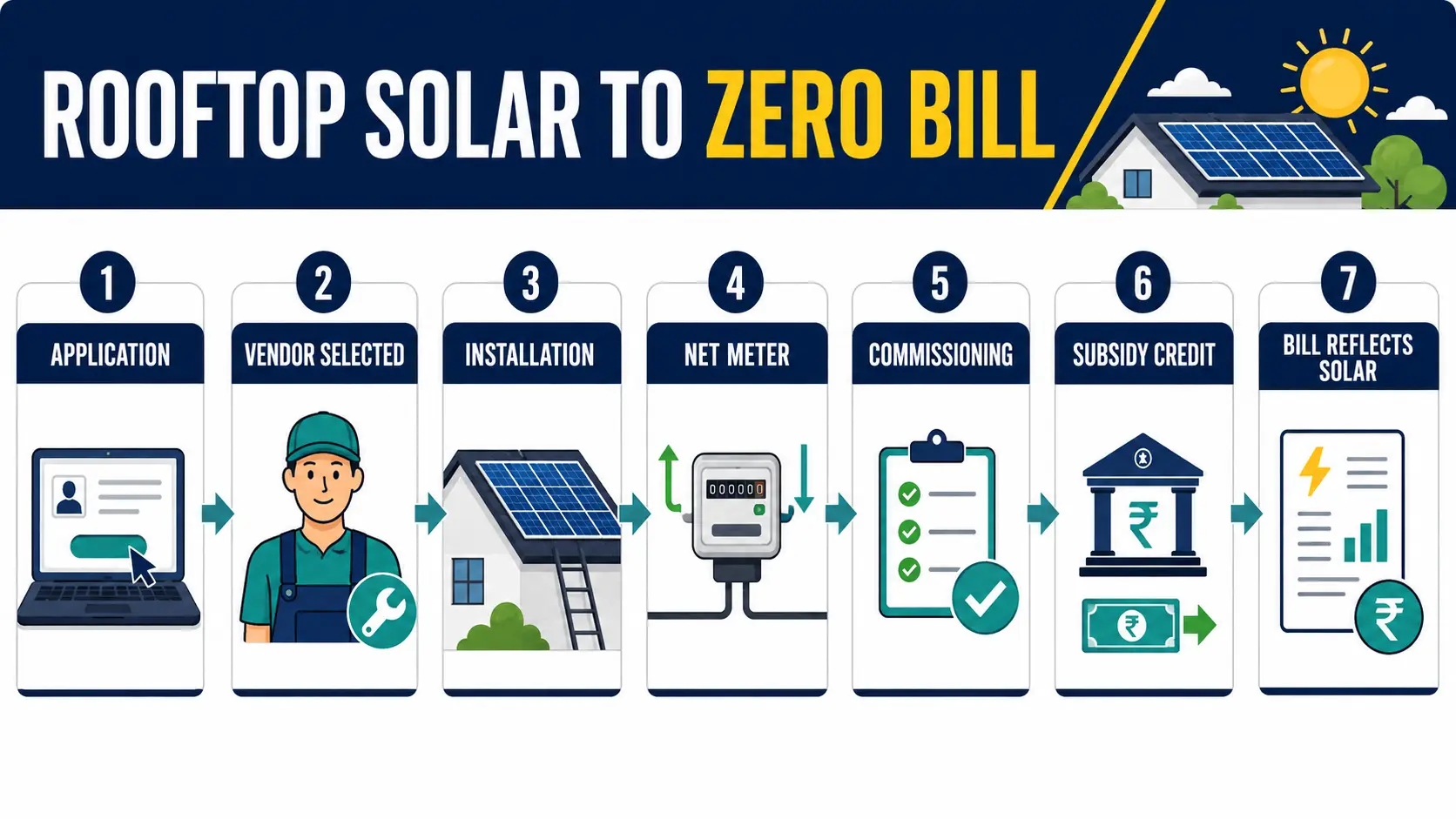
Physical panel installation is only one stage. A household should confirm the commissioning certificate, net-meter status and billing integration before expecting solar credits to appear.
Can fixed charges remain on a PM Surya Ghar electricity bill?
Possibly. Electricity tariffs are determined under state regulatory and DISCOM frameworks.
A bill may contain energy charges, fixed charges, meter charges, duties, arrears and adjustments. The August milestone release does not define the treatment of every charge in every state.
Check the bill line by line. Determine whether the payable amount comes from electricity consumption, fixed charges, previous dues or another adjustment.
Can households sell surplus rooftop-solar electricity?
The government says more than 12 lakh households collectively earned ₹421 crore from exporting surplus electricity during FY 2024–25.
The method of credit or payment depends on the applicable state rules, DISCOM process and billing arrangement.
Households should check:
- whether the net meter is active;
- the recorded import and export readings;
- the settlement period;
- the applicable export-credit rate;
- whether credits are adjusted in the bill or paid separately;
- whether unused credits carry forward or expire.
What should you check when solar is installed but the bill is not zero?
-
Confirm commissioning.
Check whether the system has been formally commissioned rather than only physically installed. -
Check the net meter.
Verify that import and export readings are being recorded. -
Review the billing period.
Check whether the bill includes electricity used before commissioning or net-meter activation. -
Compare generation with consumption.
Review inverter data and compare it with the electricity bill. -
Separate bill components.
Identify energy charges, fixed charges, duties, arrears and adjustments. -
Check export credits.
Compare the meter’s export reading with the units shown in the bill. -
Preserve evidence.
Keep the application ID, commissioning certificate, meter record, invoice, subsidy acknowledgement and electricity bills. -
Contact the responsible authority.
Billing and meter problems generally require the DISCOM. Portal or scheme-process issues may require the official PM Surya Ghar grievance route.
How are the PM Surya Ghar subsidy, loan and electricity bill connected?
The central subsidy reduces the household’s rooftop-solar installation cost. It is separate from the monthly electricity-billing calculation.
A household can receive the subsidy and still have a non-zero electricity bill when consumption or other charges exceed available solar credits.
The government says PFMS integration supports subsidy release within about 15 days. The August release does not clearly say that the period starts from the physical installation date.
The release also says concessional loans were sanctioned to 21.87 lakh applicants at a stated rate of 5.75%, benchmarked to the repo rate plus 50 basis points.
Loan caution: A benchmark-linked interest rate may change. Applicants should check processing charges, insurance, repayment terms and rate-reset conditions in the bank agreement.
Do systems up to 10 kW still need feasibility approval?
The government says feasibility approval has been waived or treated as deemed approved for rooftop systems up to 10 kW.
This does not necessarily remove every technical, safety, grid-connection, meter or commissioning requirement.
Have application and net-metering charges been removed everywhere?
No. The official release says 32 states and Union Territories have removed application and net-metering charges.
It does not state that all jurisdictions have removed those charges. Applicants should verify the latest charges through their portal and DISCOM.
How this PM Surya Ghar zero electricity bill guide was verified
Verification method: ThePulseSignal checked the August 4, 2026 Ministry of New and Renewable Energy milestone release, the July 2026 parliamentary reply, the official PM Surya Ghar portal, the official consumer portal and the government rooftop-solar DISCOM directory.
The August release was used for the beneficiary count, zero-bill number, subsidy amount, commissioned capacity, loan sanctions, fee-waiver count, vendor-rating feature, surplus-power earnings, July 2026 installation record, the reported one-lakh-households-every-six-days pace and the solarisation of more than 25,000 Central Government buildings.
The parliamentary reply was used to clarify that zero bills were reported for some months depending on household self-consumption.
Sources reviewed
Limitations and unresolved facts
The government has not published a complete household-level explanation for the difference between 50.06 lakh beneficiary households and nearly 19 lakh households reporting zero electricity bills.
- The reported national pace of one lakh beneficiary households every six days must not be applied to an individual applicant’s processing time.
- The remaining households must not be classified as failed, pending or ineligible without evidence.
- The complete current list of 32 fee-waiver jurisdictions was not established from the reviewed release.
- Fixed charges and net-metering rules vary by jurisdiction.
- The exact event starting the stated 15-day subsidy period requires confirmation from the applicable workflow.
- Bank fees and rate-reset terms may differ.
- Apartment, tenant and shared-roof cases require property- and DISCOM-specific verification.
PM Surya Ghar zero electricity bill: frequently asked questions
Does every PM Surya Ghar beneficiary get a zero electricity bill?
No. The government says nearly 19 lakh households are receiving zero bills out of more than 50.06 lakh beneficiary households.
Why is my PM Surya Ghar electricity bill not zero?
Possible reasons include consumption exceeding generation, a smaller system, pending net-meter activation, missing export credits, fixed charges, arrears or lower seasonal output.
Does PM Surya Ghar provide 300 free units automatically?
No. The scheme aims to support up to 300 units through rooftop-solar generation. It is not an unconditional allocation of 300 grid-supplied units.
Can fixed charges remain after rooftop solar installation?
They may remain depending on the applicable tariff and DISCOM rules.
Does panel installation mean the rooftop system is commissioned?
Not necessarily. Net-meter installation, inspection, activation, commissioning and portal completion may still remain.
Will the subsidy arrive within 15 days of panel installation?
The government says PFMS enables release within about 15 days, but the reviewed milestone release does not define the period as beginning from physical installation.
Can a household earn money from surplus solar power?
Yes, subject to applicable state and DISCOM rules. The government says more than 12 lakh households earned ₹421 crore collectively during FY 2024–25.
Is the 5.75% loan interest permanently fixed?
The stated rate is benchmarked to the repo rate plus 50 basis points. Applicants should check the bank’s rate-reset and fee conditions.
Are net-metering charges removed in every state?
No. The release says the charges were removed in 32 states and Union Territories.
Does one lakh beneficiary households every six days mean my application will finish in six days?
No. That figure describes the reported national expansion pace, not an individual application, installation, net-meter, subsidy or billing-service standard.
Where should I report an incorrect rooftop-solar electricity bill?
Billing, meter-reading and export-credit issues should generally be raised with the relevant DISCOM. Preserve the bill, meter readings, commissioning record and application details.
Last verified: August 5, 2026, approximately 1:45 PM IST