







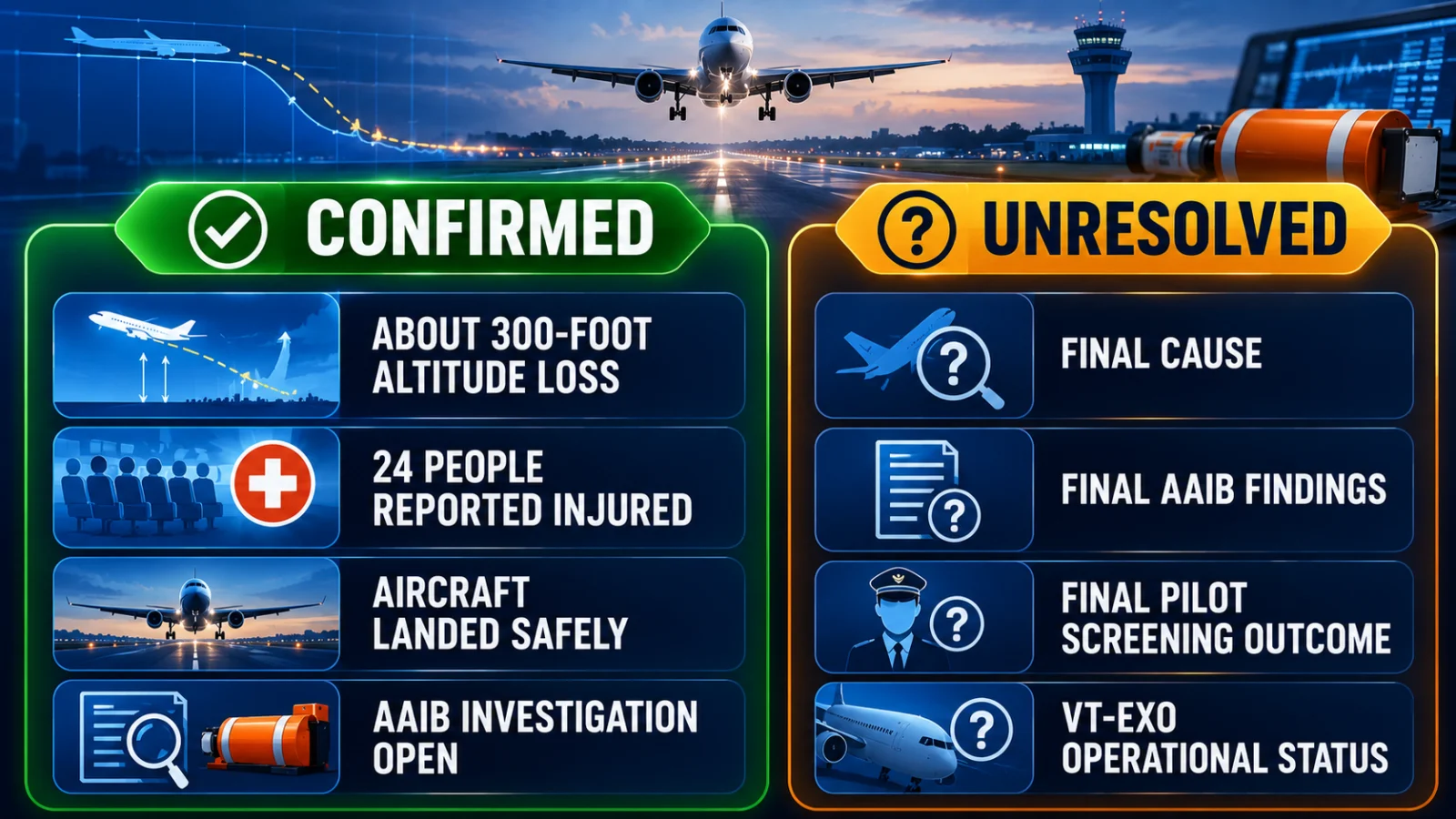
Air India flight AI2379 experienced an approximately 300-foot altitude loss during cruise on August 4, 2026, and AAIB’s preliminary findings record a rapid loss of pressure indications across all three hydraulic systems. The Airbus A320, registration VT-EXO, stabilised and landed safely in Delhi. Twenty passengers and four cabin crew members were reported injured.
AAIB’s investigation remains open. The preliminary findings describe the hydraulic and flight-control sequence but do not establish the final technical cause.
Aircraft: Airbus A320, registration VT-EXO.
Flight: Air India AI2379 from Phuket to Delhi on August 4, 2026.
Altitude event: approximately 300 feet during cruise.
Injuries: 20 passengers and four cabin crew members.
Technical sequence: pressure-loss indications affected the Green, Blue and Yellow hydraulic systems in rapid succession; autopilot disconnected and flight-control capability was temporarily degraded.
Investigation: AAIB has published preliminary findings. The final causal finding remains unresolved.
Direct answer: AAIB’s preliminary findings show that AI2379 experienced a rapid sequence of Green, Blue and Yellow hydraulic pressure-loss indications, followed by autopilot disconnection and stall-warning indications. The hydraulic systems began recovering within seconds and the aircraft subsequently stabilised.
The evidence does not yet establish whether the sequence resulted from a physical multi-system hydraulic failure, an electrical or sensing problem, another technical mechanism or any particular crew action.
What does the AAIB preliminary investigation say happened?
The aircraft was cruising at Flight Level 360 when the flight-control system recorded loss of pressure in the Green hydraulic system, followed within seconds by the Blue and Yellow systems.
The sequence was accompanied by autopilot disconnection, degradation of normal flight-control capability and stall-warning indications. The hydraulic systems then began recovering within seconds and aircraft control was restored.
AAIB continues to examine the recorded flight data, aircraft systems, maintenance information, crew actions and other evidence before reaching final findings.
The hydraulic sequence is a preliminary factual finding, not a final cause. AAIB has not yet established why the three pressure-loss indications occurred.
How many people were injured?
The official injury figure is 24 people: 20 passengers and four cabin crew members.
The Ministry’s August 4 statement separately said eight passengers and four cabin crew members were admitted to hospitals for detailed evaluation and treatment. Hospital admissions and the later injury count describe different medical measures.
Is the 300-foot altitude loss confirmed?
Yes. Ministry of Civil Aviation releases dated August 9 and August 11 describe an approximately 300-foot sudden altitude loss or variation during cruise.
The exact flight-data sequence surrounding the altitude change remains part of AAIB’s investigation.
What is known about the hydraulic-system sequence?
AAIB’s preliminary findings describe loss of pressure indications in the aircraft’s three hydraulic systems in rapid succession.
- Green hydraulic pressure was lost first.
- Blue hydraulic pressure loss followed.
- Yellow hydraulic pressure loss followed shortly afterward.
- The autopilot disconnected.
- Stall-warning indications occurred.
- The hydraulic systems began recovering within seconds.
The recorded sequence does not by itself identify the component, system or mechanism responsible for the occurrence.
Did all three hydraulic systems physically fail?
That has not been established.
The preliminary evidence records pressure-loss indications affecting all three systems. AAIB has not concluded whether this reflected simultaneous physical loss of hydraulic capability, a sensing or electrical problem, another systems condition or a combination of factors.
What is known about the Pilot-in-Command’s psychoactive-substance test?
Both flight crew members underwent the prescribed psychoactive-substance screening after the occurrence.
The Pilot-in-Command’s initial result required confirmatory testing. Subsequent reporting says the confirmatory result was non-negative for a psychoactive substance, and Air India later terminated the Pilot-in-Command’s employment.
The substance-test result does not establish the cause of the aircraft event. AAIB has not published a finding linking the test result to the hydraulic-system sequence or altitude loss.
Has the AI2379 case led to wider pilot drug testing?
Current reporting says DGCA has directed Indian airlines to conduct a one-time psychoactive-substance test of all pilots, with the exercise to be completed by July 2027.
The measure concerns aviation safety oversight across airlines. It does not determine why AI2379 experienced the hydraulic pressure-loss sequence.
Has AAIB established pilot error?
No. No final AAIB finding establishing pilot error, negligence or another crew-related cause has been identified.
Flight-crew actions, recorded cockpit information, aircraft systems and other operational evidence remain part of the investigation.
Has AAIB established a technical defect?
No final technical defect has been established. The hydraulic pressure-loss indications are recorded in the preliminary investigation material, but their origin remains unresolved.
A final finding may require examination of components, sensors, electrical systems, maintenance records, recorded parameters and other evidence.
What should affected passengers preserve?
- Travel records.
Keep the ticket, booking confirmation, boarding pass, baggage tags and seat number. - Medical evidence.
Preserve examination notes, admission records, scans, prescriptions, discharge summaries and follow-up advice. - Expense records.
Retain ambulance, hospital, medicine, transport and follow-up treatment bills. - Injury or property evidence.
Keep dated photographs and supporting records where appropriate. - Airline communications.
Preserve emails, messages, assistance records and complaint or case-reference numbers. - Insurance records.
Keep policy documents, claim correspondence and evidence submitted to the insurer.
What is known about passenger compensation?
No uniform compensation or reimbursement package for all AI2379 passengers has been publicly established in the sources reviewed.
The Ministry said officials were coordinating with hospitals and Air India to ensure medical care and necessary support.
Individual claims may depend on the injury, medical evidence, expenses, airline response, insurance and the international-carriage legal framework applicable to the passenger.
Keep medical assistance, expense reimbursement, insurance and legal compensation as separate evidence tracks. Assistance received through one route does not automatically determine entitlement under another.
Is the Phuket–Delhi route suspended?
No official suspension of the wider Phuket–Delhi route was identified.
The operational status of VT-EXO is separate from whether Air India continues to operate the route using other aircraft. Passengers should check their own flight through Air India’s flight-status channels.
What remains unresolved?
- the final technical cause of the hydraulic pressure-loss sequence;
- whether the recorded three-system pressure loss reflected physical hydraulic failure, erroneous indications or another systems problem;
- the complete relationship between the hydraulic sequence, aircraft pitch changes and stall warnings;
- AAIB’s final safety findings and recommendations;
- any final regulatory findings concerning flight-crew conduct;
- the final medical and recovery status of all injured occupants;
- the operational and repair status of VT-EXO; and
- individual passenger compensation or reimbursement outcomes.
Verification note
ThePulseSignal reviewed AAIB investigation material, Ministry of Civil Aviation releases covering the incident, injuries and flight-crew screening, the BEA notified-occurrence record, and current reporting on the technical findings and subsequent personnel and regulatory developments.
AAIB investigation material provides the strongest evidence for the hydraulic-system sequence. Ministry releases remain primary evidence for the approximately 300-foot altitude change, injury count, hospital admissions and commencement of the AAIB investigation.
Limitations
AAIB has not published a final causal finding.
- The hydraulic pressure-loss sequence should not be described as the final cause.
- The Pilot-in-Command’s substance-test outcome should not be presented as proof of causation.
- No final finding of pilot error, negligence or a specific aircraft-design defect has been identified.
- Passenger medical and compensation outcomes remain individual and incomplete.
- AAIB may revise or expand its technical interpretation as additional evidence is analysed.
Bottom line
AI2379’s approximately 300-foot altitude loss and 24 injuries are confirmed. AAIB’s preliminary investigation records a rapid loss of pressure indications across all three hydraulic systems, followed by autopilot disconnection and subsequent recovery.
The technical cause remains unresolved. AAIB’s final investigation findings will be needed to determine why the hydraulic sequence occurred and what safety conclusions follow from it.