






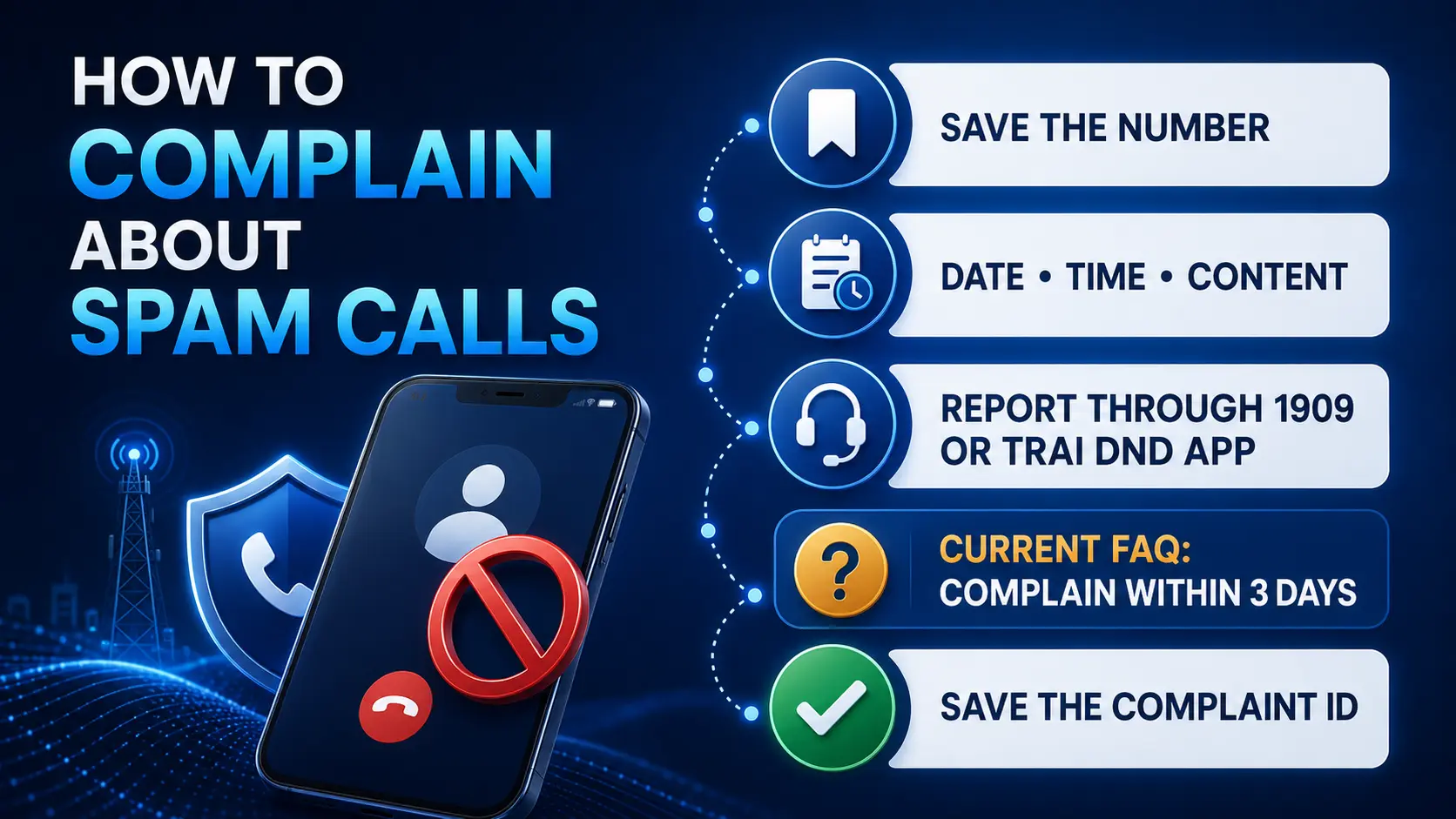
How to complain about spam calls depends on how quickly you act and how clearly you identify the communication. TRAI allows complaints and reports through 1909, the TRAI DND app, IVRS, approved apps and authenticated web portals.
For the strongest chance of formal investigation, preserve the caller number or sender header, date, time and communication details, and submit the complaint immediately.
Direct answer
To complain about a spam call, use the TRAI DND app or contact 1909 by SMS or voice call.
TRAI’s current consumer FAQ says a formal UCC complaint should be made within three days of receiving the call or message.
Current complaint rule
DND registration: At least seven days earlier for a preference-violation complaint.
Complaint window: Within three days of receipt.
Evidence: Sender, date, time and content.
Tracking: Save the complaint ID or reference.
Formal complaint
Submitted within the applicable window with enough information to identify and investigate the communication.
Spam report
May still provide useful intelligence when the formal deadline or complaint conditions are not satisfied.
In this complaint guide
- Official complaint routes
- Complaint versus report
- Three-day deadline
- Seven-day DND boundary
- 1909 SMS format
- Spam-SMS example
- Spam-call example
- Complaining by calling 1909
- Using the TRAI DND app
- Evidence to preserve
- Choosing a category
- Complaint tracking
- Why complaints become invalid
- What happens next
- Ordinary-number telemarketing
- Spam versus fraud
- What to do after three days
- Related DND explainer
- Verification method
- Limitations
- FAQs
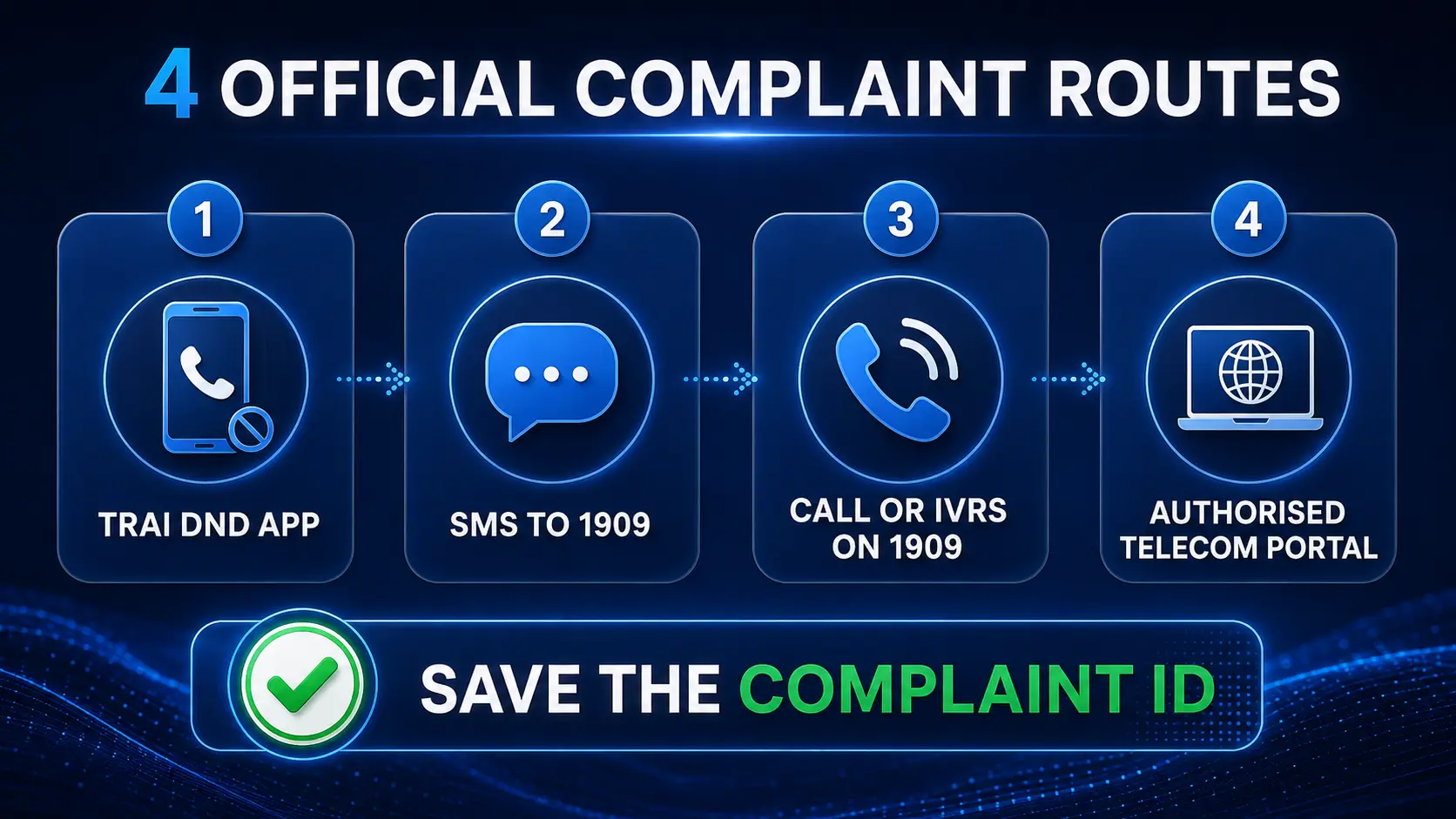
How to complain about spam calls through official routes
TRAI lists several authorised ways to submit a complaint or report:
1
TRAI DND app
Select the relevant call or message, add the required details and preserve the acknowledgement.
2
SMS to 1909
Send the communication details, sender number or header and date in the required structure.
3
Call 1909
Follow the voice or IVRS process and provide the caller or sender information.
4
Provider portal
Use an authorised app or OTP-authenticated web portal offered by the telecom provider.
Do not submit personal credentials or payment information to an unofficial complaint service. Use TRAI, 1909 or the authorised channel of your telecom provider.
What is the difference between a complaint and a report?
| Submission | Main purpose | Timing | Likely handling |
|---|---|---|---|
| Formal UCC complaint | Alleges a specific violation involving a particular call or message. | Within the current complaint deadline. | Eligible for sender-specific investigation under the complaint process. |
| Spam report | Provides intelligence about suspected spam or misuse. | May be submitted when formal conditions are not satisfied. | Can support detection or pattern analysis without identical complaint treatment. |
| Fraud report | Reports impersonation, financial loss, account compromise or cybercrime. | Immediately. | Requires the appropriate bank, cybercrime, telecom-fraud or law-enforcement route. |
A late report may still be useful. It should not, however, be presented as guaranteed to receive the same investigation as a timely formal UCC complaint.
How long do you have to complain?
TRAI’s current consumer FAQ says to complain within three days of receiving the UCC. Some earlier official material used a seven-day description, but the current FAQ provides the safer operational deadline.
The practical rule is simple:
Submit the complaint on the same day whenever possible, and no later than three days after receiving the call or message.
Why does the seven-day DND period matter?
TRAI’s current FAQ says a subscriber may complain about UCC received after seven days from the date of DND or National Customer Preference Register registration.
This means a newly registered preference may need time to become effective before a preference-violation complaint can be assessed.
Two separate periods are involved: seven days from DND registration, and three days from the unwanted communication to submit the complaint.
What is the 1909 SMS complaint format?
TRAI’s FAQ describes the complaint SMS as containing:
The wording should identify:
- what was promoted or communicated;
- the displayed sender number or SMS header;
- the date on which the communication was received.
This is a structure, not a reason to invent information. Copy the sender and date from the original call log or message.
Example 1909 complaint for a spam SMS
Illustrative format
Replace the example text and sender header with the actual message content, displayed sender and date.
Do not use this example to accuse a company that did not send the message. The original sender header and message should control.
Example complaint for a spam voice call
Illustrative description
Use the actual caller number, date, time and purpose shown in your records.
How to complain by calling 1909
-
Call 1909 from the affected mobile connection.
Use the number that received the communication. -
Select the complaint or UCC option.
Follow the current IVRS or service-provider instructions. -
Provide sender information.
State the caller number or sender header exactly. -
Give the date and time.
Use the original call log or message record. -
Describe the communication.
Explain what product, service or request was promoted. -
Save the complaint reference.
Preserve the acknowledgement for tracking.
The exact IVRS menu may differ by telecom provider and can change. This guide therefore does not invent a universal sequence of keypad options.
How to complain through the TRAI DND app
The official app supports DND preference management and UCC complaint functions. TRAI also describes complaint tracking, sender-information features and dual-SIM support.
-
Install the official app.
Verify the developer and official listing before granting permissions. -
Authenticate the mobile number.
The app may use OTP verification for the selected SIM. -
Select the offending communication.
Choose the relevant call or SMS from the available device record. -
Add the complaint details.
Confirm the sender, time, category and communication description. -
Submit promptly.
Complete the process within the current complaint window. -
Save and track the reference.
Review status updates or action information available in the app.
The current app screen may differ from older screenshots. Follow the labels shown in the installed official version rather than relying on outdated third-party instructions.
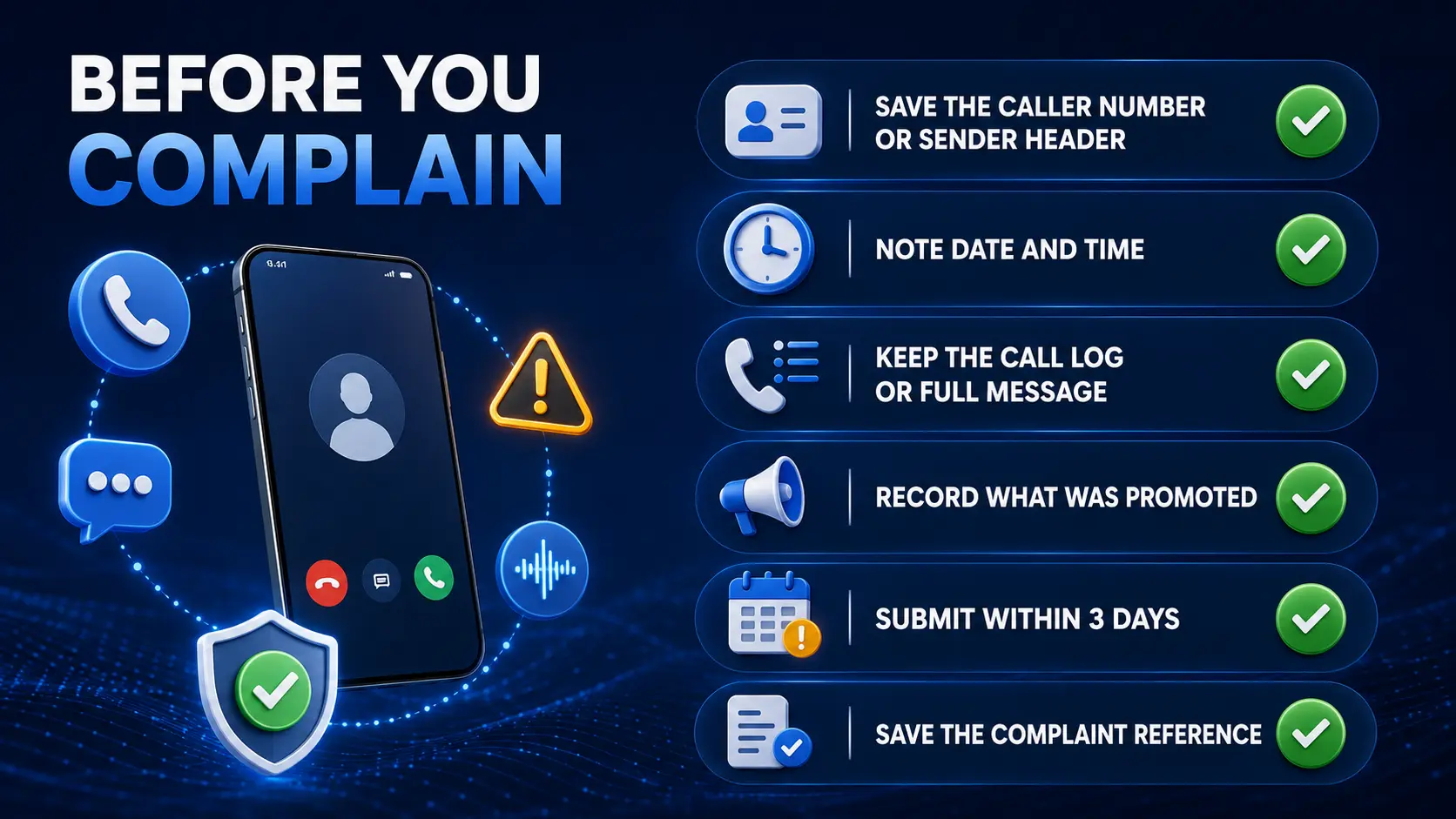
What evidence should you preserve before complaining?
For a voice call
- caller number;
- date and time;
- call duration;
- claimed organisation;
- product or service promoted;
- call-log screenshot.
For an SMS
- full message content;
- sender header or number;
- date and time;
- links included;
- message screenshot;
- any reply or consent context.
A screenshot is useful, but the original record on the device may be more valuable than a cropped or edited image.
Which complaint category should you select?
Select the category that best matches what was actually promoted or communicated.
Common categories may include:
- banking or financial products;
- insurance;
- real estate;
- education;
- health-related services;
- consumer goods;
- communications, entertainment or tourism.
Do not classify suspected fraud as ordinary promotion merely because the caller mentioned a bank or loan. Impersonation and financial loss can require a separate urgent response.
How does complaint tracking work?
After submission, the access provider should provide an acknowledgement, complaint ID or similar reference.
Preserve:
- the complaint number;
- submission time;
- channel used;
- provider acknowledgement;
- status messages;
- closure reason or action recorded.
The TRAI DND app is described as allowing users to monitor complaint status and action relating to UCC complaints.
Why might a spam complaint be rejected or treated as invalid?
Possible reasons include:
- the complaint was filed outside the current deadline;
- the sender number or header was missing;
- the date or time was incorrect;
- the communication description was too vague;
- the DND registration had not completed seven days;
- the call was classified as service or transactional;
- the sender claimed valid consent;
- the submission was treated as a report rather than a formal complaint;
- the wrong mobile connection was used for the complaint.
A closed complaint does not automatically prove the communication was lawful. Read the stated reason and preserve the response before deciding whether to escalate.
What happens after a complaint is submitted?
The telecom access provider may:
- validate the complaint details;
- identify the originating network or sender;
- check consent or preference records;
- classify the communication;
- seek information from another access provider;
- take action under the UCC framework;
- close the complaint with a stated reason.
A complaint does not guarantee immediate disconnection. Investigation and action depend on the evidence, sender status, communication type and applicable rules.
Can you complain about a sales call from a normal 10-digit number?
Yes. Ordinary mobile connections are not intended for promotional telemarketing.
A sales call from a normal mobile number may involve an unregistered telemarketer. Preserve the number, call details and purpose, and submit the complaint promptly.
An ordinary mobile number is not automatically a spam number. Report the specific commercial communication rather than making a blanket assumption about the subscriber.
When should you use a fraud-reporting route instead?
| Situation | Primary response | Can DND also be relevant? |
|---|---|---|
| Unwanted product promotion | 1909 or DND complaint | Yes |
| Caller asks for OTP, PIN, password or CVV | End the call and verify through the institution’s official channel | Possibly, but DND alone is insufficient |
| Money transferred after deception | Contact the bank and appropriate cybercrime channel immediately | A separate UCC report may also be possible |
| SIM or account compromised | Contact the telecom provider and affected institution immediately | Not the primary remedy |
Do not wait for a DND complaint outcome when money, credentials or account access are at risk.
What can you do after the three-day complaint window?
Submit the information as a report through an authorised route where available.
A late report may still:
- contribute to spam detection;
- support pattern analysis;
- help identify repeated misuse;
- inform later enforcement.
However, do not describe a late report as guaranteed to receive the same sender-specific action as a valid formal complaint.
Why do spam calls continue even after DND?
How this spam-call complaint guide was verified
Verification method
ThePulseSignal reviewed TRAI’s current unsolicited-commercial-communications FAQ, complaint and reporting page, preference-registration facility, official DND app pages, app FAQ and the February 2026 app revamp announcement.
TRAI’s current FAQ was treated as the operational source for the three-day complaint window, the seven-day DND-registration boundary and the 1909 complaint structure.
TRAI’s complaint page was used to confirm SMS, voice call, IVRS, approved mobile app and OTP-authenticated web-portal routes.
Official app materials were used to describe preference management, complaint submission, tracking, sender information and dual-SIM support.
No unverified universal IVRS menu, app button sequence or provider-specific screen was presented as current.
Official sources reviewed
Limitations and unresolved facts
TRAI defines the framework, but the exact interface and complaint handling can vary by telecom provider and app version.
- The current app interface was not reproduced screen by screen.
- IVRS menu options may differ by provider and may change.
- The article cannot determine whether a specific sender possessed valid consent.
- A complaint ID does not guarantee a particular enforcement result.
- A late report may not receive the same treatment as a formal complaint.
- An ordinary mobile number is not automatically an unregistered telemarketer.
- The article does not establish whether a displayed caller identity is genuine.
- Fraud cases may require channels outside the DND framework.
- Provider-specific complaint categories and status labels can differ.
- The current three-day deadline should be rechecked if TRAI changes its FAQ or regulations.
How to complain about spam calls: frequently asked questions
How to complain about spam calls in India?
Use SMS or voice call to 1909, the official TRAI DND app, IVRS or another authorised telecom-provider route.
How quickly must I complain?
TRAI’s current consumer FAQ says within three days of receiving the unwanted commercial communication.
What is the 1909 SMS format?
Include the communication content, sender number or header and the date of receipt.
Can I complain by calling 1909?
Yes. Call 1909 from the affected mobile connection and follow the complaint or IVRS process.
Can I use the TRAI DND app?
Yes. The official app supports DND preference management, complaints and complaint-status monitoring.
What evidence should I preserve?
Save the caller number or sender header, date, time, call log, message content, screenshots and claimed organisation.
Can I complain about a normal mobile number?
Yes, when the number was used for unsolicited commercial communication. Describe the specific call rather than assuming every ordinary number is spam.
What happens after three days?
The information may still be submitted as a report, but it may not receive the same treatment as a timely formal complaint.
Why was my complaint closed?
Possible reasons include late filing, missing details, incomplete DND activation, service-call classification or claimed consent. Read the provider’s stated reason.
Does one complaint disconnect the number?
Not automatically. The telecom provider must validate, classify and investigate the communication.
Should I use DND for financial fraud?
DND may document unsolicited communication, but financial fraud also requires immediate contact with the affected bank or appropriate cybercrime channel.
Last verified: August 5, 2026.