






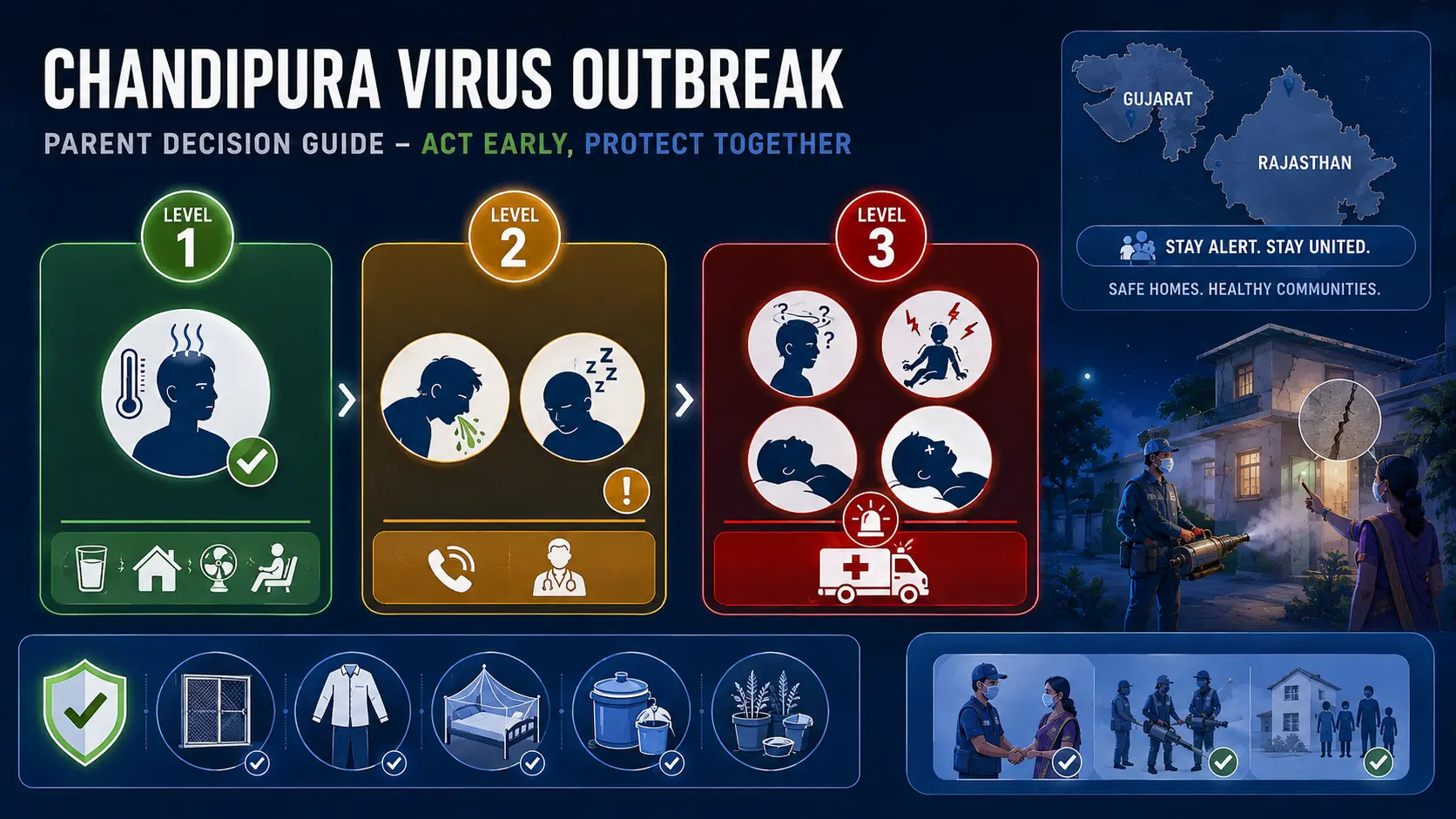
Chandipura virus illness in children can begin with sudden fever and vomiting and can progress rapidly to unusual drowsiness, altered behaviour, seizures, loss of consciousness or coma. A child who develops neurological symptoms needs urgent medical assessment. Parents should not wait for a Chandipura-specific test before seeking emergency care.
Emergency warning signs
Convulsions, confusion, difficulty waking, loss of consciousness or rapid neurological deterioration require immediate hospital assessment.
Diagnosis needs medical evaluation
Fever and vomiting alone are not specific to Chandipura virus. Dengue, malaria, meningitis and other causes of Acute Encephalitis Syndrome can produce overlapping symptoms.
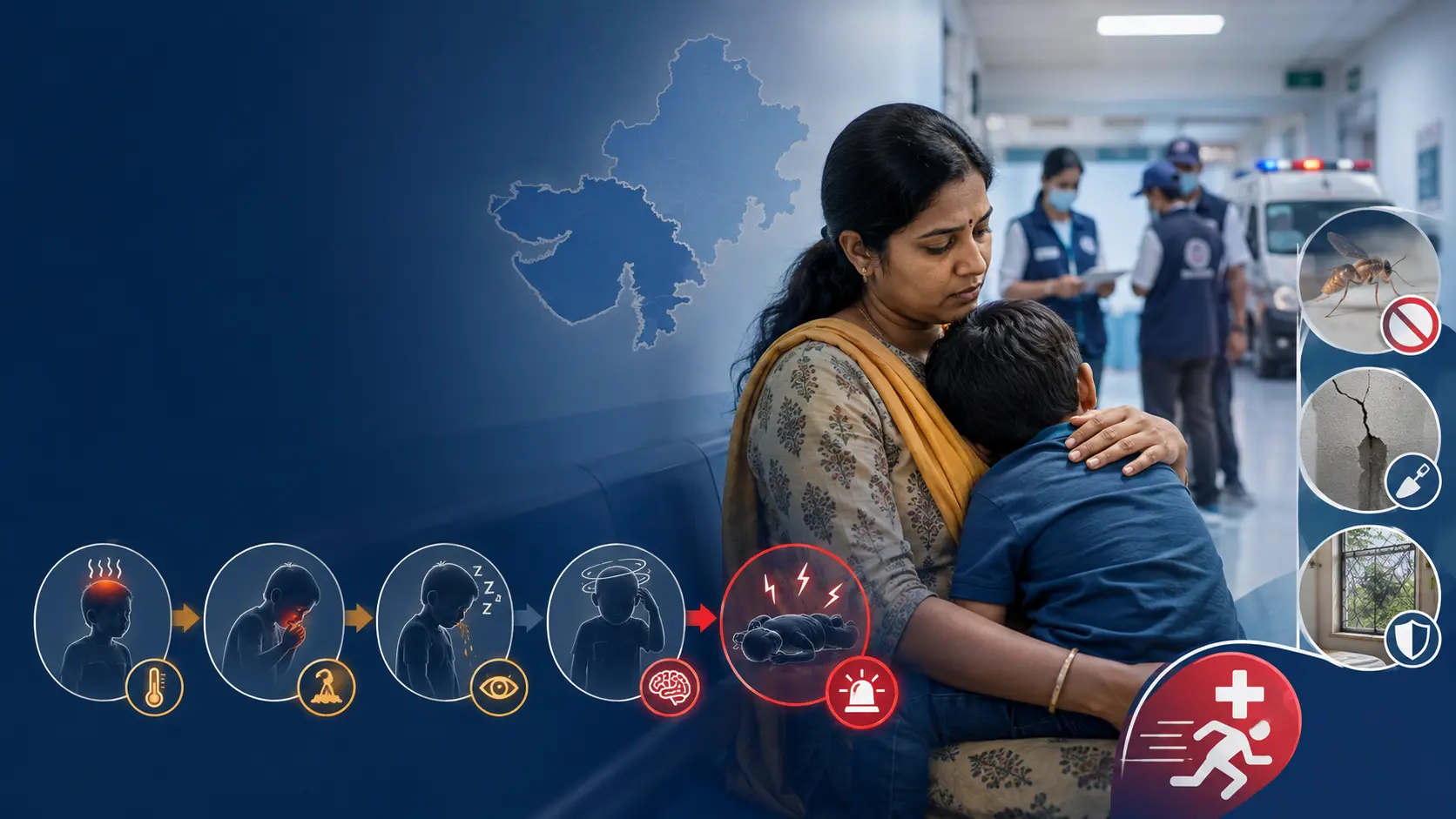
Medical emergency: seek immediate emergency care when a child has a seizure, altered consciousness, severe drowsiness, difficulty waking or rapid neurological deterioration.
In this guide
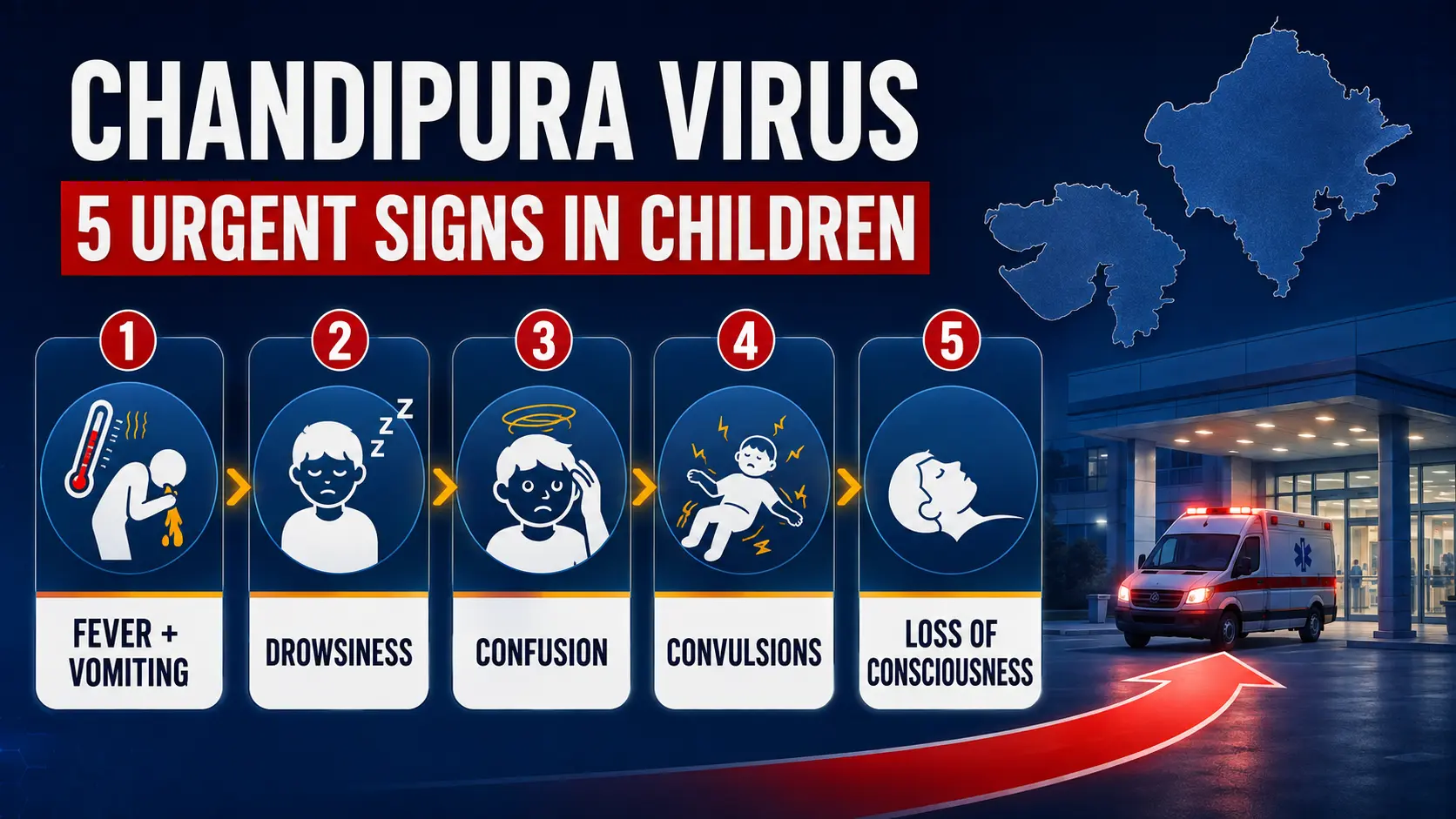
Five urgent Chandipura virus warning signs in children
WHO’s technical description of Chandipura-associated acute encephalitis includes sudden fever, vomiting, altered mental state, convulsions and progression to coma in severe illness. These features are not unique to Chandipura virus, so neurological symptoms require medical evaluation rather than home diagnosis.
- Repeated vomiting with fever. Seek medical advice promptly, especially when vomiting is accompanied by unusual tiredness, poor responsiveness or behavioural change.
- Unusual sleepiness or difficulty waking. A child who is much harder to wake than normal requires urgent assessment.
- Confusion or altered behaviour. Disorientation, agitation, reduced responsiveness or clearly abnormal behaviour can indicate neurological involvement.
- Convulsions or seizures. A first seizure, repeated seizure or seizure accompanied by fever is an emergency.
- Loss of consciousness or coma. Obtain emergency medical help immediately.
Fever alone does not diagnose Chandipura virus. Several common and serious childhood infections can begin with fever or vomiting.
When should a child go to hospital?
| Child’s condition | Practical action |
|---|---|
| Mild fever, child alert and drinking, no neurological symptoms | Seek medical advice according to local guidance and monitor carefully for worsening symptoms. |
| Fever with repeated vomiting or increasing drowsiness | Obtain urgent medical assessment. |
| Confusion, altered behaviour or difficulty waking | Go to an emergency facility immediately. |
| Convulsion, collapse or loss of consciousness | Seek emergency medical help immediately. |
| Child discharged after treatment | Follow the treating hospital’s review plan and return immediately if warning signs recur. |
During an active convulsion: do not force food, drink or oral medicine into the child’s mouth. Protect the child from injury, place them on their side when safe to do so and obtain emergency medical help.
What is the current 2026 outbreak status?
The Union Health Ministry deployed a National Joint Outbreak Response Team to Gujarat and Rajasthan on August 5 to strengthen surveillance, laboratory investigation, clinical response and investigation of transmission.
The latest state-health figures located for this guide were updated to 5 p.m. on August 27, 2026. Reporting based on the Gujarat Health Department data recorded 324 suspected cases in the surveillance update, 42 laboratory-confirmed Chandipura infections and 28 deaths among confirmed patients. Laboratory results had been received for 314 suspected cases, leaving 10 samples pending.
Current reporting describes the surveillance figures as covering Gujarat and affected border areas of Rajasthan. The figures therefore should not be read as a permanent nationwide total or assumed to represent only one district or local outbreak cluster.
324 suspected cases
The latest located state-health surveillance figures were updated through August 27.
42 confirmed infections
Laboratory results identified 42 confirmed Chandipura virus infections.
28 confirmed-patient deaths
The latest located update recorded 28 deaths among the confirmed infections.
These numbers remain time-sensitive. Ten laboratory results were still pending in the latest located update, and later state or national surveillance data can change the suspected, confirmed and death counts.
How is Chandipura virus related to Acute Encephalitis Syndrome?
Acute Encephalitis Syndrome, or AES, is a clinical syndrome involving acute fever and neurological symptoms such as altered mental status or seizures. It has several possible infectious and non-infectious causes.
Chandipura virus is one possible cause of AES. A child can enter AES surveillance as a suspected case before laboratory testing establishes whether Chandipura virus or another cause is responsible.
| Term | What it means |
|---|---|
| Suspected AES case | A child meets a clinical surveillance definition and requires investigation; Chandipura virus is not automatically confirmed. |
| Laboratory-confirmed Chandipura case | A recognised laboratory test has detected evidence of Chandipura virus infection. |
| Pending sample | The laboratory result is not yet available and should not be treated as positive or negative. |
Does Chandipura virus spread from child to child?
WHO’s 2024 outbreak assessment reported no documented human-to-human transmission. Chandipura virus is considered a vector-borne infection, and WHO identifies sandflies, mosquitoes and ticks among known or possible vectors.
Investigators examining the 2026 outbreak screened large numbers of sandflies and also examined mosquitoes and ticks. Current investigative reporting said the virus had not been detected in the screened known vectors at that stage, so the exact transmission chain responsible for the 2026 outbreak should not be presented as proven.
Practical distinction: ordinary contact with a sick child is not an established Chandipura transmission route. Families should still follow hospital infection-control instructions because a child’s final diagnosis may initially be uncertain.
Should every child with fever be tested for Chandipura virus?
No public-health evidence reviewed supports routine Chandipura laboratory testing of healthy children or every child with uncomplicated fever. Testing decisions are made by treating clinicians and public-health authorities according to symptoms, location, epidemiological exposure and surveillance protocols.
Parents should not delay emergency assessment for seizures, altered consciousness or rapid neurological deterioration while trying to arrange a specific Chandipura test.
What can families do to reduce risk?
Public-health response has focused on surveillance, rapid case detection and vector-control measures. Families in affected areas should follow current state and local health-department instructions.
- reduce insect breeding and resting sites around the home where practical;
- follow authorised local vector-control instructions;
- use age-appropriate protective clothing and approved insect-protection measures;
- avoid mixing pesticides or copying unverified chemical-control advice;
- keep children away from areas undergoing insecticide spraying until authorities say re-entry is safe;
- seek medical assessment promptly when fever is followed by repeated vomiting, drowsiness or neurological change.
Is there a Chandipura virus vaccine or specific antiviral treatment?
No licensed Chandipura virus vaccine or specific antiviral treatment was identified in the official public-health material reviewed.
Treatment is supportive. Severe encephalitic illness may require hospitalisation, seizure management, respiratory or circulatory support and paediatric intensive care according to the child’s condition.
How this guide was verified
Sources used for different claims: the Union Health Ministry’s August 5 release establishes the national outbreak-response deployment; the latest located August 27 state-health figures establish the current surveillance counts; WHO material establishes symptom progression, disease behaviour, treatment and transmission boundaries; and current investigative reporting supports the continuing uncertainty around the precise 2026 vector and transmission chain.
Sources reviewed
- Union Health Ministry — National Joint Outbreak Response Team deployment
- WHO — Acute encephalitis syndrome due to Chandipura virus, India
- August 27 state-health figures reported by The Indian Express
- Investigation into the 2026 transmission chain and vector uncertainty
- WHO South-East Asia epidemiological bulletin covering Chandipura Virus Disease in Gujarat and Rajasthan
Limitations
- The latest comprehensive surveillance figures located were updated to August 27; a newer complete state case table through September 1 was not identified.
- Ten laboratory reports were still pending in the August 27 figures.
- The exact vector and transmission chain responsible for individual 2026 cases remain unresolved.
- The surveillance coverage reported with the latest figures includes Gujarat and affected border areas of Rajasthan, so the 324 suspected-case figure should not be interpreted as a simple Gujarat-only district count.
- No current comprehensive district-by-district case table was located.
- No single statewide designated-hospital list or Chandipura-specific public helpline was verified.
- School or childcare closure guidance was not established as a general statewide rule.
- This article cannot diagnose an individual child or replace emergency medical assessment.
Related public-health and safety explainers
FSSAI ban vs recall explained
Understand how different public-health and regulatory actions should be interpreted.
Browse verified public-service updates
See ThePulseSignal’s latest health, safety and public-interest explainers.
Frequently asked questions
What are the first Chandipura virus symptoms in children?
Reported illness can begin with sudden fever and vomiting. Severe illness can progress to unusual drowsiness, altered behaviour, seizures or loss of consciousness.
How quickly can Chandipura illness become severe?
WHO and scientific reports describe rapid progression in some children, which is why neurological symptoms require urgent assessment.
Does every fever mean Chandipura virus?
No. Fever has many possible causes and cannot diagnose Chandipura infection.
How many confirmed cases were in the latest located outbreak update?
The latest surveillance figures located, updated through August 27, recorded 324 suspected cases, 42 laboratory-confirmed infections and 28 deaths among confirmed patients, with 10 laboratory results pending.
Does Chandipura virus spread between children?
WHO’s published assessment reported no documented human-to-human transmission.
Is there a vaccine?
No licensed vaccine was identified in the official public-health material reviewed.
Is there a specific antiviral treatment?
No specific antiviral treatment was identified. Treatment is supportive and severe illness may require intensive care.
Should healthy children be tested?
Routine testing of healthy children without symptoms is not supported by the public evidence reviewed.
When is a fever an emergency?
Fever accompanied by seizures, confusion, difficulty waking, loss of consciousness or rapid neurological deterioration requires emergency assessment.
Bottom line: fever or vomiting alone cannot identify Chandipura virus. The most important parent action is recognising neurological deterioration early and obtaining urgent medical care when a child becomes confused, unusually drowsy, difficult to wake, develops a seizure or loses consciousness.
Last verified: September 1, 2026.