






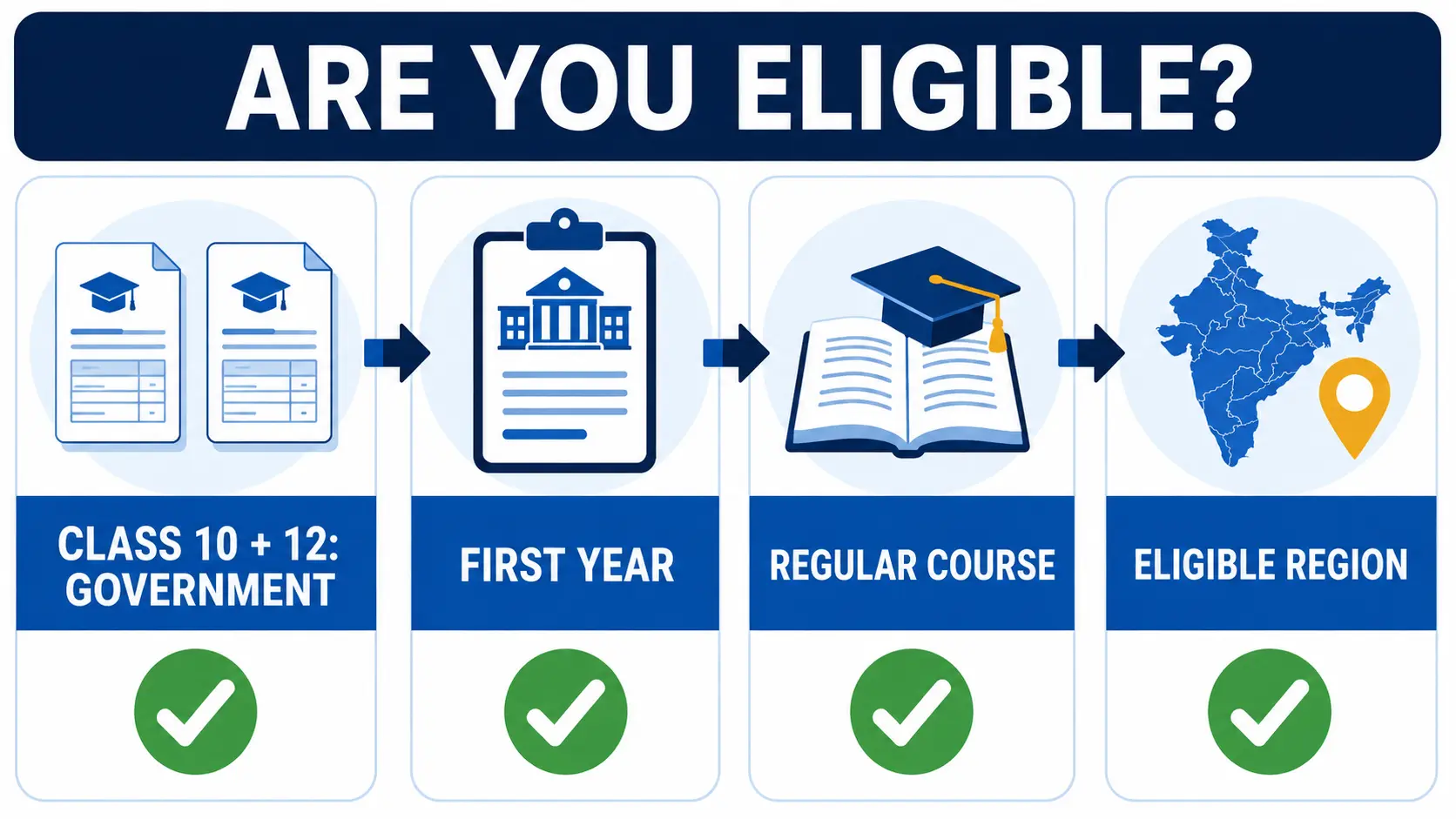
Azim Premji Scholarship eligibility 2026 still depends on the student’s school history, first-year college admission, course mode and eligible region. The Foundation’s current eligibility rules require a girl student to have completed both Class 10 and Class 12 as a regular student from government institutions in an eligible state or Union Territory and to enter the first year of her first recognised regular undergraduate degree or diploma.
The 2026 cohort’s Round 1 application period was listed by the Foundation as August 10–31, 2026. That Round 1 period has now passed. A registration link remaining visible on a webpage should not by itself be treated as proof that a late Round 1 application is valid.
A girl student who completed both Class 10 and Class 12 as a regular student from government institutions in an eligible state or UT and is entering the first year of her first recognised regular undergraduate degree or diploma for 2026–27.
The Foundation’s official application page identifies August 10–31, 2026 as the Round 1 application period for the 2026 cohort. Students should use the Foundation’s current portal or a later official announcement to determine the next valid application opportunity.
What does not automatically disqualify you
Studying at an eligible private undergraduate college, having lower marks, being older than the typical first-year student or studying in another Indian state does not by itself make an applicant ineligible.
What can make you ineligible
Private study at either Class 10 or Class 12, distance-learning undergraduate study, already being beyond first year or falling under a stated programme exclusion can prevent eligibility.
Azim Premji Scholarship Eligibility 2026: Quick Decision Table
| Student situation | Current position |
|---|---|
| Girl student | Required |
| Class 10 from government institution | Required |
| Class 12 from government institution | Required |
| Class 10 government + Class 12 private | Does not meet the stated school-history rule |
| Class 10 private + Class 12 government | Does not meet the stated school-history rule |
| First-year regular UG degree or diploma in 2026–27 | Can qualify |
| Second or later undergraduate year | Not eligible as a new applicant |
| Credible private undergraduate college or university | Can qualify |
| College in another Indian state | Can qualify |
| Distance-learning undergraduate programme | Not eligible |
| First undergraduate degree or diploma after Class 12 | Required |
| Azim Premji University programme | Excluded under the current FAQ |
| Current or past recipient of specified Wipro scholarships such as Santoor | Excluded under the current FAQ |
1. Both Class 10 and Class 12 Must Meet the Government-Institution Rule
The Foundation says applicants must have passed both Class 10 and Class 12 as regular students from a government school or college in an eligible state or Union Territory.
2. Can a Private-College Student Apply?
Yes, potentially. The undergraduate institution can be a government institution or a credible and bona fide private college or university anywhere in India. The government-institution requirement applies to the applicant’s Class 10 and Class 12 history.
3. First-Year and First-Degree Rules
New applicants must be in the first year of a recognised regular undergraduate degree or diploma lasting two to five years. The current FAQ also says this should be the applicant’s first undergraduate degree or diploma after Class 12.
Students already in the second, third, fourth or fifth year cannot apply as new applicants.
4. Distance-Learning Students Are Not Eligible
The current programme requires regular study. The Foundation’s FAQ specifically excludes undergraduate degree or diploma courses pursued through distance-learning mode.
5. Marks, Merit, Income and Age
| Question | Current programme position |
|---|---|
| Is the scholarship awarded on merit? | No |
| Is caste the selection basis? | No |
| Is religion the selection basis? | No |
| Is income the stated selection basis? | No |
| Is there a stated age limit? | No age limit is stated in the current FAQ |
6. Which States and UTs Are Eligible?
The current application page lists Andhra Pradesh, Arunachal Pradesh, Assam, Bihar, Chhattisgarh, Delhi (NCT), Jharkhand, Karnataka, Madhya Pradesh, Manipur, Meghalaya, Mizoram, Nagaland, Odisha, Puducherry, Rajasthan, Sikkim, Telangana, Tripura, Uttar Pradesh and Uttarakhand.
Andhra Pradesh and Delhi (NCT) are identified as additions for the 2026 cohort.
7. Which Applicants Are Specifically Excluded?
Applicants admitted to an Azim Premji University programme for academic year 2026–27 or earlier are excluded under the current FAQ.
Students who are or have been recipients of specified Wipro scholarships, with Santoor given as an example, are excluded under the current FAQ.
8. How Much Financial Support Is Available?
The Foundation describes financial support of ₹30,000 annually for shortlisted students for the duration of their first eligible undergraduate degree or diploma programme, which can be two to five years long.
The scholarship amount is a benefit for shortlisted students, not a substitute for meeting the eligibility requirements.
9. What Documents Are Required?
The official application guidance lists a passport-size photograph, Aadhaar, bank proof, Class 10 marksheet, Class 12 marksheet and college admission proof.
Identity and photograph
Use clear, current and unedited files. The Foundation warns against screenshots, blurred copies, cropped or altered documents where prohibited.
Bank proof
The account should be in the applicant’s name, active and supported by the required passbook or bank-statement information.
Marksheets
Class 10 and Class 12 marksheets should be clear and unedited.
College admission proof
The Foundation accepts the specified bona fide certificate or tuition-fee receipt route when the required applicant, institution and course details are visible.
The current application page says accepted uploads use PDF, PNG or JPG formats with file sizes between 30 KB and 500 KB.
10. What Is the Current Application Status?
The Foundation’s official application page states: Round 1 scholarship applications for cohort 2026 ran from August 10 to August 31, 2026.
As of September 1, that published Round 1 period has passed. Students should not assume that an application submitted after August 31 is valid solely because a registration or login link remains technically reachable.
Verification Method
This guide was checked against the Azim Premji Foundation’s official scholarship application and programme pages on September 1, 2026.
The current pages continue to support the Class 10 and Class 12 government-institution rule, first-year regular-course requirement, eligible-region list, private-college eligibility, distance-learning exclusion, ₹30,000 annual support and other eligibility boundaries described above.
Limitations and Unresolved Facts
- The eligibility FAQ still contains one inconsistent reference to academic session 2025–26 even though the main eligibility section and surrounding 2026 cohort material refer to 2026–27.
- The public application page identifies Round 1 as August 10–31, 2026 but may continue displaying registration links after that period; a visible link alone does not establish a valid late application window.
- The Foundation’s site is surfacing a Round 2 date of January 10–31, 2027, but applicants should recheck the detailed application page when that round approaches.
- Individual edge cases not addressed by the published rules should be confirmed directly with the Foundation.
Azim Premji Scholarship Eligibility 2026 FAQs
Can a girl studying in a private college apply?
Yes, potentially. A credible and bona fide private undergraduate institution can qualify if the applicant satisfies the other eligibility conditions.
Can I apply if Class 10 was government but Class 12 was private?
No under the currently stated school-history rule. Both Class 10 and Class 12 must have been completed as a regular student from government institutions in an eligible state or UT.
Can a second-year student apply as a new applicant?
No. New applicants must be first-year students in their first undergraduate degree or diploma.
Can a distance-learning student apply?
No. The current rules require regular undergraduate study.
Is there an age limit?
No age limit is stated in the current FAQ, subject to satisfying the other eligibility rules.
Are Andhra Pradesh and Delhi students eligible?
Yes. Both appear in the current eligible-region list for the 2026 cohort.
Is Round 1 still open?
The Foundation lists Round 1 applications for the 2026 cohort as August 10–31, 2026. That published period has passed.
Is there another application round?
The Foundation’s current website is surfacing a 2026 cohort Round 2 schedule of January 10–31, 2027. Recheck the official application page before applying.
Bottom Line
Azim Premji Scholarship eligibility 2026 is best checked in sequence: both Class 10 and Class 12 from government institutions in an eligible region, first-year admission, first undergraduate degree or diploma and regular rather than distance study.
The eligibility rules remain materially unchanged, but the application state has moved on: the Foundation’s published Round 1 window was August 10–31, 2026. Applicants looking for the next application opportunity should rely on the Foundation’s current portal and official Round 2 information rather than assuming Round 1 remains open.
Last verified: September 1, 2026.