




The Western Dedicated Freight Corridor completion 2026 story is more complicated than a simple September 8 inauguration. The Prime Minister’s Office says three WDFC sections covering 326 route km will be dedicated on September 8 and freight services will be flagged off from four locations, including New JNPT. But earlier DFCCIL and Ministry of Railways records already describe major sections as commissioned and the corridor as completed or operationally ready.
The key reader question is therefore not whether the WDFC exists before September 8. It is what exactly becomes new on September 8, and whether that event changes the commercial operating state for JNPT-linked freight.
Is WDFC becoming operational for the first time on September 8?
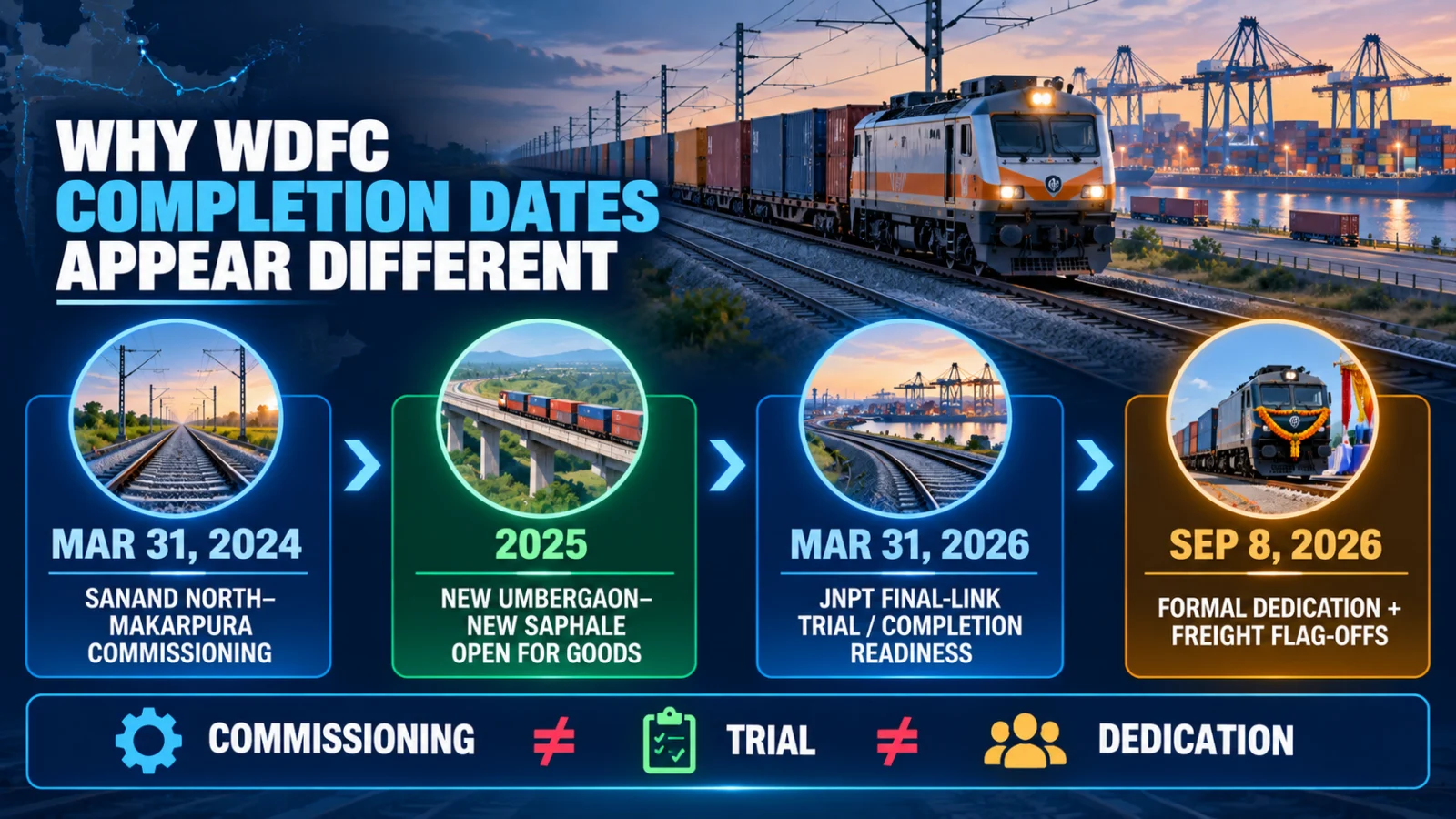
No evidence reviewed by ThePulseSignal supports treating September 8 as the first operational date of the Western Dedicated Freight Corridor. DFCCIL recorded a successful bidirectional freight trial on the final JNPT-New Saphale section on March 31, 2026 and described that milestone as completing the WDFC and establishing operational readiness of the final link. Later Ministry of Railways material described both the Eastern and Western Dedicated Freight Corridors as completed and commissioned.
September 8 is nevertheless a real current milestone: the government has scheduled a formal dedication of three sections and freight-train flag-offs from New Sanand, New Makarpura, New Umbergaon and New JNPT.
What exactly is scheduled for September 8?
The Prime Minister’s Office says three Western Dedicated Freight Corridor sections covering a combined 326 route km and developed at a stated cost of more than ₹20,700 crore will be dedicated on September 8.
The three sections are:
- Sanand North-Makarpura
- New Umbergaon-New Saphale
- New Saphale-JNPT
The same programme says freight services will be flagged off from New Sanand, New Makarpura, New Umbergaon and New JNPT.
Those are confirmed scheduled events. They do not, by themselves, prove that every one of those sections was unavailable for freight before September 8 or that a completely new commercial timetable begins on that date.
Why do official sources appear to give different WDFC completion dates?
The apparent contradiction comes from different infrastructure milestones being described with similar words.
- Construction completion means the physical works have substantially reached completion.
- Trial or operational readiness means trains have successfully used a section and the infrastructure is ready for operation.
- Commissioning can refer to a technical or administrative milestone allowing railway operation.
- Opening for public carriage of goods is a freight-service milestone for commercial goods movement.
- Dedication to the nation is a formal public infrastructure event and does not necessarily equal the first day of technical operation.
- Freight-service flag-off confirms specific train movements at an event but does not automatically establish a new recurring timetable for every freight user.
Current September 7 coverage often compresses these stages into one statement that the corridor will become fully operational on September 8. Earlier official records show that the actual operational timeline developed section by section before that date.
Was Sanand North-Makarpura already commissioned?
Yes. A parliamentary WDFC status record lists the commissioning date for the Sanand North-Makarpura section as March 31, 2024.
That makes it unsafe to describe the entire section as becoming technically operational for the first time only because it is included in the September 8 dedication programme.
Was New Umbergaon-New Saphale already open for freight?
DFCCIL issued a business-development circular in 2025 opening the New Saphale-New Umbergaon Road section for public carriage of goods. That is another reason the September 8 event should not be simplified into a claim that all 326 route km are newly entering freight operation on the same day.
When did the final JNPT link reach completion readiness?
The most important recent milestone occurred on March 31, 2026. DFCCIL reported successful freight trials in both directions on the final approximately 102 km JNPT-New Saphale section.
DFCCIL described that trial as marking completion of the entire Western Dedicated Freight Corridor and operational readiness of the final link to JNPT.
That March milestone is central to understanding today’s confusion. September 8 can still be a major formal and service-launch event without being the first point at which the corridor physically or technically became complete.
What did the Ministry of Railways say after the March trial?
Later Ministry of Railways material in August 2026 stated that work on the Eastern and Western Dedicated Freight Corridors had been completed and commissioned.
That official wording predates the September 7 PMO statement saying that with the commissioning of the three sections the DFC network will stand fully operational across its entire length.
The two statements are best treated as evidence of different administrative or public milestones unless a post-event DFCCIL or Railways notice clarifies that September 8 creates a genuinely new operating state.
Why does the JNPT connection matter?
JNPT is a major container-port gateway, so direct Dedicated Freight Corridor connectivity is strategically important for export-import cargo and industrial supply chains.
The government says the completed corridor is intended to improve port connectivity, support faster freight movement and reduce logistics burden. Those are plausible infrastructure objectives, but they should not be converted into a universal promise that every shipper will immediately receive a specific transit-time or freight-cost reduction.
Actual gains depend on origin and destination, terminal access, train path, cargo type, handling arrangements and the commercial service being used.
Will freight operators get a new timetable or booking route on September 8?
That is not yet established. In the evidence reviewed before publication, TPS did not identify a new DFCCIL operating circular that creates a universal September 8 booking process, terminal-access rule or recurring freight timetable for all users.
The four scheduled freight-service flag-offs are important evidence that trains are being operated as part of the event. TPS will still need to check whether those movements correspond to newly introduced regular commercial services or are formal inaugural services on infrastructure that was already available.
Does a fully operational WDFC mean freight costs fall immediately?
No universal immediate saving can be stated. Dedicated freight infrastructure can improve capacity, reliability and port connectivity, and the government expects logistics benefits from the WDFC. But freight costs depend on route, cargo, terminal handling, commercial tariffs and the operator’s full logistics chain.
TPS has not identified evidence supporting a single guaranteed freight-cost reduction or transit-time saving for every JNPT-linked shipment from September 8.
What is actually new on September 8?
Based on the evidence available before the event, the clearest new state is:
- formal dedication of three named WDFC sections covering 326 route km;
- formal freight-train flag-offs from four locations;
- public confirmation of the end-to-end WDFC/JNPT connectivity milestone;
- a new checkpoint for verifying whether DFCCIL or Railways introduces any fresh service, timetable, access or operating arrangement.
The article should therefore distinguish formal dedication and service flag-off from earlier technical commissioning, freight opening, trial completion and operational readiness.
Verification note
ThePulseSignal reconciled the September 7 Prime Minister’s Office programme with earlier DFCCIL completion and freight-opening records, parliamentary section-status material and a later Ministry of Railways statement describing WDFC as completed and commissioned. That comparison shows that September 8 is a genuine formal infrastructure milestone, but it should not automatically be treated as the corridor’s first operational date.
Limitations and unresolved facts
The September 8 event had not occurred at the time of the final source check. TPS had not yet verified the actual freight trains flagged off, any new DFCCIL operating circular, a new recurring timetable, a new freight-booking or terminal-access workflow, or route-specific logistics savings. Official sources also use overlapping infrastructure terms differently, so the post-event operational wording may require further reconciliation.