







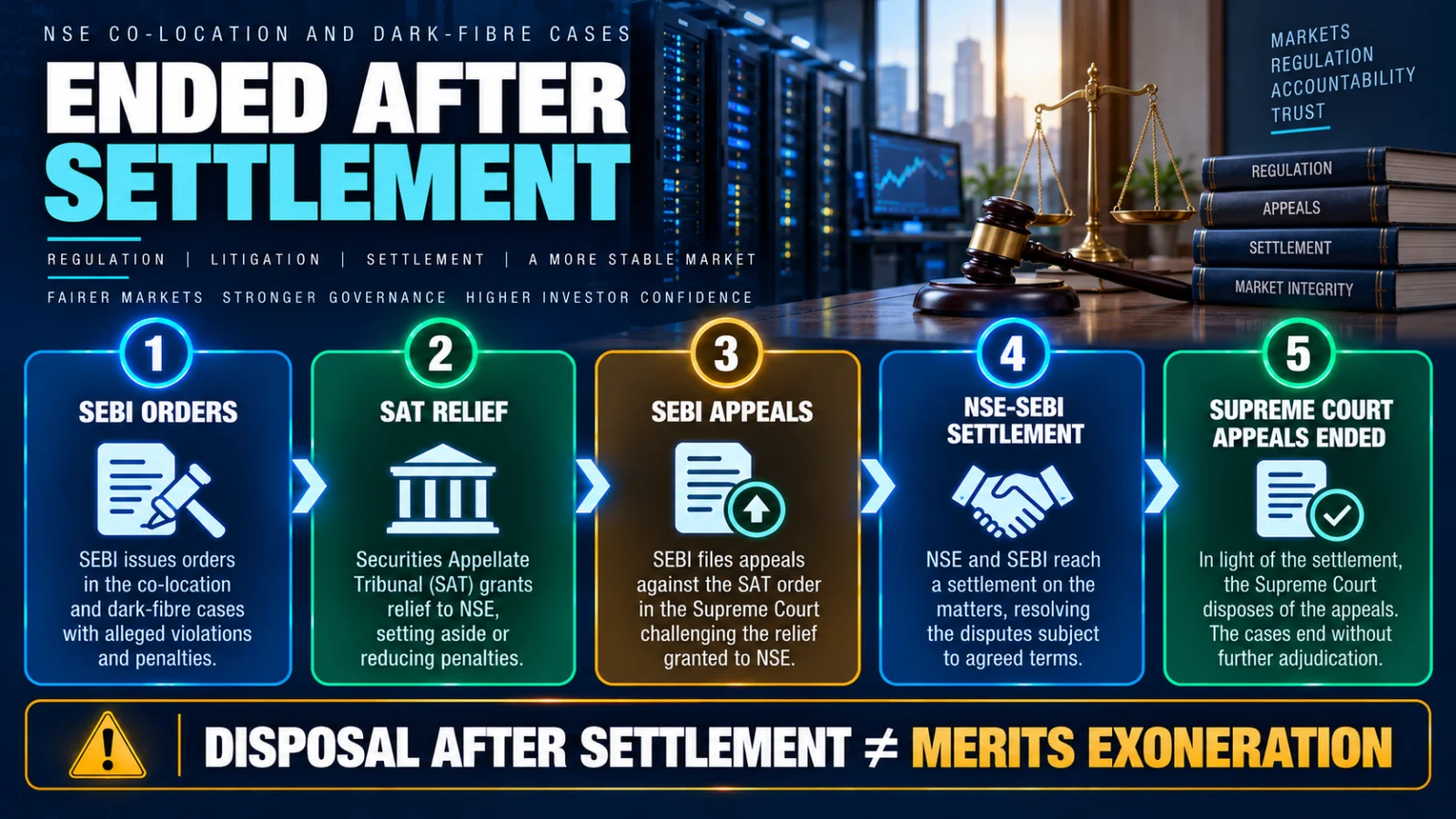
The NSE co-location case has reached a settled Supreme Court procedural state, but the outcome should not be read as a merits ruling clearing NSE of every underlying allegation. Current reporting says the Supreme Court disposed of or dismissed SEBI’s appeals in the National Stock Exchange’s co-location and dark-fibre matters after settlement between the regulator and exchange.
Current answer: the specific SEBI appeals before the Supreme Court are no longer pending after settlement. That removes an important legal overhang for NSE. It does not establish that the Supreme Court found the original allegations to be false or that every proceeding connected with the broader controversy has ended.
What changed in the NSE co-location case?
SEBI had appealed to the Supreme Court after the Securities Appellate Tribunal granted NSE relief from parts of earlier enforcement action connected with the co-location and dark-fibre matters. September 2026 reporting says those Supreme Court appeals were disposed of or dismissed after NSE and SEBI completed the relevant settlement process.
The practical change is procedural and regulatory: these particular Supreme Court appeals are no longer pending.
Does the Supreme Court dismissal mean NSE was cleared on the merits?
No such merits finding has been established in the evidence reviewed by TPS. A proceeding ending after settlement is not the same as a court independently finding that every underlying allegation was incorrect.
TPS has not recovered the controlling Supreme Court order text and therefore does not attribute unverified findings or wording to the Court.
What is confirmed: SEBI’s Supreme Court appeals in the co-location and dark-fibre matters are reported as disposed of or dismissed after settlement.
What that changes: this specific Supreme Court legal overhang is no longer pending.
What it does not prove: the available evidence does not establish a Supreme Court merits finding exonerating NSE from every underlying allegation.
What remains separate: the status of other proceedings and the investment merits of NSE’s IPO require their own evidence.
What was the co-location and dark-fibre dispute about?
The long-running NSE matter concerned allegations around preferential or unfair access to exchange infrastructure and trading systems. SEBI issued enforcement orders, NSE obtained relief on important parts of those orders from the Securities Appellate Tribunal, and SEBI pursued appeals before the Supreme Court.
The Supreme Court appeal stage ended after settlement rather than continuing to a further contested merits outcome on those appeals.
How much did NSE agree to pay in settlement?
NSE disclosed revised settlement terms aggregating about ₹1,491.21 crore for the co-location and dark-fibre matters. The amount belongs to the settlement process and should not be described as a Supreme Court fine imposed by the dismissal or disposal of the appeals.
What does this mean for the NSE IPO?
The IPO has now moved from a scheduled offering to an active subscription window. NSE’s official issue information shows the offer opened on September 17, 2026 and is scheduled to close on September 21, 2026. The official price range is ₹1,700 to ₹1,785 per equity share, with a bid lot of eight shares.
NSE’s official offer-document page now provides the Red Herring Prospectus and related issue documents. Reuters reported on September 17 that the offer had received bids for about 42% of the shares available on its first day, while noting that institutional participation often develops later in an IPO window. The planned listing date remains September 24.
The legal settlement and end of these Supreme Court appeals removed a major regulatory obstacle in NSE’s long-delayed listing process. The IPO is nevertheless a separate market event. Its subscription level, final allocation, issue outcome and post-listing performance do not establish anything further about the merits of the historical co-location allegations.
Are all NSE co-location-related proceedings now over?
TPS cannot safely make that broader claim from the evidence reviewed. The available material establishes the changed status of the Supreme Court appeals, but the complete status of every historical regulatory, enforcement, criminal or other proceeding connected with the wider controversy has not been independently reconciled.
Readers should therefore distinguish between these appeals ending and every matter connected with the wider controversy being extinguished.
What should readers watch next?
For the legal case, the strongest additional evidence would be the directly accessible Supreme Court order and any official SEBI or NSE material clarifying the scope of proceedings that remain, if any.
For the IPO, the next confirmed material checkpoint is September 21, when the issue is scheduled to close. NSE’s official issue information says the UPI mandate-confirmation cut-off on the final day is 7 PM. The final subscription state, allocation information and subsequent listing disclosures should be treated separately from the legal question of what the co-location settlement established.
What remains unresolved?
- The exact Supreme Court case numbers and operative order wording have not been directly recovered by TPS.
- Whether every proceeding connected with the broader co-location controversy is closed has not been independently established.
- The complete final settlement conditions beyond the disclosed aggregate amount have not been independently reconciled.
- The IPO remains open through September 21, so its final subscription and allocation state are not yet known.
Verification note: ThePulseSignal reviewed NSE’s settlement disclosure, current NSE issue information and offer-document pages, Reuters reporting and Informist’s report on the Supreme Court disposal. NSE’s current issue information confirms the September 17–21 subscription period and ₹1,700–₹1,785 price range. Because TPS has not directly recovered the controlling Supreme Court order, the legal conclusion remains limited to the corroborated procedural state.