






The FCI MoU 2026-27 sets a new annual performance framework for foodgrain storage, logistics, quality control, digitisation and depot efficiency, but it does not currently change ration-card eligibility or PDS grain entitlements. The Department of Food & Public Distribution and Food Corporation of India signed the FY2026-27 MoU on September 8, with part of the performance framework linked to depot-level assessment through Depot Darpan.
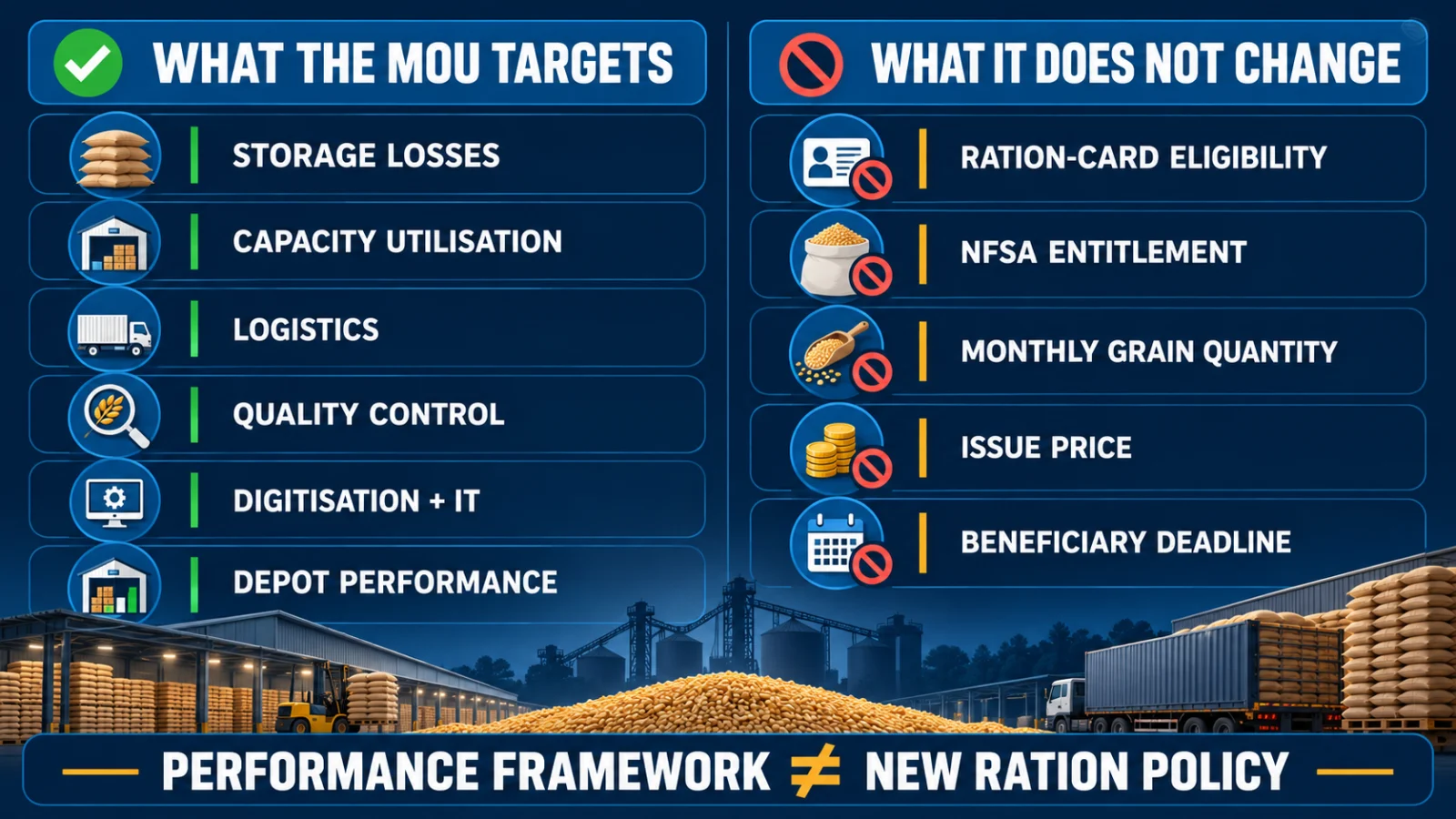
Current answer: The FY2026-27 MoU targets lower storage losses, better storage-capacity utilisation, improved logistics and supply-chain management, stronger quality control, greater digitisation, modern IT adoption and employee capability. A proportion of FCI’s targets is linked to depot performance through Depot Darpan. The reviewed announcement does not establish a new ration entitlement, ration-card rule, grain quantity, issue price or beneficiary deadline.
What does the FCI MoU 2026-27 actually change?
The agreement formalises FCI’s FY2026-27 performance priorities into an annual management framework with measurable outcome and target-based parameters. The Ministry’s public announcement identifies several operational areas that FCI will be expected to improve during the financial year.
| Performance area | What the MoU establishes now | What is still not public |
|---|---|---|
| Storage losses | Reduction in storage losses is an explicit performance area. | The numerical FY2026-27 target was not disclosed in the reviewed release. |
| Storage capacity | Improved utilisation of storage capacity is included. | No public target percentage was established. |
| Logistics | Foodgrain logistics and supply-chain management are performance priorities. | Route-specific, state-wise or cost targets were not disclosed. |
| Quality control | Strengthening quality-control mechanisms is included. | No new grain-quality threshold specific to the MoU was published. |
| Digitisation and IT | Greater digitisation and adoption of modern IT solutions are included. | The release does not identify specific new software or technology modules. |
| Employee capability | Capacity building and skill development are part of the framework. | Programme-level training targets were not published. |
| Depot performance | A proportion of MoU targets is linked to FCI depot performance through Depot Darpan. | The exact scoring weight and depot-wise FY2026-27 targets remain unresolved. |
What role does Depot Darpan play in the new MoU?
The September 8 announcement says that a proportion of the FY2026-27 MoU targets is linked to FCI depot performance through Depot Darpan. This means depot-level operational and infrastructure performance is part of how the broader annual framework will be assessed.
Depot Darpan itself is not newly created by this MoU. Existing government material describes it as a depot-assessment framework that evaluates both operational efficiency and infrastructure. Its established measures include areas such as occupancy, transit and storage losses, handling costs, demurrage, manpower expenses, safety, operational conditions, environmental aspects and statutory compliance.
Does the FCI MoU 2026-27 change ration-card or PDS benefits?
No beneficiary-facing change is established by the reviewed September 8 announcement. The MoU is an institutional performance framework between DFPD and FCI.
TPS found no evidence in the current release of a change to:
- ration-card eligibility;
- NFSA beneficiary categories;
- monthly grain entitlement;
- Central Issue Price;
- free-ration quantity;
- ration-card portability;
- PDS application procedure;
- a new beneficiary deadline.
If you are an FCI or foodgrain-operations stakeholder: the MoU is relevant because storage, logistics, quality, digital operations and depot performance are now part of the FY2026-27 performance framework.
If you are a ration-card or PDS beneficiary: no new action is established by this announcement. Do not treat the MoU as a new entitlement or eligibility notification.
If you are tracking policy outcomes: the meaningful next evidence will be numerical KPIs, depot-level implementation, operational circulars and later performance results.
Are the FY2026-27 numerical targets public?
Not in the September 8 PIB release reviewed by TPS. The announcement identifies the areas against which performance will be measured, but it does not disclose the numerical storage-loss target, capacity-utilisation percentage, logistics-cost target, depot-wise scoring thresholds or the exact proportion of the MoU linked to Depot Darpan.
Those values should therefore remain unresolved until they appear in a controlling DFPD, FCI or related official document.
What technology changes are confirmed?
The MoU calls for greater digitisation of business processes and adoption of modern IT solutions. However, the public announcement does not identify a specific new software platform, AI system, IoT deployment, warehouse automation package or implementation deadline.
TPS should therefore describe technology modernisation only at the level supported by the official release and avoid assigning specific tools or systems that have not been named.
Has FCI already reduced storage losses because of this MoU?
No outcome should be attributed to the new agreement yet. The MoU establishes performance goals for FY2026-27; it does not itself prove that losses have fallen, logistics costs have declined, depot scores have improved or food-subsidy savings have already been achieved.
What happens next?
The next useful information state will come from implementation rather than another signing announcement. TPS should monitor DFPD and FCI for numerical FY2026-27 KPI thresholds, Depot Darpan scoring or methodology changes, operational circulars, technology-rollout details and measured foodgrain-management outcomes.
If a later official decision creates an actual ration-card, NFSA or PDS beneficiary change, that would be a different reader-facing state and should be verified independently rather than inferred from this MoU.
What remains unresolved?
- The numerical FY2026-27 storage-loss target.
- The storage-capacity utilisation target.
- The exact proportion or scoring weight linked to Depot Darpan.
- Depot-wise performance targets.
- Specific new IT or digitisation modules.
- Operational implementation deadlines.
- Quantified logistics or food-subsidy savings.
- FY2026-27 measured outcomes.
- Any later beneficiary-facing PDS consequence.
Verification note: ThePulseSignal reviewed the September 8 DFPD-FCI announcement and reconciled it with existing government material describing Depot Darpan’s operational and infrastructure assessment framework. The current article separates newly confirmed FY2026-27 targets from older Depot Darpan methodology and from beneficiary rules that have not changed.