




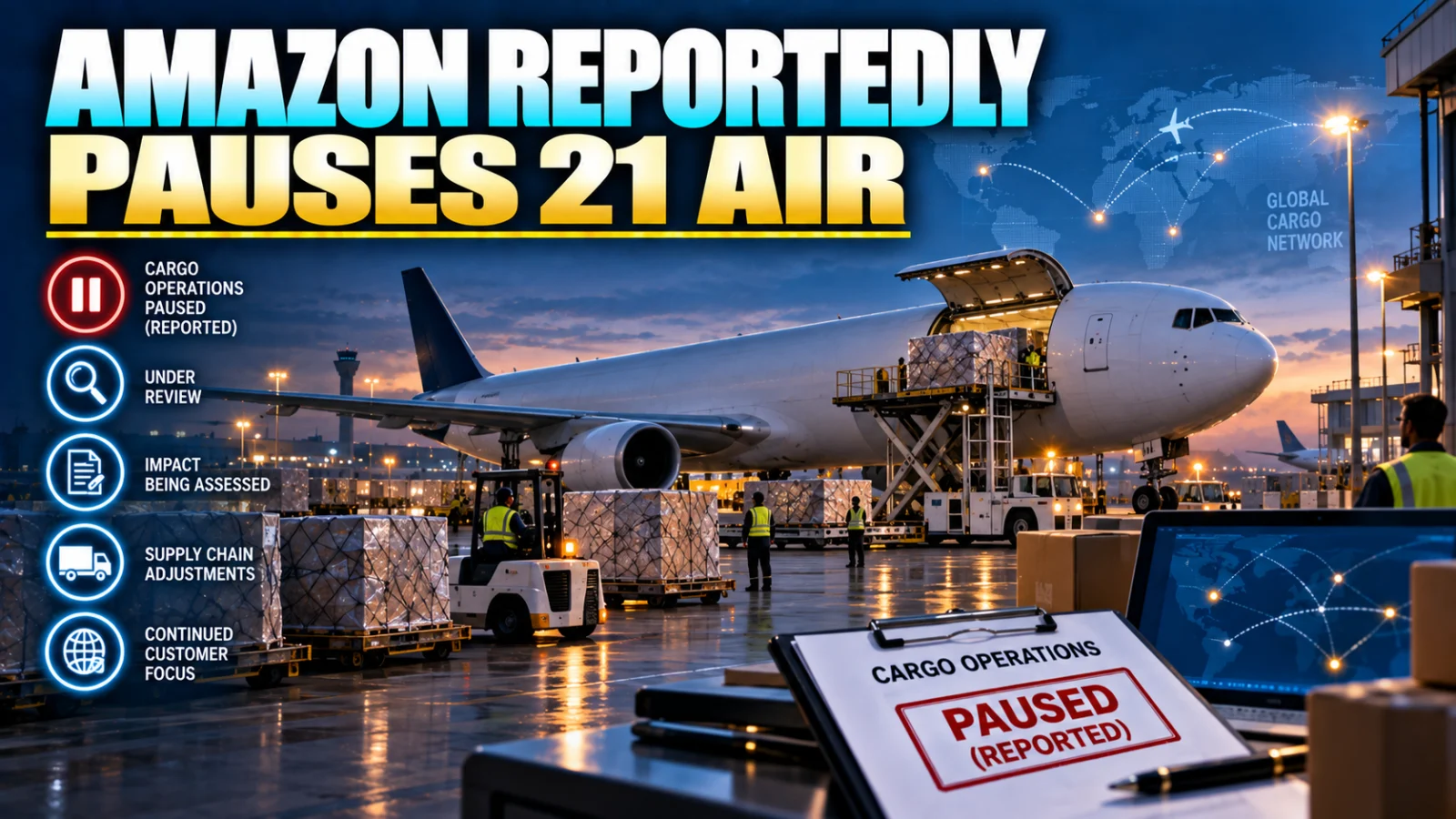
Amazon suspends 21 Air, according to multiple current reports, following the fatal September 6 cargo-plane crash in Miami. The September 14 development is a change in Amazon’s commercial relationship with one of its contracted air carriers, but it does not by itself establish that 21 Air has been grounded by a regulator, that Amazon has permanently ended the relationship or that customers are facing broad delivery delays.
What changed: Reuters, AP and The Wall Street Journal report that Amazon has paused or suspended its use of 21 Air. Amazon’s retrieved public crash-update page still shows its earlier post-crash cooperation and coordination state, and TPS has not recovered a direct September 14 Amazon or 21 Air public statement confirming the suspension.
What the reported Amazon suspension changes
The immediate change is operational at the carrier-partner level. Amazon reportedly stopped using 21 Air for its own cargo operations while the Miami accident remains under investigation. That means the earlier state — in which Amazon was publicly coordinating with 21 Air after the crash — is no longer a safe description of the current relationship.
The evidence does not yet establish how much Amazon flying has been reassigned, which routes or aircraft are affected, how long the pause will last or whether the relationship will eventually resume or end permanently.
Does this mean 21 Air has been grounded?
No regulator grounding was established in the reviewed evidence. Amazon’s reported suspension is a commercial operating decision by a customer or partner. It should not be described as an FAA grounding or as proof that all 21 Air operations have stopped.
This distinction matters because a cargo airline can have relationships with more than one customer, while an individual shipper such as Amazon can choose whether to continue assigning flying to that carrier.
Does the suspension mean Amazon deliveries will be delayed?
Broad Amazon delivery disruption has not been established. Amazon Air Cargo’s own service information describes a network that uses multiple direct air-carrier partners rather than relying on one airline for all flying. That gives Amazon alternative operating relationships, but TPS has not verified which carrier or carriers will replace any 21 Air capacity, how much capacity is being replaced or whether particular routes or shipments are affected.
For that reason, the strongest current answer is that the carrier relationship has reportedly changed, while customer-facing consequences remain unknown.
What is confirmed about the Miami crash?
The National Transportation Safety Board is investigating the September 6 runway-overrun accident involving 21 Air Flight 7598, a Boeing 767 cargo flight in Miami. The NTSB has released investigative information, including recorder findings, but it explicitly treats the investigation as ongoing.
Preliminary recorder information must not be presented as a final probable cause. TPS is therefore keeping the crash investigation separate from the business decision reported on September 14: the accident is established, the investigation continues, and Amazon’s carrier suspension is a later operational response reported by multiple news organisations.
Is Amazon permanently ending its relationship with 21 Air?
That has not been established. Current reporting uses pause or suspension language. TPS has not verified a permanent termination notice, a defined suspension period or a confirmed return-to-service plan for Amazon flying.
What should readers watch next?
The next material evidence would be a direct Amazon or 21 Air statement, confirmation of replacement carriers or reassigned cargo capacity, specific route or shipment effects, an FAA carrier-level action, a resumption or permanent termination of the Amazon relationship, or a material new NTSB investigative milestone.
Those developments belong on this same canonical while the core reader job remains understanding the Amazon–21 Air operating relationship and its cargo-network consequences.
Verification note
TPS reviewed the current Reuters-led suspension reporting, Amazon’s public post-crash update, Amazon Air Cargo’s description of its multi-carrier operating model and the NTSB investigation update. The September 14 suspension is therefore treated as reported, while the Amazon/21 Air direct confirmation, suspension duration, replacement capacity, customer impact and final accident cause remain unresolved.