






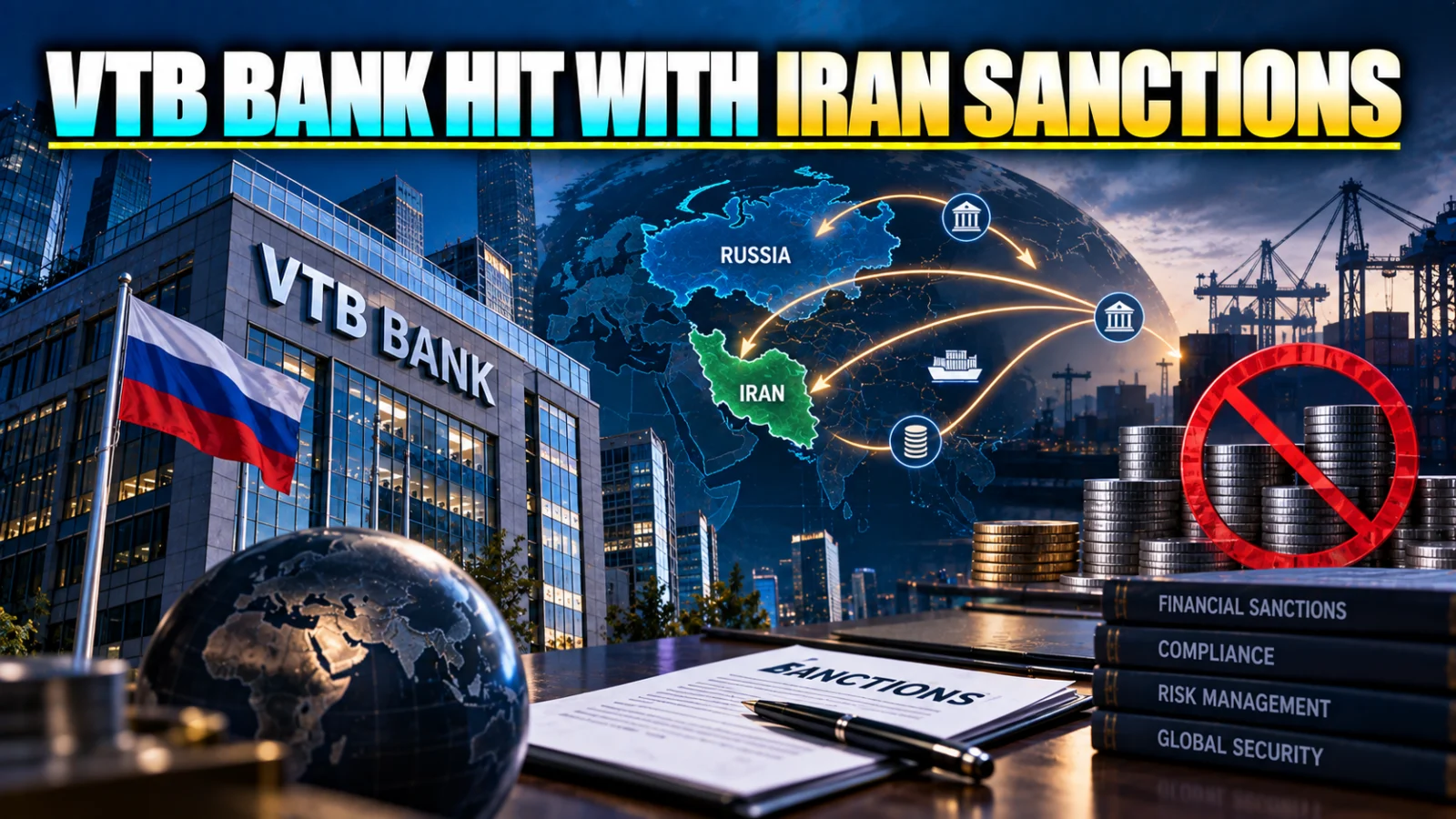
The U.S. has now identified VTB Bank as the large bank targeted in its latest Iran-related sanctions action. On September 14, the U.S. Department of the Treasury’s Office of Foreign Assets Control designated VTB Bank Public Joint Stock Company under Executive Order 13902 for operating in Iran’s financial sector.
Current status: the bank is no longer unnamed and the action is no longer merely planned. Treasury says OFAC designated VTB Bank under E.O. 13902 because of its Iran-related financial activity, including correspondent relationships with sanctioned Iranian banks and efforts Treasury says supported sanctions evasion and bilateral financial channels between Russia and Iran.
Which bank did the U.S. sanction over Iran?
The bank is VTB Bank Public Joint Stock Company, one of Russia’s largest financial institutions.
Treasury says VTB opened bank offices in Iran, established correspondent banking relationships with sanctioned Iranian financial institutions and created mechanisms intended to expand financial and trade links between Russia and Iran.
Treasury also says VTB took steps to move billions of dollars in frozen Iranian assets and developed a settlement system using Russian rubles and Iranian rials through correspondent accounts.
What legal authority did OFAC use?
OFAC designated VTB Bank pursuant to Executive Order 13902, which authorizes sanctions involving specified sectors of the Iranian economy, including Iran’s financial sector.
Treasury states that VTB was designated under E.O. 13902 for operating in the financial sector of the Iranian economy.
Was VTB Bank already sanctioned before this Iran action?
Yes. This distinction matters when interpreting the practical effect of the September 14 action.
Treasury says VTB had already been designated by OFAC under other Russia-related authorities, including E.O. 13662 and E.O. 14024. The September 14 action adds an Iran-related E.O. 13902 designation rather than turning a previously unrestricted bank into a blocked institution for the first time.
The new Iran authority nevertheless changes the compliance picture because Treasury explicitly warns that foreign financial institutions continuing to deal with VTB after the Iran designation face additional sanctions exposure.
What are the sanctions implications?
Treasury states that property and interests in property of the designated or blocked person that are in the United States or in the possession or control of U.S. persons are blocked and must be reported to OFAC.
Entities owned, directly or indirectly, 50 percent or more in aggregate by one or more blocked persons are also blocked under OFAC’s ownership rules.
Unless an OFAC authorization or exemption applies, U.S. persons and transactions within or transiting the United States generally may not deal in property or interests in property of blocked persons.
What does this mean for foreign banks dealing with VTB?
Treasury gives a particularly strong warning to foreign financial institutions. It says institutions that continue dealing with VTB following its designation under Iran sanctions authorities face increased sanctions risk and should cut off those relationships.
Treasury also says certain significant transactions involving a person designated under the relevant authority may expose participating foreign financial institutions to secondary sanctions.
One possible consequence is that OFAC can prohibit or impose strict conditions on a foreign financial institution’s ability to open or maintain a correspondent account or payable-through account in the United States if the institution knowingly conducts or facilitates certain significant transactions for a designated person.
Why did Treasury target VTB?
Treasury links the action to what it describes as Iranian sanctions evasion and financial coordination between Russia and Iran.
According to Treasury, VTB established correspondent relationships with sanctioned Iranian banks, increased its presence in Tehran and helped create financial channels intended to support trade and settlement between the two countries.
The designation forms part of Treasury’s Operation Economic Outcast, which is aimed at financial institutions, networks and intermediaries that Treasury says help Iran obtain revenue, move money or evade sanctions.
Does this prove every transaction involving VTB is automatically illegal everywhere?
No. OFAC sanctions create major U.S. compliance consequences, but the legal result for a particular transaction depends on the parties, jurisdiction, applicable sanctions authority, ownership structure, payment route and any relevant exemption or license.
Businesses should not convert a general sanctions announcement into transaction-specific legal advice. U.S. persons, foreign financial institutions and counterparties should review the actual OFAC authority and current guidance for the proposed activity.
Does the new action affect VTB’s subsidiaries?
OFAC’s general blocking framework applies to entities that are owned, directly or indirectly, 50 percent or more in aggregate by one or more blocked persons, even when a particular subsidiary is not separately named on the SDN List.
That means counterparties should screen ownership as well as the exact legal name of the entity involved.
What should banks and businesses check now?
- confirm whether the counterparty is VTB Bank or an entity owned 50 percent or more by blocked persons;
- review the September 14 Treasury action and the applicable E.O. 13902 designation;
- check whether any OFAC license, exemption or other authorization applies;
- review correspondent-bank and intermediary-bank exposure in the payment chain;
- assess secondary-sanctions exposure for significant transactions involving the designated institution;
- screen related owners, subsidiaries, beneficiaries and counterparties rather than checking the bank name alone; and
- obtain sanctions-compliance or legal review before proceeding with a consequential transaction where applicability is unclear.
What changed from the announced September 14 action?
Treasury Secretary Scott Bessent had publicly signalled that a large bank would be targeted as part of the U.S. pressure campaign against Iran. The controlling September 14 Treasury action now supplies the missing facts: the institution is VTB Bank, OFAC used E.O. 13902, and Treasury has set out the Iran-related basis and sanctions implications.
The current reader question is therefore no longer which bank might be named. It is what the VTB designation means for U.S. persons, foreign financial institutions and counterparties dealing with the bank.
What remains unresolved?
- How individual foreign banks and counterparties will change their VTB relationships in response to the Iran designation.
- Whether Treasury or OFAC will issue additional VTB-specific licenses, FAQs or implementation guidance.
- Whether other jurisdictions will announce coordinated measures tied specifically to this Iran-related designation.
- The transaction-specific effect for activities that may involve exemptions, licenses or complex ownership and payment structures.
- The measurable downstream effect on Russia-Iran trade and payment channels.
Verification note
ThePulseSignal reviewed the U.S. Treasury’s September 14, 2026 announcement identifying VTB Bank, the E.O. 13902 designation basis and Treasury’s stated sanctions implications. Reuters independently reported the designation and its Iran-related sanctions-evasion rationale. The controlling current state is a completed OFAC designation of VTB Bank under Iran sanctions authority, not a planned sanction on an unnamed institution.