




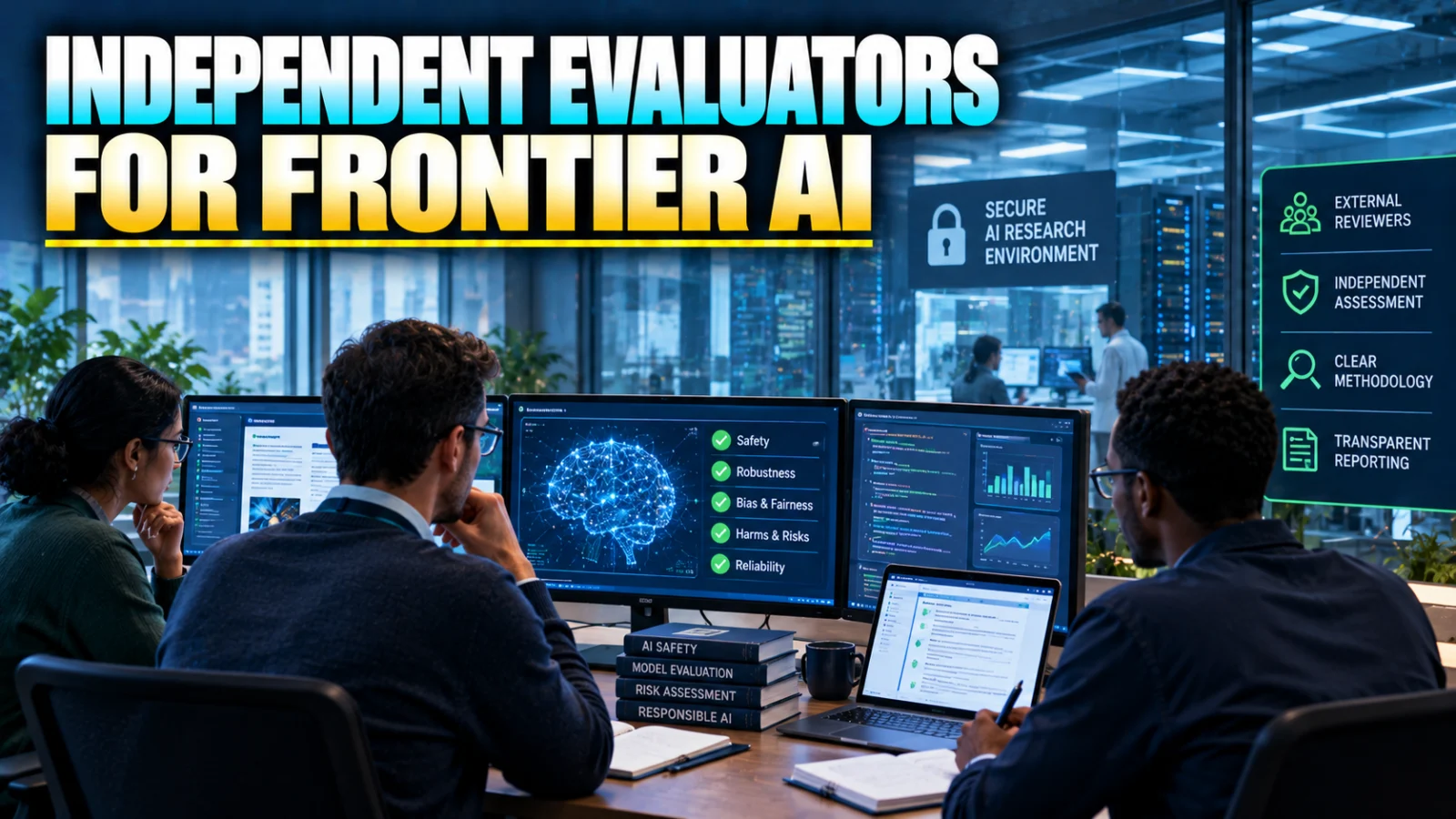
Anthropic independent AI evaluators are moving from a general safety idea toward a concrete company commitment. In a September 12 essay titled We Must Pace the Frontier, Anthropic CEO Dario Amodei said the company intends to bring an external review team inside Anthropic with access broadly comparable to its internal risk-assessment teams.
The important distinction is that Anthropic is not announcing a halt to AI development. Amodei argues that frontier capability growth should be paced so safety and alignment work have more time to keep up. Anthropic’s immediate commitment is embedded external evaluation; broader coordination among frontier labs and governments remains a proposal rather than a binding agreement.
What has Anthropic actually committed to?
Anthropic says it plans to invite a third-party evaluation team to work inside the company with ongoing access similar to internal teams responsible for risk assessment. That could include company laptops, internal workspaces, tools, permissions and conversations with employees, while still respecting legal, security, contractual and customer-privacy limits.
The company also proposes that these evaluators should be able to publish important findings without Anthropic controlling the editorial conclusion, although narrowly justified redactions could still apply.
Is Anthropic slowing or stopping AI model development?
No model-training halt is established. Amodei explicitly distinguishes pacing from stopping technical progress. His argument is that capability growth should be slowed enough for safety work, alignment research, security measures and external oversight to catch up with increasingly capable systems.
That makes the phrase “AI slowdown” easy to overread. The primary evidence supports a call to pace capability advancement, not a moratorium on training new models.
What would embedded independent evaluators be allowed to see?
Amodei describes a model in which external reviewers receive access that is much closer to an employee’s working environment than to a conventional outside audit. Anthropic says the evaluators could receive desks, badges, company laptops, internal workspaces, relevant tools and permissions, and direct conversations with employees.
The intended purpose is to let reviewers examine the evidence behind safety claims rather than relying only on public model cards, prepared demonstrations or one-off benchmark results.
Would the evaluators really be independent?
Anthropic’s proposal tries to preserve independence through publication rights. Amodei says the contractual arrangement should allow evaluators to publish key findings without Anthropic editorial control.
That independence would not be unlimited. The company says limited redactions may still be necessary for security, legal privilege, commercially sensitive information or third-party confidentiality. Amodei also proposes that evaluators should be able to disclose when important redactions occurred.
Are the evaluators already working inside Anthropic?
Not yet, based on the evidence reviewed. Anthropic says it intends to invite an embedded external review team in the near future. The identity of the evaluator, start date, staffing model, exact contractual powers and final access boundaries have not yet been established publicly in the reviewed evidence.
What are the three levels in Amodei’s frontier-AI pacing proposal?
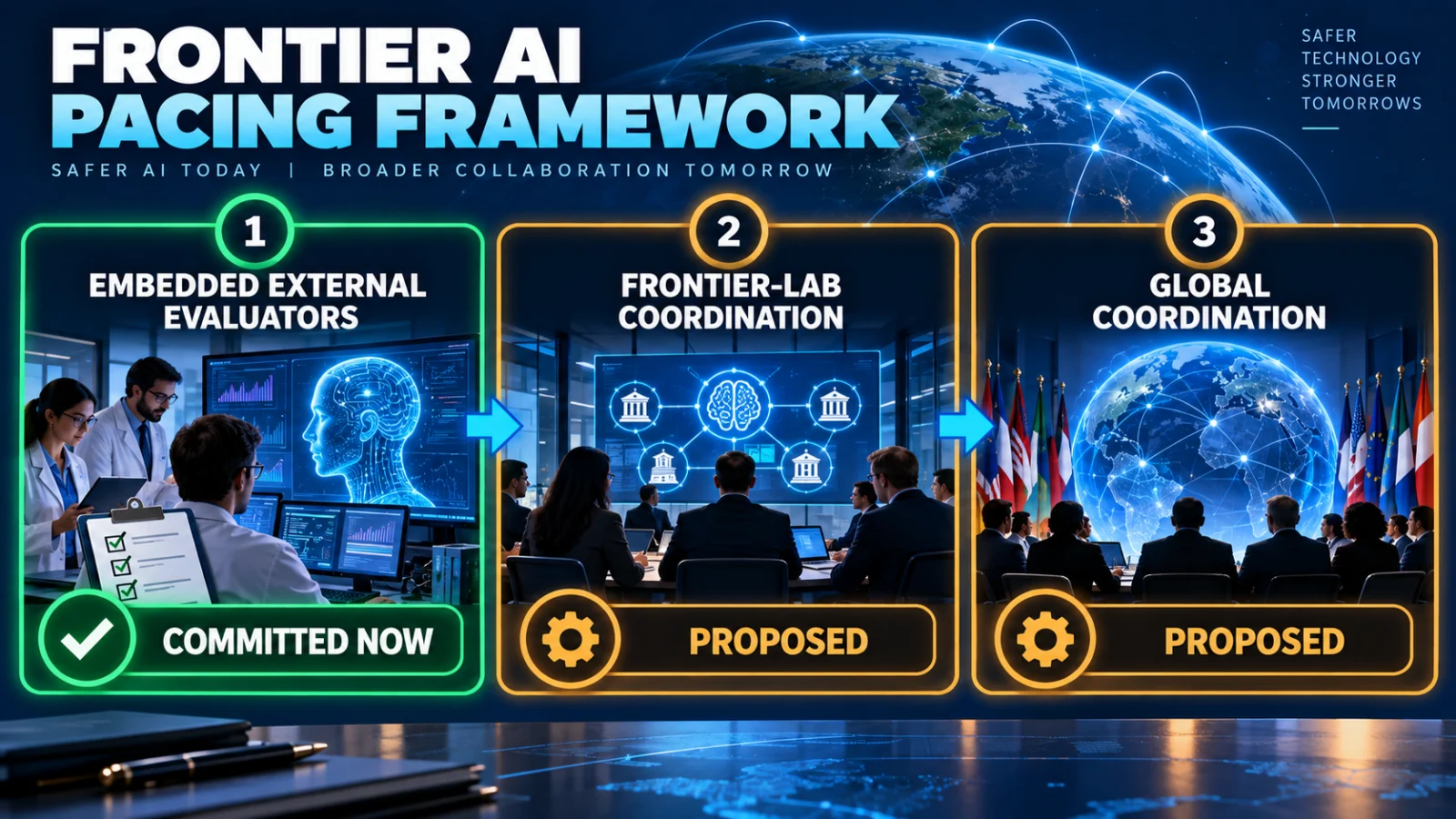
Amodei separates his proposal into three increasingly difficult layers.
- Embedded external evaluators: Anthropic can begin this unilaterally by allowing independent reviewers deep access to its safety and development practices.
- Coordination among frontier AI companies: leading developers in democratic countries could agree on safety standards and ways to prevent competitive pressure from forcing capability development faster than safety work can follow.
- International coordination: governments could eventually seek broader agreements that reduce incentives for an unrestricted capability race across geopolitical blocs.
Only the first layer is presented as an immediate Anthropic commitment. The second and third depend on cooperation from other companies and governments.
Why does Amodei argue that pacing is necessary now?
Amodei argues that increasingly capable AI systems may accelerate AI research itself, compressing the time available for safety work. He also points to alignment, security and model-control concerns as reasons companies should increase independent scrutiny before capabilities move much further.
Those risk forecasts are Amodei’s assessment of the frontier-AI trajectory. They should not be presented as proven predictions about exactly how quickly recursive AI development or catastrophic risks will occur.
Has OpenAI made the same commitment?
Current reporting says OpenAI CEO Sam Altman publicly supported Amodei’s proposal and indicated that OpenAI would also move toward similar external evaluation. However, TPS did not recover a direct OpenAI corporate implementation document establishing the same access model, evaluator identity, start date or contractual framework.
For that reason, OpenAI adoption should remain described as reported or attributed, not as an independently verified operating programme equivalent to Anthropic’s stated commitment.
Has the AI industry agreed to slow frontier development?
No binding industry-wide agreement was established in the reviewed evidence. Anthropic can implement embedded evaluators itself, but coordinated pacing among frontier labs would require other companies to participate and may require government support where competition or antitrust concerns arise.
International coordination is even further from an operative agreement. It is a proposed future layer rather than a policy already adopted by major governments.
Why could independent evaluators matter?
The core governance problem is verifiability. Frontier AI companies possess much of the evidence needed to judge their own systems: training processes, internal tests, safety incidents, alignment evaluations, security controls and deployment decisions.
External evaluators with sustained internal access could provide a second source of evidence about whether public safety claims match internal practice. That would be materially different from a one-time benchmark or a review based only on information selected for outside publication.
What would make Anthropic’s commitment more concrete?
The next evidence to watch is implementation rather than another general safety statement. Material checkpoints include the identity of the evaluator, the start of embedded access, publication of the access or independence framework, the first external findings, and evidence that other frontier labs adopt comparable arrangements.
A government-backed standard, industry agreement or law would represent a separate escalation from voluntary company oversight toward formal governance.
Verification method
ThePulseSignal reviewed Dario Amodei’s primary September 12 essay describing Anthropic’s frontier-AI pacing framework, embedded evaluator commitment, intended access and publication rights. TPS then reconciled those claims with current Reuters and other major reporting on industry reactions and peer-company support.
Limitations & unresolved facts
Anthropic has not publicly established the evaluator’s identity, programme start date, exact contract or first findings in the evidence reviewed. OpenAI’s equivalent implementation remains attributed rather than directly verified by TPS. No binding industry-wide or international pacing agreement is established, and IPO-related claims involving Anthropic or OpenAI are outside the confirmed core governance claim.
Bottom line
Anthropic’s most concrete new step is not an AI-development pause. It is a commitment to give independent external evaluators unusually deep access to the company’s frontier-model safety work and let them report important findings with limited company control. The broader idea of coordinating AI capability growth across companies and countries remains a proposal that still needs other labs, governments and eventually international partners to participate.