




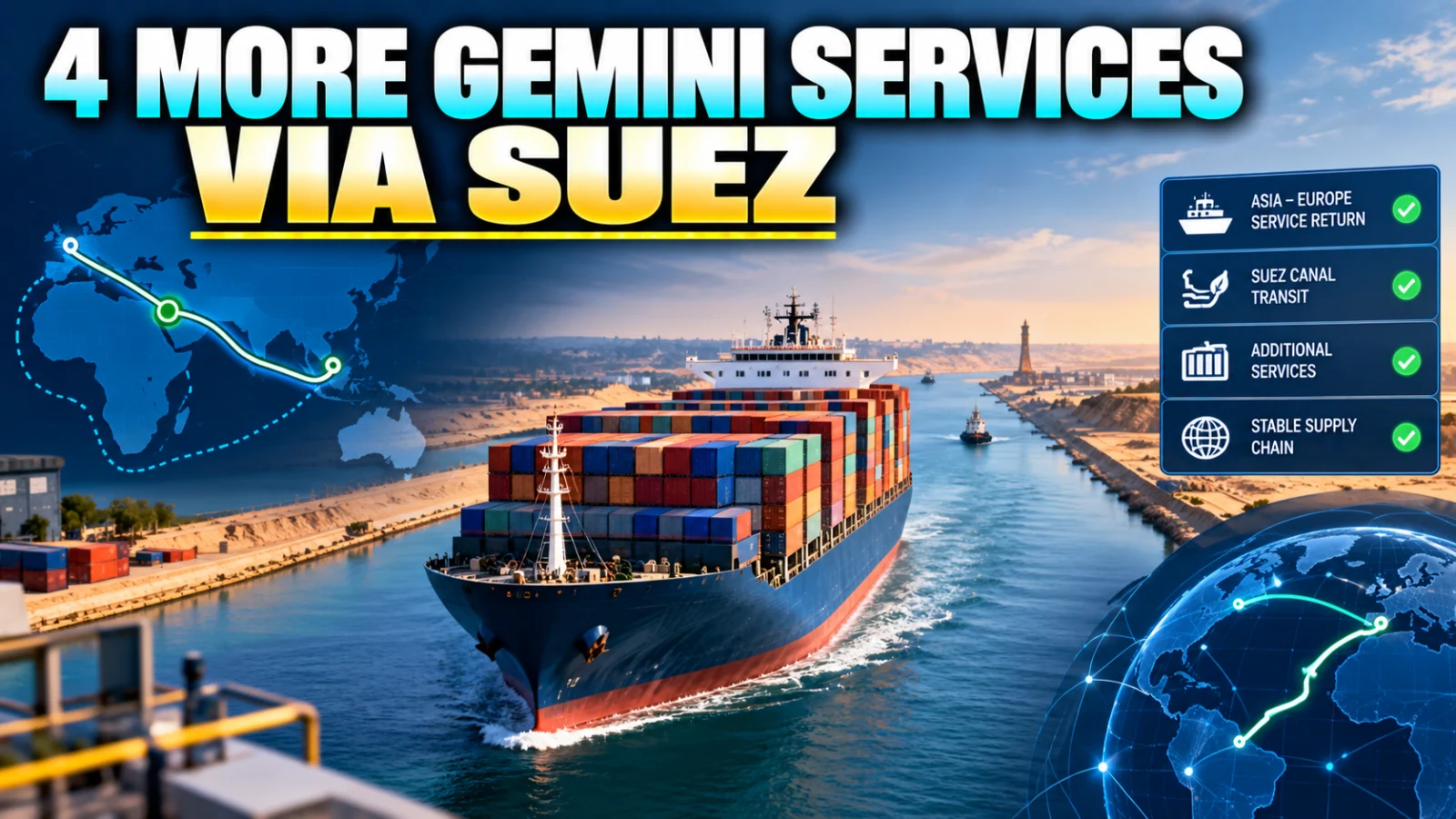
Maersk Hapag-Lloyd Suez services are expanding again, with four additional Gemini Cooperation services — AE5, AE11, AE12 and ME2 — reported to be returning to Suez Canal routing rather than continuing around the Cape of Good Hope.
The change matters for shippers using those services because Suez routing can reduce the distance travelled compared with the Cape route. But the September 14 development should not be read as proof that the entire Gemini network, the Red Sea corridor or Bab el-Mandeb has returned to normal operations.
Direct answer
Reuters reports that Maersk and Hapag-Lloyd are returning AE5, AE11, AE12 and ME2 to Suez routing as part of the Gemini Cooperation’s gradual route restoration.
This is a service-specific expansion of the carriers’ return through Suez. It does not establish that every Gemini East-West service has switched back from the Cape or that regional security risk has disappeared.
Which four Gemini services are returning through Suez?
The four additional services identified in the September 14 reporting are:
- AE5
- AE11
- AE12
- ME2
These join earlier Gemini services that Maersk had already announced for structural trans-Suez operation, including AE15 and AE19. That sequence shows a gradual service-by-service return rather than one network-wide switch.
Does this mean Maersk and Hapag-Lloyd are fully back in the Red Sea?
No. The evidence reviewed does not support describing the September 14 change as full Red Sea normalization.
Maersk’s recent carrier guidance has framed its return through Suez as targeted and gradual. Earlier service notices also state that routing remains dependent on security conditions and that individual sailings or broader service structures can move back around the Cape if conditions deteriorate.
For a shipper, the important distinction is between three different claims:
- Four more services are reported returning through Suez: supported by current September 14 reporting.
- Your exact booked sailing will use Suez: must be confirmed against the applicable service and voyage information.
- The entire Red Sea route is normalized: not established by this announcement.
What should shippers on AE5, AE11, AE12 or ME2 check?
Confirm the service code
Check whether the booking is actually assigned to AE5, AE11, AE12 or ME2 rather than another Gemini service with a different routing state.
Confirm the specific sailing
Do not assume every voyage changes immediately. Check the vessel, voyage and currently published schedule for the shipment.
Check the current route
Use the latest carrier schedule or operational information to verify whether the applicable sailing is routed through Suez or around the Cape.
Recheck the ETA
A shorter route can affect expected transit time, but the actual ETA also depends on ports, vessel rotation and operating conditions.
Watch for security-driven reversals
Carrier routing can change again if Red Sea security deteriorates or an operational restriction makes the Suez route unsuitable.
Do not infer pricing changes
A route change alone does not prove that freight rates, surcharges or other commercial charges will fall for a specific booking.
Will the Suez route make shipments arrive faster?
Potentially, but not by a fixed amount that can safely be applied to every shipment.
Routing through the Suez Canal is structurally shorter than sending an Asia-Europe or related voyage around the Cape of Good Hope. Maersk has previously cited improved transit efficiency when announcing structural trans-Suez changes.
However, the arrival impact for one container depends on the exact service, sailing, port rotation, vessel schedule, congestion and any later operational change. Shippers should therefore treat a Suez return as a route change that can improve transit efficiency, not as a guaranteed number of days saved.
When do AE5, AE11, AE12 and ME2 actually switch?
The strongest current evidence establishes the reported four-service routing change, but TPS had not recovered the direct September 14 carrier advisory containing the precise first effective sailing for each service at the time of review.
That means shippers should not treat September 14 itself as a universal first-sailing date. The controlling question for a booked shipment is whether its specific voyage falls within the carrier’s implemented trans-Suez schedule.
Could the services switch back around the Cape?
Yes. Earlier Maersk service notices explicitly preserve that possibility.
The carriers have linked structural Suez routing to their assessment of regional security and operational feasibility. If conditions deteriorate, an individual sailing or a wider service pattern can revert to the Cape route.
This is why a carrier announcement should be used together with current voyage information rather than treated as a permanent route guarantee.
What does this mean for India-linked trade?
The ME2 and wider Gemini East-West network matter to cargo moving between the Indian subcontinent, Middle East and European markets. A broader return through Suez can reduce voyage distance compared with Cape routing and may improve schedule efficiency where the trans-Suez plan is actually implemented.
That does not automatically translate into lower freight prices or identical benefits for every origin-destination pair. Commercial pricing, equipment availability, port calls and vessel schedules remain separate variables.
What has not changed?
- The announcement does not prove full Gemini network normalization.
- It does not prove that Red Sea security risk has ended.
- It does not establish that every sailing on the four services changes immediately.
- It does not guarantee an exact transit-time reduction for every shipment.
- It does not guarantee lower freight rates or surcharges.
- It does not establish that other carriers will make the same routing decision.
What should shippers watch next?
The next useful evidence is operational rather than rhetorical: direct carrier confirmation of the first affected sailings, updated schedules and rotations, implementation of those voyages through Suez, additional Gemini services returning to the corridor, or any reversal back to Cape routing.
A materially broader announcement covering the remaining East-West network would change the answer again and should be distinguished from today’s four-service expansion.
Verification method
ThePulseSignal reviewed Reuters’ September 14 report identifying AE5, AE11, AE12 and ME2, then cross-checked Maersk’s recent primary service and market updates describing earlier AE15 and AE19 trans-Suez changes, the carriers’ gradual-return approach and their security-dependent routing policy. Hapag-Lloyd operational guidance was also reviewed for the continuing need to verify current vessel and service status.
Limitations and unresolved facts
- The direct September 14 carrier notice covering all four newly reported services was not recovered during this review.
- The precise first effective sailing or voyage for each of AE5, AE11, AE12 and ME2 remains unresolved in the reviewed evidence.
- Shipment-specific ETA effects cannot be calculated reliably from the service announcement alone.
- Red Sea security and carrier operating decisions can change rapidly.
- No evidence reviewed supports treating the four-service change as full Red Sea normalization.