






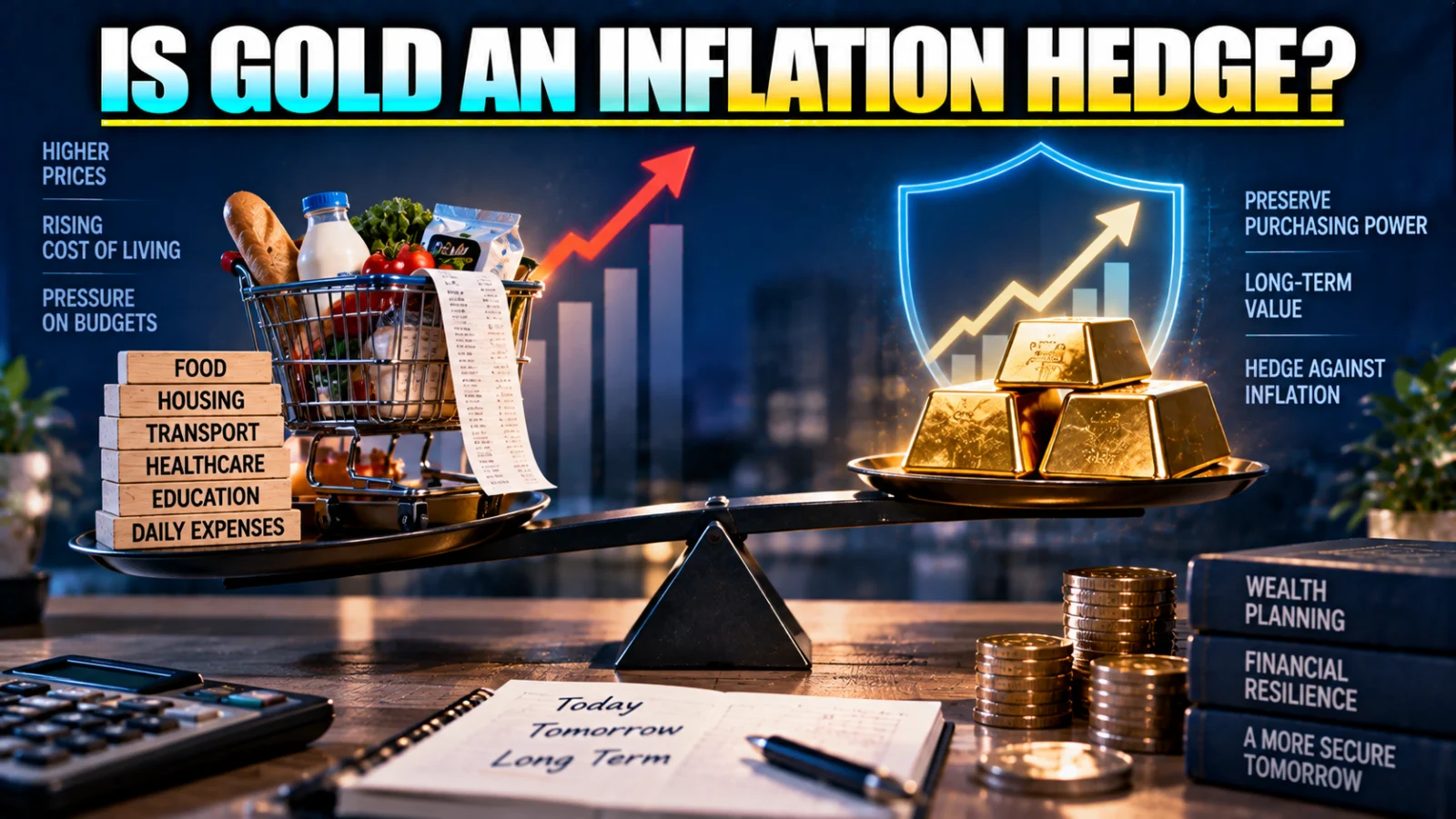
Does gold really hedge inflation? The evidence supports a qualified yes, but not the simple version of the claim often repeated by investors. Gold has historically helped preserve purchasing power over long periods and has performed strongly in some high-inflation environments. But it does not reliably rise every time consumer-price inflation increases.
That distinction defines this article. The question here is not what moves gold prices generally. TPS covers those wider forces separately. The question here is narrower: when does gold actually work as an inflation hedge, and when does that relationship break down?
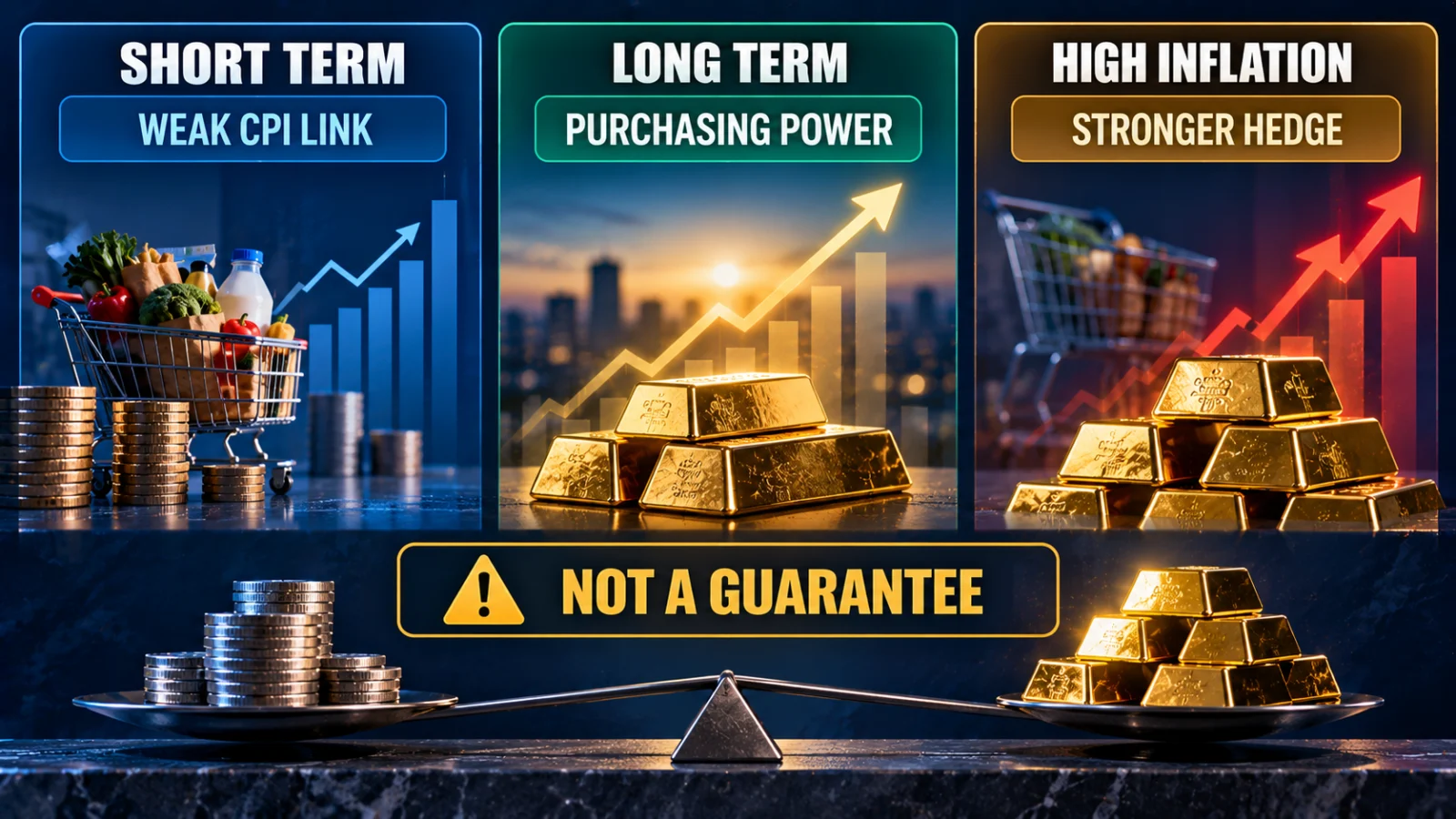
Gold does not consistently track CPI. Inflation can rise while gold falls.
Gold has a stronger record as a store of purchasing power across long periods.
Historical evidence suggests gold’s inflation sensitivity becomes more meaningful in higher-inflation regimes.
An inflation hedge is not the same thing as an asset that mirrors every inflation reading.
What does it mean for gold to hedge inflation?
An inflation hedge is an asset expected to help preserve real purchasing power when the value of money falls. That does not require the asset to move one-for-one with every monthly or annual change in the consumer-price index.
This is where much of the confusion begins. If gold were a reliable short-term inflation tracker, a higher CPI reading should consistently produce a higher gold price. Historical evidence does not support that simple rule.
Why CPI and gold do not move together consistently
World Gold Council research examining data from 1971 found that changes in US CPI inflation explained only about 16% of the variation in gold prices. The relationship was described as inconsistent and time-varying rather than stable enough to use as a mechanical short-term rule.
That finding does not prove that gold fails as an inflation hedge. Instead, it shows that the hedge needs to be judged over the appropriate horizon and against the right definition of purchasing-power loss.
When does gold appear to work better as an inflation hedge?
| Situation | What the evidence suggests |
|---|---|
| Long investment horizon | The inflation-hedge case is stronger because gold has historically preserved purchasing power across extended periods. |
| Very high inflation | Gold has historically shown stronger sensitivity when inflation is elevated rather than merely moderate. |
| Short-term CPI surprise | The relationship is weak enough that a higher inflation reading does not guarantee an immediate gold rally. |
| Broader currency or monetary erosion | Gold may respond to loss of confidence in purchasing power that is not captured fully by a single CPI measure. |
World Gold Council’s 2026 research reinforces this regime-dependent view. Its historical modelling found inflation becoming more influential in higher-inflation environments, while other financial variables continued to matter.
Why can gold fall even when inflation is rising?
Because inflation does not operate in isolation. A rise in inflation can change expectations about monetary policy, interest rates and currencies. Those responses can offset or overwhelm the direct inflation effect over shorter periods.
This article deliberately does not expand into a complete model of all forces moving gold. TPS’s existing macro hub, Why Is Gold Price Falling Despite War? 7 Forces That Actually Move Gold, owns the broader interaction between geopolitical risk, real yields, interest rates, the US dollar, ETF flows, central-bank demand and other competing macro forces.
Here, those forces matter only because they explain why the statement “inflation is up, therefore gold must go up” is unreliable.
Inflation hedge does not mean inflation tracker
This is the central distinction. An inflation tracker would be expected to move closely with inflation itself. Gold does not consistently do that.
An inflation hedge has a broader role: helping protect real purchasing power across inflationary periods. An asset can perform that role over years or decades while still falling during a particular month, quarter or even year when inflation is elevated.
What does the long-term evidence show?
World Gold Council research argues that gold’s longer-run purchasing-power relationship is more meaningful than its short-term CPI correlation. Its work also examines broader monetary measures and suggests that loss of purchasing power cannot always be captured by headline CPI alone.
This helps explain how both observations can be true at once: gold can have a weak short-term relationship with CPI while still maintaining a meaningful long-term inflation-hedging role.
Does gold hedge moderate inflation?
The case becomes less clear when inflation is moderate. Gold can perform well in moderate-inflation periods, but inflation is then only one influence among many. Historical average returns for particular inflation ranges should therefore be treated as descriptive evidence, not as a prediction.
A reader should not infer from moderate inflation alone that gold must rise. The evidence supports a conditional relationship rather than an automatic one.
Does gold hedge very high inflation?
The historical case tends to become stronger when inflation is unusually high. In those environments, concern about purchasing-power loss can become a more important driver of investor behaviour and gold demand.
Even here, however, the relationship is not guaranteed. The strength and timing of gold’s response can still depend on the surrounding financial and monetary environment.
Gold as an inflation hedge is different from gold as a safe haven
Gold can serve several overlapping roles: inflation hedge, store of value, safe-haven asset, portfolio diversifier and protection against currency weakness. These roles should not be collapsed into one claim.
An inflation-hedge question asks whether gold preserves purchasing power when the value of money erodes. A safe-haven question asks how gold behaves during financial, geopolitical or systemic stress. Those are related but distinct reader problems.
So, is gold really an inflation hedge?
Yes, but conditionally. Gold has a credible historical record of preserving purchasing power over long periods and has often been more responsive during high-inflation regimes. But its short-term relationship with CPI is too weak and variable to treat gold as a dependable inflation tracker.
The most defensible interpretation is therefore not “gold always rises with inflation” and not “gold is not an inflation hedge.” It is that gold’s inflation-hedging usefulness depends on the period being measured, the severity of inflation and the broader purchasing-power environment.
Bottom line
Gold can hedge inflation, but the protection is more credible as a long-horizon purchasing-power relationship than as a short-term reaction to each CPI release. Inflation alone is not enough to predict what gold will do next.
Readers trying to explain a current gold-price move should use the broader TPS gold macro hub. Readers trying to determine whether the inflation-hedge claim itself is true should use this canonical.
Verification note
TPS reviewed World Gold Council research on gold’s relationship with CPI, purchasing power and different inflation regimes, including its dedicated inflation-hedge research and updated 2026 analysis. Historical correlations and average returns describe past relationships and should not be interpreted as forecasts of future gold performance.