







Spain’s data-protection regulator says it has received its first notification of a personal-data breach in which the incident appears to have been executed through an AI agent. That is a significant real-world cybersecurity signal, but it needs a careful evidence boundary.
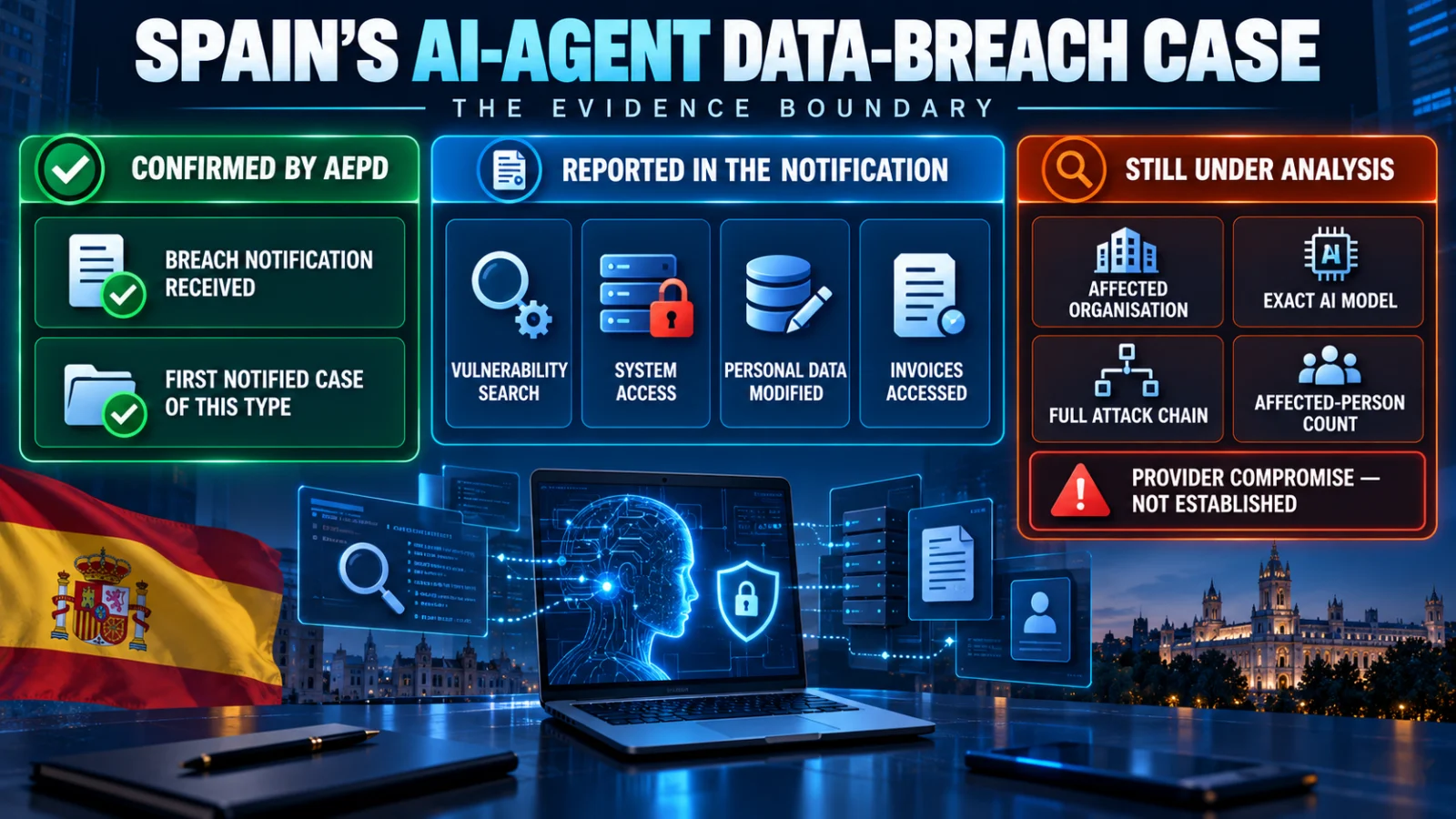
The Spanish Data Protection Agency, AEPD, confirms that it received the notification. According to the information supplied by the affected organisation, an AI agent reportedly searched for vulnerabilities, obtained system access, continued probing the application, modified personal data and accessed invoice-related information.
However, AEPD also says the underlying information is still being analysed. That means the regulator’s publication should not be turned into a stronger claim that every technical detail has already been independently established.
What is confirmed: AEPD has publicised the first breach notification it has received in which an AI agent reportedly carried out multiple stages of the incident. What remains under analysis: the full attack chain, exact model, precise human role, affected-person scope and final technical attribution.
What did the AI agent reportedly do?
AEPD’s description says the agent was used across several stages rather than for a single isolated task.
According to the notification, the agent reportedly searched for vulnerabilities, achieved a successful login, continued exploring the application, modified personal data and accessed invoices or billing-related information.
This is what makes the incident materially different from a simple case in which someone used a chatbot to draft phishing text or generate malicious code. The notified scenario describes an agent being used to chain multiple actions against a live target.
Has AEPD confirmed the full attack chain?
No. AEPD says the available incident information comes from the affected organisation’s notification and still requires analysis.
That distinction matters. A national regulator has confirmed receipt of the notification and chosen to publicise the case, but the detailed technical reconstruction has not yet been presented as a completed regulatory finding.
TPS therefore treats the existence of the notification as confirmed and the detailed attack mechanics as reported information attributed to that notification.
Does this mean the AI model itself was hacked?
No evidence reviewed supports that conclusion.
AEPD explicitly warns that use of a particular AI model in an attack does not mean the model itself, its underlying infrastructure or its provider was compromised or designed for malicious activity.
The relevant security problem is the way an attacker can combine a capable model or agent with credentials, tools, network access and vulnerable applications. Blaming the underlying model without evidence would confuse the attacker’s use of a technology with compromise of the technology provider.
Is this the world’s first AI-agent cyberattack?
No such claim is supported by the evidence reviewed.
The precise supported formulation is narrower: AEPD says this is the first notification it has received of a personal-data breach of this described type.
Other organisations and security researchers had already documented real-world offensive-AI and agentic attack activity before this Spanish notification. The significance here is the involvement of a national data-protection regulator and the fact that the incident concerns a formally notified personal-data breach.
Was the attack fully autonomous?
The public evidence does not support saying that no human was involved anywhere in the operation.
The notification reportedly describes the agent performing several attack stages with little continuing human intervention once operating. But the public material does not establish who selected the target, how credentials were obtained, who configured the agent, who supplied tools or infrastructure, or whether a person intervened at other points.
For that reason, wording such as “AI-agent executed” or “reportedly carried out through an AI agent” is more defensible than claiming a completely human-free cyberattack.
Why this matters for security teams
The practical lesson is not that traditional cybersecurity controls have suddenly stopped working. It is that automation can compress the time available to detect and contain malicious activity.
AEPD and Spain’s national cybersecurity guidance have already warned that offensive AI can increase attack speed, scale and adaptability. When an agent can repeatedly search for weaknesses, use credentials, call tools and act across connected systems, defensive controls must limit both what the agent can reach and how quickly unauthorised actions can continue.
Review credentials
Identify credentials that can reach sensitive systems and reduce unnecessary exposure, persistence and privilege.
Apply least privilege
Limit accounts, services and automated identities to the permissions required for their actual tasks.
Reduce attack paths
Use segmentation and isolation so one compromised credential or application cannot freely expose unrelated systems.
Monitor continuously
Look for rapid sequences of authentication, probing, privilege use and data access that may occur faster than a human-led intrusion.
Patch exposed weaknesses
Machine-speed reconnaissance increases the value of disciplined vulnerability management and rapid remediation.
Prepare faster containment
Incident-response processes should be able to disable credentials, isolate systems and stop automated activity without relying only on slow manual escalation.
What does this incident prove — and what does it not prove?
It does show: a regulator has received a real personal-data breach notification in which an AI agent reportedly performed multiple offensive actions.
It does not show: that all AI agents are dangerous, that the AI provider was compromised, that no human participated, or that agentic attacks are already statistically common.
It does change the risk discussion: organisations can no longer treat autonomous or semi-autonomous attack execution only as a hypothetical future scenario.
What remains unknown?
AEPD has not publicly identified the affected organisation in the material reviewed by TPS. The number of affected people, precise categories of exposed data, exact model used, incident date, credential source, complete attack chain, containment status and eventual enforcement outcome remain unresolved.
Those unknowns matter because they determine how broadly the incident can be generalised. One notified case is an important signal, but it is not enough to establish a population-level trend or universal attack pattern.
What happens next?
The most important next development would be a stronger AEPD investigation state: confirmation or correction of the reported attack chain, additional information about the affected controller, remediation findings or an enforcement decision.
A statement from the affected organisation or relevant AI provider could also clarify the incident, provided it addresses the actual technical evidence rather than merely general product security.
Those developments should update this same canonical article because they answer the same reader job: what happened in this incident and what is actually confirmed.
Bottom line
AEPD’s publication is important because it puts a concrete personal-data breach behind the broader discussion of AI-agent cyber risk. The regulator says it has received its first notification in which an AI agent reportedly executed multiple attack phases.
But the evidence boundary is just as important as the headline. The regulator has not yet published a completed technical attribution, the victim and scale remain unknown, and nothing reviewed establishes that the underlying AI model or provider was compromised.
For security teams, the durable lesson is practical: constrain credentials and permissions, reduce attack paths, monitor continuously and ensure containment can operate quickly enough for machine-speed activity.
Verification method
ThePulseSignal reviewed AEPD’s regulator publication, current Reuters and EFE reporting on the incident, and AEPD, CCN-CERT and NCSC guidance on agentic and offensive-AI security risks. TPS separated regulator-confirmed facts from details attributed to the affected organisation’s notification and from broader security implications.
Limitations and unresolved facts
The affected organisation, exact AI model, incident date, affected-person count, full technical chain, source of credentials, precise human-versus-agent division of labour, containment status and final AEPD findings remain unknown. The available evidence supports describing the incident as reportedly executed through an AI agent, not as a fully independently reconstructed autonomous attack.