







India New Zealand FTA passed parliament is now a confirmed legislative state, but it does not mean the new tariff preferences are already active. New Zealand Parliament completed the implementing bill’s third reading on September 15, 2026. The agreement still has to complete the remaining legal and bilateral implementation steps before businesses can rely on the new preferential tariff treatment.
Direct answer: New Zealand Parliament has passed the legislation needed to implement the India-New Zealand FTA, but the agreement is not yet confirmed in force. Parliament’s passage is a major implementation milestone, not the same thing as tariff commencement.
What changed in New Zealand?
New Zealand Parliament’s legislative history records the India Free Trade Agreement Legislation Amendment Bill as having completed its second reading, Committee stage and third reading on September 15. The New Zealand Government subsequently announced that the bill passed by 93 votes to 29.
The important distinction is that parliamentary passage removes one major domestic legislative hurdle. It does not by itself activate the agreement’s tariff schedule.
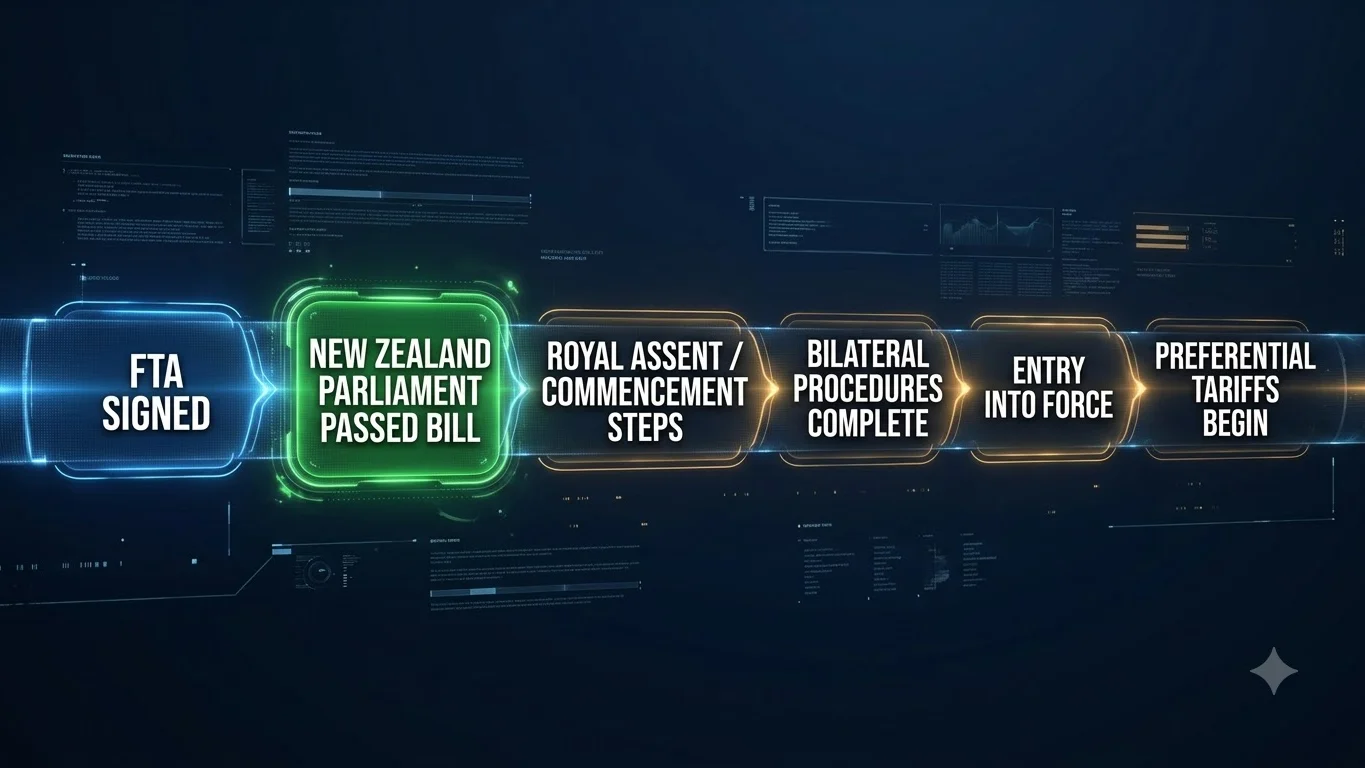
Is the India-New Zealand FTA in force now?
No. New Zealand’s Ministry of Foreign Affairs and Trade continues to classify the agreement among FTAs that have been concluded but are not yet in force. New Zealand Parliament’s bill history also did not show Royal Assent as completed at the time of TPS’s final source check.
The implementing legislation provides for commencement on a date set through the required legal process. Businesses should therefore separate three different statements: the FTA has been signed, Parliament has passed the implementing legislation, and the FTA has legally entered into force. Only the last state activates the preferential treatment provided by the agreement.
What still has to happen before tariffs change?
Royal Assent and the applicable commencement process still have to be completed before the implementing legislation becomes operative.
India and New Zealand must complete the procedures required for the agreement to enter into force. Parliamentary passage in one country is not the final bilateral commencement event.
Businesses should rely on the controlling government commencement notice rather than a projected or reported date.
Importers and exporters should continue using the currently applicable customs treatment until the agreement’s preferential rates are officially in force.
What happens to Indian exports when the FTA starts?
India’s official trade material states that New Zealand will provide zero-duty market access across its tariff lines for Indian exports from entry into force. That benefit should be described as a future FTA entitlement until the agreement becomes operative.
Actual use of a preferential tariff can also depend on product classification, rules of origin, documentation and other agreement requirements. Parliament passing the legislation does not remove those product-level compliance obligations.
What happens to New Zealand exports to India?
New Zealand’s official FTA material says that about 57% of its current exports to India are intended to become duty-free from the agreement’s first day, while tariffs are eliminated or significantly reduced on about 95% of current New Zealand exports as the agreement is implemented.
That statement should not be rewritten as “95% of Indian tariff lines become duty-free.” India’s own official material describes its offer differently: tariff liberalisation covers 70.03% of tariff lines and about 95% of bilateral trade value, while sensitive products remain excluded or protected.
Are all New Zealand products becoming duty-free?
No. India’s commitments contain sensitive-product exclusions and staged treatment for different goods. The FTA therefore should not be reduced to a claim that all New Zealand exports will enter India duty-free.
The product-level answer will depend on the tariff schedule and the applicable rules of origin once the agreement is in force.
Is October 19 the confirmed effective date?
Current reporting has cited October 19 or the second half of October as a possible implementation period. TPS did not identify a controlling bilateral commencement notice that establishes October 19 as the final legal entry-into-force date during the completed research.
That date should therefore remain reported or expected, not presented as a confirmed operative date. The controlling answer should change only when India and New Zealand formally confirm completion of the required procedures and the commencement date.
What should exporters and importers do now?
Businesses can prepare for implementation by identifying affected products, checking the agreement’s tariff schedule, understanding rules-of-origin requirements and reviewing contracts that may depend on preferential duty treatment.
They should not, however, price a shipment or make a customs declaration on the assumption that the new FTA rates are already available merely because the New Zealand Parliament has passed the legislation.
What happens next?
The next material milestones are completion of New Zealand’s remaining enactment process, completion of the required bilateral or domestic procedures, and an official entry-into-force or commencement confirmation. Those later states belong on this same TPS URL because they answer the same reader question: when can businesses actually start using the India-New Zealand FTA?
Verification note
ThePulseSignal reviewed New Zealand Parliament’s bill history, the New Zealand Government passage announcement, New Zealand MFAT’s current not-in-force classification and key FTA outcomes, the implementing legislation, and Indian government trade material describing India’s tariff commitments.
Limitations and unresolved facts
The exact final entry-into-force date was not confirmed by a controlling bilateral commencement source during the completed research. Royal Assent was also not shown as completed on the reviewed parliamentary history. Product-specific tariff treatment and eligibility can depend on tariff classification, rules of origin, documentation and staged implementation provisions that are outside this status article’s scope.