






Exxon Joliet refinery restart has not been confirmed. In the latest confirmed operational update, the Joliet, Illinois refinery remained offline on September 17 after the September 13 power outage. ExxonMobil said electrical power had been fully restored, but the refinery had not yet returned to normal operation.
Is the ExxonMobil Joliet refinery running again?
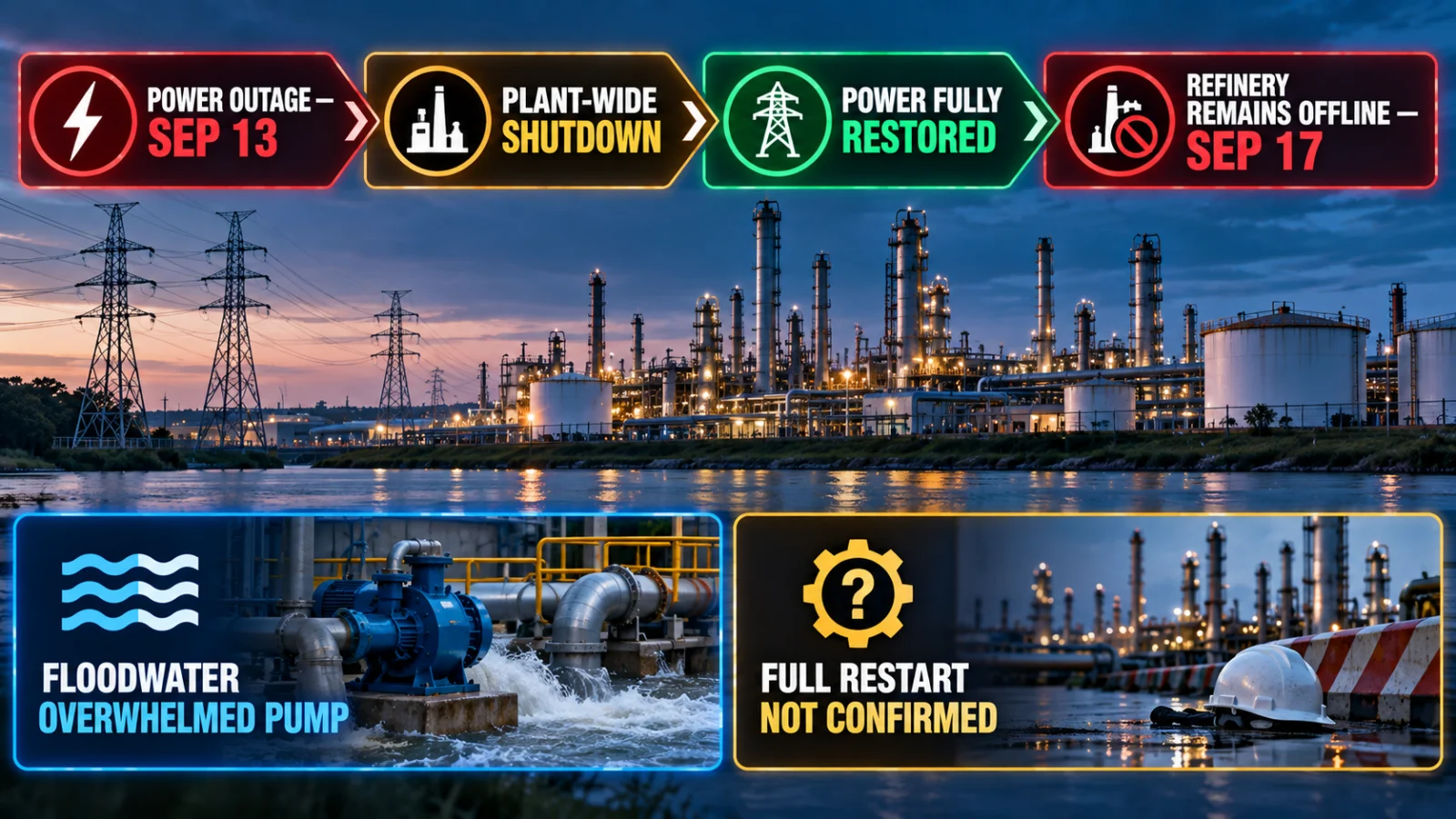
Not in the latest confirmed evidence. Reuters reported on September 17 that the refinery remained offline. ExxonMobil said power to the facility had been fully restored after the original outage, but restoration of electricity had not yet progressed to a publicly confirmed refinery restart.
What is the latest Joliet refinery status?
The current supported sequence is:
- A power outage on September 13 triggered the refinery’s safety systems and caused a plant-wide shutdown.
- ExxonMobil later said the source of the electrical outage was on ComEd primary and secondary power lines feeding the refinery.
- Electrical power to the refinery was fully restored.
- The refinery nevertheless remained offline as of September 17.
- ExxonMobil also disclosed that floodwater had overwhelmed a pump at the refinery.
- A containment boom was deployed as part of the cleanup response.
- A full restart and return to normal refinery operations had still not been publicly confirmed.
What happened with the floodwater and pump?
Reuters reported that ExxonMobil disclosed in a filing that floodwater overwhelmed a pump at the Joliet refinery. A containment boom was deployed as part of the cleanup effort.
ExxonMobil declined to say whether the pump issue was connected to the earlier power outage. The evidence therefore supports treating the floodwater and pump problem as a new operational complication without claiming that it caused the original outage or that it is solely responsible for the continuing refinery shutdown.
Has electrical power been restored?
Yes. ExxonMobil said power to the Joliet refinery had been fully restored.
That does not mean refinery production automatically resumed. A refinery can have electrical service available while process units remain shut, undergo inspections, restart sequentially or require additional operational work before normal throughput returns.
Why is power restoration different from refinery restart?
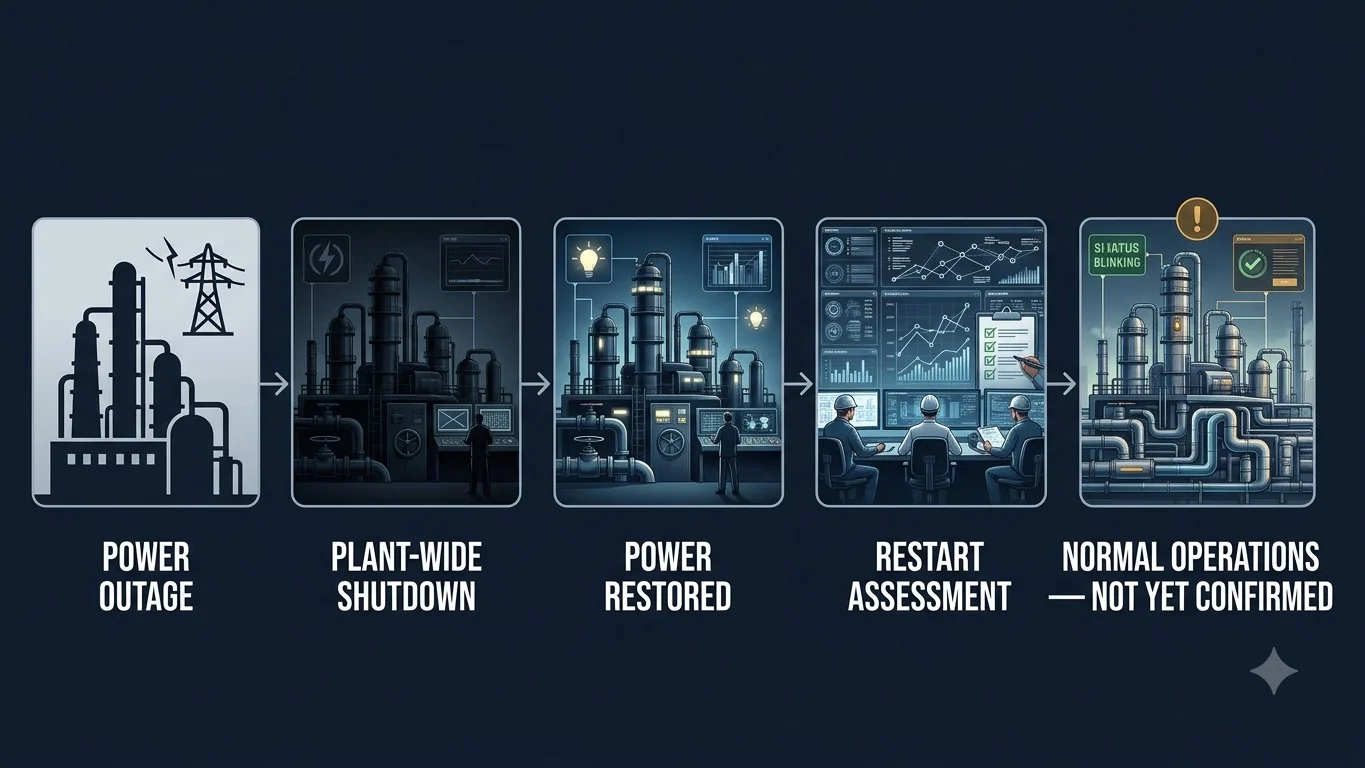
Electrical power is one prerequisite for normal refinery operations, but a plant-wide shutdown can require inspections, equipment checks, controlled unit start-ups and stabilisation before crude-processing and product-making units return to service.
For that reason, the strongest current operational fact is that power was restored while the refinery remained offline in the latest confirmed update.
Was the refinery expected to restart this week?
Industry monitor IIR Energy had expected the Joliet refinery to return to normal service by the end of the week. That expectation has not yet become a confirmed operating state in the evidence reviewed.
The latest Reuters report instead said the refinery was still offline on September 17. A forecast or expected restart window should not be treated as proof that processing units and normal fuel production have resumed.
Did the refinery flare again?
Reuters reported that the refinery flared again on September 16, citing Patrick De Haan of GasBuddy. Flaring can occur during abnormal operations, shutdowns or restart activity, but that observation alone does not establish that the refinery restarted or returned to normal production.
Why does the Joliet refinery matter?
ExxonMobil’s Joliet refinery is a major fuel supplier to the U.S. Midwest. Company information says the site can produce roughly 11 million gallons of gasoline and diesel per day.
A prolonged outage at a refinery of this scale can reduce available regional refining capacity. The significance of that loss depends on outage duration, inventories, production at other refineries, pipeline and terminal flows, imports and wider market conditions.
Does the outage explain higher Midwest fuel prices?
The Joliet outage is occurring during an already tight fuel-market environment, but the evidence reviewed does not support assigning a specific retail gasoline or diesel price increase solely to this refinery shutdown.
Fuel prices can also reflect crude prices, outages at other refineries, inventory levels, international supply disruptions, product exports, seasonal demand and distribution constraints.
The supported conclusion is narrower: keeping a major Midwest refinery offline removes refining capacity from an already tight market and can add supply pressure if the disruption persists.
What would confirm a real refinery restart?
The clearest confirmation would be ExxonMobil or other high-confidence operational evidence establishing that refinery units have restarted and normal or near-normal processing has resumed.
Useful confirmation could include a company operating-status statement or credible operational reporting that major processing units and normal throughput are back in service.
Power restoration, cleanup activity, flaring or an expected restart date do not independently prove that normal operations have resumed.
What remains unknown?
- The exact date and time when the refinery will restart.
- Whether all major process units are mechanically ready to resume service.
- Whether the floodwater-overwhelmed pump issue has materially extended the shutdown.
- Whether crude throughput has resumed at any meaningful rate.
- Whether gasoline and diesel production has resumed.
- When normal or near-normal output will be restored.
- Whether the outage has created a measurable regional fuel-supply deficit.
- How much, if any, specific retail fuel-price movement can be attributed to the Joliet shutdown.
What should readers watch next?
The next decisive state change is credible confirmation that the refinery has restarted, that normal or near-normal service has resumed, or that operational problems will keep the refinery offline materially longer.
The most useful evidence will be a current ExxonMobil operational statement or other high-confidence reporting establishing actual unit and throughput status.
Verification note
ThePulseSignal reviewed Reuters reporting from September 14 and September 17, ExxonMobil’s current Joliet facility information and independent local shutdown reporting. The September 17 evidence confirms that power was fully restored but the refinery remained offline, while a separate floodwater-related pump problem and cleanup response had also been disclosed.
Limitations and unresolved facts
No current ExxonMobil public operational notice was identified confirming full refinery restart, normal unit rates or restored normal fuel production. Public facility information describes the site’s normal capability but is not a live operations dashboard. The floodwater-related pump issue is confirmed through Exxon-attributed reporting, but ExxonMobil did not establish that it caused the original outage or specify how much it has affected the restart timeline.
Bottom line
The latest supported answer on the Exxon Joliet refinery restart is that the refinery remained offline in the latest confirmed September 17 state. Electrical power has been fully restored, but normal refinery operation has not been confirmed, and floodwater overwhelming a pump has added another operational complication while the site remains out of service.