






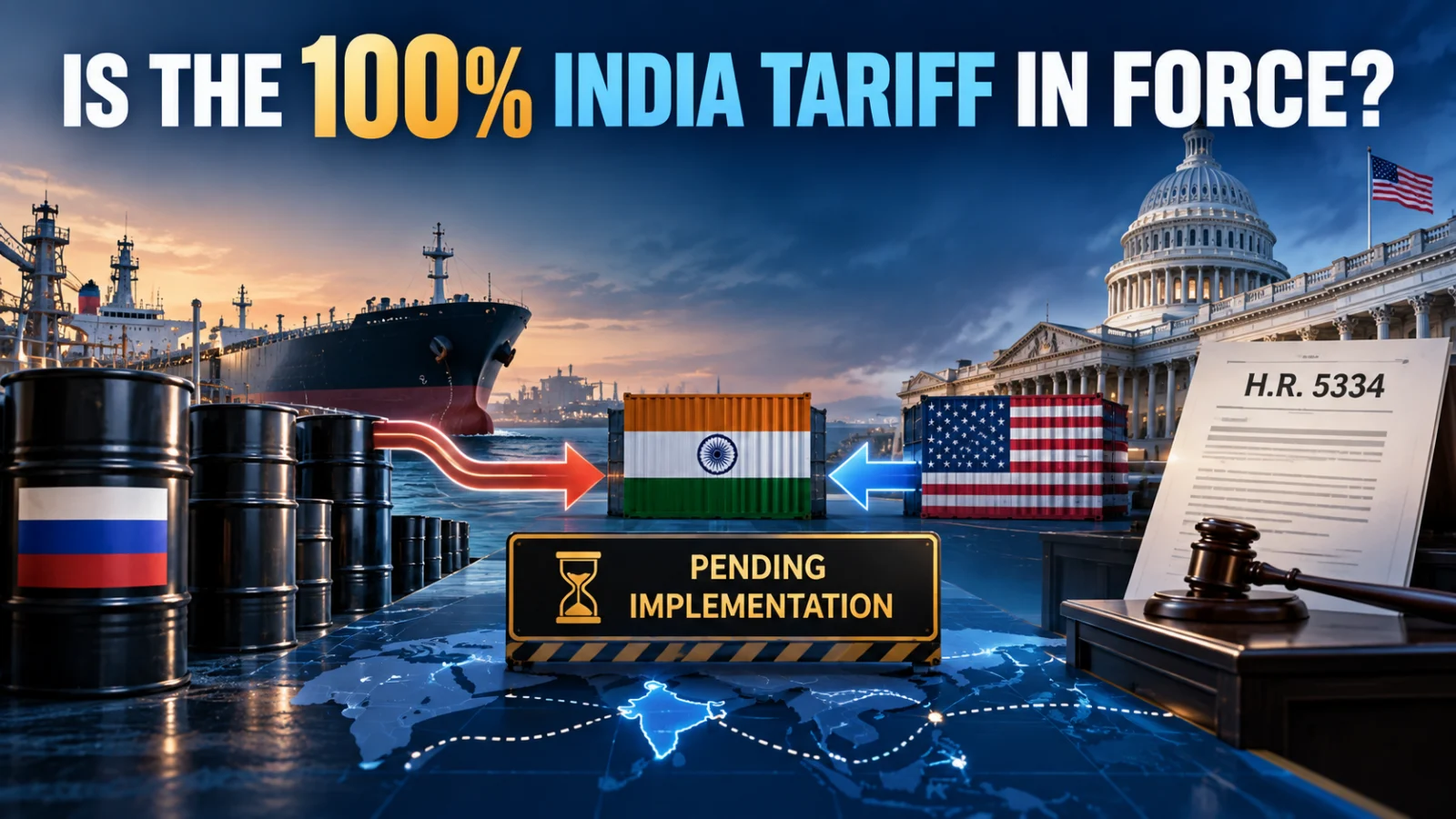
The US Russia sanctions bill India tariff story has moved to a new stage, but the most important distinction is what has not happened yet. The US Congress has completed passage of H.R. 5334, the Lindsey O. Graham Sanctioning Russia and Iran Act of 2026. The legislation contains a mechanism that can lead to additional US tariffs of up to 100% on qualifying countries that continue specified purchases of Russian-origin crude oil or natural gas. That does not mean a new 100% tariff on India is already in force.
Direct answer: Congress has passed the legislation, but ThePulseSignal has not verified presidential enactment or an operative new 100% tariff against India. The 100% figure is the upper end of the legislation’s tariff mechanism, not evidence that India currently faces that rate.
What changed in Washington
On September 16, 2026, the US House of Representatives agreed to the Senate amendments to H.R. 5334 by a 262-159 vote. That completed congressional action on the version reviewed for this article.
The change matters because earlier coverage could accurately describe the legislation as still moving through Congress. That answer is now stale. The immediate question is no longer whether Congress will clear the measure, but what happens between congressional passage and any actual India-specific tariff.
What the bill says about Russian energy buyers
Section 113 addresses countries that purchase Russian-origin crude oil or natural gas. The reviewed Senate-amended text establishes a tariff mechanism covering goods imported from a country that meets specified conditions. The statutory framework uses a rate above zero and up to 100% ad valorem rather than establishing a universal 100% rate for every country from the moment Congress acts.
The country test also matters. Under the reviewed text, the relevant country must knowingly make new purchases of Russian-origin crude oil or natural gas on or after 30 days following enactment and must have been among the five largest importers by volume during the relevant preceding 12-month period. The legislation also contains implementation, modification, exception and waiver provisions that can affect how the mechanism operates.
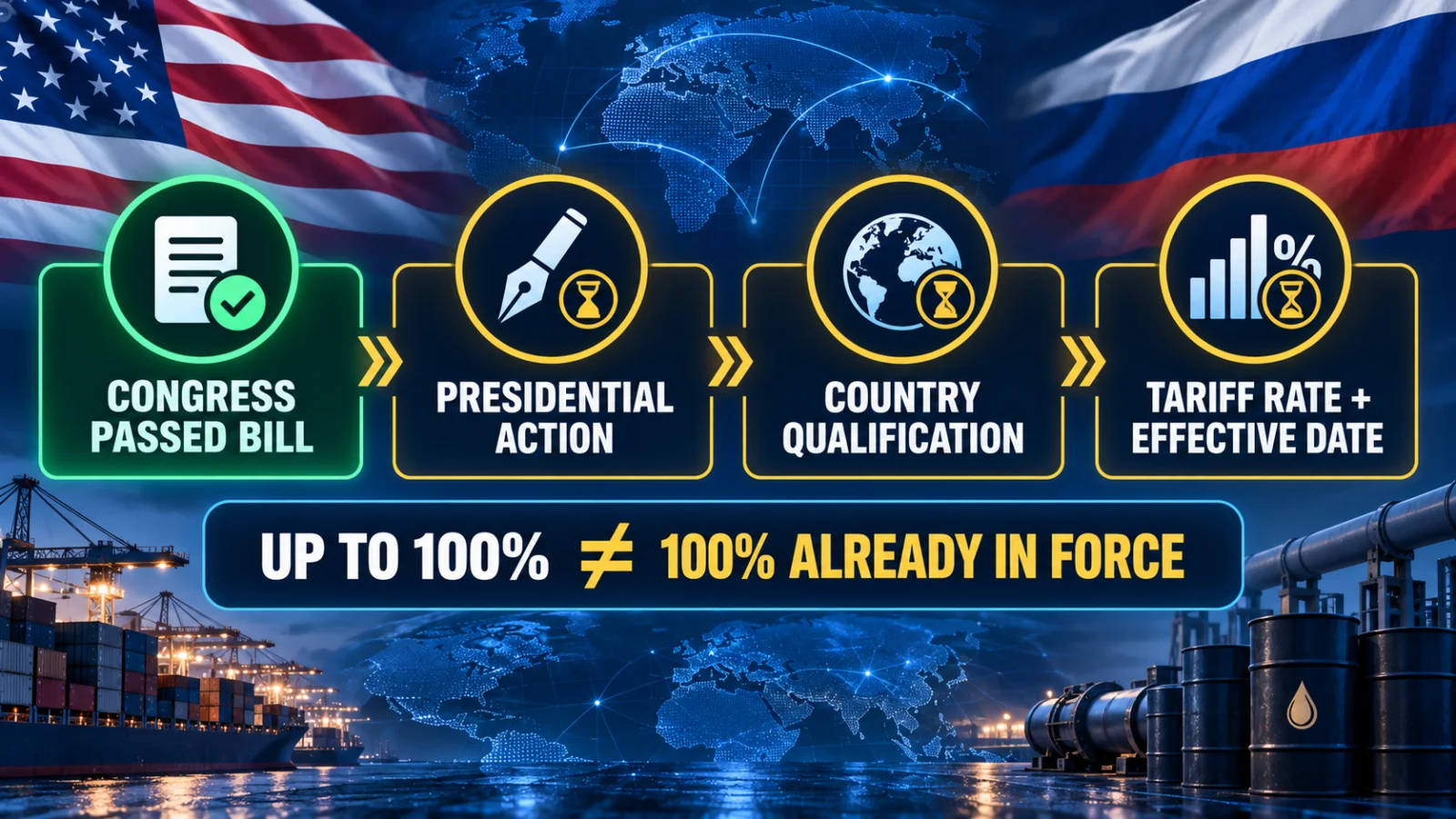
Those conditions are why three separate statements should not be treated as interchangeable: Congress passed tariff legislation; a country qualifies under that legislation; and a particular tariff rate has actually become operative against that country’s goods.
Is a 100% US tariff on India in force?
Not on the evidence reviewed for this article. ThePulseSignal has verified final congressional passage, but has not verified that H.R. 5334 has been signed into law or that an India-specific tariff determination under Section 113 has taken effect.
The White House had previously supported the Senate amendment and said presidential advisers would recommend that the President sign it. That administration position is significant, but it is not itself enactment. A statement supporting legislation and a signed law are different legal states.
The 100% number also should not be read as an automatic India tariff. Even after enactment, the legislation’s country conditions and implementation process determine whether the mechanism applies and at what rate within the statutory range.
What India has said
India’s Ministry of External Affairs has said, through government reporting reviewed by TPS, that India remains committed to ensuring energy security through diversified sourcing and changing market conditions. The ministry said the issue had been discussed with US interlocutors and that India had communicated potential implications for the bilateral relationship and the international energy market.
The ministry also said India would take necessary measures to protect its trade and economic interests and would work with Indian trade and industry bodies as developments unfold.
Those comments establish India’s current policy response. They do not establish what tariff the United States will ultimately apply, whether India will satisfy the legislation’s qualifying-country test after enactment, or what specific countermeasures or negotiated arrangements India might pursue.
What has happened and what is still pending
The US Senate approved the amended legislation and the House concurred in the Senate amendments on September 16.
The reviewed text contains a tariff mechanism of more than zero and up to 100% for countries meeting the Russian-energy purchase conditions.
India has publicly emphasized energy security, diversified sourcing and protection of its trade and economic interests.
TPS has not verified presidential enactment, an India qualification determination, an India-specific rate or an effective date for a new tariff under this legislation.
Why the 30-day condition matters
The legislation does not simply look backward at existing Russian oil purchases and immediately attach a 100% tariff. The reviewed Section 113 language refers to new Russian-origin oil or gas purchases made on or after 30 days following enactment, alongside the separate top-five importer condition.
That means the eventual commercial position depends on future facts as well as the bill becoming law. Readers should therefore be cautious with headlines that collapse congressional passage, future qualification and tariff implementation into a single event.
What businesses should watch next
The first major checkpoint is presidential action on H.R. 5334. If the bill becomes law, the next relevant evidence will be the official enactment text, the resulting statutory timetable and any US government determinations or implementation notices identifying affected countries and rates.
For Indian exporters, refiners and other businesses with exposure to US trade or Russian energy flows, commercial planning should be based on those operative measures rather than the maximum tariff number alone. There is currently no evidence-backed basis in this research package to assume that every Indian product will face a new 100% duty.
What would change this answer
This article should be updated on the same canonical URL if the President signs or otherwise disposes of the bill, if the legislation receives a public-law designation, if the United States identifies India under the Russian-energy provisions, if an actual tariff rate or effective date is announced, or if India issues a material new response.
Until one of those states is verified, the precise answer remains: Congress has created a substantially more advanced tariff risk for major Russian-energy buyers, but congressional passage alone is not the same thing as a new 100% US tariff already operating against India.