






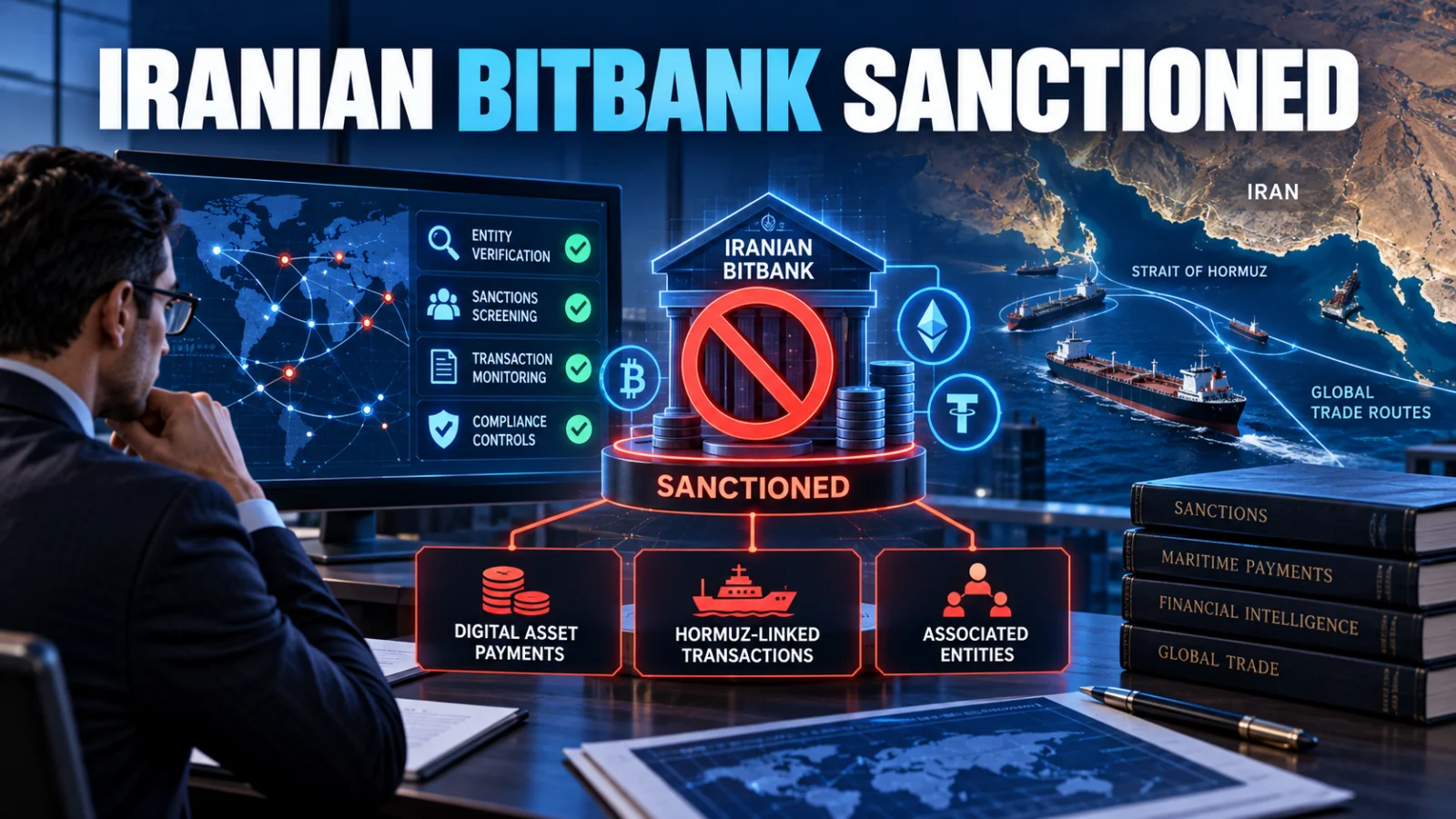
The BitBank sanctions announced by the U.S. Treasury on September 17, 2026 apply to an Iranian digital-asset exchange called BitBank, not to Japan’s unrelated bitbank service. OFAC designated the Iranian BitBank, its software developer Pishtaz Simorgh Electronic Trade Company and three associates of Iranian businessman Babak Zanjani as part of a wider sanctions action involving digital assets and payments linked by Treasury to the Strait of Hormuz.
The designation itself is confirmed by Treasury and OFAC. Claims about how BitBank was used, including alleged Bitcoin transfers to the Islamic Revolutionary Guard Corps and payments connected to Hormuz Safe, come from Treasury and should be understood as the U.S. government’s stated findings and allegations rather than independent findings by ThePulseSignal.
The sanctioned BitBank is not Japan’s bitbank
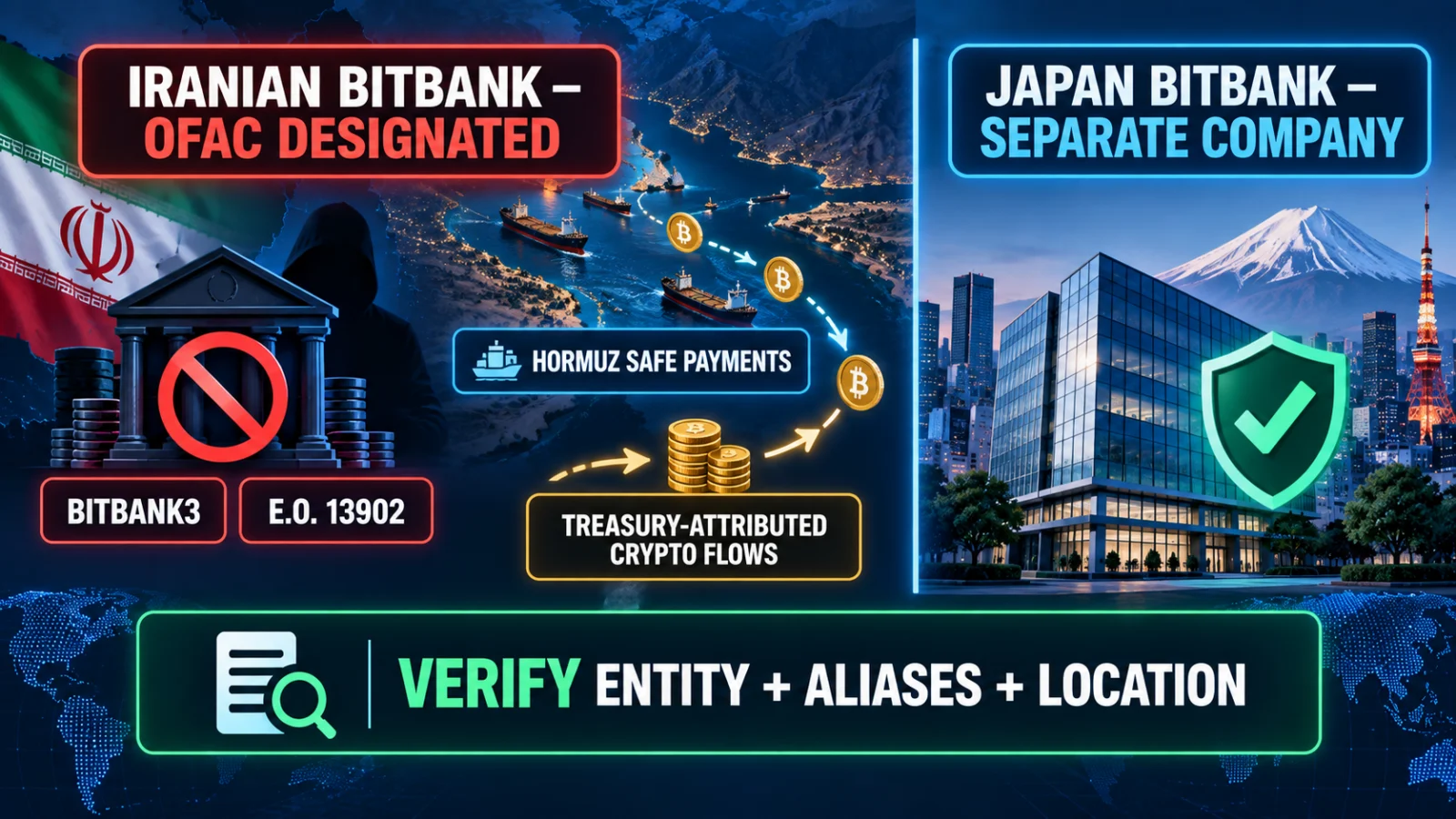
This distinction is critical. The Iranian entity listed by OFAC appears as BITBANK and BITBANK3 and is identified with Tehran details in the U.S. sanctions record. Japan’s bitbank company issued its own clarification on September 18 stating that the sanctioned Iranian BitBank is a different corporation and service with no capital or business relationship to the Japanese exchange.
Readers should therefore not assume that a headline saying “BitBank sanctioned” refers to Japan’s bitbank.cc service. Entity name, aliases, location and the exact OFAC record matter.
What OFAC designated on September 17
The Treasury action designated the Iranian BitBank, Pishtaz Simorgh Electronic Trade Company and three people described by Treasury as associates of Babak Zanjani: Hossein Ali Zaker Hossein, Mohammad Mahdi Zaker Hossein and Seyed Adel Heidari.
OFAC’s sanctions-list update records BitBank and Pishtaz Simorgh under the Iran sanctions program and E.O. 13902. The BitBank entry is also marked as subject to secondary sanctions.
That designation creates immediate compliance significance for parties screening transactions and counterparties, but it does not mean every person outside the United States faces the same legal consequence in every circumstance. Transaction-specific questions depend on the applicable sanctions rules, nexus, ownership structure and jurisdiction.
Why Treasury says BitBank was targeted
Treasury describes BitBank as part of a digital-asset infrastructure associated with Babak Zanjani and used to evade sanctions. Treasury says Zanjani used BitBank between June and July 2026 to move hundreds of millions of dollars in Bitcoin to the IRGC.
TPS is preserving the attribution here deliberately: the sanctions designation is a confirmed official action, while the specific transaction descriptions and allegations about their purpose come from Treasury’s own account.
How Hormuz Safe fits into the action
The September 17 release creates a direct connection between the sanctions action and payments associated with the Strait of Hormuz. Treasury says Hormuz Safe has used BitBank since June to transfer payments it received to the Iranian government.
That does not mean the BitBank designation itself changes physical navigation rules or vessel-transit requirements in the Strait. It is primarily a financial and sanctions-compliance development. The maritime significance comes from Treasury’s description of BitBank as infrastructure used to move payments connected to Hormuz Safe.
What the BitBank sanctions mean in practice
For sanctions-screening purposes, the first task is entity identification. A counterparty described only as “BitBank” should not be matched solely on the shared name. The OFAC-listed Iranian entity should be verified using the sanctions-list record, aliases, location details and other identifiers.
For businesses with a U.S. sanctions nexus, dealing with an SDN can create blocking and reporting obligations under applicable OFAC rules. The BitBank listing also carries a secondary-sanctions marker. However, TPS is not treating that marker as a blanket conclusion that every transaction by every non-U.S. person is automatically prohibited. Actual exposure should be assessed against current OFAC guidance and the specific transaction facts.
What Treasury says about the wider Zanjani network
Treasury’s action is broader than one crypto exchange. It presents BitBank as one piece of a network tied to Zanjani and his associates. The sanctions action also covers the software developer associated with the exchange and three individuals Treasury links to Zanjani’s business and financial operations.
The useful reader distinction is between the official sanctions action, which can be verified directly in OFAC records, and the network conduct described by Treasury, which should remain attributed to the agency.
What this does not establish
- It does not establish that Japan’s bitbank.cc was sanctioned.
- It does not establish that every company or customer using the word BitBank is connected to the Iranian entity.
- It does not by itself establish new physical transit restrictions for vessels in the Strait of Hormuz.
- It does not establish the exposure of any particular customer, wallet or transaction not identified in the reviewed official material.
- It does not justify treating every non-U.S. transaction with the same legal conclusion without checking the applicable sanctions framework.
How to verify the entity before acting
Readers dealing with a real counterparty should compare the entity against the current OFAC record rather than relying on a news headline. Relevant checks include the listed name and aliases, jurisdiction, address, websites or other identifiers and whether the counterparty is directly or indirectly owned by a sanctioned person.
For consequential payment, banking, shipping or digital-asset decisions, the current OFAC sanctions record and official guidance should control. A same-name match is not enough on its own.
What remains unknown
The reviewed primary materials do not establish a complete customer list or the exposure of individual counterparties. TPS also did not verify a comprehensive set of cryptocurrency wallet addresses belonging to the Iranian BitBank from the materials reviewed for this article.
Those gaps matter because a sanctions designation identifies the sanctioned person or entity, but it does not automatically tell every reader whether a particular wallet, transaction, corporate affiliate or customer relationship falls within the same exposure.
What happens next
TPS will watch for additional OFAC identifiers, wallet information, Treasury clarifications, related Zanjani or Hormuz Safe designations and formal guidance that materially changes the compliance picture. Those developments belong on this same canonical article as long as the reader job remains understanding the Iranian BitBank sanctions action and its Hormuz-linked payment context.
A separate evergreen guide on how to distinguish same-name companies in OFAC sanctions records may be warranted later, but only after separate demand and canonical R&D.