




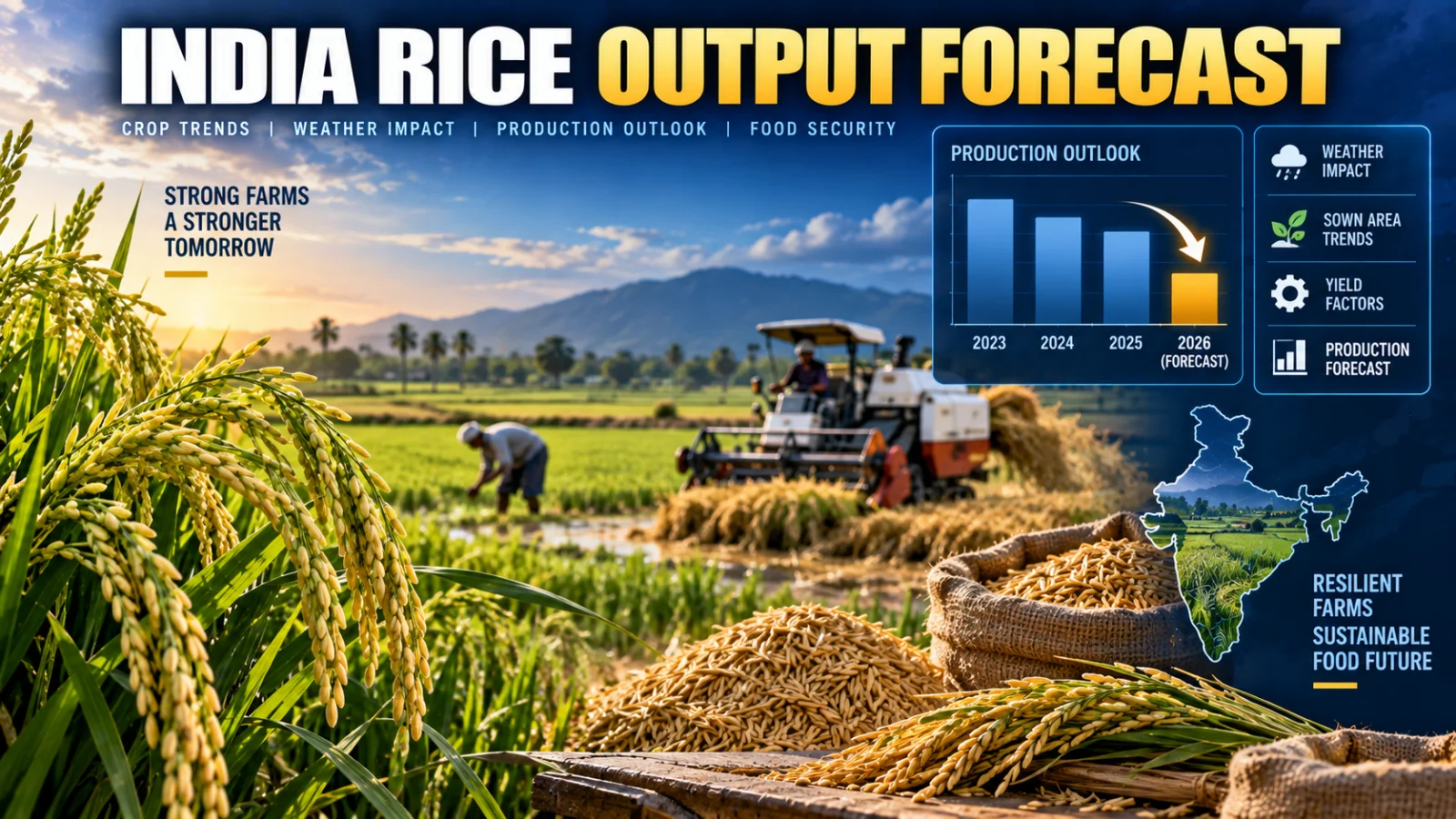
India rice production 2026 is now being projected by industry officials at roughly 144 million tonnes, about 10 million tonnes or 6.5% below the previous record crop. That is a significant current forecast, but it is not yet an official Government of India production estimate. Government acreage and weather evidence support concern about a weaker crop, while large inventories may reduce the immediate risk of a domestic shortage or abrupt export disruption.
Direct answer: the 144 million tonne figure should be treated as an industry forecast, not a confirmed harvest result. The current evidence supports a weaker 2026 rice outlook, but final production will still depend on realized yields, later crop conditions, rabi output, procurement and official production estimates.
Is the 144 million tonne rice estimate official?
No official Government of India 2026-27 rice-production estimate equivalent to 144 million tonnes was identified in the reviewed evidence. Reuters reports the figure from industry participants, including the Rice Exporters Association.
That distinction matters because an industry forecast can be useful and credible without being the controlling official crop estimate. The government normally publishes staged advance crop estimates before later revisions and final production numbers.
How much could India rice production 2026 fall?
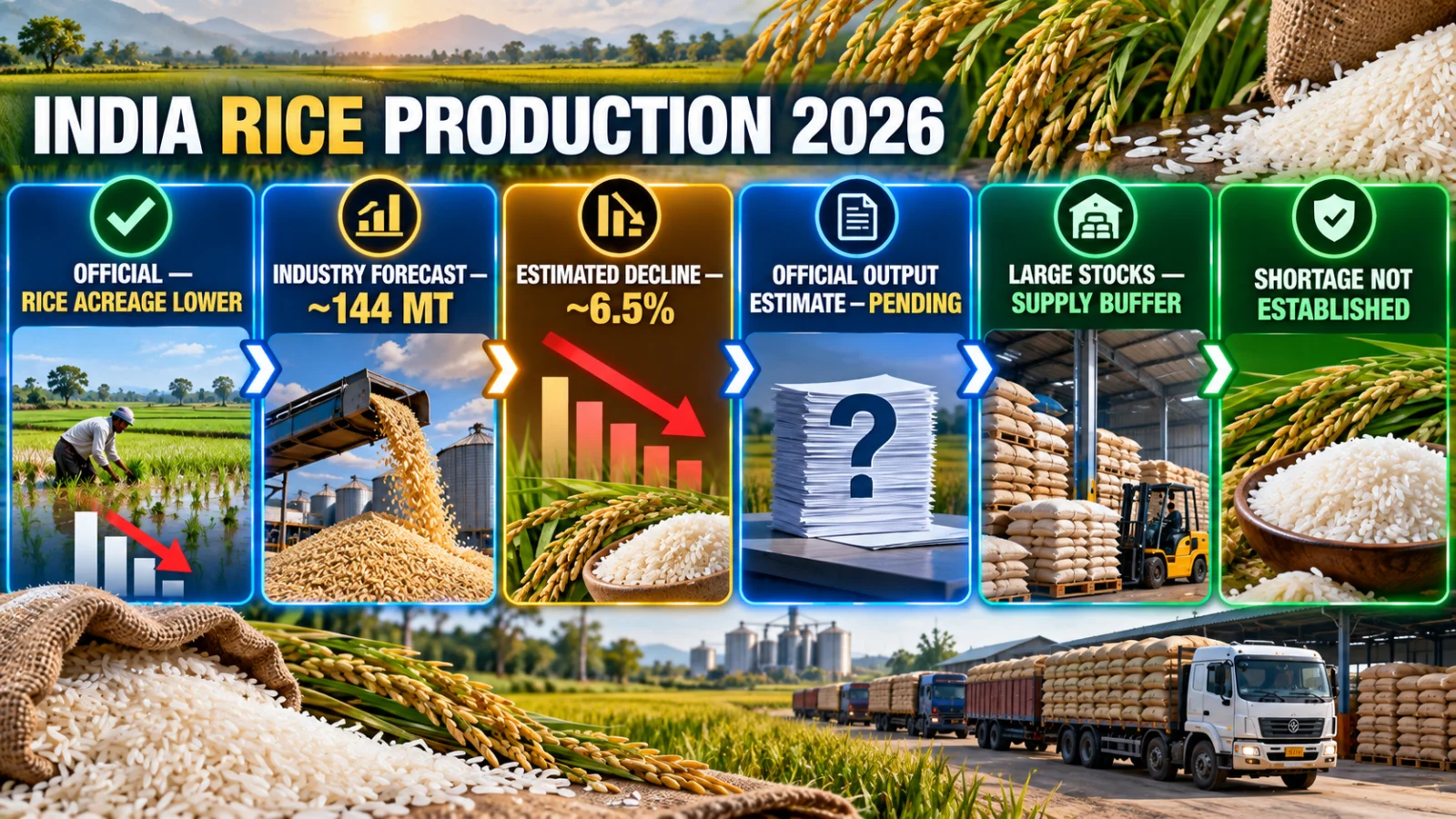
The current industry estimate reported by Reuters puts rice production near 144 million tonnes, around 10 million tonnes below the previous record crop. That represents a decline of roughly 6.5%.
If that decline materializes, Reuters reports it would be India’s largest annual rice-production fall since 2009-10. The comparison is conditional: it describes what the decline would represent if the forecast is realized, not a completed harvest outcome.
What official evidence supports concern about a weaker crop?
The strongest official support currently comes from crop-area and weather evidence rather than a new national production estimate.
TPS’s existing kharif sowing 2026 acreage tracker shows rice area at 426.81 lakh hectares as of September 11, compared with 443.78 lakh hectares a year earlier. That is a deficit of 16.97 lakh hectares.
Lower acreage alone does not determine final output, but it reduces the planted base from which the crop is produced. Rainfall distribution, irrigation, crop condition and yield then determine how much grain is actually harvested.
Why can production fall by more than acreage?
Rice production is broadly the result of harvested area multiplied by yield. A smaller planted area can reduce output, but yield conditions can amplify or offset the acreage effect.
Industry participants cited in current reporting point to weak monsoon conditions and yield pressure in addition to lower acreage. That means the roughly 6.5% production forecast should not be interpreted as simply copying the acreage decline percentage.
If you are asking whether 144 million tonnes is confirmed: no. It is a current industry estimate reported by Reuters, not yet the official Government of India production estimate.
If you are asking whether the crop outlook has weakened: yes. Lower rice acreage and weather-related yield concerns support a weaker current outlook.
If you are asking whether India now faces a rice shortage: the reviewed evidence does not establish that. Large government-held inventories are expected to provide a supply buffer.
If you are asking whether exports will be restricted: no new export restriction is established by this crop forecast. Export policy remains a separate government decision.
Does a 6.5% production decline mean India will face a rice shortage?
Not automatically. Current supply depends on more than the new harvest. Carry-in stocks, government inventories, procurement, private stocks, consumption and exports all affect how much rice is available to the market.
Reuters reports that India’s existing rice and paddy inventories are unusually large and could cushion the effect of a smaller crop. TPS did not independently establish the exact reported combined stock figure from a current controlling government table, so the safest conclusion is that inventories appear to provide a substantial buffer, not that they guarantee there can be no supply pressure.
What is happening to rice prices now?
Official Department of Consumer Affairs data show that the all-India average retail rice price was about ₹46.26 per kg on September 18. Average wholesale rice was about ₹4,148 per 100 kg.
Wholesale prices were higher than a year earlier in the reviewed official data. That does not prove the 2026 production forecast caused the increase. Prices can also reflect stocks, procurement, local supply, quality, demand, transport costs, exports and broader food-market conditions.
Will rice prices rise further if the forecast is correct?
A smaller crop can create upward supply pressure, but the direction and size of any future price effect cannot be established from the production forecast alone.
Large inventories could absorb part of the production decline. Government procurement and stock-release decisions can also affect domestic availability. A lower crop therefore raises price risk without making a particular retail or wholesale price outcome inevitable.
What could this mean for India’s rice exports?
India is a major supplier to the global rice market, so a substantial crop decline can affect export expectations even if domestic availability remains adequate.
Current industry reporting expects large stocks to help maintain export availability despite weaker production. That is an expectation, not a guarantee of future government trade policy.
TPS found no current evidence in this research establishing a new export restriction triggered by the 2026 crop forecast. Any later export duty, minimum-price rule, quota, ban or liberalization would need to be assessed as a separate policy change.
Why the existing kharif acreage article is not enough
The existing TPS kharif article answers a different question: how much area has been planted and which crops are ahead or behind last year.
This article addresses the next analytical step: whether the acreage and weather state could translate into lower rice production, and what that would mean for consumers, stocks and exports. The two pages should not be collapsed because acreage and output are related evidence layers rather than the same reader task.
What could change the 144 million tonne forecast?
- An official Government of India 2026-27 advance production estimate materially above or below the industry forecast.
- Better or worse realized yields as harvesting progresses.
- Revisions to final kharif rice acreage.
- A material change in rabi rice sowing or production.
- New government procurement and central-pool stock data.
- A major export-policy change.
- A substantial revision by industry forecasters as harvest evidence improves.
What happens next?
The most important next evidence is an official 2026-27 crop-production estimate. That would provide a government benchmark against which the current 144 million tonne industry forecast can be tested.
Later harvest, procurement and stock data will then determine whether the production decline remains mainly a forecast, becomes an officially measured shortfall, or is revised as more complete crop information becomes available.
Verification note
ThePulseSignal reviewed Reuters reporting on the industry production forecast, official Department of Consumer Affairs rice-price data, current IMD rainfall evidence and Government of India crop-estimation material. The acreage state was also reconciled with TPS’s existing kharif sowing canonical. The 144 million tonne estimate remains reported industry evidence rather than an official 2026-27 government production estimate.
Limitations and unresolved facts
- The official 2026-27 national rice-production estimate was not yet established in the reviewed evidence.
- The roughly 144 million tonne figure remains an industry forecast.
- Final kharif yields and final harvested area remain unknown.
- The exact current combined government rice and unmilled-paddy stock figure reported by Reuters was not independently reconciled to a controlling current official table.
- Future procurement volumes remain unknown.
- The eventual contribution from rabi rice remains unresolved.
- No future export restriction or liberalization should be inferred from the production forecast alone.
- The current price increase cannot be attributed solely to the weaker crop outlook.
Bottom line: India rice production 2026 could be substantially lower than last year’s record if the current industry forecast proves accurate. The key figure — about 144 million tonnes — is useful for assessing risk, but it remains a forecast. Official crop estimates, realized yields, stocks and procurement will determine whether the projected decline becomes the final production outcome.