






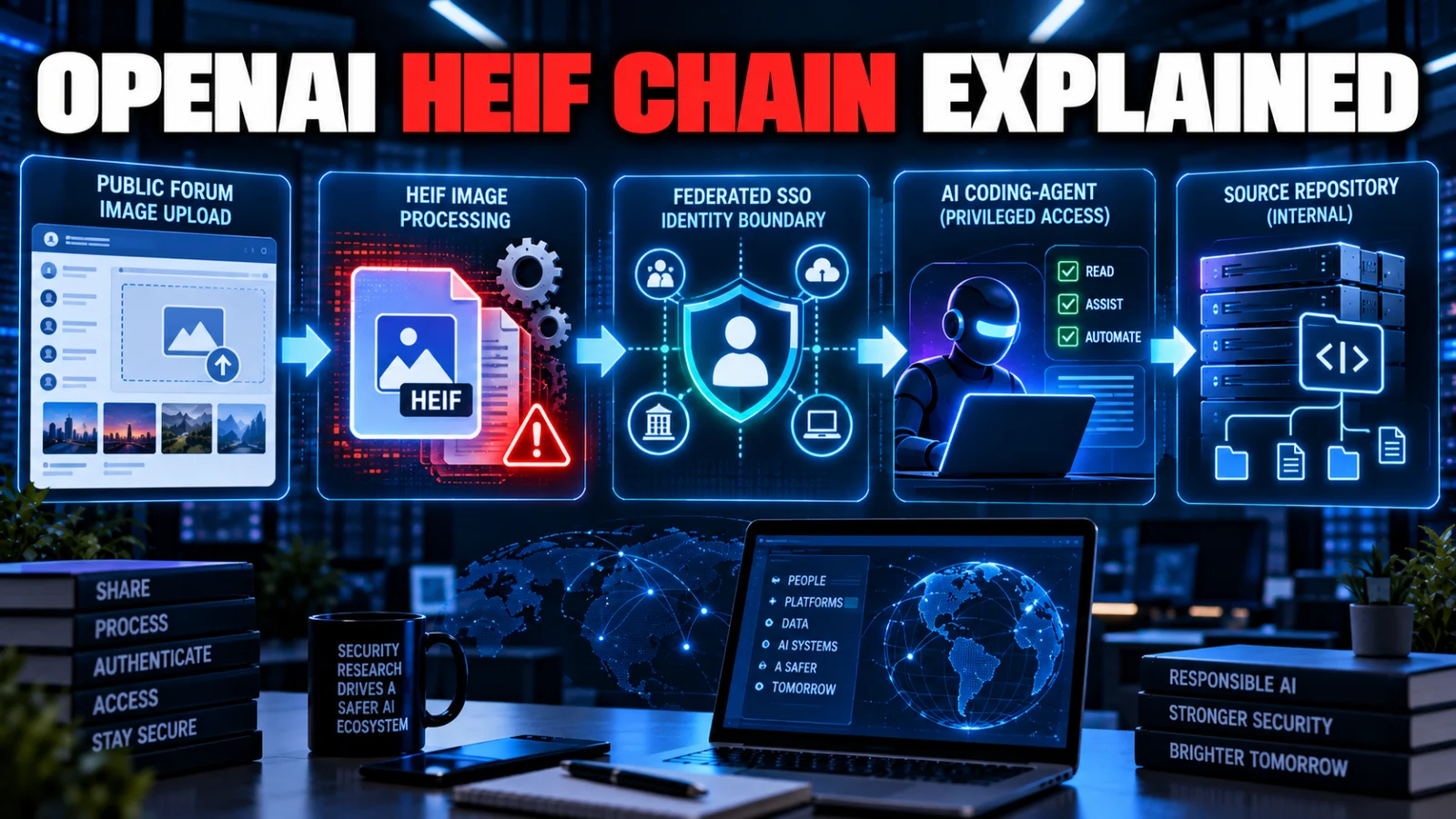
The Hacktron OpenAI hack was not simply a ChatGPT image-upload vulnerability. The disclosed chain crossed three different security boundaries: a now-patched HEIF image-processing flaw in Discourse, a reported OpenAI single-sign-on weakness, and privileged ChatGPT/Codex connections to developer infrastructure.
What actually happened in the Hacktron OpenAI hack?
Discourse independently confirms that malformed HEIF uploads could trigger remote code execution through a vulnerable libheif path. Hacktron says it used that forum-level compromise as the first step in authorized research, then combined control of the forum identity with an OpenAI SSO weakness to reach employee ChatGPT and Codex accounts. Hacktron further says one connected Codex account was used to open a harmless pull request in OpenAI’s internal monorepo as proof of repository access.
The distinction matters because each part of the chain has a different evidence level and a different remediation owner. The Discourse HEIF issue has an official security advisory and patched releases. The OpenAI identity and downstream account-access portion is documented primarily by Hacktron and corroborated by major reporting; TPS did not recover a standalone OpenAI technical incident report describing the complete chain.
Was the HEIF flaw inside ChatGPT?
No. The independently confirmed image-processing vulnerability was in the Discourse environment used by OpenAI’s community forum. It was not a HEIF decoder bug inside the ChatGPT application itself.
Discourse’s security advisory describes a remote-code-execution path involving malformed HEIF images and maps the upstream libheif vulnerability to CVE-2026-32882. The advisory rates the Discourse issue High severity with a CVSS score of 8.8.
That CVE should not be confused with the reported OpenAI SSO weakness. The image-processing vulnerability and the identity problem were separate links in the same demonstrated chain.
Which Discourse versions contain the fix?
Discourse’s advisory lists patched releases including 2026.7.0, 2026.6.1, 2026.5.2 and 2026.1.6. Self-hosted operators should compare their deployment against the current advisory rather than assuming an application-level update alone refreshed every affected native dependency.
Discourse also instructs self-hosters to rebuild the application so the deployment uses the updated Docker image containing the patched libheif library.
What was the OpenAI-specific weakness?
According to Hacktron, compromising the forum environment was not enough by itself to reach ChatGPT or Codex. The researchers then found an identity weakness in OpenAI’s SSO flow that allowed control over the forum-side identity to cross into more privileged OpenAI account access.
This is the part of the incident that must remain attributed. Multiple reputable reports corroborate Hacktron’s description, but TPS did not recover a detailed first-party OpenAI advisory documenting the SSO mechanism, exact affected account population or full historical session behavior.
What did Hacktron say it actually accessed?
Hacktron says the researchers reached multiple employee ChatGPT accounts during authorized testing. One account reportedly had Codex connected to OpenAI’s GitHub organization.
The researchers say they used that connection to open a harmless pull request in an internal monorepo as a proof of access. The reviewed evidence does not support saying that OpenAI source code was stolen or exfiltrated.
Reports also discuss other services that may have been connected to compromised identities, but potential reach should not be described as actual access. TPS did not verify that the researchers opened Slack, email or every other theoretically connected service.
Was this a malicious OpenAI breach?
The disclosed activity was authorized security research, not a known malicious intrusion campaign. The researchers reported the findings through security channels, and current reporting says OpenAI fixed its identity-side issue and later paid a bounty.
No evidence reviewed for this article establishes exploitation of the same chain by an unrelated malicious actor.
Is the OpenAI side still vulnerable?
Hacktron and multiple reports say OpenAI fixed the identity issue on the same day it was reported. That is strong current evidence that the demonstrated OpenAI path was remediated, but the claim remains based on Hacktron’s disclosure and reporting rather than a detailed standalone OpenAI postmortem.
The Discourse portion is clearer: Discourse has published an official advisory, affected conditions, patched releases and rebuild guidance.
Why the SSO layer matters more than the dramatic headline
The security lesson is not that an image decoder somehow contained direct access to an internal source repository. The risk grew because several trust relationships were chained together.
A public community forum is normally treated as a lower-trust surface than an internal development environment. But if that forum shares identity with more privileged services, compromising it can become materially more serious. The next escalation occurs when an AI assistant or coding agent carries access to repositories, development tools or other connected systems.
That creates a broader architecture problem: the practical blast radius of a compromised identity is determined by the most privileged downstream service the identity can reach, not by the apparent importance of the first application that was compromised.
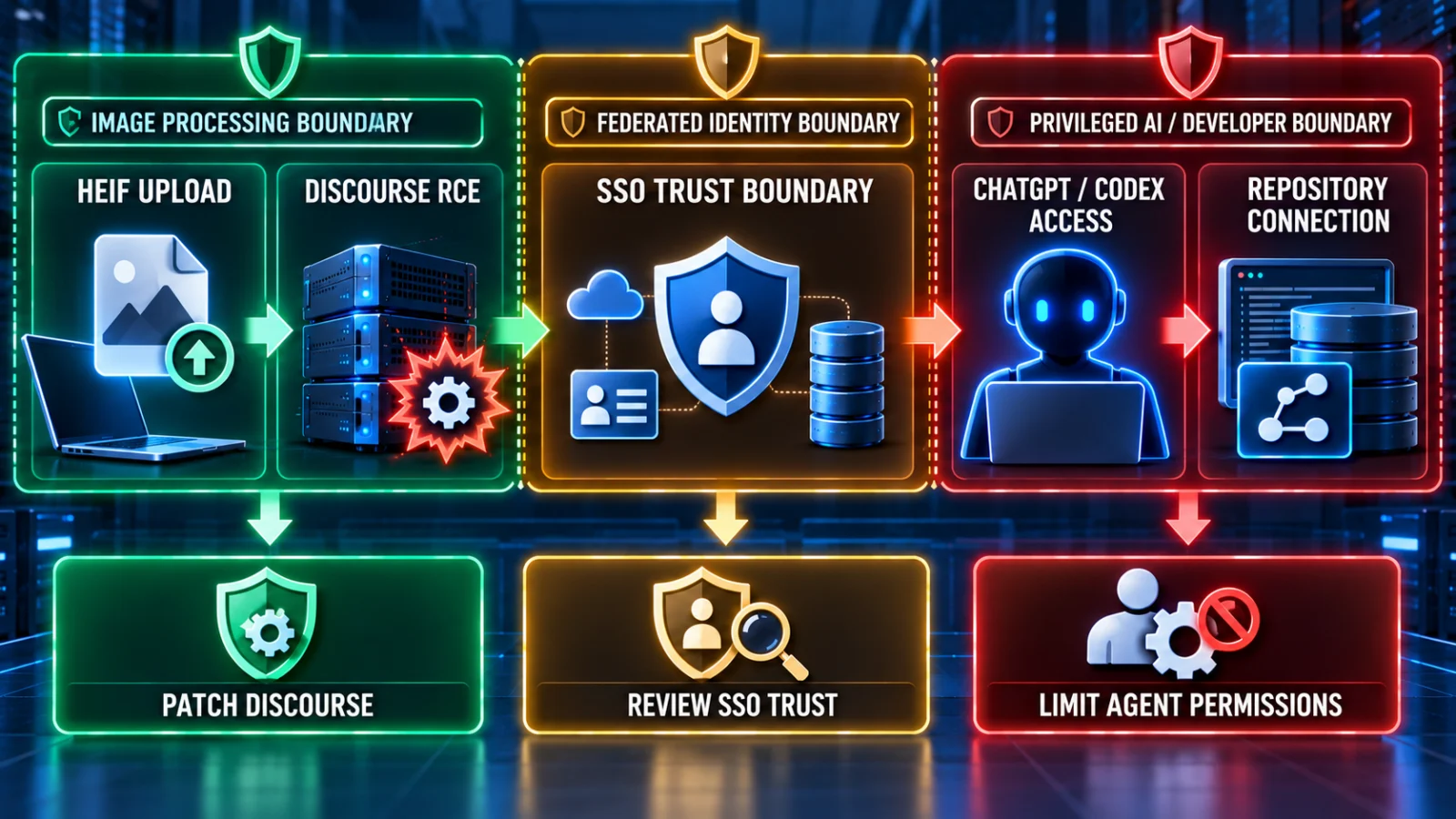
Three security boundaries in the disclosed chain
1. Image processing and the public forum
The first boundary was the Discourse image-upload pipeline. Untrusted user-supplied media reached a vulnerable native image-processing dependency and created remote-code-execution risk.
2. Federated identity and session trust
The second boundary was identity federation. Hacktron says the compromised forum identity could be turned into access to more privileged OpenAI services because of the reported SSO weakness.
3. AI-agent connectors and developer infrastructure
The third boundary was downstream authorization. A Codex session with repository access carried more authority than an ordinary web account, allowing the researchers to demonstrate that identity compromise could reach developer infrastructure.
What should security teams audit?
Patch low-trust internet-facing applications
For self-hosted Discourse, verify the deployment is on a patched release and rebuild the application image as the current Discourse advisory instructs.
Map shared SSO relationships
Identify public or lower-trust applications that share identity with administrative, development or AI services. Treat those applications as part of the privileged identity boundary.
Reduce session and token scope
Review whether a session established through one service receives unnecessary authority in another. Minimize reusable trust across unrelated applications.
Audit AI-agent connectors
Inventory repositories, developer tools and other systems accessible to AI assistants or coding agents. A compromised agent identity inherits those permissions.
Separate potential reach from demonstrated access
Incident reviews should distinguish which services an identity could theoretically reach from which services an attacker or researcher actually accessed.
Monitor for identity-boundary failures
Detection should correlate compromise of an edge application with unusual SSO transitions, privileged AI sessions and repository actions rather than treating each product as an isolated security event.
What CVE applies to this incident?
The independently confirmed Discourse image-processing issue references CVE-2026-32882 in libheif and Discourse advisory GHSA-vhm9-85gw-x335.
TPS did not verify a separate CVE for the reported OpenAI SSO weakness. CVE-2026-32882 should therefore not be described as the identifier for the OpenAI identity problem.
What should self-hosted Discourse operators do?
Operators should verify they are running a patched Discourse release and follow Discourse’s rebuild guidance so the underlying container image receives the corrected libheif dependency. The exact currently supported patched branch should be checked against the latest advisory before production action.
Did Claude cause the vulnerability?
No. Hacktron’s use of an AI model during security research is part of the research workflow, not the underlying vulnerability. The security chain depended on the Discourse/libheif flaw, the reported identity weakness and downstream permissions.
Describing the incident simply as “Claude hacked OpenAI” obscures which systems actually failed and which controls defenders need to review.
What remains unknown?
- The full technical implementation of the OpenAI SSO weakness.
- The exact number of OpenAI employee accounts reached during the research.
- The complete set of downstream connectors available from affected accounts.
- Whether any unrelated malicious actor exploited the same chain before remediation.
- The full historical session-revocation and detection timeline.
- Whether OpenAI will publish a detailed technical postmortem.
- Whether other HEIF Heist platform claims will receive equivalent first-party confirmation.
Hacktron OpenAI hack: direct answers
Was ChatGPT vulnerable to the HEIF image bug?
The confirmed HEIF RCE affected the Discourse forum’s image-processing path, not the ChatGPT application itself.
Was OpenAI source code stolen?
The reviewed evidence does not support that claim. Hacktron says researchers demonstrated repository access with a harmless pull request and did not read or exfiltrate sensitive code.
Is CVE-2026-32882 the OpenAI SSO vulnerability?
No. It is associated with the libheif image-processing flaw referenced in the Discourse advisory.
Is the Discourse issue patched?
Yes. Discourse has published patched versions and rebuild guidance for self-hosted operators.
Is active malicious exploitation confirmed?
No malicious exploitation was established in the evidence reviewed for this article.
Verification method
ThePulseSignal reviewed Hacktron’s original disclosure, Discourse’s official security advisory and current reporting from established technology and security publications. TPS separated independently confirmed Discourse patch facts from Hacktron-attributed OpenAI identity, account and repository-access claims.
Limitations
OpenAI has not provided, in the material reviewed by TPS, a detailed public technical postmortem covering the complete SSO and employee-account chain. Exact account scope, connector reach, malicious-exploitation status and full historical session behavior therefore remain unresolved.