






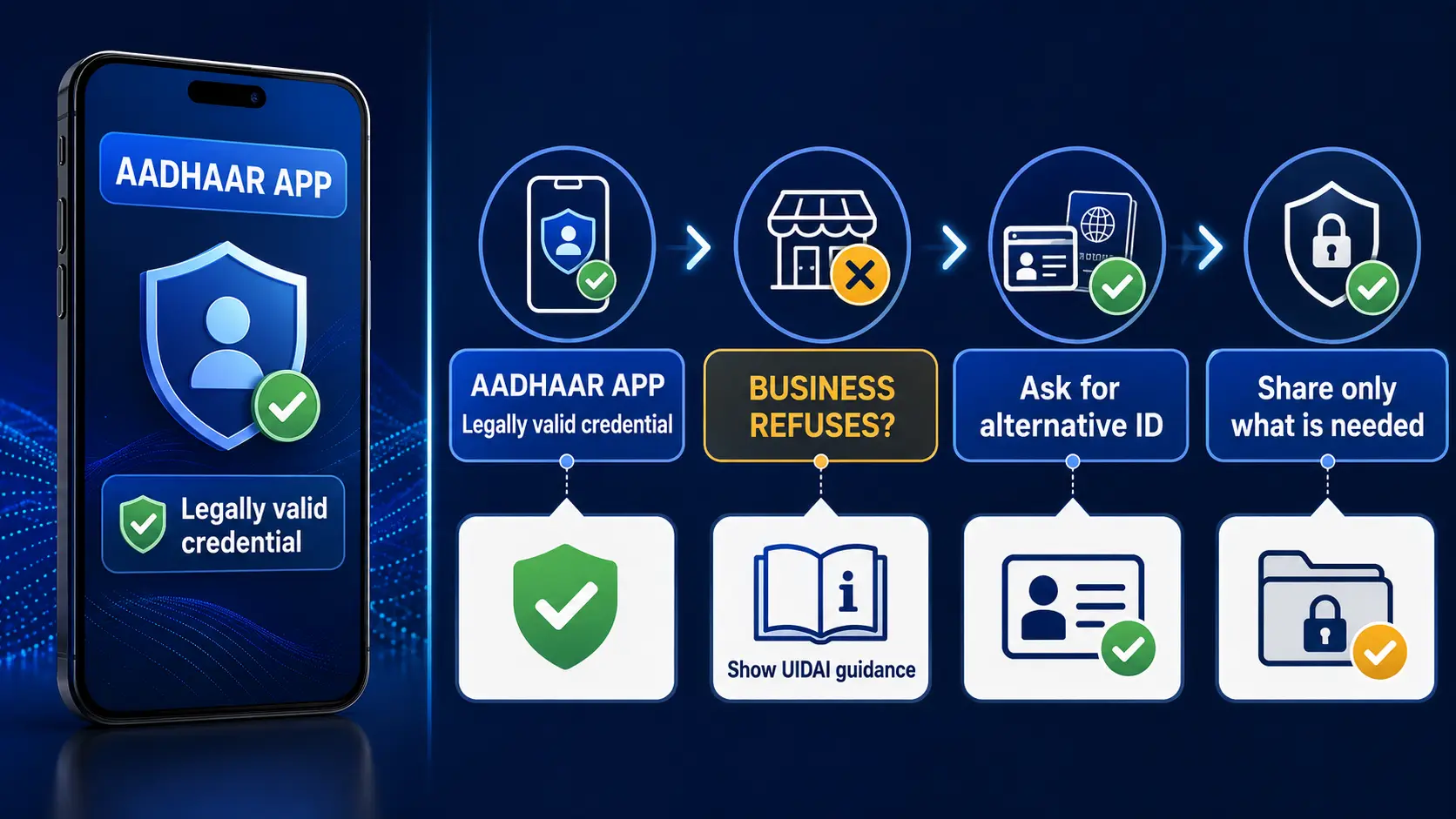
Aadhaar App acceptance is now backed by a UIDAI circular that says Aadhaar Verifiable Credentials shown, shared or verified through the official Aadhaar App are legally valid for establishing identity. UIDAI has also asked ministries, state governments, autonomous bodies, authorities and other agencies that accept Aadhaar as proof of identity to accept Aadhaar shown or shared through the app.
The Aadhaar App acceptance question is especially relevant at hotels and other front desks that still ask for a physical Aadhaar copy. The app credential is officially valid, but that does not automatically mean every private business is under a separate hotel-specific legal mandate to use the app in every situation.
Direct answer
Can a hotel refuse the Aadhaar App and demand physical Aadhaar?
A hotel should not treat the official Aadhaar App credential as fake or inherently invalid. UIDAI says Aadhaar Verifiable Credentials shown/shared through the Aadhaar App are legally valid forms of identity, alongside Aadhaar letter, e-Aadhaar, masked e-Aadhaar, Aadhaar Card and m-Aadhaar. However, the April 30 circular is framed as a UIDAI request to Aadhaar-accepting agencies, not as a standalone hotel-specific penalty rule.
Current status
Official digital credential — not merely a screenshot
UIDAI’s current FAQ specifically says the app can be used at places where physical Aadhaar copies are currently requested, by securely sharing Aadhaar data with an Offline Verification Seeking Entity with the holder’s consent.
Confirmed
- Aadhaar App acceptance is supported by UIDAI’s April 30, 2026 circular.
- Aadhaar App credentials are legally valid identity credentials.
- UIDAI recognises the Aadhaar App as an official Aadhaar application.
- UIDAI asks Aadhaar-accepting agencies to accept app-shown/shared credentials.
- Offline verification is consent-based.
Do not overclaim
- The circular does not create a hotel-specific fine for refusing the app.
- It does not say every private business must accept Aadhaar as its only identity document.
- It does not say every business must be technically integrated with the Aadhaar App.
- A plain screenshot is not the same as a UIDAI-verifiable credential.
Table of contents
Aadhaar App acceptance: is the credential legally valid?
Yes. UIDAI’s April 30, 2026 circular states that Aadhaar Verifiable Credentials shown, shared and/or verified through the Aadhaar App are legally valid forms for establishing the identity of an Aadhaar number holder. UIDAI places them alongside other recognised forms including the Aadhaar letter, e-Aadhaar, masked e-Aadhaar, Aadhaar Card and m-Aadhaar.
The credential is a digitally signed electronic record issued by UIDAI. The app allows the Aadhaar holder to share complete or partial identity details, while the 12-digit Aadhaar number itself is not transferred through the credential-sharing flow.
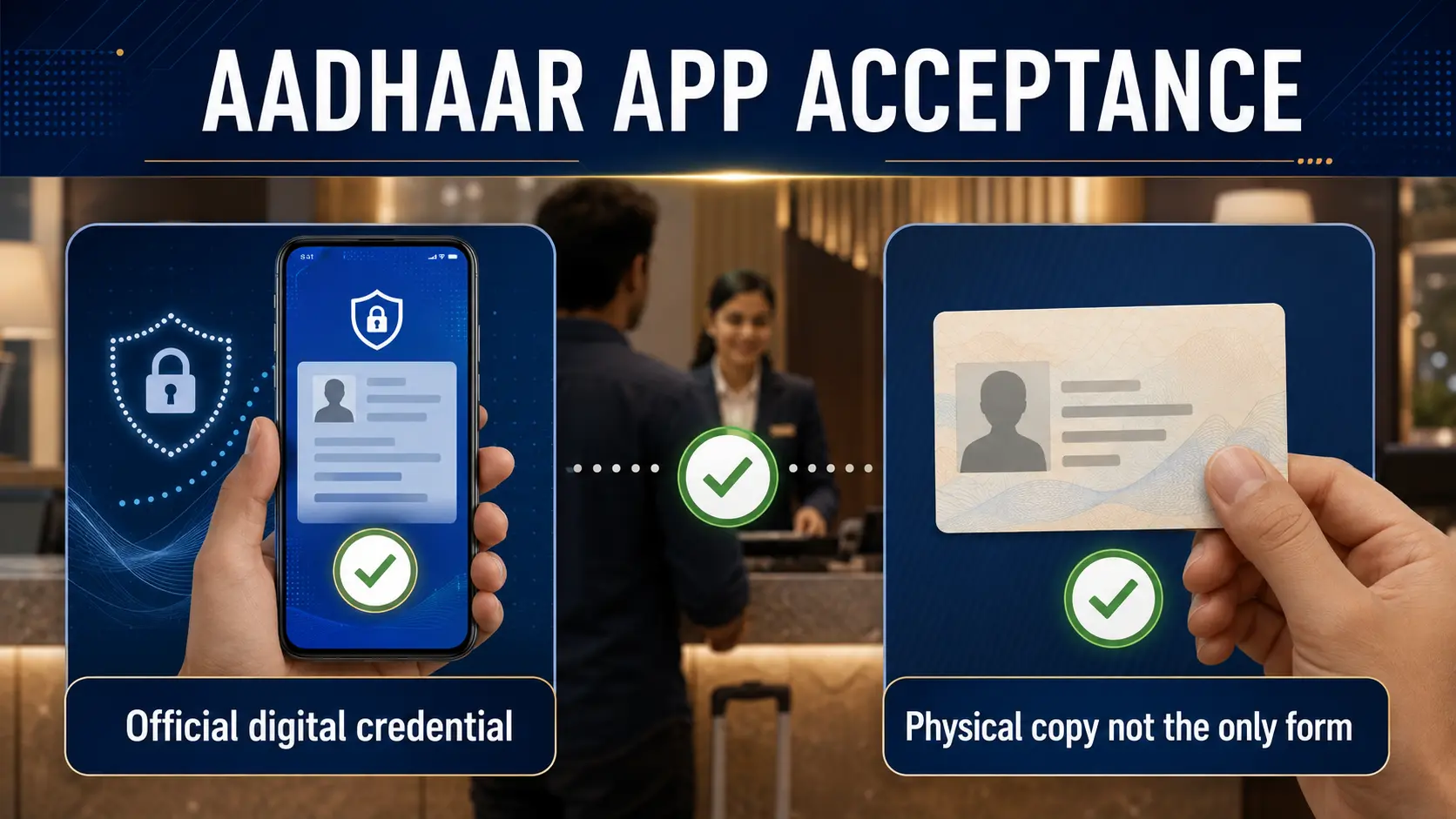
Aadhaar App acceptance at hotels: can physical Aadhaar still be demanded?
A hotel may have its own identity-verification workflow and may accept other valid identity documents. But if it is accepting Aadhaar for identity verification, UIDAI’s position is that Aadhaar shown or shared through the Aadhaar App is a valid establishment of identity.
The April 30 circular asks ministries, departments, state governments, autonomous bodies, authorities and other agencies accepting Aadhaar as proof of identity to accept Aadhaar shown and/or shared through the Aadhaar App and issue necessary instructions to those concerned.
Important distinction
“Legally valid Aadhaar credential” and “every hotel is legally compelled by this circular to complete check-in through the app” are not identical claims. The first is directly confirmed by UIDAI. The second is too broad without a hotel-specific rule or other controlling law.
Can service be denied if you do not give Aadhaar?
In Aadhaar authentication and offline-verification workflows, UIDAI’s regulations require the requesting entity or Offline Verification Seeking Entity to inform the Aadhaar holder about alternate and viable means of identification. The regulations also provide that service should not be denied merely because the resident refuses or is unable to undergo Aadhaar authentication or offline verification, provided the resident can identify themselves through a viable alternative means suggested by the entity.
This is a separate point from Aadhaar App acceptance. A service provider may have another valid identity route, and separate sector-specific rules can still matter.
What is an Aadhaar Verifiable Credential?
UIDAI defines it as a digitally signed document issued by the Authority to the Aadhaar number holder. It may include the last four digits of the Aadhaar number, demographic information and photograph, along with other information UIDAI specifies.
The Aadhaar holder can share the credential in full or in part with an Offline Verification Seeking Entity. This supports selective disclosure instead of automatically exposing every Aadhaar field.
Aadhaar App acceptance vs physical Aadhaar
| Form | UIDAI status | Verification | Privacy point |
|---|---|---|---|
| Aadhaar App Verifiable Credential | Legally valid identity credential | Digitally signed / offline verification | Selective sharing; 12-digit number need not be transferred |
| Aadhaar Card / PVC | Recognised Aadhaar form | Secure QR can be verified | Physical document exposes printed fields |
| e-Aadhaar | Recognised Aadhaar form | Digitally issued document / QR | Masked version available |
| m-Aadhaar | Recognised Aadhaar form | Official mobile Aadhaar form | Digital presentation |
What to do if Aadhaar App acceptance is refused
Clarify the refusal
Ask whether the business is refusing Aadhaar entirely, the Aadhaar App specifically, or simply lacks a verification workflow.
Show UIDAI guidance
UIDAI specifically addresses places where physical Aadhaar copies are currently requested.
Offer another ID
Ask which viable alternative identification the entity accepts if it cannot process the app credential.
Share only what is needed
Avoid unnecessary Aadhaar photocopies or disclosure of unrelated fields.
Escalate internally
If staff incorrectly say the official app is invalid, ask for a supervisor or compliance contact.
Preserve the reason
If service is refused, record what was requested and which alternative identification was offered.
Why Aadhaar App acceptance can improve privacy
UIDAI’s design allows selective sharing. The Aadhaar holder can choose which demographic details to share with an OVSE, reducing unnecessary exposure of the full Aadhaar number and unrelated identity fields.
UIDAI’s technical documentation describes privacy-preserving verifiable credentials, making Aadhaar App acceptance a data-minimisation issue as well as a convenience issue.
For another public-service example of why identity details should be entered only on official government systems, see ThePulseSignal’s EPFO passbook status and safe-access guide.
Official UIDAI sources
- UIDAI Circular dated April 30, 2026 — validity of Aadhaar Verifiable Credentials
- UIDAI circular register entry
- UIDAI Aadhaar App FAQs
- Aadhaar Authentication and Offline Verification Regulations
- UIDAI Aadhaar App technical documentation
How this was verified
ThePulseSignal reviewed UIDAI’s April 30, 2026 circular, current Aadhaar App FAQ, current authentication/offline-verification regulations and UIDAI’s technical documentation.
The circular confirms the app credential’s legal validity and asks Aadhaar-accepting agencies to accept it. The FAQ specifically addresses use where physical Aadhaar copies are requested. The regulations support alternate and viable identification in Aadhaar verification workflows.
Last verified: August 7, 2026, approximately 1:30 PM IST.
Limitations and unresolved facts
- The April 30 circular does not itself spell out a hotel-specific penalty for refusing the app.
- A private business may have separate identification requirements under another law or policy.
- Not every business is necessarily technically integrated as an OVSE.
- A plain screenshot should not be treated as equivalent to a UIDAI-verifiable credential.
- The article does not claim Aadhaar must be accepted for every transaction.
Frequently asked questions
Is Aadhaar App acceptance officially recognised?
Yes. UIDAI says Aadhaar Verifiable Credentials shown, shared or verified through the official Aadhaar App are legally valid for establishing identity.
Can I use the Aadhaar App where physical Aadhaar is requested?
UIDAI’s current FAQ says the official app allows secure Aadhaar data sharing with an OVSE according to the holder’s consent and choice.
Can a hotel call the Aadhaar App invalid?
That would conflict with UIDAI’s stated position that Aadhaar App Verifiable Credentials are legally valid identity credentials.
Does every hotel have to accept it?
The UIDAI circular requests Aadhaar-accepting agencies to accept it, but it is not framed as a hotel-specific penalty provision.
Can a hotel demand only Aadhaar?
Aadhaar offline-verification rules require viable alternative identification to be communicated in the relevant Aadhaar workflow; separate hotel rules may also matter.
Is the app credential just a screenshot?
No. It is a digitally signed Aadhaar Verifiable Credential.
Does the app expose the full Aadhaar number?
UIDAI says the 12-digit Aadhaar number is not transferred in the Verifiable Credential sharing flow.
Can I share only selected details?
Yes. UIDAI says complete or partial demographic details can be shared according to consent.
What if a business cannot verify it?
Ask what viable alternative identification it accepts and whether a supervisor can check the official UIDAI credential.
Is physical Aadhaar invalid now?
No. Physical Aadhaar Card, Aadhaar letter, e-Aadhaar, masked e-Aadhaar and m-Aadhaar remain recognised alongside the Aadhaar App credential.