




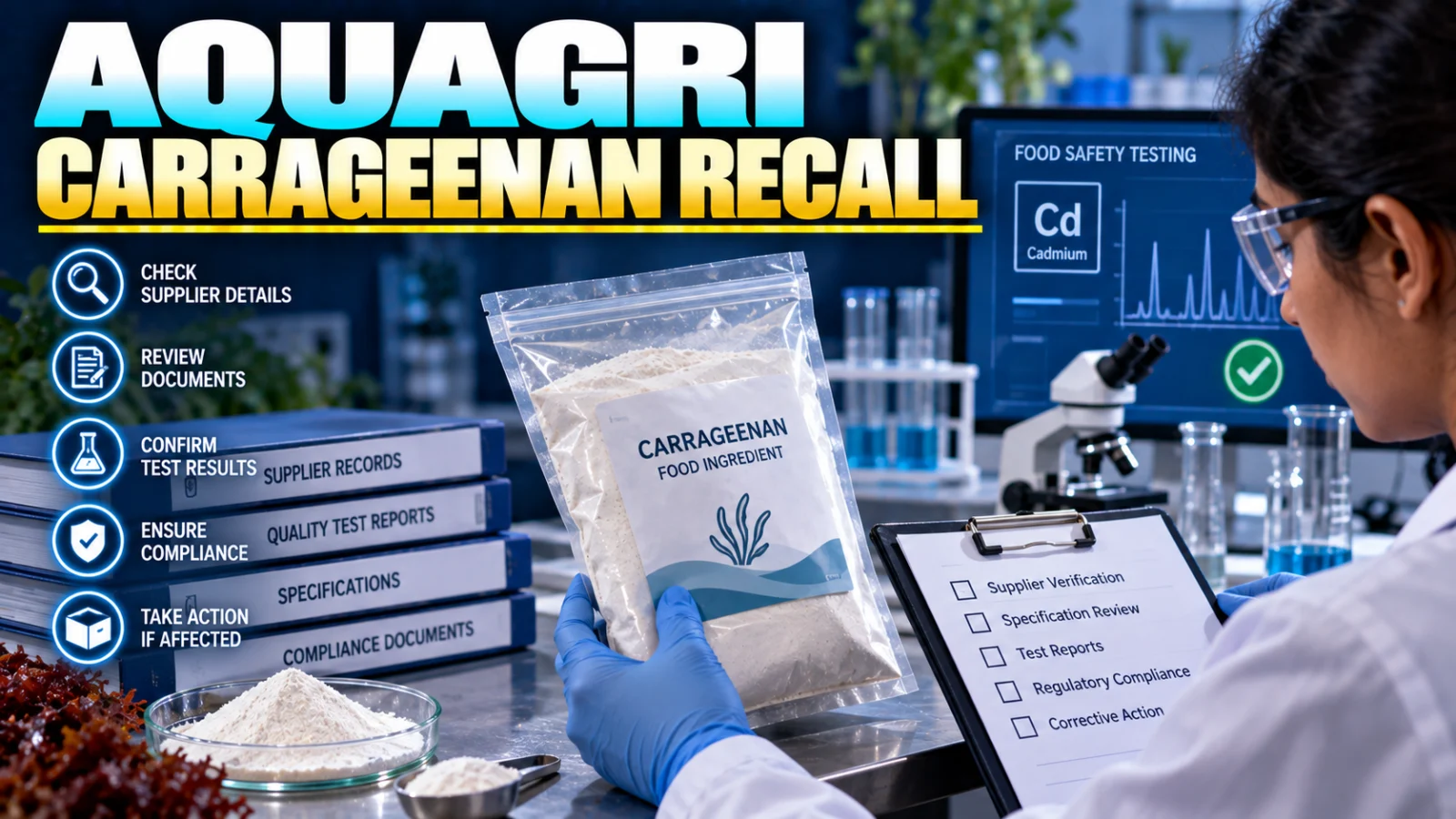
The Aquagri carrageenan recall is being reported after Food Safety and Standards Authority of India action linked to cadmium-related non-compliance. Multiple current reports quoting FSSAI say Aquagri Processing Pvt Ltd was directed to immediately recall carrageenan after both an original regulatory sample and a referral-laboratory retest were classified unsafe.
The important limitation is equally clear: TPS has not recovered the direct product-specific FSSAI recall notice or the exact affected lot, batch, grade, quantity, distribution footprint or downstream-product list. Food businesses therefore should not assume that every Aquagri carrageenan lot is affected, but they also should not treat their stock as outside the recall without checking supplier and regulatory records.
What is currently reported about the Aquagri carrageenan recall?
PTI and other current reports directly attribute the recall action to FSSAI. According to that reporting, a carrageenan sample drawn by FSSAI’s Southern Region was found non-compliant with the applicable cadmium specification and was classified unsafe.
Aquagri reportedly appealed the initial finding. A second part of the sample was then tested by a Referral Food Laboratory, which was also reported to have classified the sample as unsafe. FSSAI was subsequently reported to have directed immediate recall of the implicated carrageenan.
Which Aquagri carrageenan lot or batch is affected?
That remains unknown from the evidence TPS has recovered. Current reporting identifies the product as carrageenan from Aquagri Processing Pvt Ltd, but TPS has not found a controlling notice that specifies the affected lot number, batch number, production date, grade, SKU or package configuration.
This means the article cannot responsibly tell a business that all Aquagri carrageenan is recalled. It also cannot identify a particular commercial Aquagri grade as affected without a controlling source.
What does the cadmium finding mean?
The current FSSAI-attributed reporting says the sampled carrageenan did not meet the applicable cadmium requirement and was classified unsafe. TPS has not recovered the analytical report showing the measured cadmium concentration or the exact specification value applied to this sample, so those numbers should not be inferred.
The strongest current statement is therefore that the regulator-attributed recall followed cadmium-related non-compliance confirmed through the reported referral-laboratory retest.
What should food businesses verify now?
Record the exact Aquagri product description, supplier, invoice, purchase date, internal material code and any batch or lot identifiers shown on the packaging or certificate of analysis.
Keep supplier invoices, certificates of analysis, inward-goods records, production records and stock-location details together so the material can be matched quickly if FSSAI or Aquagri publishes exact scope.
Review current communication from Aquagri, the distributor and FSSAI before deciding whether a particular lot is inside or outside the recall.
If a supplier or regulator confirms that a specific lot in your possession is affected, use production and dispatch records to identify work-in-progress, finished batches and customers linked to that ingredient.
TPS is not advising businesses to classify every Aquagri carrageenan lot as recalled. The correct action depends on the controlling recall scope when that information becomes available and on any direct supplier or regulator instruction received by the business.
Are any finished food products confirmed as affected?
No downstream finished-food list was recovered in this research. Carrageenan is used across several food-manufacturing applications, but general product uses are not evidence that any named brand, manufacturer or finished food received the recalled material.
TPS will not name downstream products unless FSSAI, Aquagri, a distributor or another controlling source identifies them.
Is this the same recall as Shalimar coriander powder?
No. Although both actions were reported together by FSSAI, they involve different food business operators, products and safety findings. The Shalimar’s Chef coriander powder case concerns pesticide-residue non-compliance in a consumer spice product. The Aquagri case concerns cadmium-related non-compliance in carrageenan, which creates a separate ingredient-supply and traceability problem for food businesses.
What remains unknown?
TPS has not recovered the direct FSSAI product-specific recall post or notice, exact affected lot or batch, carrageenan grade, quantity, measured cadmium result, distribution geography, customer list, downstream finished products or recall-completion status.
Those gaps do not erase the reported recall state, but they limit how precisely a buyer can identify affected inventory today.
What happens next?
The same page should be updated if FSSAI or Aquagri publishes the exact lot or batch, product grade, quantity, distribution list, customer instructions, downstream-product information, recall expansion or recall completion. A stronger primary document should strengthen this canonical rather than create a second article for the same reader job.
Verification note
ThePulseSignal reviewed the FSSAI food-recall framework and current PTI and NDTV Profit reporting that directly attributes the Aquagri recall, initial cadmium failure, appeal and referral-laboratory retest to FSSAI. TPS did not recover the direct product-specific FSSAI recall artifact and has preserved that limitation throughout this article.