






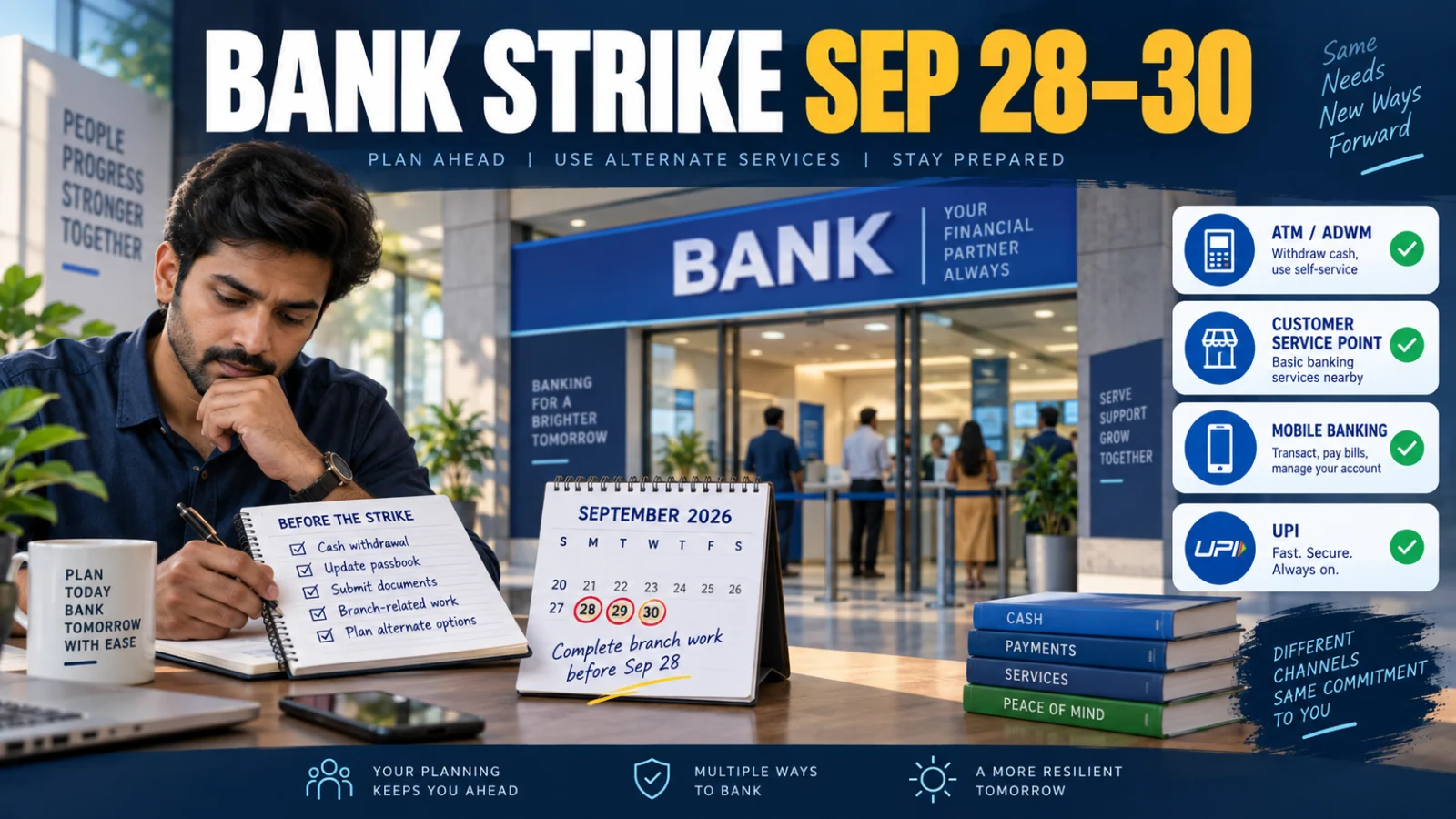
A three-day nationwide bank strike is proposed for September 28, 29 and 30, 2026. State Bank of India has told customers that branch and office work may be affected and has advised people to complete important banking transactions in advance where possible.
Current status: UFBU has served strike notices for September 28–30. SBI says it is making arrangements to provide essential banking services, but branch-dependent work may still be disrupted depending on employee participation. Customers can plan cash and routine transactions through ATMs/ADWMs, Customer Service Points, internet banking, YONO, mobile banking and UPI where those channels meet their needs.
Is there a bank strike from September 28 to 30?
Yes, a three-day strike has been proposed by the United Forum of Bank Unions for September 28, 29 and 30, 2026. SBI’s September 7 stock-exchange disclosure says UFBU served strike notices covering those three dates after the September 11 action.
The notice also lists a continuous strike from October 26, 2026. These are announced strike dates, but customers should still check for any later settlement, deferment or revised advisory before relying on the schedule.
What has SBI told customers?
SBI has advised customers to complete important banking transactions before the September 28–30 strike period to reduce the risk of inconvenience from branch disruption.
For cash requirements, the bank has pointed customers to ATMs and Automated Deposit and Withdrawal Machines. It has also advised use of Customer Service Points and digital channels including internet banking, YONO, mobile banking and UPI for transactions that can be completed without a branch visit.
Will SBI branches be closed for all three days?
SBI has not said that every branch will definitely be closed. Its exchange disclosure says the bank has made arrangements for normal functioning of branches and offices, while also warning that work is likely to be affected by the strike.
The practical impact can therefore differ by branch, location, staff participation and service. Customers who need document verification, staff-assisted work, locker access, certain cheque services or other branch-dependent transactions should avoid assuming normal service without checking the specific branch.
Why could branch access be difficult for five consecutive days?
September 26 and 27 fall immediately before the proposed three-day strike. Those weekend closures can combine with the September 28–30 strike period to create a five-day stretch in which normal weekday branch access may be limited or uncertain for some customers.
That does not mean every banking service will be unavailable for five days. Digital channels, ATMs, ADWMs and Customer Service Points operate separately from normal branch counters, subject to their own availability and transaction rules.
Will UPI, YONO and internet banking work during the strike?
SBI has specifically advised customers to use internet banking, YONO, mobile banking, UPI and other digital channels during the proposed strike period.
A strike does not by itself mean those systems will stop working. However, digital services can still face unrelated technical outages, maintenance windows, transaction limits or account-specific restrictions. For a time-sensitive payment, confirm the transaction status rather than assuming success.
What about ATMs and cash?
SBI has advised customers to use ATMs and ADWMs for cash needs during the strike period. ATM availability can still vary by machine, network condition and cash replenishment, especially if branch staffing is disrupted.
If cash is essential, it is safer to plan before the strike dates rather than depend on a single ATM during the three-day action.
What happened on September 11?
UFBU’s earlier nationwide strike took place on September 11 and caused significant disruption to branch-dependent banking in multiple parts of India. That action ended, but the same broader labour dispute now has another announced strike phase for September 28–30.
The dispute has centred prominently on the demand for a five-day banking week along with other employment, pension and service-condition issues raised by bank unions.
Is another strike planned after September 30?
SBI’s September 7 disclosure says UFBU also served notice for a continuous strike beginning October 26, 2026.
That later action remains a future announced programme. Customers should check fresh guidance closer to the date because conciliation, negotiations or a formal union decision could change the position before October 26.
What should bank customers do before September 28?
- Complete important branch-dependent transactions in advance where practical.
- Confirm the operating status of the specific branch before travelling.
- Plan cash needs using ATMs or ADWMs, with a backup option if one machine is unavailable.
- Use Customer Service Points where the required service is supported.
- Use internet banking, YONO, mobile banking or UPI for eligible routine transactions.
- Keep proof of any deadline-sensitive payment or banking instruction.
- Check for a fresh SBI, UFBU or other controlling bank advisory before the strike begins.
Verification and limitations
SBI’s stock-exchange disclosure confirms that UFBU served strike notices for September 28, 29 and 30 and warns that bank work may be affected despite contingency arrangements. Current reporting on SBI’s customer advisory says customers have been asked to finish important banking work in advance and use ATMs, ADWMs, CSPs and digital channels during the strike period.
The exact effect cannot be known branch by branch before the strike occurs. Employee participation, local staffing, cash availability, cheque processing and digital-system uptime can vary. A later settlement or deferment could also change the strike schedule.
Bottom line: the September 28–30 bank strike is currently an announced nationwide action, and SBI is warning customers to plan ahead. Do not assume every branch will be fully closed or fully operational; complete important branch work early and verify your bank’s latest guidance before travelling.
Last verified: September 21, 2026.