





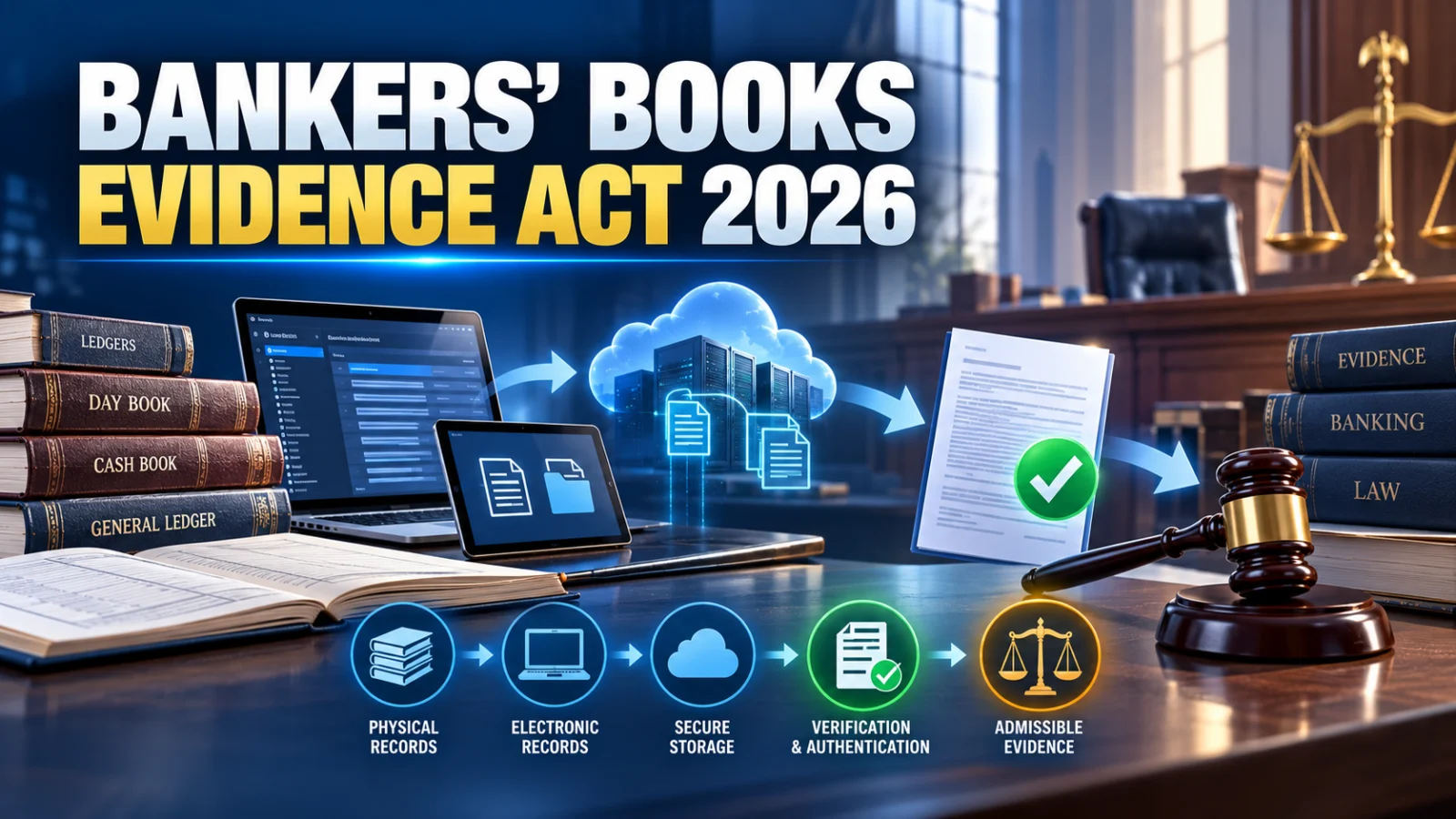
Bankers’ Books Evidence Act 2026 will come into force on October 1, 2026. The new law replaces the century-old 1891 framework and modernises how banking records can be certified and used as evidence, including records maintained electronically, digitally, virtually, off-site or in cloud environments.
Direct answer: the 2026 Act does not simply declare every digital bank document automatically admissible. It expands the statutory framework to modern banking systems, sets certification requirements for banking records, preserves conditions for electronic evidence and clarifies how courts can inspect records or require banks and bank officers to participate in proceedings.
When does the Bankers’ Books Evidence Act 2026 start?
The Central Government has fixed October 1, 2026 as the commencement date for the Act. Before that notification, the law had been enacted but its operative date remained dependent on a later Gazette notification.
That distinction matters. Until October 1, the 2026 Act is an enacted law with a future commencement date. From October 1, its provisions become the operative framework covered by the commencement notification.
What does the 2026 Act replace?
The new legislation replaces the Bankers’ Books Evidence Act, 1891, a framework created long before internet banking, distributed computing, cloud infrastructure and modern electronic recordkeeping became normal parts of banking operations.
The core purpose remains familiar: allowing banking records to be proved through certified copies and defined evidentiary procedures without requiring original banking books or bank officials in every proceeding. The 2026 law updates that framework for contemporary record systems.
Designed around traditional bankers’ books and a predominantly physical recordkeeping environment.
Expressly accommodates physical, electronic, digital, virtual, off-site and cloud-based banking records.
Determine whether the banking record is covered, properly certified and capable of satisfying the Act’s evidentiary conditions.
The Act does not make every screenshot, PDF or online-bank document admissible merely because it exists electronically.
What counts as bankers’ books under the new law?
The 2026 Act modernises the definition of banking records so that the framework is not confined to traditional paper books. The reviewed statutory material covers records maintained in physical or written form as well as records stored electronically or digitally, including records maintained at off-site, virtual or cloud locations and associated backup or disaster-recovery environments.
This is one of the most important practical changes because modern banks frequently maintain operational and archival records across distributed technology systems rather than in a single physical ledger.
Are digital and cloud bank records automatically admissible?
No. The fact that a record is electronic, digital or cloud-hosted is not by itself enough to establish admissibility.
The Act prevents relevant banking evidence from being rejected merely because it exists in electronic or digital form, but the record still has to satisfy the applicable statutory certification and evidentiary requirements.
For readers, the important distinction is between recognising a digital record as a legally supported record format and proving that a particular record meets the conditions required for use as evidence. Those are not the same question.
How are banking records certified?
The Act provides certification mechanisms for banking records rather than requiring the original underlying banking system or original physical book to be brought before the court in every case.
The certification framework differs depending on the form of the record. Physical copies and electronic or digital records have statutory certification requirements designed to establish that the copy accurately represents the relevant banking entry or record.
This means a litigant should not assume that an ordinary printout, downloaded statement or screenshot automatically has the same evidentiary status as a properly certified banking record under the Act.
What additional conditions apply to electronic records?
The statutory framework also addresses the reliability of the system used to create or maintain electronic and digital banking records.
The reviewed provisions include conditions relating to ordinary use of the system, proper operation, accuracy of the data, authorised handling of records, protection against unauthorised alteration or tampering, and security of the computer system and stored information.
These conditions are important because the evidentiary question is not only whether a digital record exists, but whether the process and system supporting that record provide the reliability required by the law.
Can a court inspect bank records?
Yes. The Act provides a court-controlled mechanism for inspection of banking records and for obtaining certified copies where the legal conditions are met.
The court remains central to that process. The existence of an electronic record does not give an unrelated person an unrestricted right to inspect bank data, and the Act should not be read as changing ordinary bank privacy or account-access rules.
Can a bank officer be summoned to court?
The 2026 Act continues an important procedural protection for banks. Where the bank is not itself a party to the proceeding and the relevant matter can be proved through the statutory banking-record mechanism, a bank officer is not meant to be routinely compelled to appear simply to prove those records.
The reviewed law provides a route for a court to require participation for special cause, with reasons recorded in writing. That preserves judicial discretion while reducing unnecessary demands on bank personnel where certified records can do the evidentiary work.
Does the Act automatically cover every financial company?
No. Readers should not assume that every NBFC, fintech platform or other financial-sector entity automatically falls within the same statutory scope merely because it handles financial records.
The reviewed framework allows the Central Government to extend the Act to specified entities or classes of entities through notification. Whether a particular non-bank entity is covered therefore depends on the controlling statutory definition and any applicable notification.
What changes for banks and legal teams from October 1?
The most immediate change is that the 2026 Act becomes the operative legal framework for the banking-record evidence questions covered by it.
For banks and their legal or compliance teams, that means record-certification workflows should be assessed against the new statutory requirements. For lawyers and litigants, the important task is to distinguish an ordinary banking document from a properly certified record that satisfies the applicable evidentiary conditions.
The Act itself establishes the framework, but institution-specific internal procedures may differ. TPS has not verified a universal bank-by-bank implementation workflow, and readers should not assume every institution will use identical operational processes.
What the Act does not change
The Bankers’ Books Evidence Act 2026 is an evidence and legal-procedure law. It does not by itself change ordinary bank-account access, transaction limits, customer charges, payment rules, loan terms or day-to-day internet-banking functions.
Its significance is narrower but important: it governs how covered banking records are identified, certified and used in legal proceedings.
What happens next?
The next confirmed material milestone is October 1, 2026, when the Act comes into force. After that, the same canonical should be reviewed for any implementing notifications, extension to additional financial-sector entities, significant banking-industry guidance or material court interpretation.
Verification note
ThePulseSignal reviewed the Government of India commencement information, the Ministry of Finance explanation and the published statutory framework supporting the October 1 effective date and the provisions covering certification, electronic banking records, court inspection and bank-officer participation.
Limitations and unresolved facts
- Institution-specific implementation procedures have not been treated as universal unless directly established by controlling official guidance.
- Future notifications may extend the Act to additional specified financial-sector entities.
- Later court interpretation may clarify how individual provisions operate in disputed cases.