






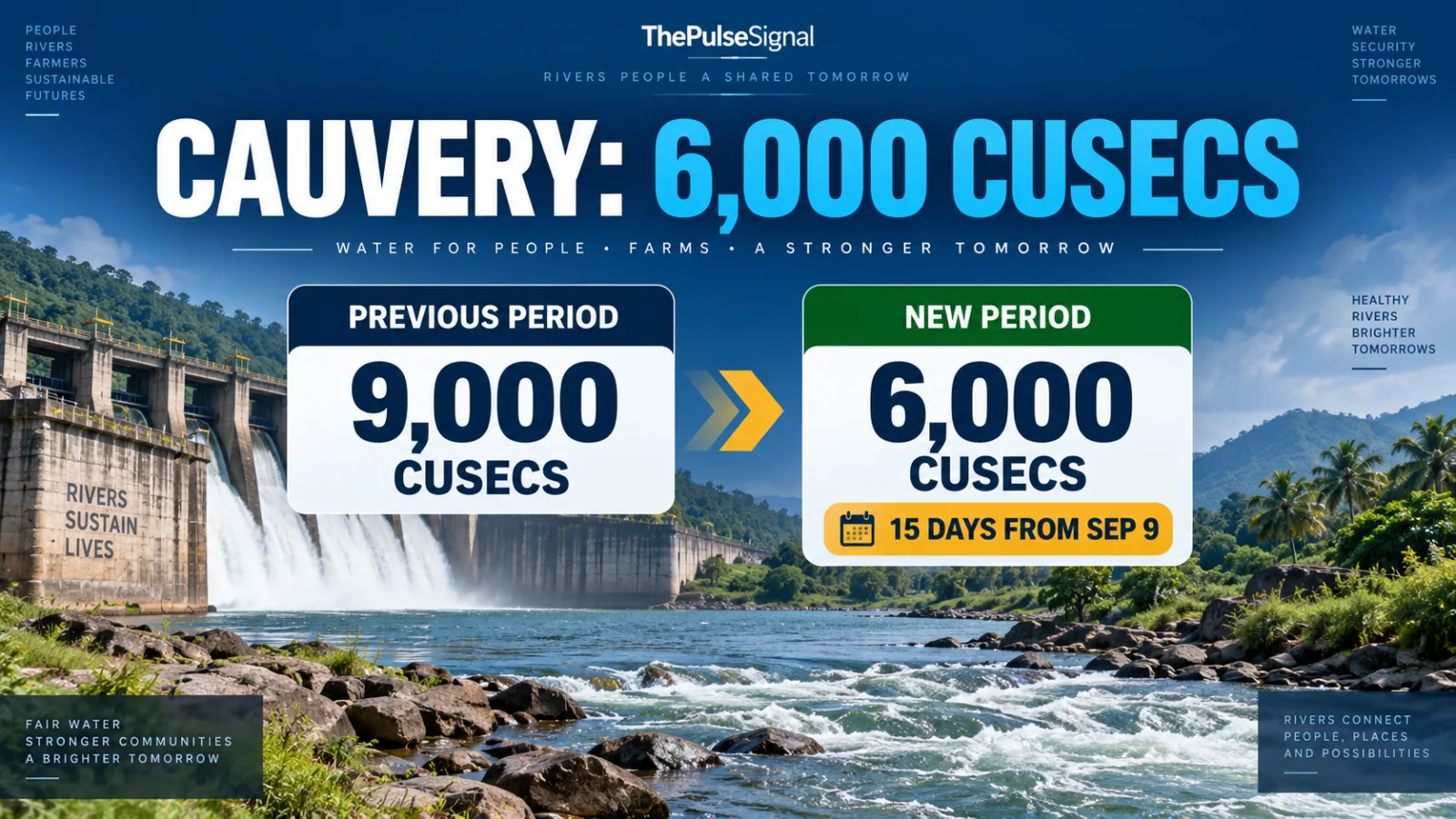
The current Cauvery 6000 cusecs direction is reported to apply for 15 days from September 9, 2026. Multiple current reports say the Cauvery Water Management Authority (CWMA) upheld a Cauvery Water Regulation Committee (CWRC) recommendation requiring Karnataka to ensure a daily flow of 6,000 cusecs to Tamil Nadu during the new period.
What changed with the Cauvery 6000 cusecs direction?
The reported operative figure for the new period is 6,000 cusecs, down from the preceding reported requirement of 9,000 cusecs. Current reports say the new 15-day period began on September 9, with some reports specifying an 8:00 AM start.
The important distinction is that an authority direction and actual physical compliance are not the same thing. TPS has confirmed consistent reporting of the 6,000-cusec decision, but has not independently verified that 6,000 cusecs is currently being achieved at the relevant measurement point.
What CWMA is reported to have decided
Current reporting from multiple national and regional outlets says CWMA upheld the CWRC recommendation for Karnataka to ensure 6,000 cusecs of Cauvery water flow to Tamil Nadu for 15 days. The new figure follows the earlier 9,000-cusec state for the preceding period.
TPS has not recovered the direct September 8 CWMA or CWRC order or minutes. For that reason, this article does not treat secondary descriptions of the precise measurement or compliance wording as a substitute for the controlling primary text.
Why the change from 9,000 to 6,000 cusecs matters
The numerical change means older pages describing 9,000 cusecs as the current requirement are no longer sufficient for readers checking the latest Cauvery position. The current question is what requirement applies now and whether subsequent evidence shows that the direction is being implemented, modified or challenged.
The change also remains relevant because the reported direction operates for a limited 15-day period rather than establishing a permanent flow level.
Has Karnataka actually started meeting the 6,000-cusec direction?
TPS has not independently verified the current post-September 9 physical flow. Reports about the CWMA decision establish the authority’s reported direction, but they do not by themselves prove the volume actually crossing the relevant measurement point after the new period began.
Earlier reporting included a Karnataka water-resources official saying the state had complied with the preceding period and had released about 33 TMC toward Biligundlu up to that point. That statement relates to the earlier state and should not be read as proof of compliance with the new 6,000-cusec period.
What does Biligundlu have to do with the Cauvery dispute?
Current reporting frequently refers to Biligundlu when describing Cauvery water reaching Tamil Nadu. However, TPS has not recovered the controlling September 8 order needed to state the exact operative compliance wording for this 15-day direction. The article therefore distinguishes reported authority instructions from verified flow measurements.
Is Karnataka challenging the CWMA direction in the Supreme Court?
Karnataka publicly indicated that it was considering approaching the Supreme Court against the direction, according to current reporting. At the time of this verification, TPS had not independently confirmed a filed petition or a Supreme Court order changing, staying or otherwise modifying the reported 6,000-cusec requirement.
This is one of the main facts that can materially change the article. If a petition is filed or the court issues an order, the legal-status section should be updated on this same URL rather than creating another article for the same current Cauvery requirement.
What is confirmed and what remains unresolved?
Corroborated: multiple current reports say CWMA upheld a 6,000-cusec daily Cauvery flow direction for 15 days from September 9, replacing the preceding 9,000-cusec state.
Still unresolved: TPS has not recovered the direct CWMA/CWRC order, has not independently verified the exact current physical flow after the new period began, and has not confirmed a Supreme Court filing or court order altering the direction.
What happens next?
The next useful update is not another repetition of the 6,000-cusec announcement. The material states to watch are actual flow or compliance evidence, a Karnataka Supreme Court filing, any court order, or a revised CWMA/CWRC direction.
As those facts become available, TPS can update this same canonical page so readers can continue using one URL to check the current Cauvery release requirement and its implementation or legal status.
Verification note
TPS compared multiple contemporaneous reports from Economic Times, Times of India, New Indian Express, ThePrint/PTI and other current coverage. The reports consistently describe a 6,000-cusec direction for 15 days from September 9 and Karnataka’s objection. The controlling CWMA/CWRC order, current post-start flow measurement and any Supreme Court filing remained unresolved during this review.