




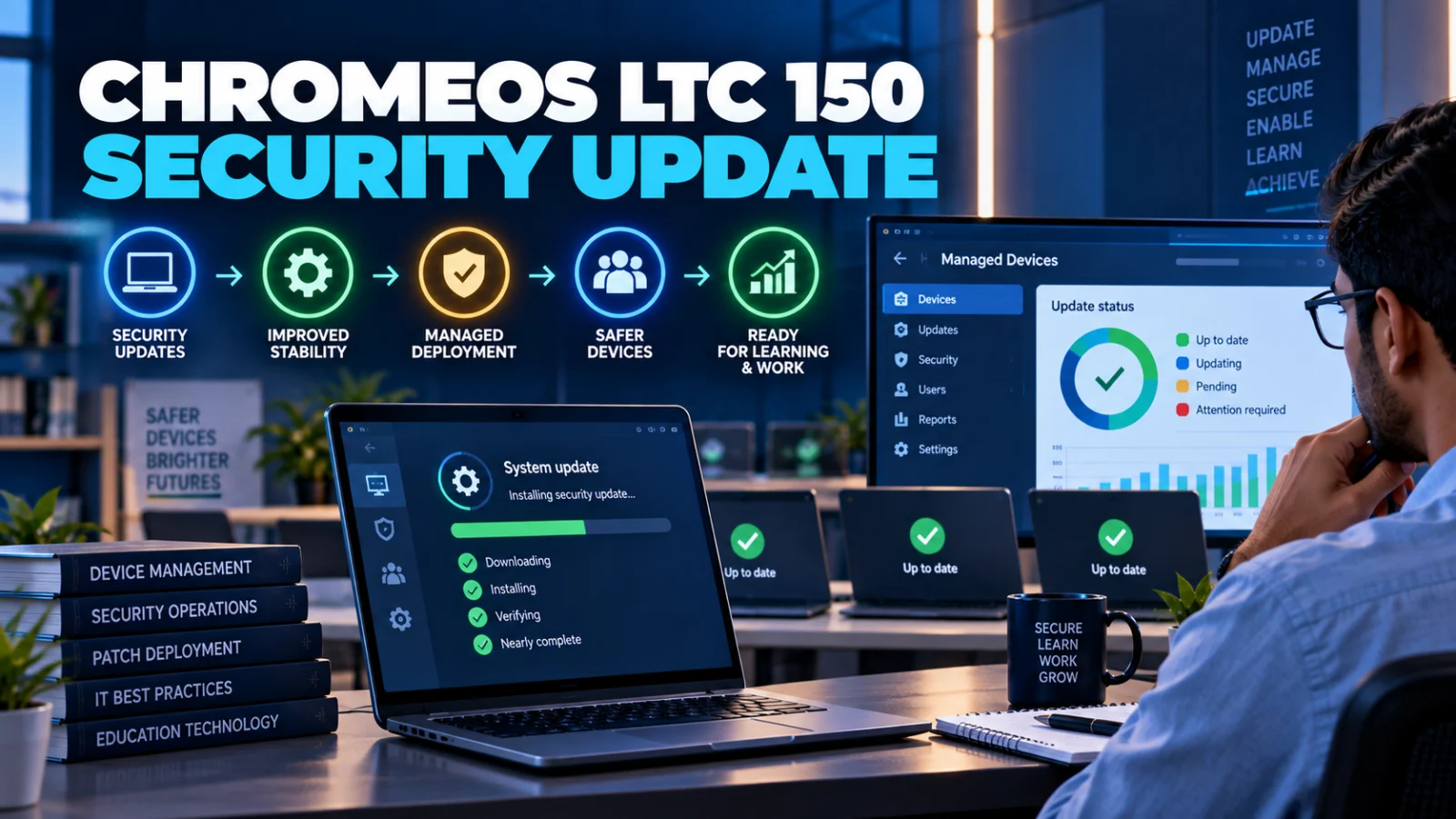
Google has begun rolling out ChromeOS LTC 150.0.7871.253, Platform 16700.63.0, as a security-focused update for devices on the Long-term Support Candidate channel. For administrators, the immediate question is not simply whether a new ChromeOS build exists, but whether managed LTC devices have actually received the expected version.
Direct answer: ChromeOS LTC 150 devices should now be moving to version 150.0.7871.253 where the rollout is available. Administrators should verify both the release channel and installed version instead of assuming every device has completed the rollout. ChromeOS LTS remains a separate channel state and is scheduled to move to LTS 150 on October 6, 2026.
What changed in ChromeOS LTC 150.0.7871.253?
The September 11 LTC release advances the ChromeOS 150 long-term-support candidate build to 150.0.7871.253 with Platform version 16700.63.0. Google’s release information identifies a selected set of security fixes, including multiple vulnerabilities rated High severity and one rated Medium.
This does not mean every Chromebook or Chromebox is affected in exactly the same way or receives the release simultaneously. The update applies to the LTC channel, and device-specific rollout completion can vary. A device remaining temporarily on an earlier LTC build should therefore be investigated in the context of its update policy, support state and rollout availability rather than automatically treated as a failed security update.
LTC and LTS are not the same current state
A key distinction is that LTC and LTS are separate long-term-support stages. LTC receives the next long-term-support feature set before it becomes the formal LTS release. Google’s current schedule places ChromeOS LTS 150 on October 6, 2026. Until that transition, administrators should not treat an LTS device remaining on the older LTS generation as evidence that the LTC 150.0.7871.253 rollout failed.
How administrators can verify the update
Check whether the managed device is actually assigned to the LTC channel rather than Stable or LTS.
On the device, open About ChromeOS and verify the ChromeOS version. Additional details can be used to confirm the release channel.
For devices where the current rollout is available, look for ChromeOS 150.0.7871.253 with Platform 16700.63.0.
If a managed LTC device remains on an earlier build, check update policy, rollout availability, device support and normal update completion before treating it as a security incident.
Does this mean the vulnerabilities are actively exploited?
No active-exploitation conclusion should be drawn from the severity labels alone. The reviewed release information establishes that security fixes are included, but it does not establish that the listed vulnerabilities are being actively exploited in the wild. High severity describes vulnerability impact and technical risk; it is not the same as evidence of current exploitation.
That distinction matters for administrators deciding how to communicate the update internally. The defensible action is to verify patch state and normal security-update deployment, not to describe the release as an emergency zero-day response unless later evidence establishes that state.
What administrators should watch next
The next known lifecycle milestone is Google’s scheduled October 6, 2026 move to ChromeOS LTS 150. Before then, this article should be updated if Google revises the LTC release, replaces 150.0.7871.253 with another LTC build, confirms active exploitation, or if a listed vulnerability is added to an authoritative exploited-vulnerability catalogue.
Verification note: TPS reviewed Google’s ChromeOS release information, long-term-support documentation, update guidance and published LTC/LTS schedule. Exact device-by-device rollout completion remains unresolved and should be verified on the affected fleet.