







Cline CVE-2026-59723 affects Cline Hub deployments running versions before 3.0.30, according to the published CVE record and the Cline fix history reviewed by TPS. The issue involves the Hub dashboard’s privileged browser WebSocket path and insufficient validation of cross-origin connections. Cline addressed the underlying condition in the 3.0.30 release.
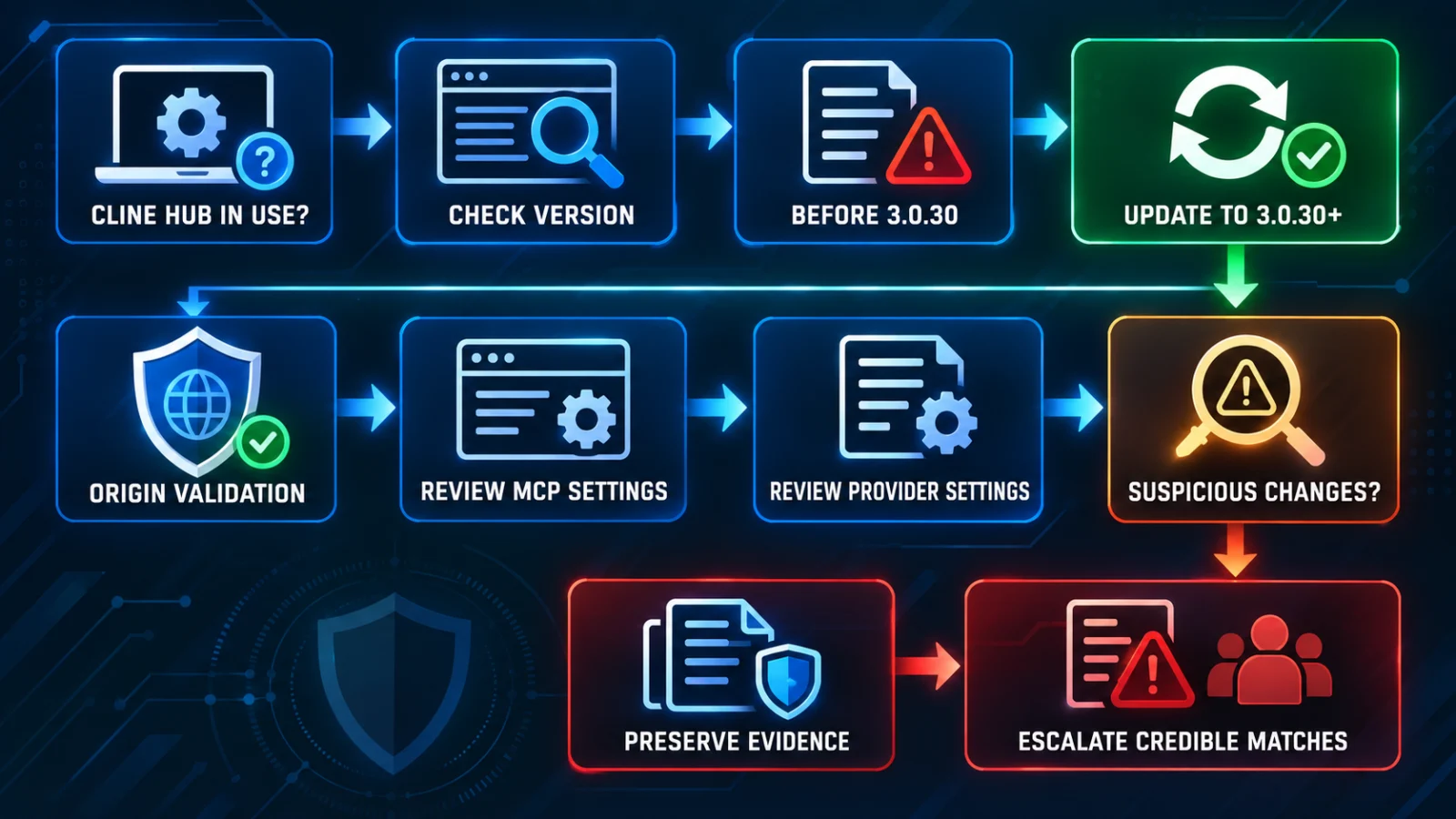
Current answer: if your Cline installation is older than 3.0.30 and you use Cline Hub or the local dashboard, treat it as potentially affected and update to 3.0.30 or later. The documented chain can let a malicious webpage alter Cline configuration, including MCP or provider settings, and may under specific conditions progress to command execution. No active exploitation is confirmed in the reviewed evidence.
What is Cline CVE-2026-59723?
CVE-2026-59723 is a cross-origin WebSocket hijacking issue affecting Cline Hub’s browser-facing dashboard. In the vulnerable implementation, a webpage from an untrusted origin could establish a connection to the privileged /browser WebSocket without the Origin checks expected for a sensitive local service.
This matters even when the service is bound to a local interface. A browser visiting a malicious site can still attempt connections to services on localhost, so local-only network binding is not by itself a substitute for validating the browser origin before accepting privileged WebSocket traffic.
Which Cline versions are affected?
The published CVE record defines versions before 3.0.30 as affected. TPS also reviewed the Cline fix pull request and the 3.0.30 release history, which support 3.0.30 as the remediation boundary.
There is an evidence inconsistency worth noting: the current GitHub repository advisory interface displays package metadata that can be read as <=3.0.24 with no patched version listed, while the CVE record and the referenced fix history identify the broader <3.0.30 affected range and 3.0.30 fix. For a real deployment, confirm the current Cline guidance and your installed version before deciding that the system is protected.
What can the WebSocket flaw allow?
The Cline advisory demonstrates that an attacker-controlled webpage can interact with privileged Hub functionality through the affected WebSocket path. That can include reading session or workspace information and changing configuration such as MCP or provider settings.
The advisory also describes a path that can potentially reach command execution, but that consequence is conditional. It depends on the configuration, available provider or MCP capabilities and session behavior. It should not be described as automatic command execution merely because an affected version is installed.
Does localhost make an affected Cline Hub safe?
No. The security problem exists precisely because browser-origin traffic can target a service listening on the local machine. The security boundary therefore depends on the server validating which browser origins and hosts are allowed to establish the privileged connection.
The reviewed Cline fix adds Host and Origin validation around the browser-to-desktop request and WebSocket upgrade path. That is the relevant control change administrators should expect in a protected build.
If the affected browser-facing Hub path is not used, exposure may differ, but version verification is still the first reliable check.
If it is earlier than 3.0.30, treat the installation as affected by CVE-2026-59723.
The CVE record and referenced Cline fix history identify 3.0.30 as the fixed boundary reviewed by TPS.
Inspect MCP configuration, provider settings and other privileged Hub state for unexpected changes rather than assuming an old version automatically means successful exploitation.
If logs, configuration changes or other evidence indicate unauthorized activity, preserve the relevant records and use the organization’s established incident-response process.
Is active exploitation confirmed?
No confirmed in-the-wild exploitation was established in the evidence reviewed for this article. Public technical detail or proof-of-concept material demonstrates that the vulnerability can be exercised, but that is different from verified attacks against real organizations.
TPS therefore does not describe CVE-2026-59723 as actively exploited, a zero-day campaign or a confirmed compromise affecting Cline users.
Why is this appearing now if the fix is older?
The present TPS signal comes from renewed visibility in current GitHub and security-feed surfaces. The technical flaw, its Cline fix and the 3.0.30 release predate the September 24 resurfacing.
That distinction is important: the current value of the article is helping Cline users verify exposure and remediation while the CVE is receiving fresh attention, not presenting an older vulnerability as newly discovered.
What should Cline users verify after updating?
Confirm the installed version first. If you previously ran an affected release and have reason to suspect malicious activity, review sensitive Cline Hub configuration for unexpected changes, including MCP or provider settings, and correlate those findings with local logs and the surrounding development environment.
An old vulnerable version proves exposure to the flaw, not successful compromise. Likewise, a configuration difference by itself may have a legitimate explanation. Investigation should be evidence-led rather than based on the CVE label alone.
What remains unknown?
No reliable evidence reviewed by TPS establishes active exploitation, victim count, campaign attribution or the number of Cline Hub installations still running affected versions. The exact reason the advisory re-entered current feeds on September 24 also does not change the older technical remediation state.
Verification note
TPS reconciled the Cline security advisory with the published CVE affected-version record, the Cline code-fix pull request and the 3.0.30 release history. That review supports the cross-origin WebSocket issue and the 3.0.30 remediation boundary while preserving the current metadata discrepancy and the absence of confirmed active exploitation.
Bottom line: Cline CVE-2026-59723 is primarily a version-and-exposure verification problem. Cline Hub users on releases before 3.0.30 should update, and previously exposed environments should investigate only when there is credible evidence of unauthorized configuration or activity.