






Container stuck transshipment port tracking can be confusing because a status such as “discharged” at an intermediate hub may be completely normal. The real problem begins when the container does not make the planned onward connection, gets reassigned to another vessel, waits because of capacity or documentation, or the carrier changes the route altogether.
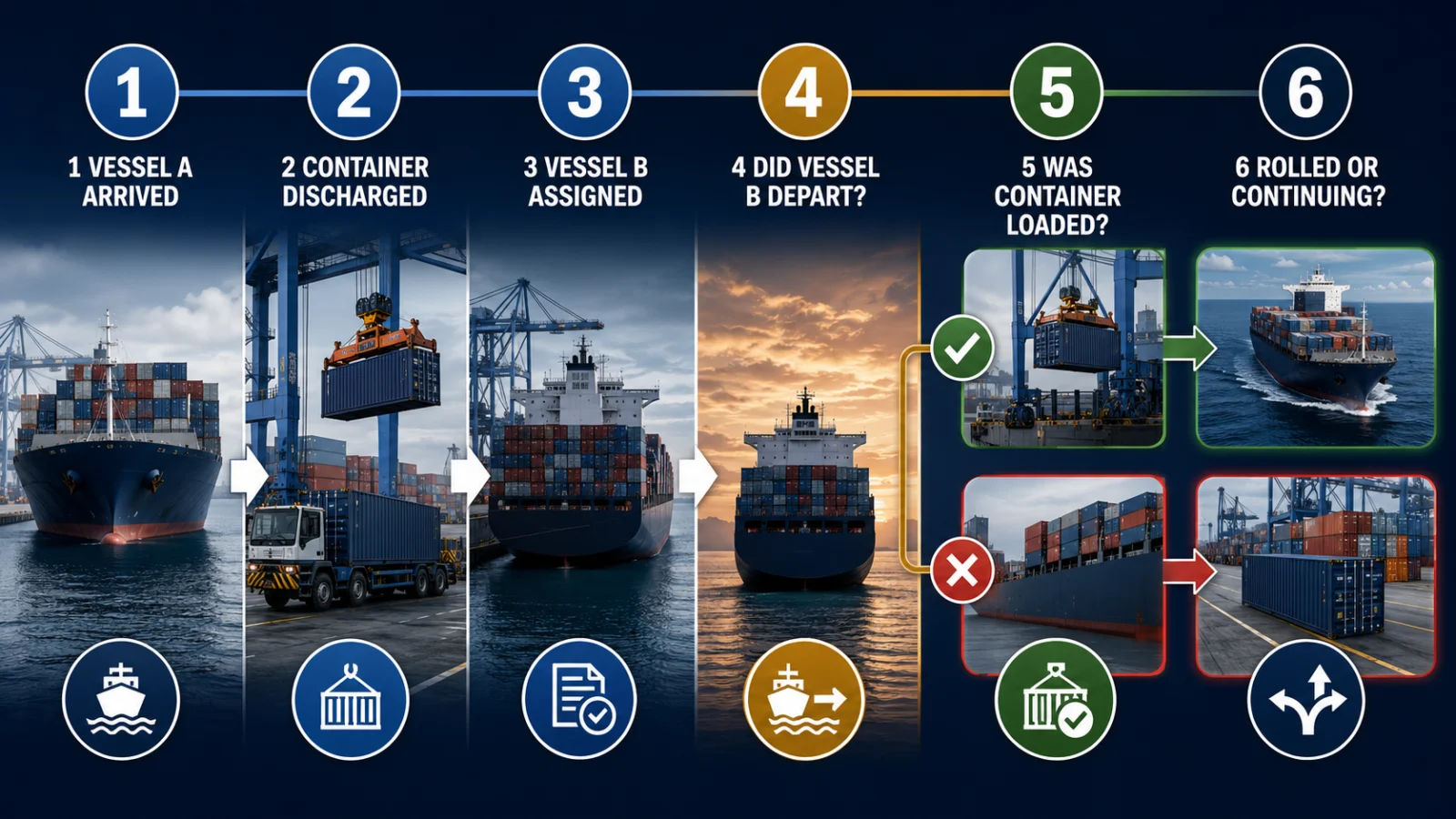
The fastest way to understand what happened is to stop looking only at the final ETA and reconstruct the connection: Vessel A arrival → container discharge → planned Vessel B → load event → Vessel B departure.
Direct answer
How do you know why your container is still at the transshipment port?
Confirm whether the first vessel arrived and your box was discharged. Then identify the vessel and voyage that were supposed to carry it out of the hub.
If that connecting vessel has not departed yet, your box may simply be waiting normally. If the vessel departed without a load event for your container and a new vessel or voyage later appears, the evidence increasingly points to a missed connection and rollover or rebooking.
First thing to check
“Discharged” is not automatically bad news
At a planned transshipment hub, discharge from the first vessel is expected. The box normally has to come off Vessel A before it can be loaded onto Vessel B.
The key question is what happened to the onward connection.
Normal transshipment
Discharged, next vessel pending
The box is ashore at the planned hub and the connecting vessel has not yet sailed.
Connection at risk
Departure is approaching
The next vessel is due to leave but there is still no confirmed loading event for the container.
Missed connection
Planned vessel departed
The intended onward vessel has sailed and the container does not appear to have loaded.
Rolled or rerouted
New plan appears
A replacement vessel, voyage, hub, feeder or alternative routing is assigned after the original connection fails or changes.
In this guide
- Normal transshipment sequence
- What “discharged” means
- Find the connecting vessel
- Check the connection window
- Confirm a missed connection
- Recognise a rollover
- Missed connection vs rollover
- Tracking silence and data lag
- AIS vs container tracking
- Carrier rerouting
- Documentation and manifest holds
- Other reasons a box waits at the hub
- Watch, verify or act
- Worked shipment example
- Verification boundaries
- Limitations
- FAQs
The normal transshipment sequence
Transshipment is a planned logistics process in which cargo transfers from one vessel to another at an intermediate port instead of travelling directly from origin to destination on one vessel.
Normal container transshipment path
DCSA’s Track & Trace framework treats load, discharge and transshipment milestones as distinct shipping events. This distinction matters because vessel movement and container movement are related but not identical.
Important: if the intermediate port was already part of the booked route, seeing your box discharged there is normally evidence that the first leg completed — not evidence that the carrier sent the container to the wrong destination.
What “discharged” at a transshipment port actually tells you
A discharge event normally means the container was removed from the vessel that carried it into the hub.
What it establishes
- the box reached the hub according to the reported milestone;
- the first ocean leg has generally ended;
- the container is expected to await its next movement.
What it does not establish
- that the next vessel is already confirmed;
- that the connection will be made;
- that the box has been rolled;
- that customs or manifest requirements are complete;
- that the revised final ETA is certain.
ONE’s July 2026 Manzanillo advisory provides a useful real-world example: transshipment cargo had already been discharged at the terminal but continued to face significant delay before onward loading because of congestion.
Editorial interpretation: “discharged” proves a movement happened. It does not prove the next movement happened.
Find the vessel that is supposed to carry the container next
Once discharge is confirmed, the most useful question becomes:
Which vessel and voyage are supposed to carry this container out of the hub?
Look for:
- the next vessel name;
- the connecting voyage number;
- planned departure from the transshipment port;
- planned destination or next hub;
- any updated carrier routing;
- the next expected loading milestone.
| Evidence | What it tells you | Strength |
|---|---|---|
| Container / booking tracking | Reported discharge, loading and routing milestones for your box | Strong shipment-specific evidence |
| Current carrier schedule | Which vessel and voyage are currently planned | Strong planning evidence |
| Carrier advisory | Whether the route, hub or service has changed | Strong operational evidence |
| Terminal information | Local congestion, operational constraints or cargo availability | Useful local evidence |
| AIS | Whether the planned connecting vessel arrived or departed | Useful vessel evidence |
The connection window is where many transshipment delays begin
A container cannot move onto Vessel B until Vessel A has arrived, the box has been discharged and the terminal has enough time to process the transfer.
Connection timing
This explains why a relatively modest delay on the first leg can produce a much larger final delay. If Vessel B sails only weekly, missing it by a few hours can translate into several additional days of waiting.
How to confirm a missed transshipment connection
The evidence becomes stronger when several milestones line up.
1
Confirm discharge
Your container reached the hub and was removed from Vessel A.
2
Identify Vessel B
Find the vessel and voyage originally planned for the onward leg.
3
Check Vessel B departure
Determine whether the planned connecting vessel has actually left the hub.
4
Look for the load event
Check whether your box was reported loaded before Vessel B departed.
5
Check replacement routing
See whether another vessel or voyage has appeared in the carrier record.
6
Verify with the carrier
Use carrier confirmation where the tracking sequence remains ambiguous.
Do not conclude “missed connection” merely because a load event has not appeared yet. If Vessel B has not departed, the box may still be moving normally through the terminal.
How to recognise that the container was rolled
A rollover means cargo originally intended for one sailing is moved to a later sailing.
Strong evidence can look like this:
Rollover evidence chain
Stronger rollover evidence
- carrier explicitly says the booking was rolled;
- vessel or voyage assignment changes after the original sailing departs;
- a replacement load event appears on a later vessel;
- the carrier provides a revised connection.
Weaker rollover evidence
- ETA changed;
- container is still shown at the hub;
- port is congested;
- no tracking event has appeared for several hours.
Missed connection and rollover are related — but not identical
A missed connection describes what happened operationally: the container did not make the intended onward vessel.
A rollover describes what happens to the cargo plan: the container is shifted from the intended sailing to a later one.
| Scenario | Missed connection? | Rollover? |
|---|---|---|
| Vessel A arrives late and the box misses Vessel B, then moves to Vessel C | Yes | Yes |
| Carrier removes cargo from Vessel B because of capacity and moves it to Vessel C | Not necessarily caused by inbound connection | Yes |
| Box waits at hub while Vessel B has not yet arrived | No evidence yet | No evidence yet |
| Original route is replaced with another hub or feeder | Possibly | May instead be a rerouting or contingency plan |
Windward’s operational delay taxonomy similarly distinguishes rollover, transshipment delay, insufficient transshipment time and route changes as separate conditions rather than treating every hub delay as the same event.
Tracking silence is not proof that the container stopped moving
Shipping tracking data can lag behind actual terminal operations.
DCSA has specifically identified inconsistent and delayed exchange of container tracking events as an industry problem and has standardised milestones such as load, discharge and transshipment to improve visibility.
No new tracking event
The data source has not published a new event yet.
Confirmed no onward movement
The carrier, terminal or later evidence establishes that the box did not make the planned next movement.
These are not the same conclusion. Treat missing data as uncertainty until stronger shipment-specific evidence appears.
AIS can confirm vessel movement, not container movement
AIS is particularly useful during transshipment because it can independently show whether Vessel A or Vessel B has arrived, waited or departed.
| Question | AIS | Container tracking |
|---|---|---|
| Did Vessel A reach the hub? | Useful | Often reflected through arrival/discharge milestones |
| Was my container discharged? | No | Yes, if carrier event is available |
| Did Vessel B depart? | Useful | Schedule or transport event may show it |
| Was my box loaded on Vessel B? | No | Shipment-specific load event is stronger evidence |
| Was the box rolled? | No | Carrier rebooking and changed vessel assignment are stronger evidence |
For the broader distinction between port-level disruption and shipment-specific evidence, see ThePulseSignal’s port disruption container shipment guide.
Sometimes the route changes instead of simply waiting for the next vessel
Carrier networks are dynamic. When a port, corridor or service becomes difficult to operate, cargo may be shifted through another transshipment hub, feeder or land connection.
Maersk’s 2026 network updates provide examples of transshipment traffic being moved away from an original hub and connected through alternatives such as Salalah or Khor Fakkan during wider route disruption.
Editorial interpretation: if the next vessel disappears from tracking but a different hub, vessel or service appears, the problem may be a network reroute rather than a simple rollover onto the next departure from the same port.
Documentation can also stop the next load
Not every rollover is caused by congestion or vessel delay.
Carrier policies can require complete shipping instructions or manifest information before cargo is allowed onto the next vessel. Maersk has documented cases where late shipping instructions or advance-manifest requirements can result in cargo being rolled, retained on board or held at a load port.
Operational cause
Capacity, congestion, vessel delay, schedule recovery or insufficient connection time.
Documentation cause
Shipping instructions, manifest approval or other required filing was not completed in time.
Network cause
Carrier changes the service, transshipment hub, feeder or onward route.
This is why a carrier message or booking record is often necessary before assigning a definitive cause.
Other reasons a container can remain at the hub
- terminal congestion;
- late inbound vessel;
- insufficient connection time;
- capacity shortage on the next vessel;
- blank sailing;
- port omission;
- feeder delay;
- route restructuring;
- customs or manifest requirements;
- dangerous-goods documentation;
- carrier operational hold;
- tracking-event publication delay.
A changed ETA is not the cause. It is a symptom that tells you the shipment plan changed somewhere. The milestone sequence and carrier evidence are needed to determine why.
Watch, verify or act
1
WATCH
The box is discharged at the planned hub, the connecting vessel has not departed and the connection remains in the current carrier schedule.
2
VERIFY
The connection window is narrowing, tracking is silent, the vessel assignment changed or the next ship appears ready to depart without a load event.
3
ACT
The planned vessel departed without the box, the carrier confirmed rollover, documentation is blocking loading or a new route materially changes delivery planning.
Worked example: reconstruct the transshipment instead of guessing from ETA
Assume a container is booked from India to Europe through a major Asian hub.
| Evidence | What you can conclude |
|---|---|
| Vessel A arrived at the hub | The inbound vessel reached the connection port. |
| Container tracking shows “discharged” | The box was removed from Vessel A and the first leg completed. |
| Vessel B is scheduled to depart tomorrow | The connection is still possible; no rollover is established. |
| Vessel B departs and no load event appears | The original connection may have been missed and should be verified. |
| Carrier tracking now assigns Vessel C three days later | There is strong evidence the shipment has been rebooked or rolled to a later connection. |
| Carrier advisory instead sends the shipment through another hub | The cargo is being rerouted rather than simply waiting for Vessel C at the original hub. |
This is substantially more reliable than saying:
“The ETA changed, so the port must be congested.”
Where this fits in the TPS shipment-diagnostics cluster
Related TPS shipping guide
Port disruption: is your container actually affected?
Use this when the starting problem is a wider port, terminal or shipping disruption and you need to determine whether it intersects with your specific shipment.
Transshipment diagnosis
This guide begins one step later: your box has reached or is expected at an intermediate hub and you need to determine what happened to the onward connection.
Verification notes: confirmed, interpreted and not established
Confirmed
- Transshipment normally involves discharge and later loading onto another vessel.
- DCSA treats load, discharge and transshipment as distinct tracking events.
- Containers can remain delayed at hubs after discharge.
- Carrier policies can cause rollover for operational or documentation reasons.
Carrier / industry examples
- ONE documented significant delay to already-discharged transshipment cargo at Manzanillo.
- Maersk has rerouted transshipment cargo through alternative hubs during network disruption.
- Maersk has documented documentation-related cargo rollover conditions.
TPS interpretation
- Vessel B departure without a load event materially strengthens missed-connection suspicion.
- A later vessel assignment materially strengthens rollover evidence.
- Tracking silence should remain uncertainty until stronger evidence appears.
Not established by one status
- that the container was definitely rolled;
- that congestion caused the delay;
- that the carrier lost the container;
- that the next ETA is final;
- that additional charges will apply.
Verification method
ThePulseSignal reviewed DCSA tracking and transshipment standards to separate vessel, transport and equipment events; CMA CGM’s DCSA-based tracking implementation for discharge and re-loading event structure; ONE’s 2026 Manzanillo transshipment-delay advisory; Maersk operational material covering hub rerouting and documentation-related rollover; and shipping-industry material describing missed connections and rollover behaviour.
General port disruption, individual container milestones, vessel movement, carrier rebooking and routing changes are treated as different evidence layers rather than merged into one conclusion.
Limitations and unresolved facts
No public guide can determine the live state of an individual container without its current booking, carrier, container, vessel and voyage information.
- A discharge event does not prove that the next connection has been missed.
- A missing load event can reflect tracking latency rather than physical non-movement.
- AIS tracks vessels, not individual containers.
- A vessel departure without a visible load event is an investigation signal; carrier confirmation or later vessel assignment provides stronger rollover evidence.
- Carrier terminology and tracking-event timing can vary.
- Different terminals and carriers publish different levels of operational detail.
- Blank sailing, port omission, rollover and rerouting are separate events even when they produce similar ETA changes.
- Documentation, customs or manifest requirements can prevent loading even when there is available vessel capacity.
- A new vessel assignment may itself change again during network recovery.
- Demurrage, detention and storage treatment depends on the carrier, terminal, contract and local tariff.
Container stuck transshipment port: frequently asked questions
Is “discharged” at a transshipment port normal?
Yes, if the port is the planned transshipment hub. The container normally has to be discharged from the first vessel before being loaded onto the connecting vessel.
How do I know if my container missed its connecting vessel?
Confirm the planned connecting vessel and voyage, determine whether it has departed and check whether your container shows a corresponding load event. If the vessel departed without the box and another vessel later appears, the evidence of a missed connection becomes much stronger.
How do I know if my container was rolled?
The strongest evidence is carrier confirmation or a change from the original vessel and voyage to a later vessel or voyage after the original sailing departs.
Does no tracking update mean my container is stuck?
No. Tracking data can lag behind actual operations. A missing update should be treated as uncertainty until a carrier, terminal or later milestone confirms the shipment state.
Can I use vessel tracking to see whether my container made the connection?
You can use AIS to determine whether the connecting vessel arrived or departed, but AIS cannot prove that your individual container was loaded. Container or booking tracking is stronger for that question.
Why would a container be rolled if the port is not congested?
Capacity, late inbound arrival, insufficient connection time, documentation, manifest approval, schedule recovery or other carrier operational decisions can cause a rollover even without severe general port congestion.
Can the carrier change the transshipment port?
Yes. During operational disruption, carriers can revise the route, use another hub or change the feeder or connecting service. Check the latest booking route rather than relying only on the original booking confirmation.
Does a revised ETA prove the container was rolled?
No. An ETA change only proves the expected timing changed. You need vessel, voyage, milestone or carrier evidence to determine whether the cause was rollover, missed connection, congestion, rerouting or something else.
Bottom line
When a container is stuck at a transshipment port, do not begin with the final ETA. Reconstruct the connection.
Best evidence chain: Vessel A arrived → container discharged → Vessel B identified → Vessel B departure checked → load event checked → replacement vessel or reroute verified.
If Vessel B has not departed, the shipment may still be progressing normally. If Vessel B departed without the container and a new vessel or voyage later appears, the evidence increasingly supports a missed connection and rollover.
Last verified: August 22, 2026. This guide reflects current DCSA tracking concepts and current carrier examples showing that discharged transshipment cargo can remain delayed because of connection, capacity, network-routing or documentation constraints.