







Adobe Commerce and Magento operators still need the dedicated CVE-2026-75650 hotfix, and Adobe’s September 16 guidance makes the remediation boundary clearer. Adobe says the CVE-2026-75650 hotfix is not included in the September Isolated security patch and should be applied separately. Adobe also strongly recommends rotating encryption keys and associated credentials as part of remediation. CISA continues to list the vulnerability in its Known Exploited Vulnerabilities catalog because of active exploitation.
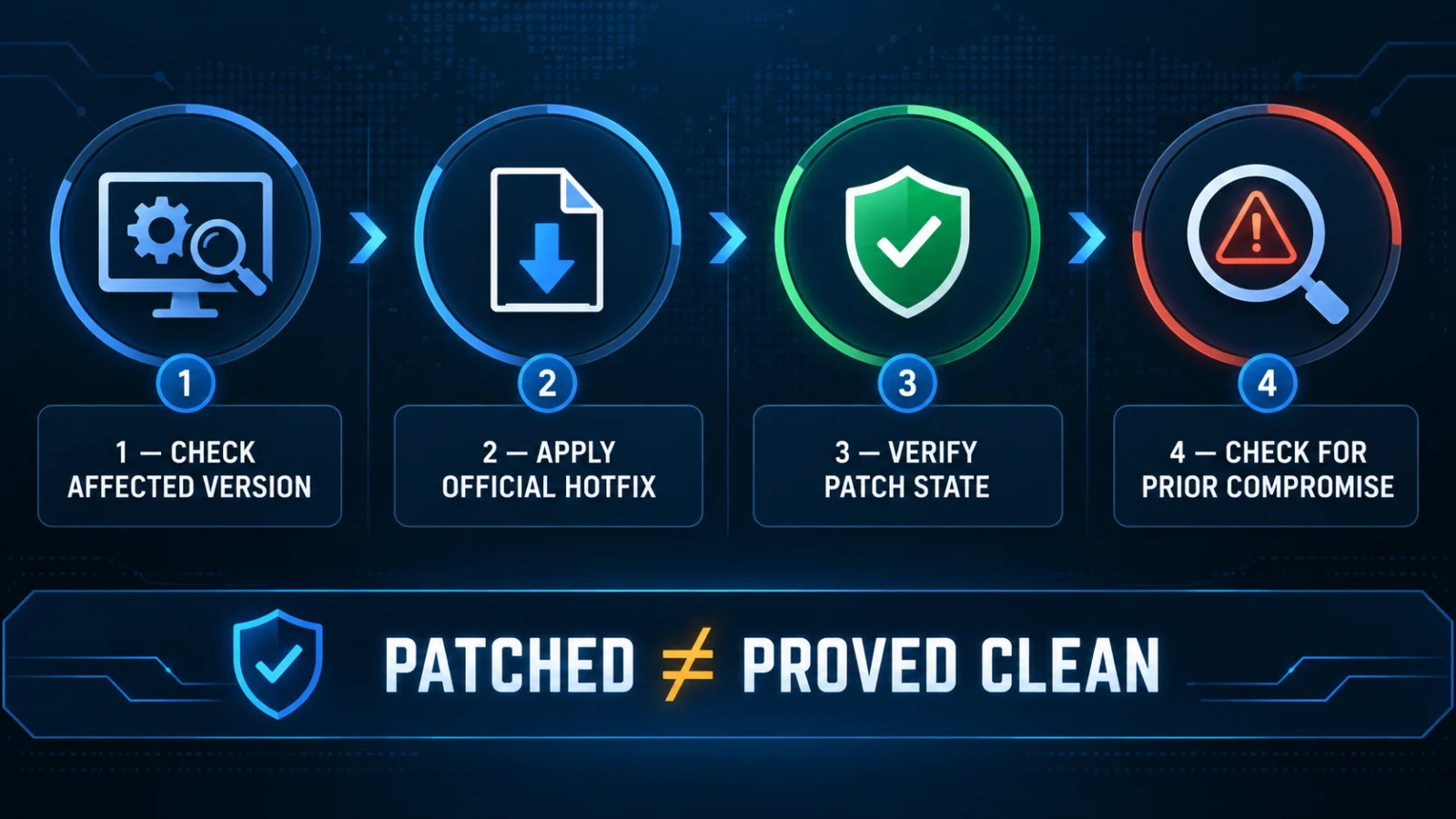
Direct answer: if your deployment is affected, do not treat the September 2026 Commerce security patch alone as complete CVE-2026-75650 remediation. Apply Adobe’s dedicated hotfix, apply the applicable September security patch for your supported branch, rotate encryption keys and associated credentials in line with Adobe guidance, verify the resulting state, and investigate possible pre-patch compromise separately.
What does Adobe currently require for CVE-2026-75650?
Adobe’s controlling CVE bulletin remains APSB26-146. Adobe rates CVE-2026-75650 Critical with a CVSS score of 10.0, says authentication is not required for exploitation and confirms that exploitation has occurred in the wild.
The vulnerability is an improper-neutralization issue in a template engine that can result in arbitrary code execution.
Adobe’s current Commerce guidance says operators must apply the CVE-2026-75650 hotfix separately from the September security patch. Adobe’s September 16 guidance explicitly says the hotfix is not included in the September Isolated patch file.
Does the September Commerce security patch include the CVE-2026-75650 hotfix?
No. Adobe’s September 16 Commerce guidance says the APSB26-146 hotfix for CVE-2026-75650 is not included in the September Isolated patch file.
Adobe says the hotfix can be applied before or after the September Isolated patch and that no specific installation order is required. Because CVE-2026-75650 is actively exploited, Adobe recommends applying the hotfix as soon as possible.
What changed with credential and encryption-key guidance?
Adobe’s current urgent-action guidance instructs affected operators to apply the patch and rotate encryption keys. Its September 16 guidance also strongly recommends rotating encryption keys and associated credentials as part of remediation.
This is now part of the official Adobe remediation path, not only a threat-research recommendation. Operators should follow Adobe’s current product instructions and their incident-response process for the exact keys, credentials and secrets that need rotation.
Changing encryption keys or credentials does not by itself prove that a previously exposed system was not compromised. Patching, credential containment and compromise verification remain separate tasks.
What does CISA’s KEV listing mean now?
CISA added CVE-2026-75650 to its Known Exploited Vulnerabilities catalog on September 8, 2026, citing evidence of active exploitation.
The KEV record assigned a September 11, 2026 remediation due date for covered U.S. Federal Civilian Executive Branch agencies under BOD 26-04 and required forensic triage under that directive. That deadline has now passed.
The September 11 date was not a universal private-sector deadline. For private Adobe Commerce and Magento operators, KEV status remains strong prioritization evidence, but the controlling remediation instructions come from Adobe and the organization’s own incident-response requirements.
Which September Adobe Commerce versions are available?
APSB26-138 provides September 2026 security fixes for supported Adobe Commerce, Adobe Commerce B2B and Magento Open Source branches.
Adobe lists September builds or isolated security fixes across supported branches, but operators should use Adobe’s live tables and release guidance for their exact product and version rather than relying on a shortened list.
The important CVE-2026-75650 point is unchanged: Adobe says the separate APSB26-146 hotfix is still required in addition to the September security patch.
What affected operators should do now
1. Identify the exact deployed version. Confirm the Adobe Commerce, Adobe Commerce B2B or Magento Open Source branch and patch level actually running in production.
2. Compare it against APSB26-146. Determine whether the deployment falls within Adobe’s affected-version table for CVE-2026-75650.
3. Apply Adobe’s dedicated CVE-2026-75650 hotfix. Do not assume the September Isolated security patch includes it.
4. Apply the applicable September security patch. Use Adobe’s current APSB26-138 guidance for the supported branch.
5. Rotate encryption keys and associated credentials. Follow Adobe’s current Commerce guidance and your incident-response process for the exact secrets that require rotation.
6. Verify the patched state. Confirm the hotfix and September security patch were applied successfully in the production environment.
7. Investigate possible earlier compromise. A store exposed before remediation should be assessed for evidence of exploitation, persistence or secondary attacker activity.
8. Apply organization-specific KEV obligations. Covered U.S. federal civilian agencies should verify closure of the September 11 BOD 26-04 remediation and forensic-triage requirements.
Does applying the patches and rotating keys prove the store is clean?
No. Remediation and compromise verification remain separate security questions.
Applying the September security patch, the dedicated CVE-2026-75650 hotfix and key or credential rotation addresses current remediation requirements. None of those actions can retrospectively prove that an exposed system was not compromised before remediation.
Sansec observed exploitation beginning on September 4, before Adobe’s emergency hotfix became available on September 7. Its investigation documented malicious background processes, persistence behaviour, changing implant variants and additional attacker activity.
Those findings establish that real compromise occurred on some stores. They do not prove that every affected Adobe Commerce or Magento deployment was compromised.
What compromise evidence has been reported?
Sansec’s StyleSmuggler investigation describes suspicious processes, persistence locations, command-and-control infrastructure and attack-request patterns associated with observed exploitation.
The researchers also reported that attacker payloads changed rapidly during the campaign.
Published indicators are useful investigative leads, not an exhaustive proof test. Attackers can change filenames, infrastructure, payloads and persistence methods.
What if none of the published indicators are present?
Absence of a published IOC does not establish that the store is clean.
For a materially exposed system, operators should assess broader evidence such as web and application logs, filesystem changes, unexpected processes, scheduled tasks, credentials, administrative actions, deployment history and other host or security telemetry available for the exposure period.
The appropriate depth of investigation depends on the store’s exposure, business impact, available evidence and incident-response requirements.
What is different about APSB26-138?
APSB26-138 is the broader September Commerce security update and addresses vulnerabilities separate from CVE-2026-75650.
Adobe says it is not aware of exploitation in the wild for the vulnerabilities fixed by APSB26-138 itself. That statement should not be confused with CVE-2026-75650: Adobe separately confirms active exploitation of CVE-2026-75650 in APSB26-146.
Adobe’s September 16 guidance also clarifies that the September Isolated patch does not contain the APSB26-146 hotfix.
What is confirmed and what remains unresolved?
Confirmed: Adobe published APSB26-146 on September 7; CVE-2026-75650 is Critical, CVSS 10.0, unauthenticated and exploited in the wild; Adobe provides a dedicated hotfix; the September Isolated security patch does not include that hotfix; Adobe recommends rotating encryption keys and associated credentials; and CISA added the CVE to KEV.
Confirmed from direct incident research: exploitation was observed before the Adobe hotfix, and Sansec documented evolving malicious processes, persistence and additional attacker activity.
Still unresolved: no authoritative global victim count is established, the complete attacker population and IOC set may evolve, and public evidence cannot determine whether an individual store was compromised.
What should operators monitor next?
- changes to Adobe APSB26-146 or its hotfix installation guidance;
- changes to Adobe’s September security-patch guidance or future integration of the CVE fix into later releases;
- new Adobe guidance on encryption-key or associated-credential rotation;
- new StyleSmuggler compromise indicators or attacker techniques;
- changes to CISA KEV or BOD 26-04 guidance; and
- evidence of persistence or exploitation after remediation.
Verification method
ThePulseSignal checked Adobe’s APSB26-146 bulletin, Adobe’s urgent Commerce guidance, Adobe’s September 16 APSB26-138 Commerce guidance, CISA’s KEV listing and September 8 alert, and Sansec’s StyleSmuggler investigation.
Limitations and unresolved facts
Public evidence cannot establish whether a specific Adobe Commerce or Magento store was compromised. The complete victim count, attacker scope and future IOC set remain unknown. CISA’s September 11 deadline applied to covered U.S. federal civilian agencies, not every private organization. Operators should check Adobe’s live guidance before production changes because supported-version and remediation instructions can change.
Bottom line: operators should treat the September Commerce security patch and the CVE-2026-75650 hotfix as separate required actions. Adobe’s current guidance also calls for encryption-key and associated-credential rotation, while any store exposed before remediation still needs a separate compromise assessment.
Last verified: September 18, 2026.