





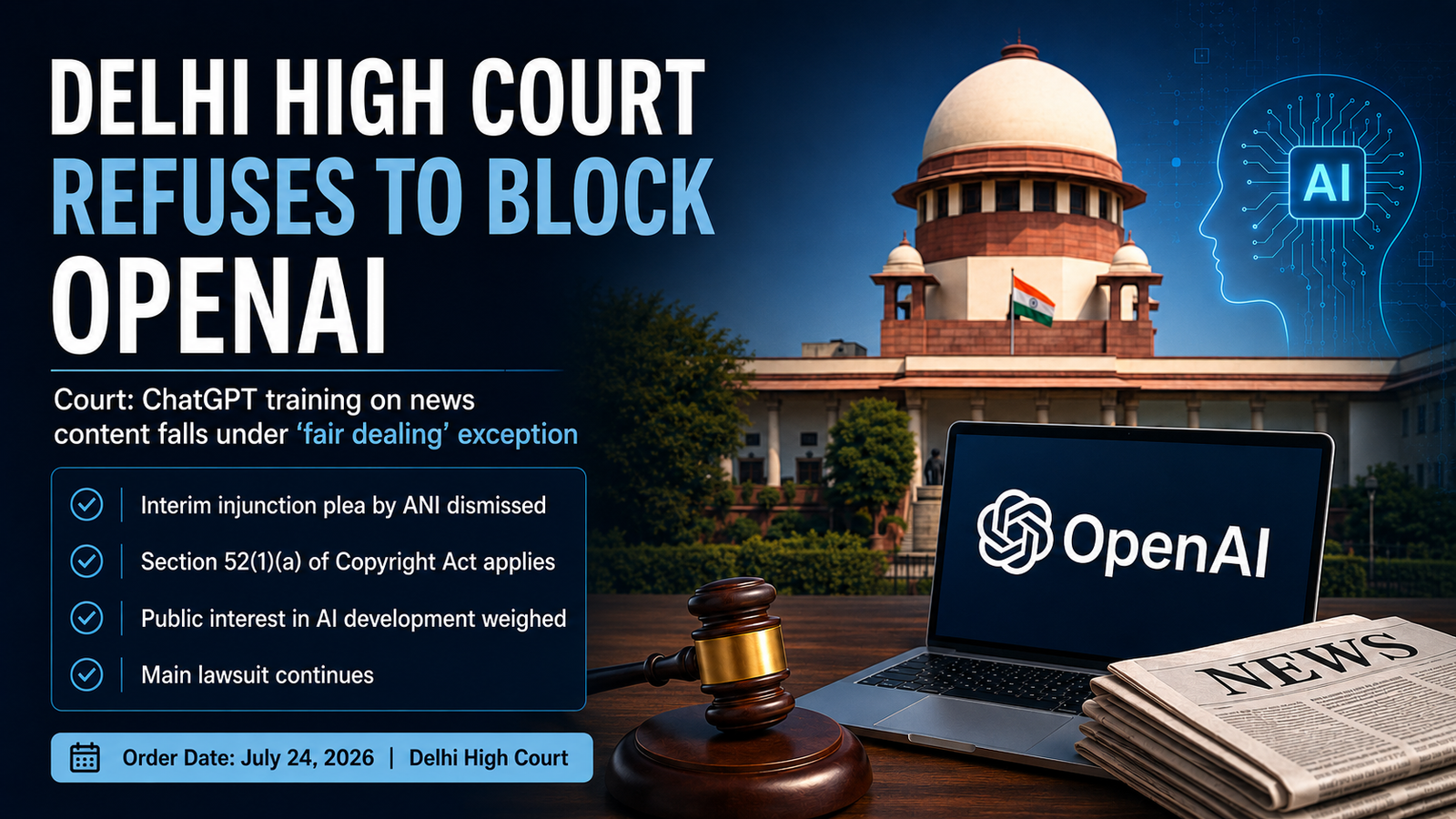
The ANI OpenAI ChatGPT interim ruling from the Delhi High Court refused ANI’s request for a temporary order restraining OpenAI from using its news content in training the models underlying ChatGPT. At this preliminary stage, the court found OpenAI’s storage and use of ANI’s works prima facie covered by the Copyright Act’s fair-dealing exception for research. ANI’s main copyright lawsuit remains pending.
This is an interim ruling, not the final judgment in the ANI–OpenAI copyright dispute. The court’s findings are prima facie and may be reconsidered after evidence is examined during the trial.
ANI OpenAI ChatGPT interim ruling: what the Delhi High Court decided
On July 24, 2026, Justice Amit Bansal dismissed the interim injunction application filed by Asian News International against OpenAI.
ANI had asked the court to restrain OpenAI from accessing, storing, reproducing or otherwise using its copyrighted reports in connection with ChatGPT and the large language models that power it.
The court did not finally dispose of those allegations. It concluded that ANI had not established the requirements for interim relief on the evidence presented at this stage.
The full July 24 order can be read in the Delhi High Court judgment reproduced by Indian Kanoon.
Why the court refused interim relief
1. AI training was prima facie treated as research
The court took the preliminary view that storing ANI’s literary works for training the models underlying ChatGPT fell within “private or personal use, including research” under Section 52(1)(a) of the Copyright Act, 1957.
The reasoning distinguishes model training from publishing or communicating copies of the original articles to the public. The court observed that training material is used to enable a model to generate new responses and perform tasks when prompted.
2. ANI did not establish substantial reproduction at this stage
The court examined examples relied on by ANI and found that the ChatGPT responses shown were not substantially similar reproductions or nearly exact copies of ANI’s reports.
It also found that ANI had not yet demonstrated that ChatGPT memorised and regurgitated its articles. The court said these disputed questions may require evidence during the trial.
3. The prompts relied on by ANI were examined closely
The order noted that some prompts were detailed, repeated or asked for exact material. Even after those prompts, the court was not satisfied that the resulting responses amounted to substantial reproduction of ANI’s copyrighted expression.
This finding was limited to the evidence before the court at the interim stage. It does not mean every possible AI-generated output is automatically lawful.
4. Public interest formed part of the interim-relief analysis
The court considered the balance of convenience and potential harm to both OpenAI and the public. It concluded that an interim injunction could cause greater prejudice than refusing one while the main case continues.
This was part of the court’s decision on temporary relief. It was not a final declaration that all AI training serves the public interest or that copyright owners cannot succeed in later proceedings.
5. Delhi had jurisdiction to hear the dispute
OpenAI had challenged the Delhi High Court’s territorial jurisdiction. The court accepted that Indian courts could exercise jurisdiction in relation to OpenAI’s services being made available to users in India, including Delhi, while the broader copyright dispute remained before the court.
What the ANI OpenAI ChatGPT interim ruling means
What it means now
- OpenAI is not subject to the interim restraint ANI requested.
- The court has taken a preliminary view that the training use shown in this case falls under fair dealing for research.
- ANI did not establish substantial reproduction or memorisation on the present evidence.
- The main copyright lawsuit remains active.
What it does not mean
- It is not a blanket licence to use every copyrighted work for every AI purpose.
- It is not a final judgment resolving ANI’s copyright claims.
- It does not establish that every ChatGPT output is non-infringing.
- It does not prevent the court from reaching different conclusions after a full trial.
Why this ruling matters for AI companies and publishers
The ANI OpenAI ChatGPT interim ruling is one of India’s first substantive judicial assessments of whether copyrighted news material may be used to train large language models without a licence.
For AI developers, the order provides preliminary legal support for the argument that model training can qualify as research under India’s fair-dealing framework in the circumstances examined by the court.
For publishers and other copyright owners, the decision shows that a successful claim may require detailed evidence of how specific works were stored, reproduced, memorised or generated in substantially similar form.
The ruling leaves unresolved broader questions about licensing, compensation, attribution and the legal treatment of AI training when the main suit is finally decided.
What happens next in ANI vs OpenAI?
ANI’s main copyright suit against OpenAI remains pending. The parties may present fuller technical and legal evidence concerning training data, model behaviour, reproduction and the application of copyright exceptions.
The July 24 order itself states that its observations were made only for deciding the interim application and would have no bearing on the final outcome of the suit.
Any later appeal order, modification or final judgment that changes the answer to this dispute should be treated as a substantive development and updated on this same TPS URL.
Frequently asked questions
What is the ANI OpenAI ChatGPT interim ruling?
It is the Delhi High Court’s July 24, 2026 decision refusing ANI’s request for an interim injunction against OpenAI while ANI’s broader copyright suit continues.
Did the Delhi High Court finally rule that AI training is legal in India?
No. The court refused interim relief in this specific dispute and expressed prima facie views. The main lawsuit remains pending.
Can OpenAI continue using ANI material for training?
OpenAI was not restrained by the interim order sought by ANI. The legal position may still be affected by later proceedings or the final outcome of the suit.
What is fair dealing under Indian copyright law?
Section 52 of the Copyright Act identifies specified acts that do not constitute copyright infringement. The provision includes fair dealing for purposes such as private or personal use, including research, subject to the circumstances and legal requirements applicable to the particular use.
Did the court find that ChatGPT never reproduces copyrighted content?
No. The court found that ANI had not established substantial reproduction or memorisation using the examples and evidence presented at the interim stage.
Is this ruling binding on every future AI copyright case?
No. This is an interim ruling arising from the facts, evidence and legal arguments in this particular case. Other disputes may involve different facts, evidence and legal issues.
Verification and methodology note
This article is based on the Delhi High Court’s July 24, 2026 decision in ANI Media Pvt. Ltd. v. Open AI OpCo LLC, concerning ANI’s application for interim relief in its copyright lawsuit against OpenAI.
ThePulseSignal reviewed the judgment text and cross-checked the central findings with Reuters’ reporting on the ANI–OpenAI ruling.
The central findings checked were the refusal of interim relief, the court’s prima facie treatment of OpenAI’s training use under Section 52(1)(a), the absence of demonstrated substantial similarity or memorisation on the evidence presented, the public-interest analysis and the territorial-jurisdiction issue.
What remains pending: the final determination of ANI’s copyright claims and any later appellate or trial-stage development that could alter the preliminary legal position described in this article.
Article last verified: July 25, 2026.