




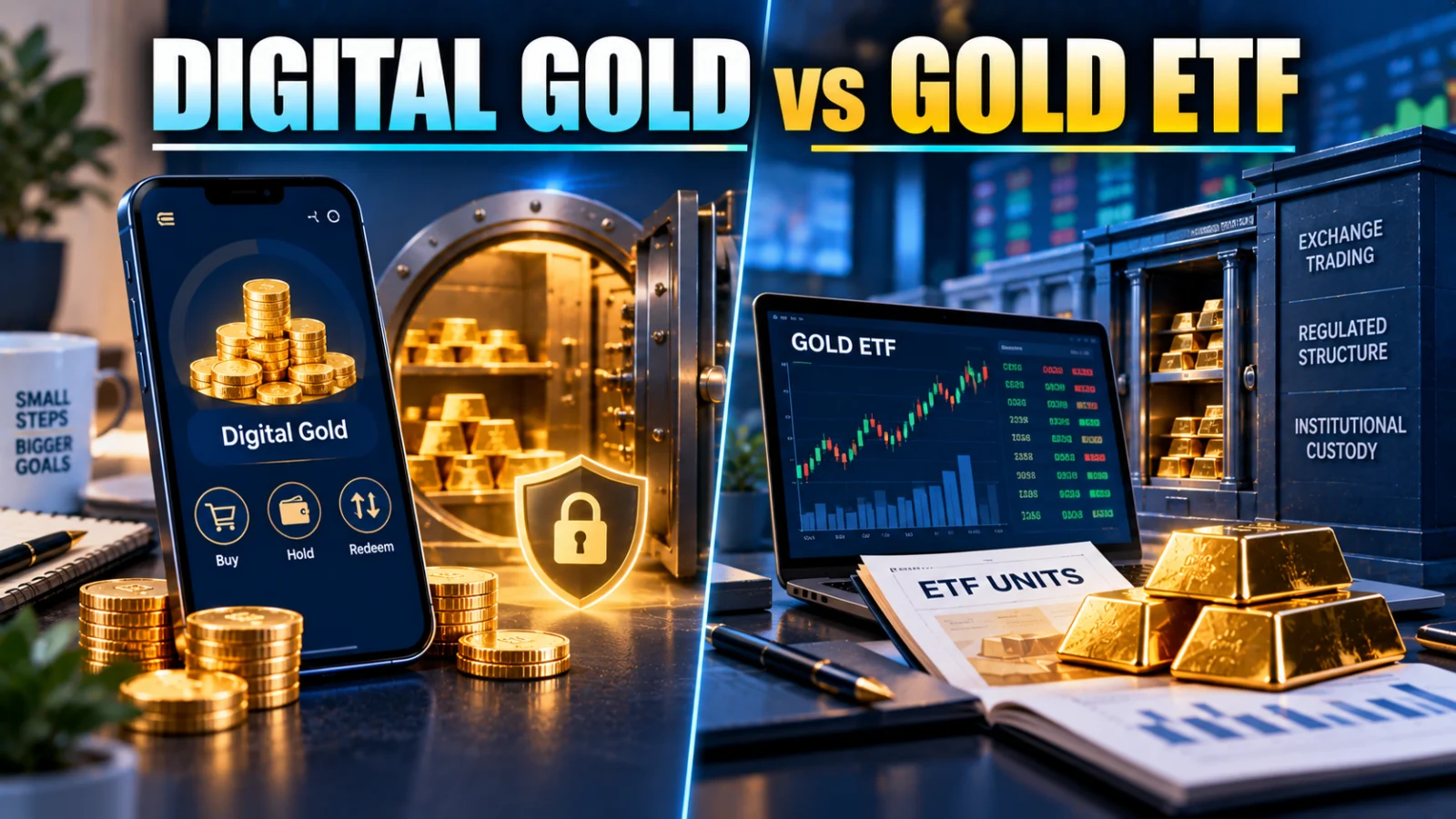
Digital gold and a Gold ETF are not legally or structurally the same investment in India. Both may give you economic exposure to gold prices, but the regulatory framework, what you hold, how custody works, the role of intermediaries and the investor-protection framework are materially different.
The most important distinction is regulatory. SEBI warned on November 8, 2025 that online products commonly marketed as Digital Gold or E-Gold sit outside SEBI’s securities-market regulatory framework. SEBI separately identified regulated gold-investment routes such as Gold ETFs, exchange-traded commodity derivatives and Electronic Gold Receipts.
That means an app showing both products under the word “gold” does not make them legally interchangeable.
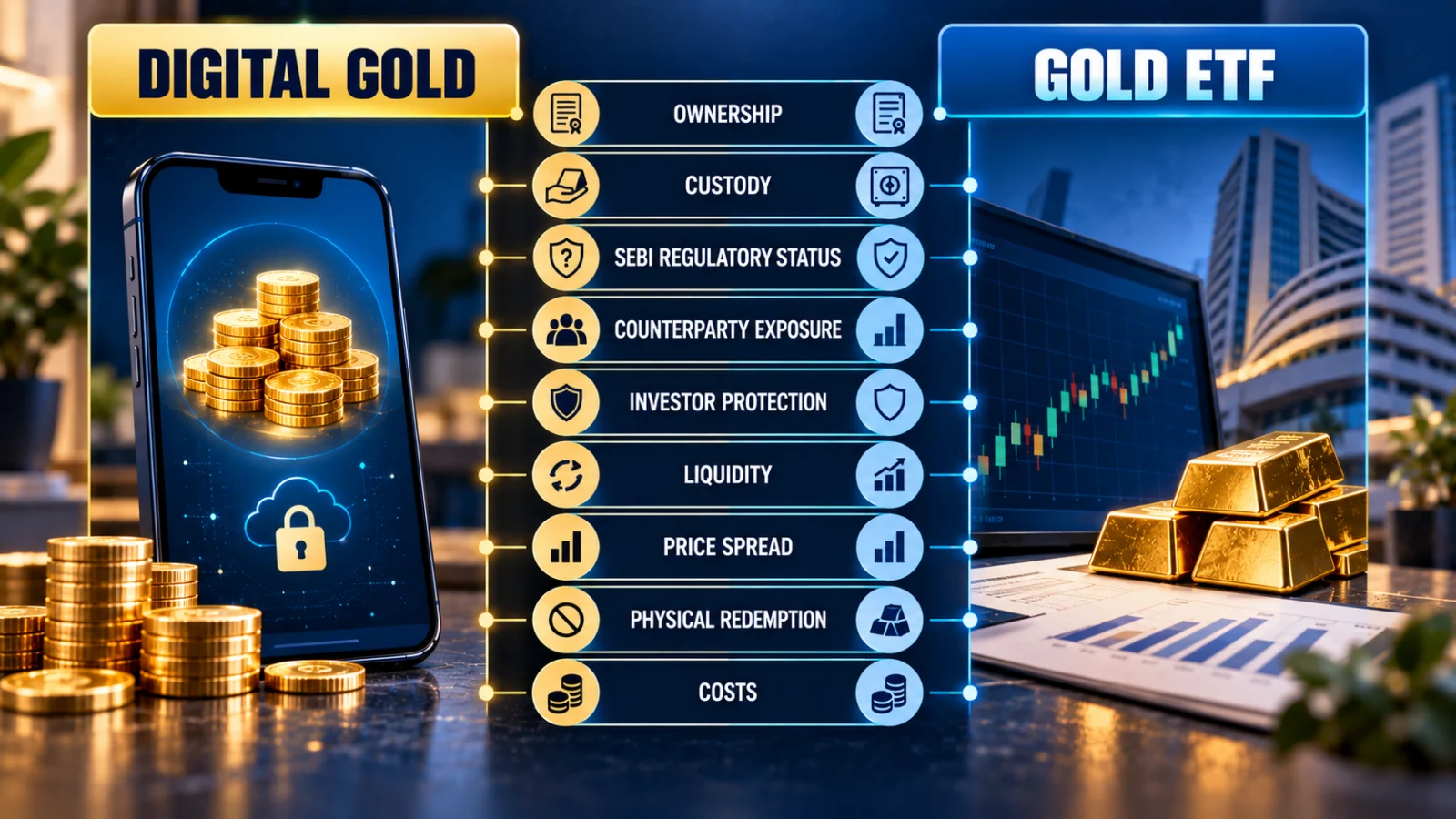
| Question | Digital gold | Gold ETF |
|---|---|---|
| Regulatory position | SEBI has cautioned that the digital-gold products covered by its warning are outside its securities-market regulatory framework | Operates within the SEBI-regulated mutual-fund and securities-market framework |
| What the investor holds | Depends on the provider’s contractual structure and terms for the digital-gold balance | ETF units representing an interest in the mutual-fund scheme |
| Where it is held | Provider-specific arrangement that must be checked in the platform’s current terms | ETF units are held through the securities-market/demat framework; the scheme’s underlying assets are held under the fund’s custody arrangements |
| Investor protection | SEBI said securities-market investor-protection mechanisms are not available for the digital-gold products covered by its caution | Falls within the regulatory framework applicable to mutual funds, exchanges, depositories and other regulated market intermediaries |
| Trading/liquidity route | Buying and selling normally depend on the platform/provider’s terms and quoted prices | ETF units trade on a stock exchange during market hours, subject to market liquidity |
| Physical redemption | May be offered by individual providers subject to their minimum quantity, fabrication, delivery and other terms | Retail ETF investors should not assume ordinary ETF units automatically provide small-quantity physical delivery; scheme-specific redemption rules apply |
| Main structural risk to inspect | Provider, counterparty, custody and contractual arrangement | Market price, tracking difference, liquidity, scheme expenses and securities-market operating risks |
Why SEBI’s digital-gold warning matters
SEBI’s November 2025 caution is stronger than a simple product-preference statement. The regulator said investors should understand that digital-gold products offered through online platforms are different from securities-market gold products regulated by SEBI.
SEBI specifically warned that such digital-gold products may expose investors to counterparty and operational risks. It also stated that the investor-protection mechanisms available under the securities-market framework are not available for those products.
This does not mean every digital-gold provider must fail or that every digital-gold purchase is automatically unsafe. It means the investor should not assume the same regulatory protections merely because the asset displayed on screen is gold.
What do you actually own with a Gold ETF?
When you buy a Gold ETF, you buy units of a regulated mutual-fund scheme. Those units trade on a stock exchange and are normally held in demat form.
The scheme then holds its permitted underlying gold exposure according to its scheme documents and the regulatory framework. The investor therefore owns ETF units rather than a specific retail gold bar sitting separately under the investor’s personal name.
This distinction matters because the legal relationship is with the regulated scheme and its units, while custody of scheme assets is handled through the fund’s regulated institutional structure.
What do you actually own with digital gold?
Digital gold requires a more provider-specific answer.
The app may show a quantity of gold credited to your account, but the legal and contractual arrangement behind that balance depends on the provider’s current terms. Investors should check who sells the gold, who is responsible for custody, whether the gold is described as allocated or otherwise identified, whether a trustee or custodian is involved, what records establish the customer’s claim and what the contractual remedy is if a provider or intermediary fails.
TPS should not treat all digital-gold products as having one universal ownership or custody structure. SEBI’s warning establishes the regulatory boundary, but the detailed contractual structure must still be checked provider by provider.
Who holds the physical gold?
With a Gold ETF, the scheme’s underlying assets are held within the mutual-fund’s institutional custody structure under the applicable scheme and regulatory framework.
With digital gold, custody can involve the seller, vault provider, trustee or another contractual arrangement depending on the service. The investor must read the actual provider terms rather than assuming the gold is held in the same way as a regulated ETF’s underlying assets.
This is one reason the two products should not be treated as interchangeable merely because both reference physical gold.
Counterparty risk: where the difference becomes practical
SEBI’s digital-gold caution explicitly highlights counterparty and operational risks.
In practical terms, a digital-gold investor depends on the contractual chain behind the platform: the entity selling or recording the gold, the custody or vault arrangement, payment and settlement systems, redemption arrangements and the provider’s ability to honour the customer’s claim.
A Gold ETF also has operational dependencies and is not risk-free. However, its fund, exchange, depository, custody and investor-facing structure sits inside the regulated securities-market architecture.
The question is therefore not whether one product has “risk” and the other has none. The important question is which risks exist, who regulates the structure and what remedies or investor protections apply if something goes wrong.
What happens if the digital-gold provider fails?
This is one of the most important questions — and it cannot be answered universally without the provider’s contractual terms.
SEBI has warned that securities-market investor-protection mechanisms do not apply to the digital-gold products covered by its caution. That means an investor should not assume that the safeguards and grievance structures associated with SEBI-regulated securities automatically protect a digital-gold balance.
The practical outcome if a provider fails can depend on how the customer’s gold claim is legally structured, whether assets are segregated, how custody is documented, the contractual rights against the seller or custodian and any applicable insolvency or dispute process.
Before investing, the reader should therefore verify these questions in the provider’s current terms rather than relying only on marketing statements such as “24K gold”, “insured vault” or “100% backed”. Those descriptions alone do not establish the complete legal failure-resolution framework.
What happens if an ETF intermediary fails?
A Gold ETF should also not be described as immune from operational or intermediary failure. The difference is that the investor’s ETF units and the fund’s assets operate within a regulated market structure involving the mutual fund, asset-management company, trustee, custodian, exchange, broker and depository framework as applicable.
Failure of one intermediary is therefore not the same legal situation as failure of an unregulated digital-gold provider. The exact consequence still depends on which intermediary failed and the applicable regulatory process.
Liquidity: app sale versus exchange sale
Digital-gold liquidity generally depends on the provider’s platform and its buy/sell terms. The price shown to purchase gold and the price offered when selling it back may differ, creating a spread. Provider-specific minimums, settlement rules or temporary operational limits can also matter.
A Gold ETF trades on a stock exchange. Investors place buy or sell orders through the market, and the execution price depends on available liquidity and the bid-ask spread. The ETF’s traded price can also differ somewhat from its underlying net asset value.
Neither route should therefore be described as having a single universal “gold price”. Execution mechanics matter.
Price spread and tracking
For digital gold, an investor should compare the provider’s purchase price with the price available for immediate resale. Taxes, platform pricing, fabrication and delivery terms can also affect the total economics depending on the transaction.
For a Gold ETF, the important measures are different: exchange bid-ask spread, scheme expenses and how closely the ETF tracks its underlying gold benchmark over time.
A comparison that looks only at the headline gold price can therefore miss the actual cost of entering, holding and exiting either product.
Can both be converted into physical gold?
Digital-gold platforms may offer physical redemption, but provider-specific conditions can include minimum quantities, fabrication charges, delivery charges, available products and delivery restrictions.
A Gold ETF should not be purchased on the assumption that a small retail holding can always be converted directly into a physical coin or bar. Physical creation or redemption facilities can operate at larger institutional-unit levels or under scheme-specific conditions.
If physical delivery is an important reason for choosing a product, verify the current redemption rules before investing.
Storage: who pays and who controls it?
Digital-gold marketing may describe storage as free for a period or included in the service. That does not remove the need to check who the custodian is, whether storage terms can change, whether a later storage fee applies and what happens when any stated free-storage period ends.
In a Gold ETF, the investor does not personally arrange vault storage for the scheme’s underlying gold. Those institutional custody costs and arrangements form part of the fund structure and ultimately contribute to the scheme’s expenses.
Costs: do not compare only the visible fee
The two routes expose costs differently.
| Cost area | Digital gold | Gold ETF |
|---|---|---|
| Entry/exit pricing | Provider purchase/sale price and spread | Market bid-ask spread |
| Product expense | May be embedded in provider pricing or disclosed through platform terms | Scheme expense ratio applies |
| Trading cost | Depends on platform terms | Brokerage and other applicable market charges can apply |
| Holding/storage | Provider-specific storage terms or charges may apply | Institutional custody is handled within the fund structure |
| Physical delivery | Fabrication and delivery-related charges may apply where offered | Physical redemption is subject to scheme-specific eligibility and procedures |
Is Gold ETF automatically the better product?
The regulatory distinction is clear, but TPS should not convert that fact into a universal investment recommendation.
A Gold ETF may offer a regulated securities-market structure and transparent exchange mechanics, but it also requires the reader to understand demat/trading arrangements, market liquidity, tracking difference and scheme costs.
Digital gold may provide small-ticket convenience and, depending on the provider, a physical-redemption route. But convenience does not erase the regulatory, counterparty and contractual differences identified by SEBI.
The right comparison is therefore not simply “easy app versus difficult ETF”. It is convenience versus structure, regulation, liquidity, costs and the legal protection surrounding the investment.
Which questions should you verify before choosing?
- What exactly do I legally own after paying?
- Which entity owes me the gold or investment value?
- Who holds the underlying gold?
- Is the product regulated by SEBI?
- Which investor-protection and grievance mechanisms apply?
- How is my purchase price calculated?
- What price will I receive if I sell immediately?
- What costs apply while holding the product?
- Can I convert it to physical gold, and under what minimums and charges?
- What contractual protection applies if the provider, broker or another intermediary fails?
Digital gold vs Gold ETF: the core answer
They can both provide exposure to gold, but they are not the same legal or regulatory investment.
A Gold ETF is a SEBI-regulated mutual-fund product traded through the securities market. The investor owns ETF units and participates through the regulated fund, exchange, depository and custody framework.
Digital gold is structured through provider-specific contracts. SEBI has explicitly cautioned that the digital-gold products covered by its November 2025 warning are outside its securities-market regulatory framework and do not receive the securities-market investor-protection mechanisms available to regulated products.
That regulatory distinction should be the starting point of the comparison. After that, the reader still needs to compare ownership terms, custody, counterparty exposure, liquidity, spreads, redemption conditions and total costs.
Verification note
TPS based the regulatory distinction on SEBI’s public caution regarding digital gold and SEBI investor material explaining exchange-traded funds. AMFI material was used to support the mutual-fund and Gold ETF operating context. Provider-specific digital-gold ownership, custody, storage and physical-redemption terms can vary, so those details must be verified against the current terms of the provider being considered.