






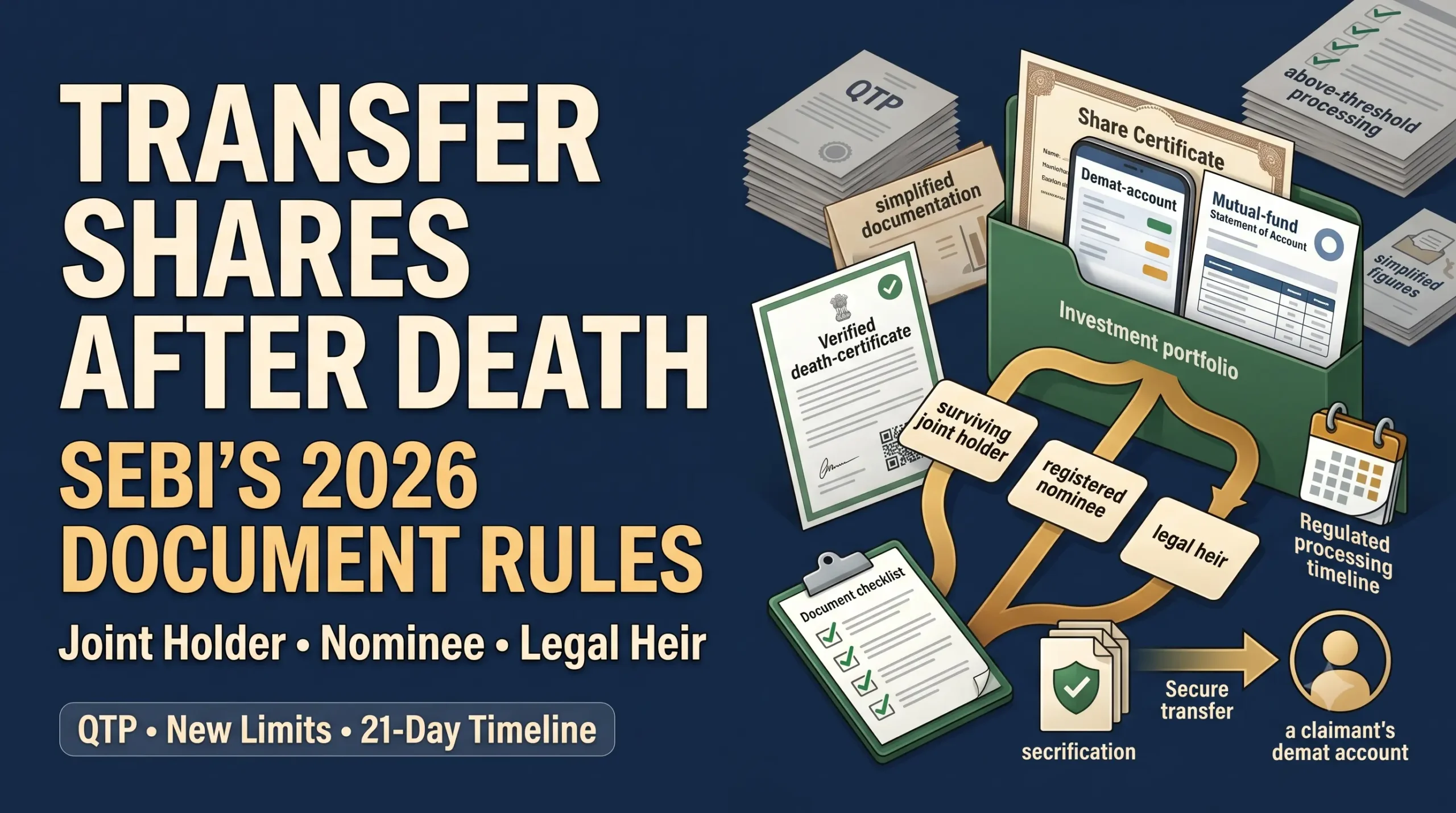
Documents required to transfer shares after death depend on whether the claimant is a surviving joint holder, registered nominee or legal heir without nomination. SEBI’s revised 2026 framework is now in force and standardises the main document routes, value thresholds, forms and processing timeline for listed securities and units issued by asset management companies.
SEBI Circular
Framework in force
Last verified: August 24, 2026
Documents required to transfer shares after death: direct answer
The correct document checklist depends first on who is claiming the securities.
A surviving joint holder should ordinarily need only a copy of the deceased joint holder’s death certificate under SEBI’s survivorship rule.
A registered nominee must submit the prescribed transmission request form, latest Client Master List, verifiable death certificate and the applicable original security certificate or Statement of Account.
Where there is no nominee, additional documents depend on whether the claim qualifies for Quick Transmission Processing, simplified documentation or the above-threshold route.
The simplified-documentation thresholds are now ₹10 lakh for physical securities and ₹30 lakh for dematerialised securities. The older ₹5 lakh and ₹15 lakh limits belong to the previous framework.
In this guide
- What changed under SEBI 2026
- Is the revised framework in force?
- Old and new limits
- Documents by claimant type
- Official Annexure forms
- Operational submission steps
- Quick Transmission Processing
- Simplified documentation
- Above-threshold claims
- Death-certificate rules
- The 21-day timeline
- Quick decision table
- Frequently asked questions
SEBI introduced a harmonised and risk-based framework for transmission of listed securities and units issued by asset management companies after the death of a sole holder or all joint holders.
The framework applies across listed companies, registrars and transfer agents, depositories, depository participants and AMCs.
There is no single document checklist for every claimant. The first step is to identify the claimant route.
SEBI 2026 rules at a glance
- Current status: the revised framework is in force
- Surviving joint holder: ordinarily only the deceased joint holder’s death certificate
- Registered nominee: transmission form, latest Client Master List, death certificate and applicable certificate or Statement of Account
- QTP: low-value route for eligible no-nomination claims by specified immediate relatives
- QTP limits: ₹10,000 for physical holdings and ₹30,000 for dematerialised holdings
- Simplified-documentation limits: ₹10 lakh for physical holdings and ₹30 lakh for dematerialised holdings
- Processing timeline: no more than 21 calendar days after all required documents are received
- Disputed claims: outside the standard framework and may require legal or judicial resolution
What changed under SEBI’s July 2026 framework?
SEBI issued Circular No. HO/38/13/11(14)2026-MIRSD-POD/I/17111/2026 on July 23, 2026.
The framework introduces:
- a harmonised transmission process
- Quick Transmission Processing for specified low-value claims
- higher simplified-documentation thresholds
- standard transmission forms
- a combined affidavit-cum-No Objection Certificate
- QR-code-enabled death certificates as an accepted verification route
- additional verification routes for deaths outside India
- a 21-calendar-day processing limit after all required documents are received
- reduced documentation for surviving joint holders
The framework applies after the death of a sole holder or all joint holders. It does not apply where there are disputed, contesting or competing claims that require legal or judicial resolution.
Is the revised SEBI transmission framework now in force?
Yes. The July 23 circular states that its provisions, revised transmission framework and model forms come into force with effect from 30 days from the date of issuance.
Thirty days from July 23, 2026 falls on August 22, 2026. As of August 24, the framework is therefore no longer in the pre-commencement transition period.
SEBI also said that requests received before commencement should, where possible, be processed using the revised framework so investors receive the benefit of the simplified procedure. Documents already submitted before commencement should not be demanded again merely because the new framework uses a different format.
Old limits versus the current 2026 limits
The earlier simplified-documentation limits were ₹5 lakh for physical securities and ₹15 lakh for dematerialised securities.
The current thresholds are ₹10 lakh for physical securities and ₹30 lakh for dematerialised securities.
| Claim category | Previous framework | Current 2026 framework | Meaning |
|---|---|---|---|
| Physical simplified documentation | ₹5 lakh | ₹10 lakh | Eligible claims within the current limit may use the simplified route. |
| Demat simplified documentation | ₹15 lakh | ₹30 lakh | The limit applies per beneficial owner. |
| Physical QTP | No equivalent route | Up to ₹10,000 | Low-value route for specified immediate relatives. |
| Demat QTP | No equivalent route | Up to ₹30,000 | Low-value route for specified immediate relatives. |
| Processing timeline | Earlier instructions varied | 21 calendar days | The period starts after all required documents are received. |
For physical securities, the thresholds apply per listed entity. For eligible Statement of Account holdings, the relevant limits apply per AMC. For dematerialised securities, they apply per beneficial owner.
Documents required to transfer shares after death by claimant type
A joint holder survives
One or more joint holders remain alive after another joint holder dies.
A nominee is registered
The deceased sole holder or all deceased joint holders left a valid nomination.
No nominee is registered
The claimant must identify whether QTP, simplified documentation or the above-threshold route applies.
The claim is disputed
Competing claims require the appropriate legal or judicial process.
Documents required for a surviving joint holder
Where one or more joint holders survive, SEBI says the processing entity should not seek KYC documents, indemnities or undertakings from the surviving joint holder except a copy of the deceased joint holder’s death certificate.
- A copy of the deceased joint holder’s death certificate
The surviving holder should still submit the operational service request required by the relevant DP, RTA, listed entity or AMC and obtain an acknowledgement.
| Holding form | Operational step | What the survivor should confirm |
|---|---|---|
| Demat account | The DP processes the survivorship request under its account workflow. | Whether the existing account continues, must be modified or requires another destination arrangement. |
| Physical securities | The listed entity or RTA processes transmission and the required demat conversion. | How the physical certificate and demat-credit process will be handled. |
| Mutual-fund or SOA holding | The AMC or RTA processes the applicable transmission request. | The destination folio or account details and any operational KYC requirement. |
Documents required for a registered nominee
Where a valid nomination exists, SEBI requires:
- The transmission request form specified in Annexure 3
- The latest Client Master List of the nominee’s demat account
- A verifiable death certificate
- The original security certificate or copy of Statement of Account, as applicable
The nominee receives the assets as trustee on behalf of the deceased holder’s legal heirs. Transmission to the nominee discharges the regulated entity from its transmission obligation, but it does not by itself determine every underlying succession or beneficial-ownership dispute.
Nominee transmission and inheritance rights are different questions
For the DP, RTA or AMC: a valid nominee can receive the securities through the prescribed transmission route.
For succession rights: legal heirs may still have rights under the applicable will, succession law or court order.
Where competing claims exist, obtain case-specific legal advice before dealing with disputed securities.
Documents required when there is no nominee
Where there is no nomination, the common document set is:
- A transmission request form — Annexure 2 for QTP and Annexure 3 for other claims
- The latest Client Master List of the claimant’s demat account
- A verifiable death certificate
- The original security certificate or copy of Statement of Account, as applicable
Additional documents then depend on whether the claim is QTP, simplified documentation or above the simplified threshold.
Which SEBI transmission forms should claimants use?
Use the prescribed current forms
- Annexure 2: Transmission Request Form-cum-Undertaking for QTP claims
- Annexure 3: Transmission Request Form for claims other than QTP
- Annexure 4: Notarised indemnity bond
- Annexure 5: Notarised affidavit-cum-NOC from legal heirs, where applicable
Open the official SEBI circular and annexures.
SEBI requires processing entities to make the standardised forms and document lists available physically and on their websites.
Use the prescribed form issued through SEBI or the processing entity because a paraphrased form may omit required wording, signatures, witnesses, indemnity terms or declarations.
How to submit a share-transmission claim
1. Identify the claimant route
Surviving joint holder, nominee, QTP claimant, simplified legal-heir claim or above-threshold claim.
2. Identify the processing entity
DP for demat holdings, listed company or RTA for physical securities, and AMC or RTA for eligible mutual-fund or SOA holdings.
3. Download the current form
Use the processing entity’s implementation of the SEBI-prescribed form.
4. Submit and obtain acknowledgement
Keep the date, acknowledgement, ticket number and proof of every document supplied.
5. Check the deficiency list immediately
SEBI requires the entity, when acknowledging the claim, to identify missing, incomplete or incorrect documents.
6. Preserve the complete-document confirmation
When all required documents have been supplied, the entity must confirm receipt. That date matters for the 21-day processing period.
Quick Transmission Processing
QTP is a low-value route for no-nomination claims by specified immediate relatives.
It is available only to a parent, spouse, child or parent-in-law of the deceased security holder.
| Holding type | Maximum QTP value | Eligible claimant |
|---|---|---|
| Physical securities or eligible SOA holdings | ₹10,000 | Parent, spouse, child or parent-in-law |
| Dematerialised securities | ₹30,000 | Parent, spouse, child or parent-in-law |
Documents required for QTP
- The common no-nomination documents
- The Annexure 2 Transmission Request Form-cum-Undertaking on plain paper
- A document establishing the claimant’s qualifying relationship with the deceased holder
Relationship evidence can include the documentary categories recognised in the model form. Where normal relationship documents are unavailable, follow the affidavit route provided in the prescribed form.
Simplified-documentation claims
The current simplified-documentation limits are:
- ₹10 lakh for physical securities
- ₹30 lakh for dematerialised securities
In addition to the common documents, the claimant generally submits:
- A notarised indemnity bond in Annexure 4
- A notarised affidavit-cum-NOC from all legal heirs in Annexure 5
Alternatively, an eligible family settlement deed may be used where the circular’s conditions are met.
If the claimant submits a court-issued succession document such as a Succession Certificate, Probate of Will, Letter of Administration or Court Decree, the indemnity and affidavit requirements can be reduced as specified by SEBI.
Claims above the simplified threshold
For claims exceeding ₹10 lakh in physical mode or ₹30 lakh in dematerialised mode, the common documents are supplemented by the above-threshold succession documentation.
- Notarised affidavit-cum-NOC from legal heirs, where applicable
- Will route: copy of Will as applicable under succession law plus the prescribed indemnity
- Legal-heirship route: Legal Heirship Certificate or equivalent issued by the relevant authority plus indemnity
- Court-document route: Succession Certificate, Letter of Administration or Court Decree
For above-threshold cases, processing entities may seek additional documents where required, but reasons must be recorded in writing.
Is probate always required?
No. The revised SEBI framework expressly removes a universal mandatory-probate approach. The correct succession document depends on the claimant route, available evidence, applicable succession law and whether the claim is disputed.
What counts as a verifiable death certificate?
- An original death certificate
- A copy attested by the claimant and verified against the original where permitted
- A copy attested by a notary public, Gazetted Officer or Judicial Magistrate First Class
- A death certificate containing a QR code
When the investor died outside India
SEBI permits certified proof of death from a foreign jurisdiction through specified verification routes, including:
- a magistrate, judge or notary public in the country of issuance
- an Indian Embassy or Consulate
- apostille
- an authorised overseas branch of an Indian scheduled commercial bank
- an overseas correspondent bank of an Indian bank
If the original death certificate is in a language other than English, the claimant must also submit a self-certified English translation along with the certified original-language document.
How is the claim value calculated?
For listed securities, SEBI says the claimant should use the previous closing price at any recognised stock exchange.
For units issued by AMCs, use the last available Net Asset Value.
Do not substitute face value, original purchase price or an old portfolio statement for the prescribed valuation method.
Where should the claim be submitted?
- Physical shares or issuer folio: listed company or its RTA
- Demat securities: depository participant
- Mutual-fund or Statement of Account holdings: AMC or its RTA
When does the 21-day processing period begin?
The processing entity must settle the transmission case within a period not exceeding 21 calendar days from the date it receives all required documents associated with the claim.
The clock therefore does not necessarily begin on the date an incomplete request is first submitted.
- The claimant submits the request and documents
- The entity acknowledges receipt and identifies missing, incomplete or incorrect documents
- The claimant supplies the missing material
- The entity confirms that all required documents have been received
- The 21-calendar-day processing period runs from the complete-document date
If the claim is delayed beyond the prescribed period or rejected, SEBI requires the entity to communicate the reasons in writing.
What happens to physical share certificates?
For transmission involving physical securities, the claimant should ordinarily have the original certificates unless the case is handled as duplicate-cum-transmission.
After verification and processing, the entity initiates dematerialisation for direct credit into the security holder’s or claimant’s demat account.
What if an intermediary asks for a document that does not appear in the SEBI framework?
Ask the processing entity to state:
- the claimant category assigned to the case
- the valuation used
- the rule supporting the additional document
- the reason for the deviation in writing
- the complete deficiency list
SEBI says deviations from the prescribed procedure must be communicated with reasons recorded in writing, and additional-document requirements should be applied consistently to similar cases.
What happens to claims submitted before August 22?
SEBI told processing entities to strive to process requests received before commencement under the revised framework so investors could receive the benefit of the simplified procedure.
If a claimant had already submitted documents, the processing entity should not demand re-submission merely because the revised framework uses a different format.
What should a claimant do if the request is delayed or repeatedly returned?
- Ask for the claimant category assigned to the case
- Request the complete deficiency list in writing
- Ask for the exact circular, annexure or intermediary rule supporting every additional demand
- Submit missing documents with a dated covering message and preserve proof
- Obtain confirmation of the date on which all required documents were received
- If the 21-day period expires without settlement, request the written reason for delay
- Use the entity’s grievance mechanism and the applicable SEBI investor-grievance route if the issue remains unresolved
Quick decision table
| Your situation | Route | Main documents or next step |
|---|---|---|
| A joint holder survives | Survivorship | Ordinarily, the deceased joint holder’s death certificate |
| A valid nominee exists | Nominee route | Annexure 3, nominee CML, death certificate and certificate or SOA |
| No nominee; physical claim up to ₹10,000 | QTP if eligible | Annexure 2, relationship proof and common documents |
| No nominee; demat claim up to ₹30,000 | QTP if eligible | Annexure 2, relationship proof and common documents |
| No nominee; physical claim up to ₹10 lakh | Simplified documentation | Common documents plus indemnity and affidavit-cum-NOC or permitted alternative |
| No nominee; demat claim up to ₹30 lakh | Simplified documentation | Common documents plus indemnity and affidavit-cum-NOC or permitted alternative |
| Claim above the threshold | Above-threshold route | Common documents plus applicable succession documents |
| Disputed or competing claim | Outside standard framework | Appropriate legal or judicial resolution |
The documents required to transfer shares after death should always be checked against the claimant category, holding value and current form issued by the relevant DP, RTA, listed entity or AMC.
Documents required to transfer shares after death: frequently asked questions
Are the revised SEBI transmission rules now in force?
Yes. The July 23, 2026 circular says the framework comes into force 30 days from issuance. That commencement point fell on August 22, 2026.
What does transmission of shares mean?
It is the process by which securities held by a deceased investor move to a surviving holder, nominee or legal heir without using a normal sale or voluntary transfer.
Can shares be transmitted without a nominee?
Yes. The claimant must use the applicable QTP, simplified-documentation or above-threshold route.
Does a nominee need a succession certificate?
The core nominee-document list does not require a succession certificate for transmission to a valid registered nominee.
Can a sibling use QTP?
No. QTP is limited to a parent, spouse, child or parent-in-law.
Is probate mandatory?
No. The correct route depends on the claim category, value, available evidence and applicable succession law.
When does the 21-day period start?
It starts when the processing entity receives all required documents associated with the claim.
Are mutual-fund units included?
Yes. The framework also covers units issued by asset management companies.
What remains operationally uncertain?
Processing entities can differ in their online interfaces, submission channels and internal account-handling workflow even though SEBI now standardises the core forms, documentation and timelines.
Above-threshold claims can require additional evidence depending on their facts, and disputed inheritance claims may require legal proceedings.
Primary source: SEBI Circular No. HO/38/13/11(14)2026-MIRSD-POD/I/17111/2026.
Verification and editorial limitation
Status: Confirmed against SEBI’s July 23, 2026 circular and annexures. The 30-day commencement period has ended and the revised transmission framework is now in force.
Last verified: August 24, 2026.
Limitation: This is a general process guide, not personalised legal, inheritance, succession, tax or investment advice. Claimants should use the current forms and submission route provided by the relevant DP, RTA, listed entity or AMC.