






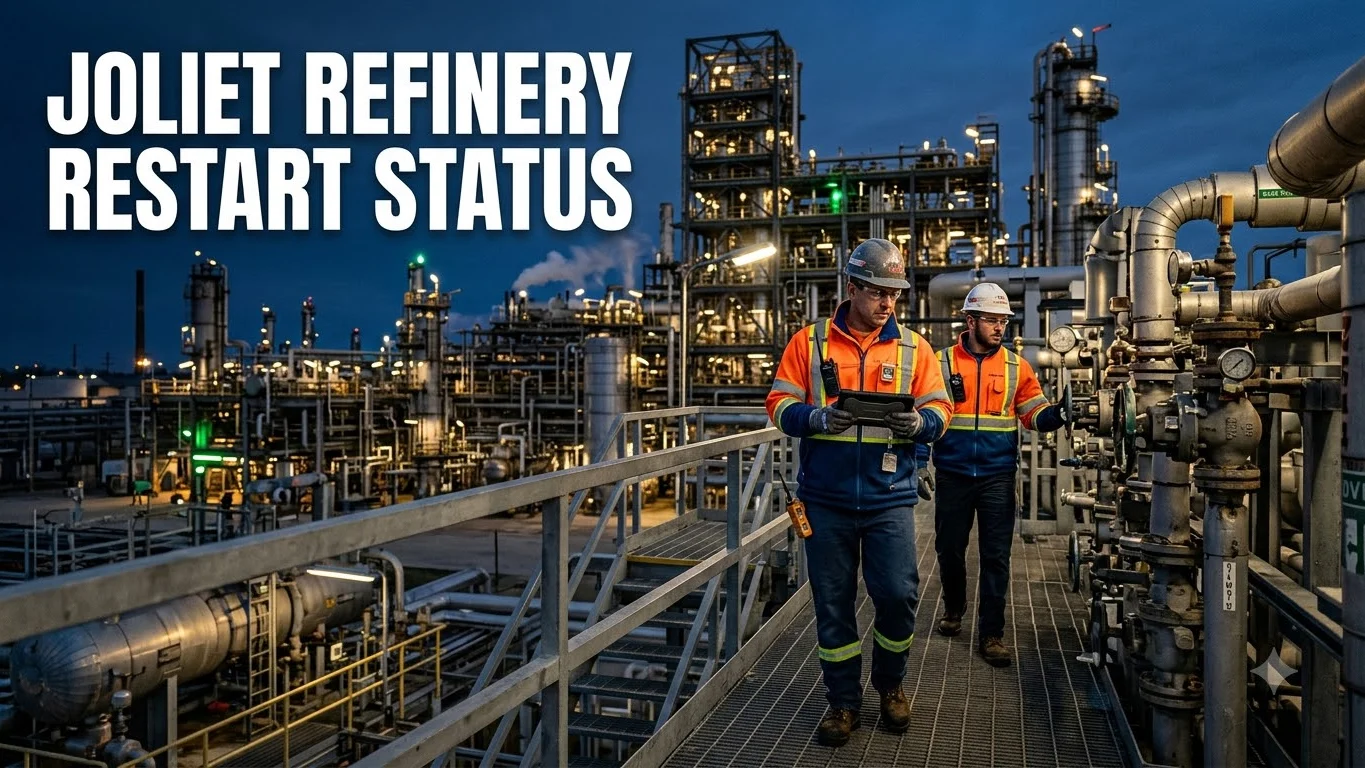
Exxon Joliet refinery restart remains unconfirmed in the latest evidence reviewed by ThePulseSignal on September 17. ExxonMobil’s Joliet, Illinois refinery underwent a plant-wide shutdown after a power outage on September 13. Electrical power was subsequently restored, but the available evidence does not yet establish that the refinery has returned to full or normal operations.
Has ExxonMobil’s Joliet refinery restarted?
A full restart has not yet been publicly confirmed. Reuters reported that power had been restored and ExxonMobil was assessing the refinery and working to stabilise units after the shutdown. The report said normal operations were expected by the end of the week, but an expected restart window is not the same as confirmation that the refinery is already operating normally.
What is confirmed about the Joliet refinery shutdown?
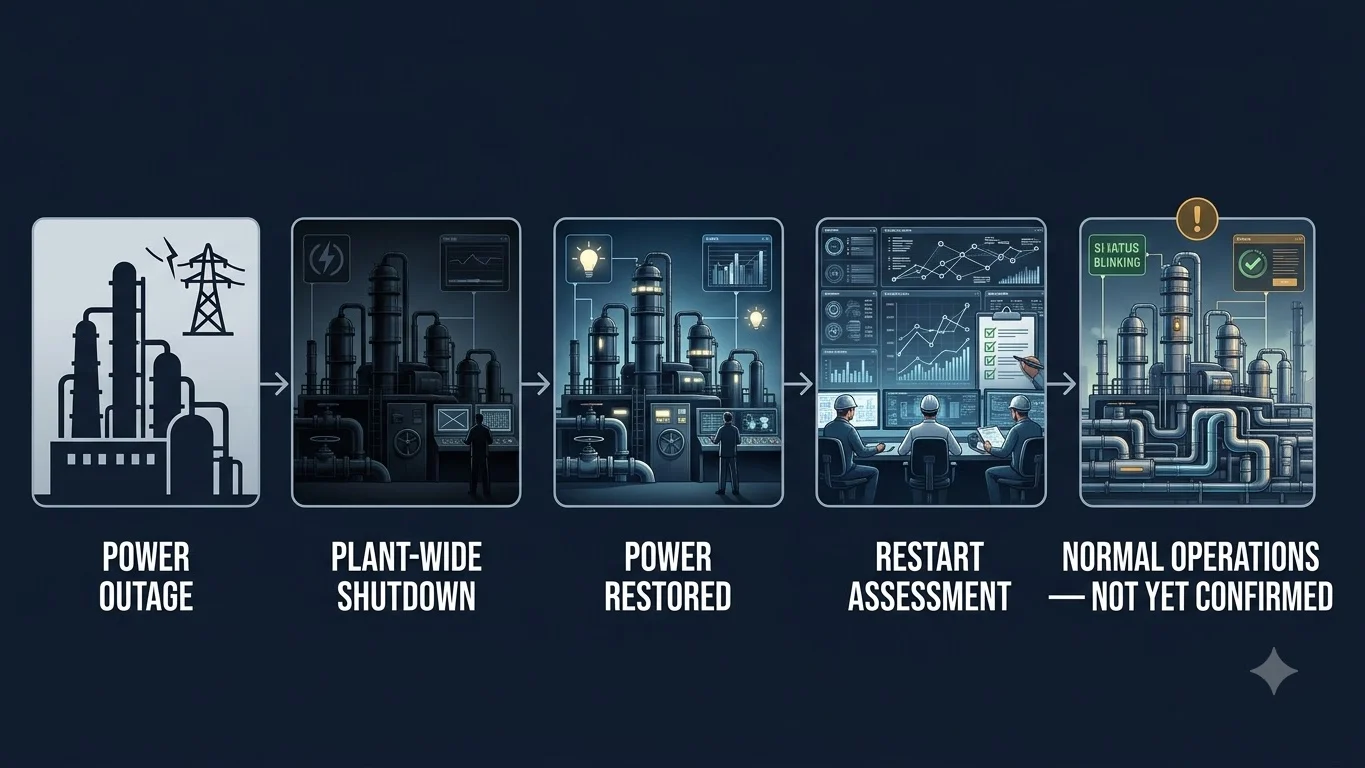
The refinery experienced a power outage on September 13 that resulted in a plant-wide shutdown. ExxonMobil-attributed information reported by Reuters confirmed that power was later restored while the company assessed the facility and worked through the restart process.
Independent local reporting from CBS Chicago also confirmed the outage and refinery shutdown. That reporting did not establish that the refinery had subsequently returned to full normal operation.
What does power restoration mean?
Restoring electricity is an important prerequisite for restarting refinery equipment, but it does not prove that crude-processing units, conversion units and product systems are already operating at normal rates.
A refinery restart can involve inspections, sequential unit start-ups, stabilisation and checks before normal throughput is restored. TPS therefore separates the confirmed restoration of electrical power from the still-unconfirmed question of full refinery restart.
What is the latest restart expectation?
Reuters reported that the Joliet refinery was expected to return to normal service by the end of the week. That remains an expected operational state rather than a confirmed completion state.
TPS did not find a newer ExxonMobil operational statement confirming that all relevant units had restarted or that the refinery had returned to normal crude runs and product output.
Why does the Joliet refinery matter?
ExxonMobil describes Joliet as a major refinery serving fuel markets in the U.S. Midwest. Its current facility information lists processing capacity of roughly 275,000 barrels per day.
A shutdown at a refinery of this scale can matter to regional gasoline and diesel supply if it persists. However, TPS does not have evidence establishing that this outage has caused a specific retail fuel-price increase, supply shortage or quantified market impact.
Does the shutdown mean Midwest fuel prices will rise?
Not necessarily, and TPS cannot responsibly assign a direct price effect from the evidence currently available.
The impact depends on how long the refinery remains below normal operation, which units are affected, regional inventories, alternative refinery supply, pipeline flows, product imports and broader market conditions.
The correct current conclusion is narrower: an extended outage at a major Midwest refinery can tighten regional product availability, but the duration and actual price impact are not yet established.
What would confirm that the refinery has actually restarted?
The strongest confirmation would be a current ExxonMobil statement or other high-confidence operational evidence establishing that processing units have restarted and normal or near-normal service has resumed.
A report that power has returned, workers are assessing equipment or a restart is expected soon does not by itself establish full production restoration.
What remains unknown?
- The exact date and time of full refinery restart.
- Whether all major processing units have resumed operation.
- Whether crude throughput has returned to normal rates.
- Whether gasoline and diesel production has returned to normal output.
- Whether the outage has created a measurable regional fuel-supply deficit.
- Whether any observed Midwest fuel-price movement can be causally attributed to the Joliet shutdown.
What happens next?
The next material state change is confirmation that the refinery has restarted, confirmation that normal operations have resumed, or evidence that the outage will continue beyond the previously reported expectation.
When credible operational evidence establishes that state, this same TPS article should be updated rather than creating another URL for the same restart-status reader job.
Verification note
ThePulseSignal reviewed the September 14 Reuters report containing ExxonMobil-attributed operational details, ExxonMobil’s current Joliet facility information and independent local reporting from CBS Chicago. The shutdown and restoration of power are supported; a full return to normal refinery operations was not established in the evidence reviewed on September 17.
Limitations and unresolved facts
TPS did not recover a current ExxonMobil operational notice confirming full refinery restart. Public facility information describes normal capacity but is not a live operations dashboard. The article therefore does not claim that the Joliet refinery has restarted, that all units are operating normally or that the shutdown has caused a specific fuel-price impact.
Bottom line
The latest supported answer on the Exxon Joliet refinery restart is that the September 13 power outage and plant-wide shutdown are confirmed, electrical power was restored, and restart work was underway, but a full return to normal refinery operations had not yet been publicly confirmed in the evidence reviewed on September 17.