






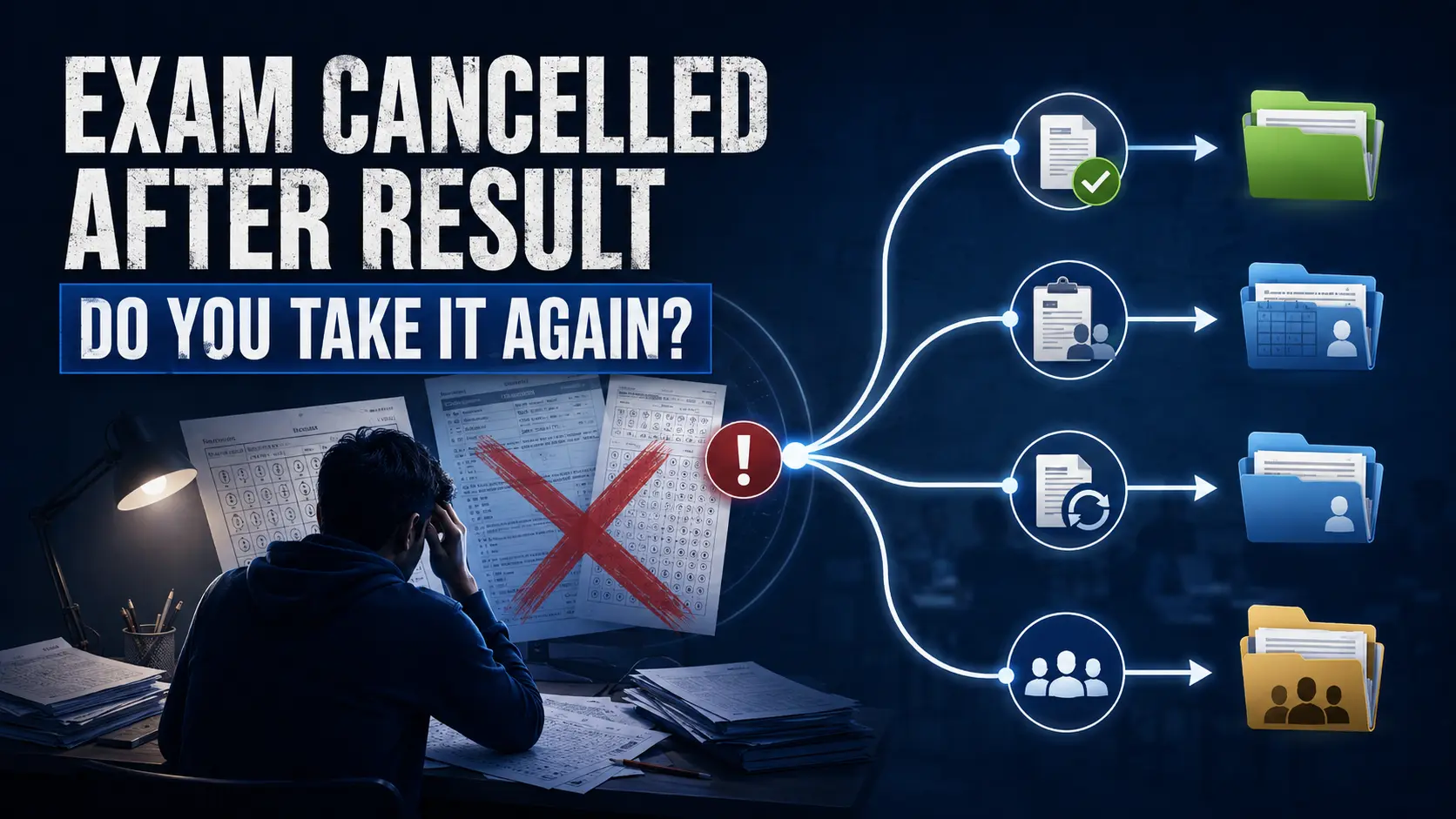
Government exam cancelled after result does not automatically mean that every qualified candidate has to take the same examination again. A re-test is one possible remedy, but an authority can also revise a result, repeat only one affected stage, isolate affected candidates or abandon the old recruitment and start afresh.
First identify exactly what the authority cancelled: an examination date, one centre or shift, a declared result, one stage of recruitment, or the entire selection. The next step depends on that distinction and on the operative order issued by the recruiting authority.
Cancellation does not automatically mean re-test
Different recruitment problems can produce different remedies.
Can affected candidates be separated?
If the problem can be isolated, a narrower remedy may be possible.
Forms, fees and age rules
These must be checked against the fresh notice for the particular recruitment.
What can “government exam cancelled” actually mean?
The phrase is often used too loosely. Five very different situations can sit behind the same headline.
A future exam date is cancelled
The examination may simply be postponed or rescheduled. Candidates normally wait for the revised date rather than applying from the beginning.
One centre, shift or affected group is invalidated
A limited re-test can be ordered only for that part of the examination if the affected candidates can be identified.
A declared result is cancelled or found defective
The authority may revise, withdraw or recalculate the result without necessarily conducting the entire examination again.
One recruitment stage is cancelled
The authority can repeat a particular stage while retaining other valid parts of the recruitment.
The entire recruitment is cancelled
A fresh selection cycle may follow, potentially with a new notification, eligibility dates and application instructions.
A candidate needs the operative order to know whether the old application, result or qualification survives.
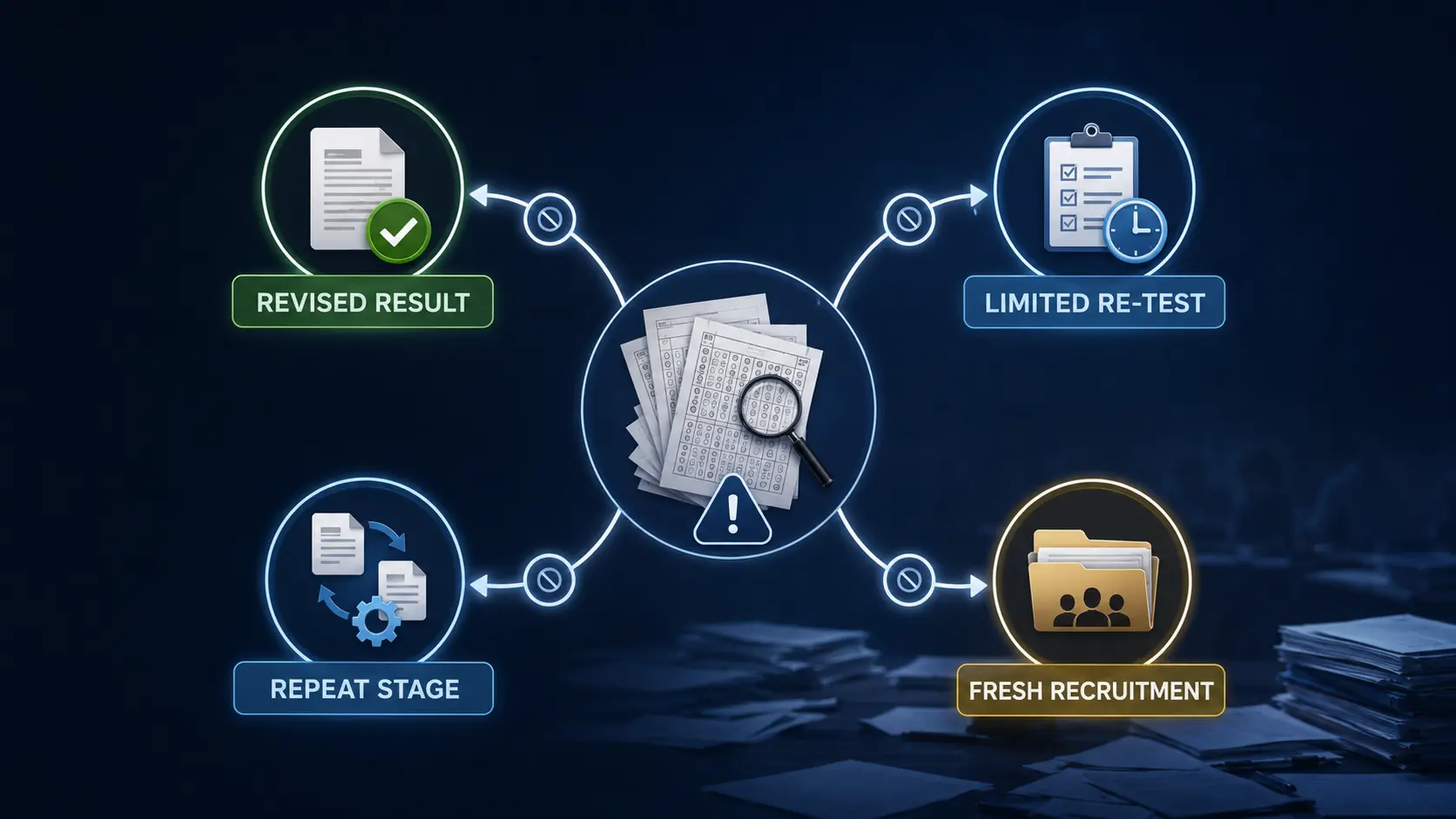
Four different remedies can follow an exam problem
This is the core decision framework. It appears only once in this guide because these are the four genuinely different administrative outcomes candidates need to understand.
Revised result
The authority corrects the result or qualified list without repeating the examination itself.
Limited re-test
Only a defined group, centre, shift or affected set of candidates is asked to sit again.
Repeat one stage
A particular recruitment stage is redone while other valid parts of the process are preserved.
Fresh recruitment
The previous selection is abandoned and a new notification or examination cycle begins.
Can an authority revise the result instead of conducting the exam again?
Yes. A useful state-public-service-commission example comes from JPSC itself.
JPSC Combined Civil Services
JPSC issued a revised preliminary result and then proceeded toward mains
The official archive shows an initial preliminary result followed later by a revised preliminary result. The Commission then issued mains-related instructions rather than automatically repeating the entire preliminary examination.
This example does not mean every disputed result can be repaired in the same way. It demonstrates why “exam problem” and “fresh exam for everybody” are not synonyms.
The sequence can be verified in JPSC’s official Combined Civil Services Examination 2021 archive.
What does the Supreme Court framework say about cancelling an entire examination?
The most useful modern principle comes from Vanshika Yadav v. Union of India, arising from the NEET 2024 controversy.
Question 1: Is the problem systemic?
If the examination process as a whole has been compromised and reliable separation is impossible, a broad cancellation becomes more legally defensible.
Question 2: Can affected candidates be separated?
If tainted and untainted candidates can reasonably be distinguished, a narrower response may avoid making unaffected candidates repeat the process unnecessarily.
The Supreme Court treated proportionality as important: the remedy should match the reach of the defect. The full decision is available through the Supreme Court judgment record for Vanshika Yadav.
Passing an examination stage does not create an absolute guarantee that the result can never be cancelled. At the same time, authorities do not automatically need to destroy an entire recruitment where the problem can be isolated and a narrower correction is legally workable.
What happens if you already passed prelims, mains or the final selection?
The practical stakes rise as a recruitment moves forward, but the exact consequence still depends on what the cancellation order covers.
Check whether evaluation continues
If the test itself is invalidated, the authority may never declare the old result and may instead order a fresh or limited examination.
Check whether the qualified list survives
The result may be preserved, revised, withdrawn or replaced by another prelim depending on the operative order.
Check which earlier stage is affected
An interview or document-verification stage may stop if an earlier part of the recruitment is being reconsidered.
Read the cancellation scope carefully
A final result can still become subject to cancellation or litigation where the recruitment process itself is found defective.
The legal position becomes more individual
Appointment status, service consequences and court protection can require case-specific legal analysis.
The fresh 14th JPSC controversy is a current example because candidates had already cleared prelims before cancellation was announced. TPS is tracking that separately in 14th JPSC Exam Cancelled: Is the Prelims Result Cancelled or Will There Be a Re-Exam?.
Do candidates have to apply and pay again after cancellation?
Not automatically. A fresh examination can use the existing applicant pool, while a completely new recruitment can require another application. The same distinction applies to examination fees.
Possible without a fresh form
The authority may keep the existing applications and simply issue a revised examination date or limited re-test instruction.
Do not assume refund or new payment
The old fee may be retained, adjusted, refunded, waived or replaced by a fresh payment requirement. Only the authority’s notice can settle it.
A candidate should never make another payment through an unofficial link simply because a message claims that a cancelled recruitment has reopened.
What happens to the age limit if the recruitment starts again?
This becomes important when a recruitment takes months or years and a candidate crosses the upper-age limit before a new advertisement appears.
The original advertisement may calculate eligibility against a specified cut-off date.
If the original applicant pool is carried forward, the authority may preserve part of the earlier eligibility framework.
A new recruitment can use a different reference date. Do not assume the old age clause automatically continues.
Age protection should be treated as confirmed only where the government or recruiting authority expressly grants it.
The same caution applies to EWS, OBC-NCL, domicile, disability and other certificates whose validity can depend on a particular recruitment year or cut-off date.
Can qualified candidates challenge a blanket cancellation?
Recruitment and examination cancellation decisions can be judicially reviewed. Courts can examine whether the authority had enough material, whether the irregularity was broad enough to justify wholesale cancellation, and whether a narrower solution could have protected unaffected candidates.
That does not mean every challenge succeeds. Where the process is systemically compromised and reliable segregation is not possible, courts can uphold cancellation even though innocent candidates also suffer.
What should candidates save immediately?
Application
Downloaded application form and registration number.
Payment
Fee receipt and transaction reference.
Admit card
Original admit card and examination-centre details.
Result
Result PDF, scorecard and qualified-list entry.
Eligibility records
Age, category, domicile and reservation certificates used.
Official orders
Cancellation notice, revised result, re-test notice and fresh notification.
These documents can matter if the authority later asks candidates to verify an existing application, changes eligibility treatment or the recruitment becomes subject to litigation.
Related TPS guides
Frequently asked questions
If a government exam is cancelled, will it always be reconducted?
No. The authority may revise the result, conduct a limited re-test, repeat one stage or restart the entire recruitment.
If I already passed prelims, is my qualification protected?
Not automatically. Check whether the result itself has been preserved, revised or withdrawn by the operative order.
Can only some candidates be asked to take a re-test?
Yes. A limited re-test is possible where the affected candidates, centre or group can be identified.
Do I have to register again?
Only if the recruiting authority’s fresh notice requires another application. A new exam date does not automatically mean a new form.
Will my old examination fee be refunded?
There is no universal rule. Check the authority’s refund, adjustment, waiver or fresh-payment instruction.
Can the entire recruitment be cancelled even if I did nothing wrong?
Yes, where the process is found to be systemically compromised and separating affected candidates is not realistically possible. Courts can also review whether wholesale cancellation was proportionate.
Verification notes: what is established and what remains authority-specific
JPSC’s official archive shows a real case where a preliminary result was revised and the recruitment then continued.
The Supreme Court’s Vanshika Yadav judgment explains the systemic-integrity and tainted-versus-untainted approach to examination cancellation.
The useful question after cancellation is which part of the old process can still be trusted. That determines whether the remedy can be narrow or must be broader.
Registration, fees, age relaxation, certificate validity and exact re-test procedure depend on the individual recruitment notice and cannot be generalized across every government exam.
Verification method
ThePulseSignal reviewed JPSC’s official Combined Civil Services recruitment archive, Jharkhand recruitment-rule material published through JPSC and the Supreme Court’s Vanshika Yadav examination-cancellation framework.
The examples in this guide are used to explain legally and administratively possible outcomes. They are not used to claim that one recruiting authority’s procedure automatically controls another authority’s recruitment.
Sources checked
Limitations and unresolved facts
There is no single national procedure covering every UPSC, state PSC, SSC, police, teacher, railway or other government recruitment cancellation. The governing recruitment rules and the fresh order of the competent authority must always be checked.
Court decisions are fact-specific. The principles in this guide explain when wholesale cancellation can be proportionate; they are not a substitute for case-specific legal advice.
Last verified: August 13, 2026, 12:33 AM IST.