




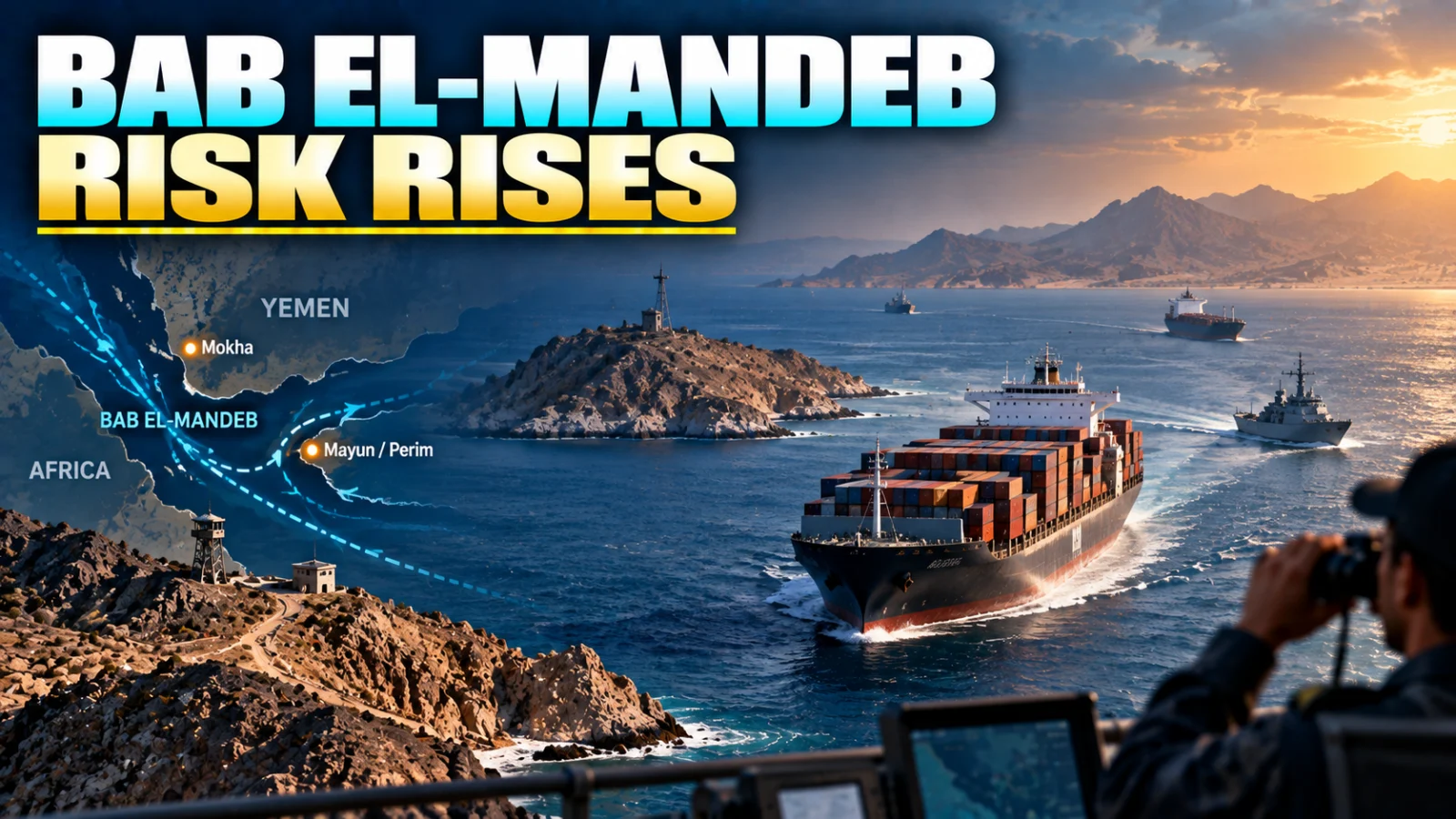
Houthis Bab el-Mandeb coverage now has a new complication: Associated Press and other current reporting say Houthi forces have captured Mokha and Mayun, also known as Perim, immediately around the Bab el-Mandeb chokepoint. That materially changes the security geography of the route, but it does not by itself establish that the strait is closed.
The key reader distinction is between territorial control near a shipping lane and actual closure of that shipping lane. Current maritime evidence reviewed by TPS continues to describe a high-risk Houthi threat environment, while current reporting also indicates that vessels are still using the Red Sea corridor.
What has reportedly changed at Bab el-Mandeb?
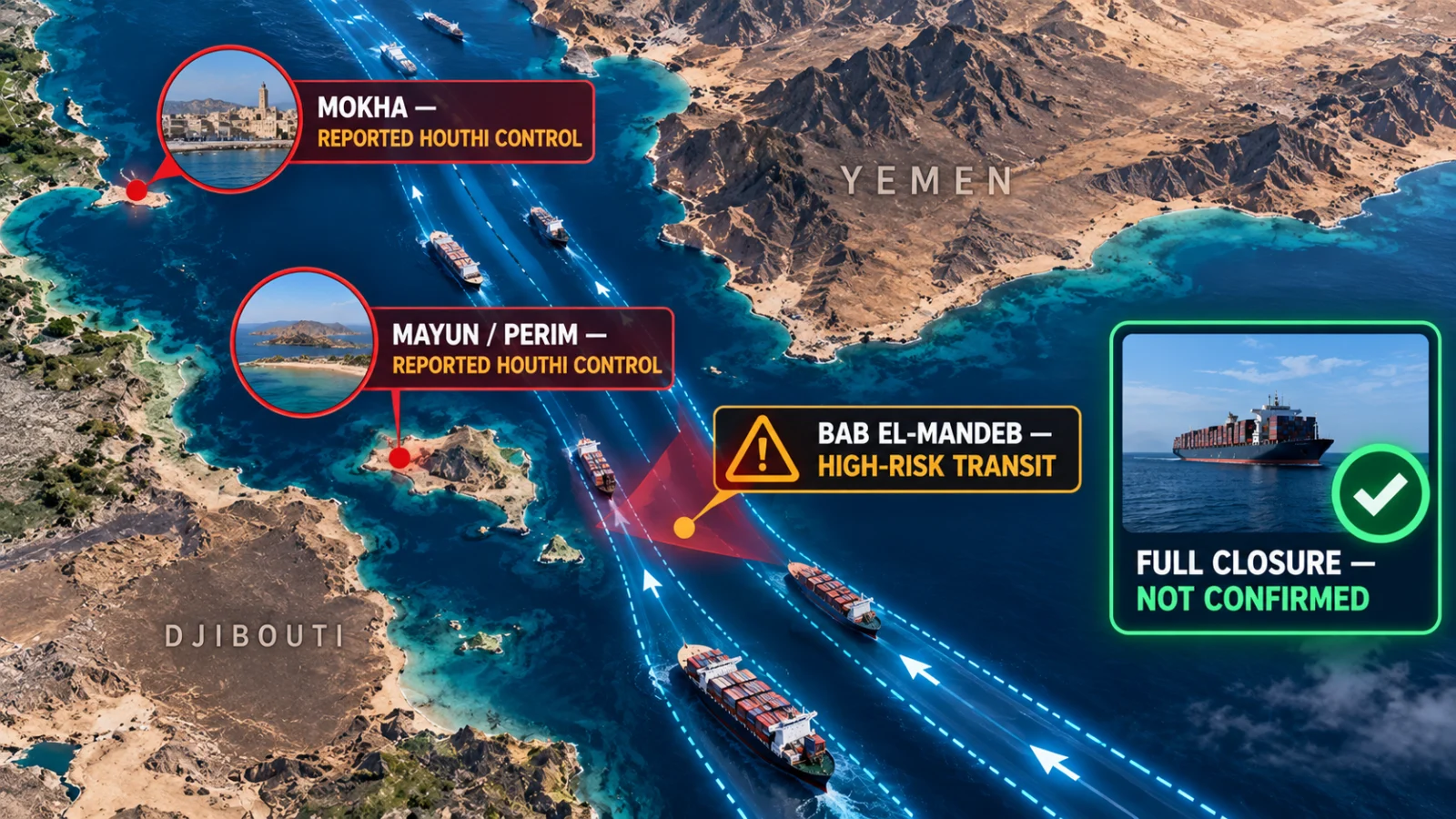
Current major reporting says Houthi forces captured Mokha on Yemen’s Red Sea coast and Mayun/Perim Island inside the Bab el-Mandeb Strait. Mayun is strategically important because it sits directly within the chokepoint between the Red Sea and the Gulf of Aden.
The territorial advance therefore gives the Houthis a stronger physical position around a route that was already exposed to missile, drone and vessel-attack risk. The strongest responsible wording remains that these captures are reported and strongly corroborated; TPS did not recover one complete public primary territorial statement naming both Mokha and Mayun/Perim.
Is Bab el-Mandeb closed?
No full closure has been established by the evidence reviewed for this article. Current U.S. Maritime Administration guidance continues to warn commercial vessels about the Houthi threat in the Red Sea, Bab el-Mandeb and Gulf of Aden region, but it does not announce that the strait has been completely closed.
Current Reuters reporting also says vessels continue using the Red Sea corridor even as risk and shipping costs rise. That matters because control of nearby territory can increase surveillance, attack capability and commercial risk without automatically producing a blockade or ending all commercial passage.
Why Mayun or Perim Island matters
Mayun, also called Perim, lies inside Bab el-Mandeb. Its position gives forces operating from the island unusually close proximity to one of the world’s important maritime passages linking the Red Sea with the Gulf of Aden and the wider Indian Ocean.
That does not mean whoever controls Mayun automatically controls every ship crossing the strait. Maritime control depends on far more than possession of land: vessel movements, military capability, surveillance, attacks, navigational restrictions, escort arrangements, carrier decisions and wider regional military conditions all matter.
Why Mokha matters to the shipping picture
Mokha is a Red Sea coastal position north of Bab el-Mandeb. Reported Houthi control there extends the group’s territorial presence along the Yemeni approach to the strait and adds another layer to an already difficult maritime-security environment.
For shipping and trade readers, the practical consequence is therefore an increase in uncertainty and operational risk rather than a proven binary switch from open to closed.
What current maritime guidance says
The U.S. Maritime Administration’s active advisory for the Red Sea, Bab el-Mandeb, Gulf of Aden and nearby waters continues to warn that Houthis pose a threat to commercial vessels. Operators covered by that advisory are directed to use current maritime-security procedures and reporting channels when planning or conducting transits.
That official risk guidance is more useful for operational decisions than assuming a route status from conflict headlines alone. A media report that territory has changed hands and an official notice that a shipping lane is closed are different evidence states.
What the Houthi advance does not prove
The available evidence does not establish that the Houthis have stopped all commercial traffic through Bab el-Mandeb, that they control every navigable channel, or that every carrier has suspended transit. It also does not support treating a Houthi statement about navigation safety as an independent maritime-safety guarantee.
Likewise, TPS should not convert the territorial advance into unsupported numerical claims about freight rates, oil prices, insurance premiums or India’s import costs unless those consequences are separately measured and evidenced.
What shipping and trade readers should watch next
The most important next signals are operational rather than rhetorical: a new MARAD or UKMTO warning, a confirmed vessel attack near Bab el-Mandeb, explicit navigation restrictions, major carrier suspension or rerouting, insurance-security reclassification, or a counteroffensive that changes control of Mokha or Mayun.
If any of those states becomes confirmed, this same article should be updated rather than creating a new URL for each wording variation. The core reader job remains the same: understanding the current Bab el-Mandeb shipping state and what the latest military development means for commercial transit.
Verification note
ThePulseSignal compared current AP and Reuters reporting on the reported Houthi capture of Mokha and Mayun/Perim with active U.S. MARAD guidance for commercial shipping in the Red Sea and Bab el-Mandeb region. The territorial advance is treated as reported and strongly corroborated, while the operational conclusion is narrower: the reviewed evidence does not establish that Bab el-Mandeb is fully closed.