







India’s September 2026 rainfall picture has moved well beyond the opening-week forecast stage. IMD-attributed reporting on September 14 says rainfall for the month is running about 15% below normal so far, while roughly 43% of the country is in rainfall-deficient conditions. The national shortfall is now visible in realized rainfall, but regional outcomes remain sharply uneven.
What does India’s September rainfall deficit mean now?
The national below-normal outlook has gained support from mid-month realized rainfall, but it still should not be applied uniformly to every state, district or crop. Some regions have received significant rain while substantial areas remain deficient. Crop risk therefore depends on local rainfall, crop stage, soil moisture, irrigation access and temperature rather than the national percentage alone.
How far below normal is September rainfall so far?
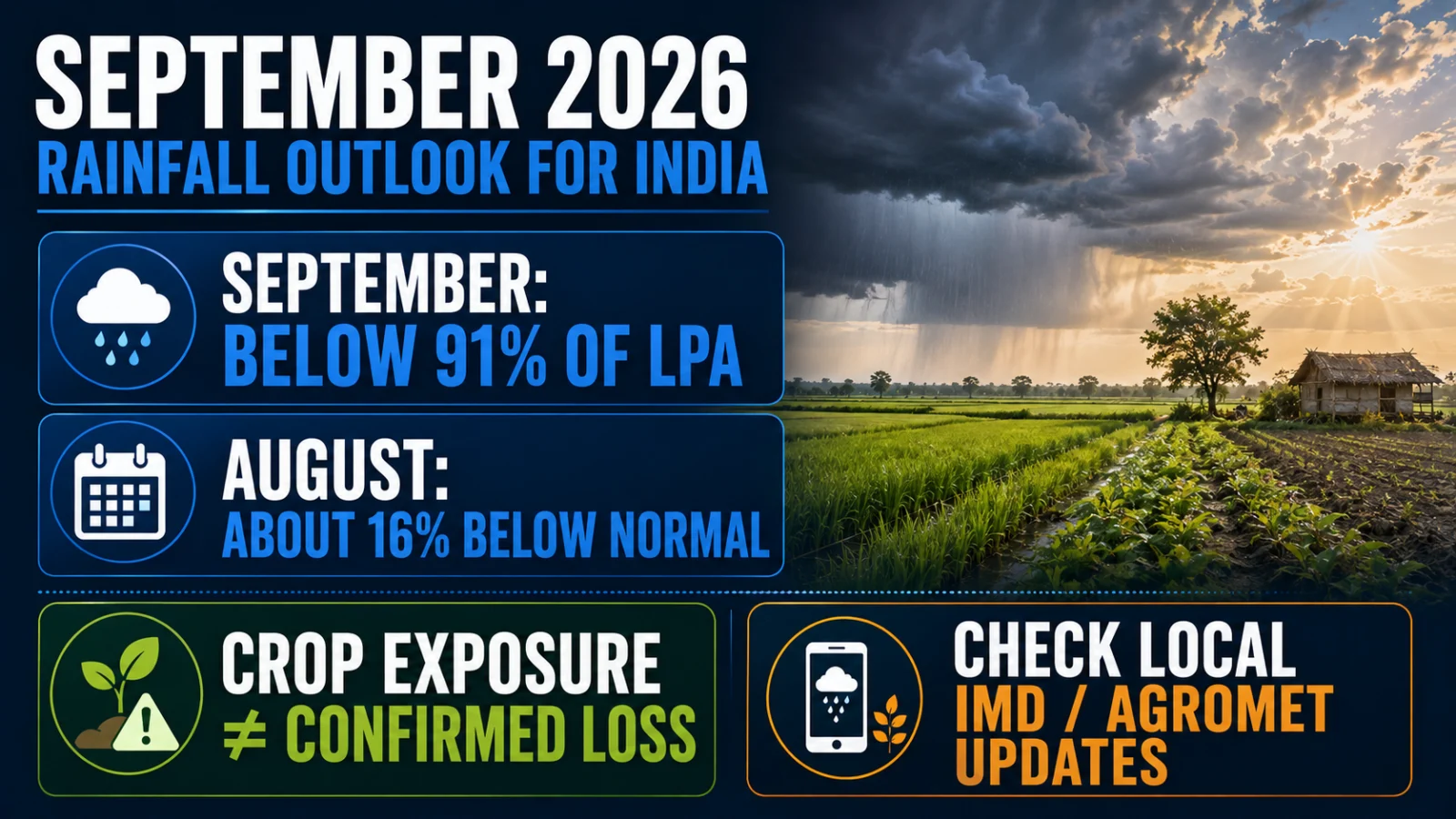
Current IMD-attributed reporting says India has received about 15% less rainfall than normal in September so far. It also indicates that approximately 43% of the country is rainfall deficient.
This is materially stronger evidence than the monthly outlook alone because the deficit is now being observed during the month. However, September is not complete, so the final national departure can still change before month-end.
Which parts of India are especially rainfall-deficient?
Current reporting identifies substantial shortfalls in several regions. Punjab is reported around 40% below normal, while Meghalaya is around 59% deficient and Arunachal Pradesh and Manipur are each around 42% below normal. Other areas have received closer-to-normal or locally heavy rainfall.
These state-level figures show why the all-India number is useful as a national signal but insufficient for farm-level decisions. Within the same state, district rainfall can differ considerably.
A 15% national deficit does not mean every district is 15% dry. September rainfall remains geographically uneven, and local agricultural exposure depends on realized district conditions.
Does this confirm IMD’s below-normal September outlook?
It strengthens the outlook’s central risk signal but does not settle the final monthly outcome yet.
IMD’s September outlook had placed all-India rainfall most likely below 91% of the month’s long-period average. By September 14, realized rainfall is running below normal nationally, which is directionally consistent with that outlook.
The remaining half of the month still matters. Additional rain systems could narrow the national deficit, while continued weak rainfall could deepen it.
Why does the August deficit still matter?
India entered September after another weak rainfall month. Current reporting places August rainfall roughly 13.8% below normal nationally.
That matters because agricultural exposure depends partly on the moisture available before September began. Districts that entered the month with weak soil moisture can be more sensitive to another rainfall shortfall than districts that had already received adequate monsoon rain.
Which crops remain exposed?
Cotton, soybean, maize, pulses and rice remain among the important kharif crops whose outcome can be affected by September rainfall conditions.
The actual risk differs by crop and location. Some crops are approaching maturity, some still require moisture, and irrigated areas may be less exposed than rainfed areas. Localized heavy rainfall can also create the opposite problem through waterlogging, lodging, erosion, disease pressure or harvest disruption.
The evidence boundary therefore remains crop exposure, not confirmed nationwide crop loss.
Has the September deficit already caused national crop losses?
No nationwide crop-loss outcome is established by the rainfall data alone.
A rainfall deficit increases risk, but confirmed production losses require stronger evidence such as crop-condition assessments, field observations, acreage changes, yield estimates or official production forecasts.
Some districts may already be experiencing moisture stress while others may be benefiting from recent rain. National rainfall data cannot prove one common crop outcome across India.
Why September rainfall still matters for rabi sowing
September rainfall influences the soil moisture carried into the winter-crop season. Wheat, rapeseed, chickpea and other rabi crops can benefit from adequate residual moisture after the southwest monsoon.
A persistent rainfall deficit in already dry regions could weaken that carryover. Better rainfall later in September could improve soil conditions before sowing begins.
It is still too early to convert the current September deficit into a definitive national rabi-production forecast.
What does the rainfall deficit mean for food prices?
The rainfall pattern can contribute to food-price pressure if it materially reduces production or disrupts supply, but rainfall is only one part of that chain.
Current reporting on food inflation is already pointing to pressure from an erratic monsoon and other cost factors. However, the September rainfall deficit alone does not establish a specific future price increase for cereals, pulses, oilseeds or other foods.
Production estimates, inventories, import and export policy, global commodity prices and later crop assessments will determine the actual price effect.
Can heavy rain in some regions coexist with a national deficit?
Yes. National monthly rainfall is an aggregate.
Heavy or very heavy rain in one region can occur while other large areas remain deficient. That is why regional flooding or intense rainfall does not automatically contradict a below-normal all-India monthly outcome.
The agricultural effects can also move in opposite directions at the same time: one area can face moisture stress while another faces waterlogging or harvest disruption.
When could the monsoon start withdrawing?
IMD now expects southwest monsoon withdrawal from northwest India to begin around September 19, slightly later than the normal September 17 date.
Rain is still expected in parts of northwest India before withdrawal begins, so September 19 is not a statement that rainfall across India ends on that date. Monsoon withdrawal is a phased process.
The withdrawal milestone matters for this analysis because it helps determine how much opportunity remains for late-season rainfall in regions still carrying moisture deficits.
What should farmers and agricultural businesses monitor next?
- daily and weekly realized rainfall from IMD;
- district and subdivision rainfall departures;
- short- and medium-range rainfall forecasts;
- district agrometeorological advisories;
- soil-moisture and reservoir conditions where relevant;
- crop-condition and acreage updates from agriculture authorities;
- the expected monsoon-withdrawal transition from around September 19;
- temperature and evapotranspiration conditions; and
- later government crop-production estimates.
For field-level decisions, the newest local forecast and district agrometeorological advisory are more useful than applying the 15% national September deficit directly to one farm.
What could change this assessment?
A sustained spell of widespread rainfall during the second half of September could narrow the national deficit and improve soil moisture in some exposed areas. Continued weak rainfall across deficient regions could strengthen concern about crop stress and pre-rabi moisture conditions.
Later official crop-condition and production data will be needed to determine whether current rainfall exposure becomes measurable yield or production loss.
How this was verified
ThePulseSignal reviewed IMD rainfall-monitoring and realized-weather surfaces, subdivision and district rainfall information and district agrometeorological guidance. Current September 14 reporting based on IMD data was also checked for the national rainfall deficit, regional shortfalls and the expected monsoon-withdrawal timing.
The evidence now supports a mid-month national rainfall deficit alongside strong regional divergence. It does not establish a nationwide crop-loss outcome.
Last verified: September 14, 2026.
Limitations and unresolved facts
- September is still in progress, so the final national monthly rainfall departure is unknown.
- State and district rainfall departures can change during the remaining weeks.
- The national 15% deficit does not describe every district or farm.
- Crop-stage, irrigation, soil moisture and local temperature conditions remain important sources of variation.
- No reviewed evidence establishes nationwide September crop or yield losses.
- Monsoon withdrawal from around September 19 is an expected transition and can still be revised by IMD.