






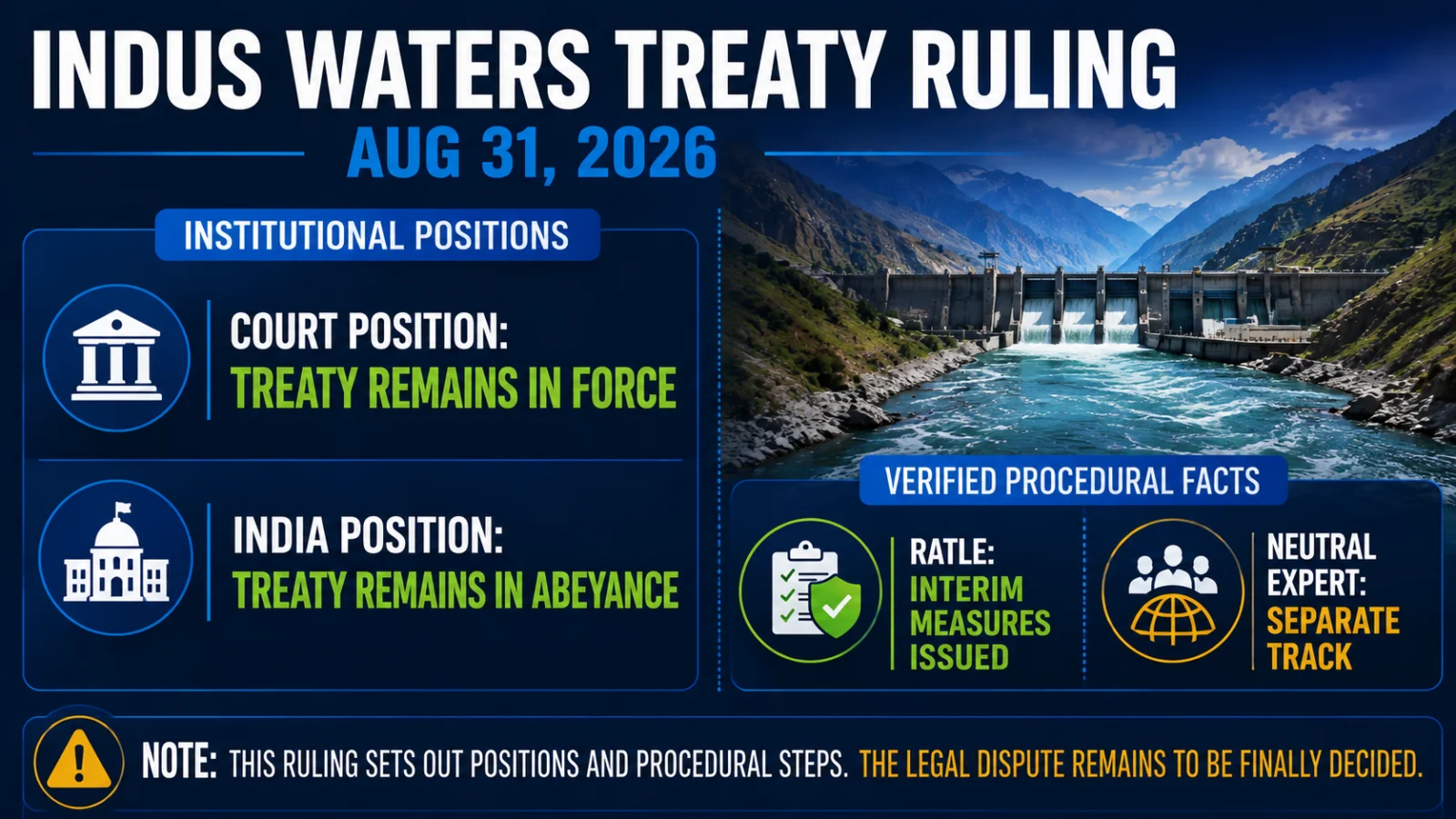
The Indus Waters Treaty ruling 2026 has created two sharply different institutional positions. The Court of Arbitration says the treaty remains in force and has issued interim measures concerning specified construction activity at the Ratle Hydro-Electric Plant. India rejects the Court’s jurisdiction and says its decision to keep the treaty in abeyance remains unchanged. The safest reading is therefore not that the dispute has been conclusively settled, but that a new formal tribunal ruling now exists while India continues to reject its legal effect.
Direct answer: the Aug 31 ruling does not establish that the entire Ratle project has been stopped, and it does not show that India has accepted the Court’s decision. The Court’s position is that the Indus Waters Treaty remains fully in force and that temporary restrictions apply to specified Ratle construction activity. India’s reported position is that the Court is illegally constituted, lacks jurisdiction and cannot alter India’s decision to keep the treaty in abeyance.
What happened on August 31?
The Permanent Court of Arbitration announced that the Court of Arbitration in the Indus Waters Western Rivers proceedings had issued two important decisions on August 31, 2026: an award on the status of the Indus Waters Treaty and an order on interim measures concerning the Ratle Hydro-Electric Plant.
That changes the information state because the dispute is no longer only about competing interpretations, jurisdiction and pending proceedings. There is now a formal treaty-status award and a project-specific interim order that readers must distinguish from India’s separate position on the legitimacy of the Court itself.
What did the Court say about the Indus Waters Treaty?
The Court’s position is that the Indus Waters Treaty remains in force and that India continues to be bound by treaty obligations. That is the Court’s legal finding within the arbitration proceeding.
It is important to attribute that conclusion correctly. TPS is not presenting the Court’s interpretation as an uncontested legal position accepted by both governments, because India rejects the Court’s authority to decide the matter.
What is India’s position?
Current reporting quoting India’s Ministry of External Affairs says India considers the Court of Arbitration illegally constituted, rejects its jurisdiction over India’s sovereign decisions and maintains that India’s decision to hold the Indus Waters Treaty in abeyance remains in force.
The direct Aug 31 MEA page was not recovered during the final verification for this article, so TPS treats this as a strongly corroborated reported Government of India position rather than pretending that the underlying MEA text was independently inspected.
So is the Indus Waters Treaty in force or in abeyance?
There is no single uncontested answer shared by the two sides in the evidence reviewed.
| Question | Court of Arbitration position | India’s position | What is established now |
|---|---|---|---|
| Treaty status | The treaty remains fully in force. | India says its abeyance decision remains unchanged. | A formal Court ruling exists, but India continues to reject its legal effect. |
| Court jurisdiction | The Court has continued the proceeding and issued awards and orders. | India says the Court is illegally constituted and lacks jurisdiction. | India’s jurisdictional objection remains unresolved between the parties. |
| Ratle | The Court issued temporary measures restricting specified construction activity. | India says the Court’s pronouncements will not affect India’s actions. | The order exists; actual Indian implementation or project-response changes are not yet established. |
| Neutral Expert | A separate treaty dispute track continues to address technical differences. | Indian government material says India stopped participating after placing the treaty in abeyance. | The Neutral Expert process remains a separate unresolved procedural track. |
This distinction is the core of the current dispute. Saying simply that the treaty has been “restored” would ignore India’s continuing position. Saying simply that the Court’s decision has no relevance would ignore the fact that an international arbitration award and interim order now formally exist.
What did the Court order at the Ratle project?
The Court issued interim measures concerning the Ratle Hydro-Electric Plant. Current reporting on the order says the restrictions concern specified construction work, including concreting of the dam wall and power-intake structures beyond specified levels while the separate Neutral Expert process remains pending.
The exact numerical construction levels in the full interim-measures order were not independently extracted during the final TPS review, so they are not reproduced here.
Did the Court stop the entire Ratle project?
No reviewed evidence supports describing the order as a complete shutdown of the Ratle project. The available evidence points to temporary limits on specified construction activity rather than a blanket prohibition on every project activity.
That distinction matters because a headline such as “Ratle project stopped” would go beyond what the reviewed order announcement and current reporting establish.
How long are the Ratle interim measures expected to apply?
Current reporting on the order says the interim restrictions are intended to remain in place until 90 days after the Neutral Expert’s final decision.
TPS has not independently extracted that duration from the full operative order text, so it should be treated as corroborated reporting rather than a separately reproduced primary-order clause.
What is the Neutral Expert deciding?
The Neutral Expert is a separate dispute-resolution mechanism under the Indus Waters Treaty. The technical proceedings concern differences relating to the Kishenganga and Ratle hydroelectric projects.
Indian government material records that the Neutral Expert had asserted competence over the technical points referred to that process. This is distinct from the Court of Arbitration proceeding, which has addressed different legal and treaty-interpretation questions.
Why are there both a Court of Arbitration and a Neutral Expert?
The treaty provides different dispute-resolution paths for different kinds of disagreements. In the current dispute, Pakistan initiated arbitration while India supported treatment of the relevant technical questions through the Neutral Expert route.
The coexistence of the two proceedings became a major procedural dispute in its own right. The Court has continued its proceeding, while India has maintained that the arbitration was improperly constituted and that the Neutral Expert was the appropriate route for the technical differences.
Is India participating in the Neutral Expert proceeding now?
Indian government material reviewed by TPS states that after India placed the treaty in abeyance, it decided not to participate in the ongoing Neutral Expert proceedings.
That does not mean the existence of the Neutral Expert process disappears. It means the procedural track can continue to be relevant to the dispute even while India’s current participation position has changed.
Does the Aug 31 ruling immediately change water allocation?
No new water-allocation formula or immediate redistribution of river flows was established in the reviewed evidence. The current development concerns treaty status, dispute jurisdiction and interim Ratle construction measures.
Readers should therefore avoid interpreting the ruling as proof that a new quantity of water must immediately be released, withheld or reassigned between India and Pakistan.
Does the ruling prove India will change Ratle construction?
No. The order establishes what the Court says should happen, but India’s reported position is that the Court lacks jurisdiction and that its pronouncements will not affect India’s actions.
What India actually does at Ratle after the order is therefore a separate factual question. TPS did not establish a verified post-order construction change, suspension or compliance action at the project during the current review.
What changed — and what did not?
- Changed: a formal Court of Arbitration award on treaty status now exists.
- Changed: a project-specific interim-measures order concerning Ratle now exists.
- Unchanged in India’s reported position: India continues to say the treaty remains in abeyance and the Court lacks jurisdiction.
- Not established: that the entire Ratle project has been stopped.
- Not established: that India has accepted or implemented the Court’s interim measures.
- Not established: that the Aug 31 ruling created a new immediate water-allocation formula.
What happens next?
The next material state could come from several places: publication or closer examination of the full award and interim-measures order, a directly recoverable Government of India statement, a verified change in Ratle construction activity, the Neutral Expert’s eventual decision, further Court clarification or another formal diplomatic or treaty-development step.
Those developments matter because today’s ruling establishes a new legal document, but it does not resolve the central practical conflict between what the Court says India is obliged to do and what India says the Court has authority to require.
How this was verified
ThePulseSignal reviewed the Permanent Court of Arbitration’s Aug 31 announcement confirming the treaty-status award and Ratle interim-measures order, Indian government material describing India’s abeyance and Neutral Expert participation position, and multiple current reports from major publishers covering the Court’s findings, India’s rejection and the reported scope of the Ratle restrictions. Claims were separated into primary-confirmed facts, attributed government positions, corroborated reporting and unresolved implementation questions.
Limitations and unresolved facts
The direct Aug 31 MEA statement was not recovered during the final review. TPS also did not independently extract the exact numerical construction levels or every operative clause from the full Ratle interim-measures order. India’s actual post-order project response, the enforceability consequences of the Court’s ruling where India rejects jurisdiction, the Neutral Expert’s final decision and any immediate change in Ratle construction remain unresolved.