






Iran sanctions tightened again on September 17, 2026. OFAC designated Iranian digital-asset exchange BitBank, its software developer Pishtaz Simorgh Electronic Trade Company and three associated individuals under Iran-related authorities. That follows OFAC’s September 14 Iran-related action against VTB Bank and the September 10 shift to a presumption-of-denial policy for Iran-related specific licence applications.
For Indian exporters, payment teams, banks, shipping companies, airlines, logistics providers and compliance teams, the practical rule remains transaction-specific: re-screen the current counterparties, ownership, payment chain, banks, digital-asset platforms, vessels or carriers, sector exposure and authorizations before proceeding.
Direct answer: The latest OFAC actions widen the screening problem across conventional banking and digital assets. BitBank and related parties were added on September 17, while OFAC’s September 14 action added an Iran-related E.O. 13902 basis for VTB Bank because of alleged Iran sanctions-evasion activity. Indian businesses should verify every bank, exchange, intermediary, ownership link, transport party and authorization before proceeding.
What is the latest Iran sanctions change?
On September 17, 2026, OFAC designated BitBank, an Iranian digital-asset exchange, together with its developer Pishtaz Simorgh Electronic Trade Company and three associated individuals.
Treasury said BitBank was part of a sanctions-evasion infrastructure linked to Iranian financier Babak Zanjani and designated BitBank and Pishtaz Simorgh under E.O. 13902 for operating in Iran’s digital-asset sector.
For Indian businesses, the important point is that sanctions screening cannot stop at conventional bank accounts. A digital-asset exchange, software provider, wallet-related intermediary or other facilitator can itself become a sanctions issue.
What changed with VTB Bank on September 14?
On September 14, 2026, OFAC took an Iran-related action against VTB Bank Public Joint Stock Company under E.O. 13902 for involvement in Iranian sanctions evasion, including correspondent relationships with sanctioned Iranian banks.
VTB was already subject to U.S. sanctions under Russia-related authorities. The September 14 action adds a distinct Iran-related sanctions basis and reinforces the need to identify the exact financial institution, branch, correspondent and sanctions authority involved in a payment chain.
OFAC’s current VTB record includes a New Delhi branch among the bank’s listed aliases and locations. Indian payment and treasury teams should not treat the presence of an India location as evidence that a route is outside U.S. sanctions screening.
What changed on September 10?
On September 10, 2026, OFAC changed its Iran-related specific licensing policy under Operation Economic Outcast.
OFAC says Iran-related specific licence applications are now considered with a presumption of denial, except as required by law or in certain circumstances such as risk to life, limb or environmental safety.
This does not mean that every existing general licence has disappeared, nor does it mean every Iran-related transaction is prohibited. It does mean businesses should not assume that an uncertain transaction can proceed because OFAC may later grant a specific licence.
What else did OFAC do on September 10?
OFAC also announced additional Iran-related and counter-terrorism designations and an Iran sanctions enforcement action.
The September 10 SDN changes included parties in Iraq, Lebanon and the United Arab Emirates. One UAE entity, Shams and Bahr Trading Company L.L.C., was added under the Iran E.O. 13902 authority.
A payment or trade route does not become low risk merely because an intermediary is based outside Iran.
What changed on September 8?
OFAC’s September 8 action materially changed the aviation side of the Iran sanctions framework.
OFAC suspended Iran General License J-1, concerning specified temporary-sojourn civil-aircraft transactions, and issued Iran General License DD for wind-down of certain civil aviation-related and other transactions that had previously been authorized.
OFAC also issued Counter Terrorism General License 37 for specified wind-down transactions involving certain persons blocked on September 8.
Indian aviation, freight-forwarding, aircraft-support, insurance, payment and logistics teams should verify whether an Iran-linked aviation transaction depends on an authorization affected by the September 8 changes.
What happened to Golden Global Bank on September 4?
OFAC’s September 4 action added Türkiye-based Golden Global Investment Bank and two subsidiaries to the SDN List under Iran-related authorities.
OFAC also issued Iran General License CC for specified wind-down transactions involving persons blocked on September 4.
The September 4 action remains relevant, but it is no longer the latest material sanctions development.
Why do these changes matter to Indian businesses?
The September 4, September 8, September 10, September 14 and September 17 actions show several ways sanctions exposure can change while an underlying commercial transaction appears unchanged:
- a bank or third-country intermediary can become newly relevant under an Iran sanctions authority;
- a general licence can be suspended or replaced with a wind-down authorization;
- OFAC’s policy for granting transaction-specific licences can become substantially more restrictive;
- a financial institution can acquire another sanctions basis linked to Iran-related activity; and
- a digital-asset exchange or supporting technology provider can be designated as part of a sanctions-evasion network.
An Indian company may therefore face a new compliance issue even if its Iranian buyer, seller or contract has not changed.
Do not screen only the direct Iranian counterparty. Check banks, correspondents, trading companies, exchange houses, digital-asset platforms, aviation parties, vessels, logistics providers, ownership chains and the exact authorization relied upon.
Does the September 10 policy mean specific licences will never be approved?
No. OFAC describes the policy as a presumption of denial, not an absolute legal prohibition on every specific licence approval.
OFAC identifies exceptions where approval may still be considered, including circumstances required by law and certain situations involving risk to life, limb or environmental safety.
For ordinary commercial planning, a business should not treat a possible future specific licence as a dependable workaround until OFAC actually grants it.
What is the difference between a general licence and a specific licence?
A general licence is an authorization OFAC publishes for a defined category of activity when its conditions are satisfied.
A specific licence is an authorization issued by OFAC in response to an individual application.
The September 10 presumption-of-denial policy concerns Iran-related specific licence applications. It should not be interpreted as automatic cancellation of every existing Iran general licence.
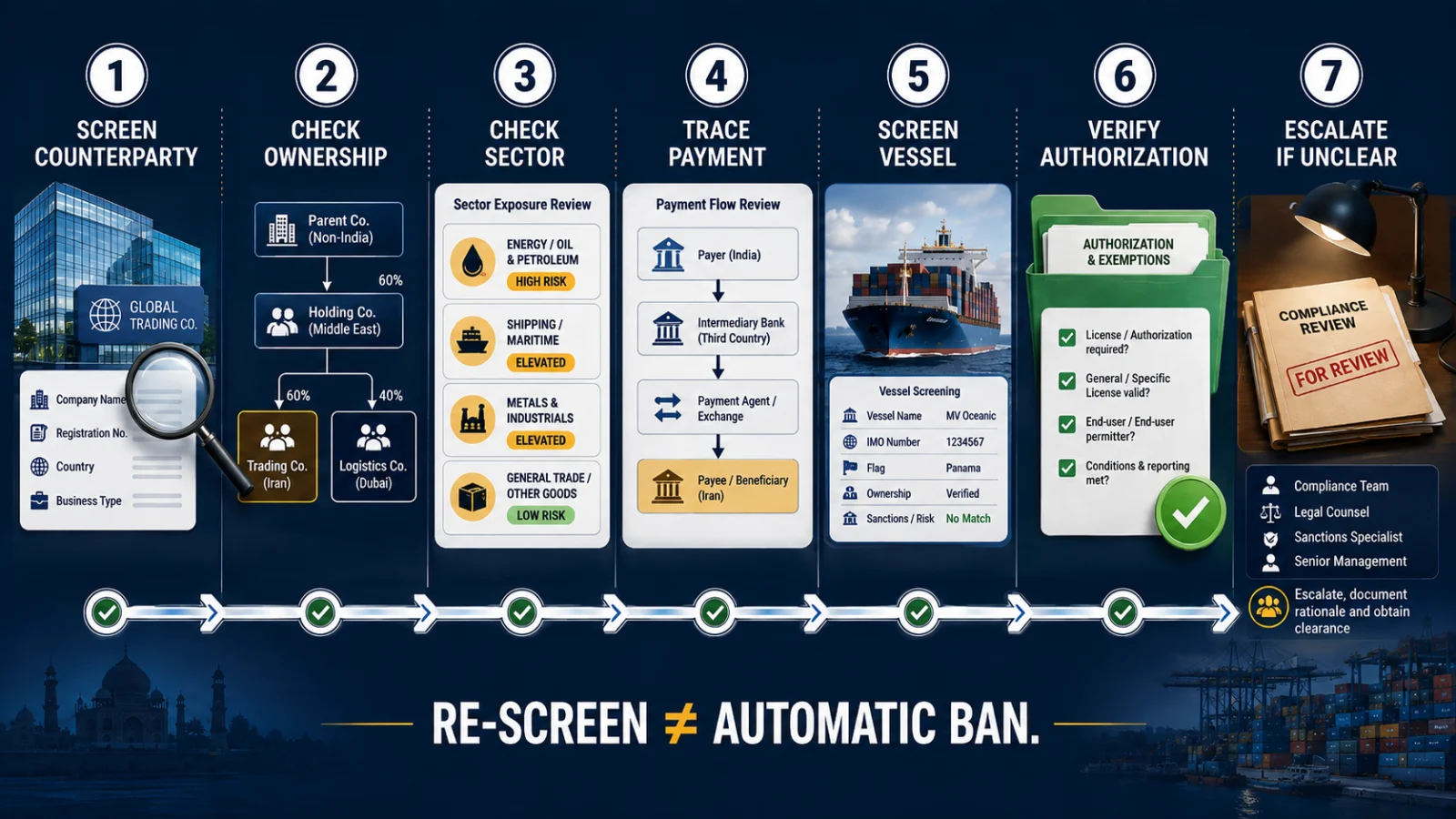
What should an Indian exporter recheck before proceeding?
1. Screen the direct counterparties
Check buyers, sellers, agents, freight parties, service providers and other material counterparties against current sanctions data.
2. Check ownership
A company that is not itself named can still require sanctions analysis because of ownership by blocked persons.
3. Trace the complete payment chain
Identify originating, receiving, intermediary and correspondent banks, together with exchange houses, digital-asset platforms and other settlement facilitators.
4. Re-screen third-country entities
Türkiye, UAE, Russia and other third-country locations do not remove Iran sanctions risk when the involved entity is designated or otherwise restricted.
5. Identify sector exposure
Determine whether the transaction touches Iranian financial, aviation, shipping, technology, digital-asset, gold or other activities covered by applicable sanctions authorities.
6. Check transport parties
For maritime cargo, screen the vessel, IMO number, owners, operators, managers, charterers and insurers. For aviation activity, check airlines, aircraft-related parties, operators and the authorization relied upon.
7. Verify the exact authorization
Confirm whether the activity relies on a current general licence, exception or specific licence and whether that authority remains valid.
Does this mean all India-Iran trade is prohibited?
No. The current OFAC actions do not establish a blanket prohibition on every India-Iran transaction.
The answer depends on the parties, ownership, payment route, transport chain, sector, U.S. nexus, sanctions authority and any applicable licence or exemption.
What should payment and treasury teams recheck?
- all banks and correspondent institutions in the payment chain;
- VTB Bank and other institutions appearing in current OFAC records;
- third-country exchange houses or settlement facilitators;
- digital-asset exchanges and related platforms where cryptocurrency is involved;
- ownership links to blocked persons;
- the specific sanctions authority attached to each relevant party; and
- whether any general or specific licence actually authorizes the transaction.
What should shipping teams recheck?
- vessel name and IMO number;
- registered owner, operator and manager;
- charterer and cargo interests;
- insurers and financial intermediaries;
- ports, transshipment points and third-country facilitators; and
- the payment route connected to freight, bunkering, insurance or port services.
What should aviation and logistics teams recheck?
Verify airlines, aircraft-related parties, freight forwarders, maintenance or support providers, payment intermediaries and the exact authorization relied upon.
Do not assume that a transaction previously covered by Iran General License J-1 remains authorized after its September 8 suspension.
What about food, medicine and humanitarian trade?
Humanitarian categories can have different sanctions treatment, but the product category alone does not eliminate screening requirements.
Businesses still need to verify the parties, banks, transport route and exact applicable authorization or exemption before relying on humanitarian treatment.
Which authorizations now need particular attention?
- Iran General License CC — September 4 wind-down authorization tied to persons blocked that day;
- Iran General License J-1 — suspended on September 8;
- Iran General License DD — September 8 wind-down authorization for specified civil aviation-related and other previously authorized transactions;
- Counter Terrorism General License 37 — specified September 8 wind-down activity; and
- Iran-related specific licence applications — subject to the September 10 presumption-of-denial policy.
What should companies not conclude?
- Do not conclude that every India-Iran transaction is prohibited.
- Do not conclude that a third-country bank or trading company is automatically low risk.
- Do not conclude that cryptocurrency or another digital-asset route sits outside OFAC sanctions.
- Do not conclude that an old general licence remains usable without checking its current status and conditions.
- Do not conclude that OFAC will grant a specific licence merely because an application can be filed.
A practical transaction decision rule
PROCEED TO NORMAL COMMERCIAL REVIEW only when current screening identifies no material sanctions issue and the payment, transport and authorization route is established.
HOLD AND VERIFY where ownership, banking, digital-asset intermediary, vessel, airline, sector or authorization evidence is incomplete.
ESCALATE where a blocked party, designated financial institution, designated digital-asset platform, designated transport party, unclear general licence, specific-licence dependency or material secondary-sanctions issue appears.
A public guide cannot determine whether a particular transaction is lawful without the actual parties, ownership, banks, route, cargo or service, contracts and controlling sanctions authorities.
What happens next?
Operation Economic Outcast has continued through banking, aviation, digital-asset, intermediary and proxy-network actions. Further OFAC designations, licence changes, enforcement actions or India-relevant financial and transport measures could materially change the transaction decision.
Indian businesses should therefore use OFAC’s current Iran sanctions page and Recent Actions feed as current-state checks rather than relying on a previously approved route.
Verification note
ThePulseSignal checked OFAC’s September 4 Golden Global action, the September 8 aviation-related action, the September 10 licensing-policy and designation action, the September 14 VTB Bank action, the September 17 BitBank action, OFAC’s current Iran sanctions programme page, OFAC Recent Actions and corresponding U.S. Treasury releases.
The most recent material changes are OFAC’s September 17 BitBank designations and September 14 Iran-related action against VTB Bank. They sit on top of the September 10 presumption-of-denial licensing policy and September 8 aviation authorization changes.
Last verified: September 18, 2026.
Limitations
- No India-specific Treasury or OFAC compliance deadline was identified in the sources reviewed.
- The current actions do not establish that every India-Iran transaction is prohibited.
- The September 10 presumption-of-denial policy concerns Iran-related specific licence applications and is not automatic cancellation of every general licence.
- General Licences CC and DD are wind-down authorizations whose exact scope must be checked in the controlling text.
- VTB Bank was already subject to other U.S. sanctions before the September 14 Iran-related action.
- Transaction-specific consequences depend on counterparties, ownership, payment routes, digital-asset intermediaries, transport parties, sector exposure and applicable authorizations.
- OFAC designations, licences and policies can change quickly.
- Indian government, banking, customs or trade guidance may separately change the practical workflow.
Bottom line
The Iran sanctions decision state is materially tighter than it was after the September 10 licensing change alone. OFAC added an Iran-related E.O. 13902 basis for VTB Bank on September 14 and designated BitBank and related digital-asset actors on September 17.
Indian businesses should re-screen current counterparties, ownership, payment routes, banks, digital-asset platforms, shipping or aviation parties and authorizations before proceeding with an Iran-linked transaction.
If the transaction depends on a blocked party, uncertain general licence, suspended authorization or hoped-for specific licence approval, hold the transaction and obtain transaction-specific sanctions or legal review before proceeding.