






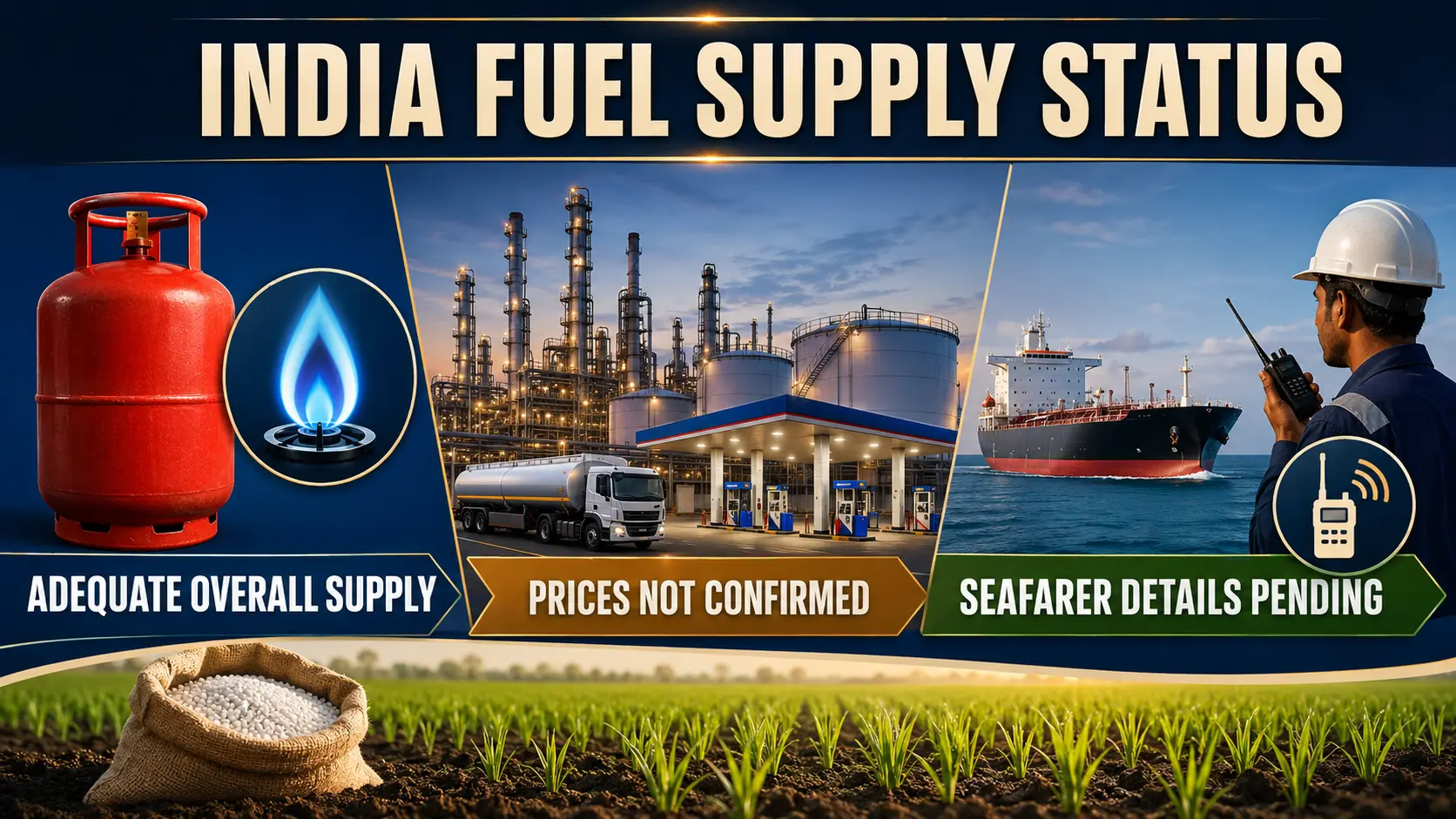
The current India LPG and petrol shortage status is not the same as the commercial-LPG disruption reported earlier in 2026. After the July 30 CCS review, the government said the overall supply and stock position for major petroleum products remained adequate, but it did not guarantee unchanged prices or publish the number of days those stocks would last.
India LPG and petrol shortage: direct answer
No current nationwide shortage of major petroleum products has been acknowledged by the government in the official material reviewed through August 25, 2026.
The July 30 review said India’s overall stock and supply position remained adequate. It also said LPG procurement sources had been diversified and adequate crude availability was allowing central public-sector refineries to operate above 100% utilisation.
No later official Central-government statement materially reversing that national supply assessment was identified during ThePulseSignal’s August 25 review.
That assurance does not establish that every distributor, commercial user or location has identical availability. It also does not say that petrol, diesel or LPG prices cannot change later.
Current-status warning:
Some search results still lead with the commercial-LPG disruption and panic buying reported earlier in 2026.
That historical disruption is relevant, but it should not be presented as proof that India is currently experiencing a nationwide household LPG, petrol or diesel shortage.
Government rejects widespread fuel-adulteration claims: what the testing data shows
In an August 2026 government clarification reviewed for this article, the Ministry of Petroleum and Natural Gas rejected claims alleging widespread fuel adulteration or contamination. Oil Marketing Companies were described as maintaining fuel-quality monitoring and additional checks across the retail network.
The earlier government clarification reviewed by ThePulseSignal also reported testing for chloride and sulphide and identified a limited number of chloride-contamination detections within that described exercise.
Important boundary: A limited number of detections within one described sampling exercise does not establish that only that number of fuel-quality incidents of every possible type occurred across India.
Adulteration, contamination, water ingress and E20 are not the same
Adulteration
Deliberate mixing of an unauthorised, inferior or cheaper substance into fuel. It is a malpractice and can trigger action under fuel-quality and dealership rules.
Contamination
Unwanted material entering fuel. It may arise from storage, transport, water ingress, corrosion or another handling problem and is not automatically proof of deliberate adulteration.
Water ingress
Water entering a storage tank, pipeline, dispenser or vehicle-fuel system. Testing for water ingress is one quality-control measure, not a complete test for every possible defect.
E20 petrol
Petrol blended with 20% ethanol under the notified fuel programme. Fuel supplied to the prescribed standard is not “adulterated” merely because it contains ethanol.
Vehicle trouble does not by itself prove adulteration.
Stalling, poor mileage, corrosion, injector problems or warning lights can have several causes. A vehicle complaint should be documented and investigated, but one symptom alone cannot establish what entered the fuel or whether the outlet acted deliberately.
What should a consumer do after suspecting poor-quality fuel?
- Stop using the vehicle if continuing could cause damage. Move it safely and avoid further driving when serious symptoms begin immediately after refuelling.
- Preserve the purchase record. Keep the receipt, outlet name, pump number, date, time, fuel grade, amount and payment record.
- Document the symptoms. Record warning lights, engine behaviour, photographs, videos and the kilometres driven after refuelling.
- Do not drain or discard evidence without documentation. Ask the workshop to record the condition of the fuel, filters and affected components.
- Notify the outlet and the relevant Oil Marketing Company. Request a written complaint or reference number rather than relying only on a verbal conversation.
- Ask what test or inspection was performed. A density check, water test, laboratory sample or vehicle diagnosis answers different questions.
- Avoid claiming deliberate adulteration without evidence. Describe the observed problem and allow the sampling and investigation process to determine the cause.
In this guide
- Fuel-quality claim and testing update
- What the government confirmed
- Why maritime routes matter
- Earlier disruption versus current status
- What adequate supply means
- Could fuel prices increase?
- Domestic versus commercial LPG
- Why refineries exceed 100%
- Seafarer support and contacts
- Fertiliser and the Rabi season
- What readers should do
- What remains unknown
- Frequently asked questions
CCS fuel review at a glance
- The government says the national stock and supply position for major petroleum products is adequate.
- LPG procurement sources have been diversified.
- The countries, suppliers, contract quantities and stock duration were not disclosed.
- CPSE refineries were reported to be operating above 100% utilisation.
- No petrol, diesel or LPG retail-price decision was announced in the July 30 CCS statement.
- Alternate fertiliser sources were discussed for the approaching Rabi season.
- A support mechanism was ordered for seafarers and their families.
- The CCS statement did not publish the mechanism’s dedicated contacts or launch date.
- No later official nationwide-shortage acknowledgement was identified during the August 25 review.
What did the government confirm about India’s fuel supply?
The Prime Minister chaired the fourth special Cabinet Committee on Security meeting concerning the continuing West Asia conflict.
The review covered petroleum products, including LNG and LPG, fertiliser requirements, Indian citizens and diaspora communities, and Indian seafarers serving on Indian and foreign-flagged vessels in conflict zones.
The official statement confirmed several operational points.
Overall supply described as adequate
The government said the current overall stock and supply position for major petroleum products remained adequate.
LPG sourcing diversified
Alternative procurement arrangements have been made, although supplier countries and quantities were not published in the CCS statement.
Refineries running at high utilisation
Adequate crude availability was said to be supporting CPSE refinery utilisation above 100%.
Fertiliser alternatives reviewed
Alternate sources were discussed for maintaining supply ahead of the Rabi season.
Seafarer assistance ordered
A mechanism was directed for information, emergency help and counselling for seafarers and families.
Unified monitoring ordered
Government departments were directed to continue coordinated monitoring and protective measures.
Why maritime routes matter to India’s fuel-supply planning
The CCS statement confirms that LPG procurement sources were diversified, but it does not identify the supplier countries, cargo volumes, routes or commercial terms.
The broader supply-chain context helps explain why diversification can matter. Major maritime energy routes can be affected by conflict, shipping restrictions, longer voyages, freight costs and insurance risk.
Those effects can influence the cost and timing of energy supplies even when India continues to have adequate national stocks.
| Maritime factor | Why it matters | What is confirmed for India | What remains unconfirmed |
|---|---|---|---|
| Strait of Hormuz | A major transit route for oil, petroleum products and LNG moving out of the Persian Gulf. | India says LPG procurement sources have been diversified and overall petroleum supply remains adequate. | The CCS statement does not say which Indian cargoes, suppliers or contracts were shifted because of this route. |
| Red Sea and Bab el-Mandeb | Security incidents can disrupt shipping, raise risk costs or cause vessels to take longer routes. | The government is monitoring the wider West Asia conflict and its effect on supplies and seafarers. | The CCS statement does not identify a particular Red Sea incident as the reason for an LPG procurement decision. |
| Freight and insurance | Higher voyage risk or longer routing can increase transport costs before any retail-price decision is made. | No retail-price decision was announced in the July 30 CCS statement. | The government did not publish route-specific freight, insurance or landed-cost data. |
Evidence boundary: Maritime chokepoints provide relevant external context, but the official CCS statement does not publicly attribute India’s LPG diversification to any one route, attack or supplier change.
For background on the global route risk, see the U.S. Energy Information Administration’s oil-transit chokepoint analysis and the International Maritime Organization’s Red Sea material.
Earlier LPG disruption versus the current verified position
The India LPG and petrol shortage question is confusing because search results can combine different points in time.
Earlier in 2026, government and news reports described a significant commercial-LPG disruption linked to the West Asia conflict, import constraints and household-supply prioritisation.
The July 30 statement is a later national assessment. It says major-petroleum supply and stocks are adequate and LPG procurement has been diversified.
ThePulseSignal’s August 25 review did not identify a later official Central-government statement declaring a nationwide shortage of major petroleum products.
| Issue | Earlier 2026 position | Latest verified national position | What readers should conclude |
|---|---|---|---|
| Domestic LPG | Household supply was prioritised during disruption. | No current nationwide shortage acknowledged in the official material reviewed. | Do not treat the earlier commercial disruption as proof of a current national household shortage. |
| Commercial LPG | Restrictions and phased restoration were reported. | Current commercial availability was not quantified in the CCS statement. | National adequacy does not prove identical allocation for every commercial customer. |
| Petrol and diesel | Government repeatedly emphasised adequate supply. | Overall major-petroleum supply remains described as adequate. | No nationwide petrol or diesel shortage was identified in the official material reviewed through August 25. |
| LPG procurement | Alternative sourcing and allocation measures were used. | Procurement sources are described as diversified. | The supply base has been broadened, but CCS did not disclose supplier details. |
| Retail prices | Crude costs and geopolitical risks created pressure. | No retail-price commitment was made in the CCS statement. | Supply adequacy and future retail prices are separate questions. |
Controlling distinction: “There was a commercial-LPG disruption earlier in 2026” and “the government currently describes overall petroleum supply as adequate” can both be true.
What does “adequate supply” establish?
It establishes that the Union government was not reporting an overall nationwide shortage of major petroleum products in the controlling July 30 assessment.
The August 25 review did not identify a later official Central-government statement reversing that national position.
The CCS assessment also indicates that adequate crude remained available to central public-sector refineries and that alternative LPG procurement had been arranged.
It does not reveal stock duration, local distributor availability, commercial allocation, future shipping conditions or future prices.
| Government statement | What it establishes | What it does not establish |
|---|---|---|
| Petroleum stocks and supplies are adequate | No officially acknowledged nationwide shortage in the controlling assessment. | Future price stability, stock duration or identical local availability. |
| LPG sources diversified | India has made alternative procurement arrangements. | Supplier countries, volumes, contract terms or product allocation. |
| Refineries above 100% utilisation | Actual throughput exceeded rated capacity for the measured period. | Unlimited production or immunity from future crude and shipping disruption. |
| Fertiliser alternatives discussed | Rabi-season supply risk is under active review. | State-wise stocks, product-wise quantities or assured local availability. |
| Seafarer mechanism ordered | A formal assistance arrangement was directed. | A dedicated operational phone number, launch date or final geographic scope from the CCS statement itself. |
Will petrol, diesel or LPG prices increase?
The July 30 CCS statement does not answer that question.
It does not announce a price increase. It also does not promise that prices will remain unchanged.
Retail fuel prices can be influenced by crude-oil prices, exchange rates, freight, insurance, taxes, subsidies, company recoveries and government policy.
The CCS statement is about supply continuity and operational preparedness. It should not be converted into a price forecast.
Do not assume: An adequate stock position does not automatically prevent a later price change, and higher global crude prices do not automatically prove that a particular retail increase has been approved.
Are domestic and commercial LPG conditions the same?
No. Domestic household cylinders and commercial LPG serve different customer categories and may be managed differently during a disruption.
Earlier 2026 reporting focused heavily on commercial LPG restrictions, restaurant and industry impacts, household prioritisation and staged restoration.
The July 30 CCS statement gives an overall national assurance and says sourcing has been diversified. It does not publish separate availability percentages for domestic and commercial LPG.
A restaurant, industrial unit or distributor experiencing a local allocation problem should not treat the broad national statement as proof that its individual supply issue is impossible.
What does refinery utilisation above 100% mean?
Refinery utilisation compares actual crude processing with the plant’s rated or nameplate capacity.
A refinery can exceed 100% when debottlenecking, optimisation, maintenance improvements or operating changes allow it to process more than the original rated baseline.
It does not mean the refinery has unlimited capacity or is violating a physical limit.
In the CCS statement, the figure is used to show that adequate crude availability is supporting continued output of petrol, diesel and other petroleum products.
What support was ordered for Indian seafarers?
The Prime Minister directed a mechanism to provide timely information, emergency assistance and counselling to seafarers and their families.
The statement specifically refers to Indian seafarers serving on domestic and foreign-flagged vessels in conflict zones.
This is broader than assistance limited only to Indian-flagged ships.
Is the new seafarer helpline operational?
The July 30 CCS release does not say that a new dedicated helpline is already operational.
It does not publish a new phone number, email address, launch date or eligibility form.
Families do not need to wait before using existing official crisis, grievance and consular channels. Those contacts should be described as existing services, not automatically as the newly ordered CCS mechanism.
Existing official help for seafarers and families
| Official channel | Contact or action | Use it for | Important limitation |
|---|---|---|---|
| DG Shipping crisis and grievance contact points | +91-22-22613668 +91-8657549760 +91-9004048406 support.dgs@gov.in |
Existing seafarer crisis or grievance escalation through the Directorate General of Shipping. | These are existing DG Shipping contact points. The July 30 statement does not identify them as the dedicated contacts for the newly ordered CCS mechanism. |
| MEA MADAD portal | Register and track a consular grievance | Consular assistance involving an Indian citizen abroad and follow-up with the relevant Indian Mission or Post. | MADAD is a general consular-grievance service, not a vessel-rescue control room. |
| MEA / Overseas Workers Resource Centre | 1800-11-3090 | Guidance relating to overseas-worker or recruiting-agent grievances and referral to the appropriate official channel. | Do not describe this as the new CCS seafarer helpline. |
| Indian Embassy or Consulate | Find the relevant Indian Mission or Post | Country-specific consular assistance, local coordination and emergency advisories. | Contacts and emergency instructions differ by country and can change during a crisis. |
What information should a family prepare?
- Seafarer’s full name, passport number and Continuous Discharge Certificate number, if available.
- Vessel name and seven-digit IMO number.
- Vessel flag, ship manager and employer details.
- Recruitment and Placement Services Licence number, where applicable.
- Current or last-known vessel location and the date and time of the last successful contact.
- Nature of the emergency, including any medical, security, attack, detention or missing-person concern.
- Name, relationship and contact details of the person reporting the case.
- Copies or screenshots of recent messages, contracts, joining documents or location information.
Immediate danger:
A seafarer onboard should follow the vessel master, company security procedures and applicable maritime-distress protocols. Families should contact the employer or ship manager and official authorities without waiting for a separate implementation notice for the CCS-directed mechanism.
Which countries and waters are covered?
The July 30 statement uses the broad terms “West Asia conflict” and “conflict zones.”
It does not list individual countries, ports, sea lanes, vessels or geographic boundaries for the new mechanism.
Families should use the latest official DG Shipping, MEA, embassy or employer notice relevant to the vessel and location involved.
Has India announced an evacuation?
No evacuation or repatriation operation was announced in the July 30 CCS statement.
MEA or individual Indian missions may issue separate country-specific travel, departure or evacuation instructions where circumstances require them.
Readers should not interpret a security review or support mechanism as proof that an evacuation has begun.
Could the conflict affect fertiliser supply for the Rabi season?
The possibility is being actively managed.
The CCS reviewed fertiliser requirements and discussed alternate sources ahead of the Rabi season.
The Prime Minister directed that measures be taken to ensure uninterrupted fertiliser supply.
The CCS statement does not identify fertiliser products, substitute countries, import quantities, state allocations or district-level availability.
Farmers should rely on state agriculture departments, authorised dealers and later Fertiliser Ministry notices for product-specific availability rather than assuming that a national review confirms stock at every local outlet.
What should consumers, families and businesses do now?
Practical next steps
- Do not panic-buy petrol, diesel or LPG based only on speculative social-media posts.
- Check the local distributor or oil-company channel when a delivery or allocation problem affects you directly.
- Separate domestic-cylinder information from commercial-LPG allocation information.
- Do not treat commentary about crude prices or export duty as an approved retail-price notice.
- For a seafarer emergency, preserve the vessel name, flag, IMO number, employer, last contact time and location information.
- For a seafarer emergency, contact the employer or ship manager where possible, then use verified DG Shipping, Indian Mission and MEA channels as appropriate.
- Farmers should check state and dealer notices for the required fertiliser product rather than relying on general national assurances.
What should readers not assume?
- Do not assume an immediate nationwide fuel shortage has been announced.
- Do not assume retail fuel prices will definitely rise or definitely remain unchanged.
- Do not assume an export-duty increase is the same as a domestic pump-tax increase.
- Do not assume national adequacy means every commercial LPG customer has normal allocation.
- Do not assume refinery utilisation above 100% means unlimited output.
- Do not assume existing maritime contacts are the newly ordered CCS mechanism.
- Do not assume an evacuation has begun.
- Do not assume fertiliser availability is identical in every state and district.
What remains unknown after the CCS review?
- The number of days covered by current petroleum inventories.
- Product-wise stocks for petrol, diesel, LPG, LNG and aviation fuel.
- The countries and companies supplying diversified LPG under the July 30 assessment.
- Domestic-versus-commercial LPG allocation figures.
- Any future petrol, diesel or LPG retail-price decision.
- The new seafarer mechanism’s dedicated contacts and launch date.
- The countries, waters and vessels covered by that mechanism.
- Fertiliser product quantities and state-wise Rabi allocations.
- The structure and public reporting process of the unified monitoring mechanism.
India LPG and petrol shortage: frequently asked questions
Is India currently facing an LPG shortage?
The government has not acknowledged a current nationwide shortage in the official material reviewed through August 25. The July 30 CCS assessment says the overall supply and stock position for major petroleum products is adequate and LPG procurement sources have been diversified.
That does not prove that every commercial user or local distributor has identical availability.
Was there an LPG supply problem earlier in 2026?
Yes. Earlier reporting and government interventions described a substantial commercial-LPG disruption, household-supply prioritisation and staged restoration measures.
The July 30 assessment is a later status update and should not erase that history.
Will petrol and diesel prices increase?
The CCS statement does not announce an increase or guarantee that prices will remain unchanged.
Supply adequacy and future retail prices are separate questions.
How many days will India’s fuel stocks last?
The July 30 statement does not provide a days-of-cover figure.
“Adequate” is the government’s overall assessment, not a published stock-duration calculation.
Why can refinery utilisation exceed 100%?
Utilisation is measured against rated or nameplate capacity. Optimisation and debottlenecking can allow actual processing to exceed that original baseline.
It does not mean production is unlimited.
Is the new Indian seafarer emergency helpline operational?
The July 30 CCS statement confirms that a support mechanism was ordered, but it does not publish a dedicated new phone number, email address or launch date.
Existing official contacts may remain usable, but their role in the new mechanism should not be assumed without an implementing notice.
Has India announced evacuation flights from West Asia?
No evacuation was announced in the July 30 CCS statement.
Any evacuation or departure advice would require a separate MEA, embassy or other government announcement.
Could the conflict affect fertiliser availability?
Supply risk is under active review and alternate sources were discussed for the Rabi season.
The CCS statement does not provide product-wise or state-wise availability figures.
Is contamination the same as adulteration?
No. Adulteration usually refers to deliberate mixing of an unauthorised substance. Contamination can result from water ingress, storage, transport, corrosion or another handling failure and may be accidental.
Is E20 petrol adulterated fuel?
No. E20 is a notified petrol blend containing ethanol. Fuel supplied according to the prescribed standard is not adulterated merely because ethanol is present.
Controlling source: Prime Minister’s Office / PIB — July 30, 2026 Cabinet Committee on Security review.
Historical comparison: Earlier 2026 government fuel-supply and LPG intervention notices are used only to distinguish the earlier disruption from the later national assessment.
External context: Maritime-source material is used only to explain why global shipping routes matter. It is not used to claim that the Indian government attributed LPG diversification to a specific route or attack.
Existing seafarer assistance: Existing DG Shipping and MEA assistance channels are separate from the newly directed CCS support mechanism unless a later implementing notice explicitly connects them.
Verification and editorial limitation
Status: The July 30 CCS meeting, national supply assessment, diversified LPG sourcing, high refinery utilisation, fertiliser review and direction for seafarer support are confirmed by the official government statement.
Currentness check: Official Central-government sources were rechecked through August 25, 2026. No later official acknowledgement of a nationwide shortage of major petroleum products was identified during this review.
Last verified: August 25, 2026.
Limitation: This article explains the verified national official position. It is not a guarantee of future availability or pricing and does not replace location-specific emergency, maritime, agricultural or commercial-supply information.