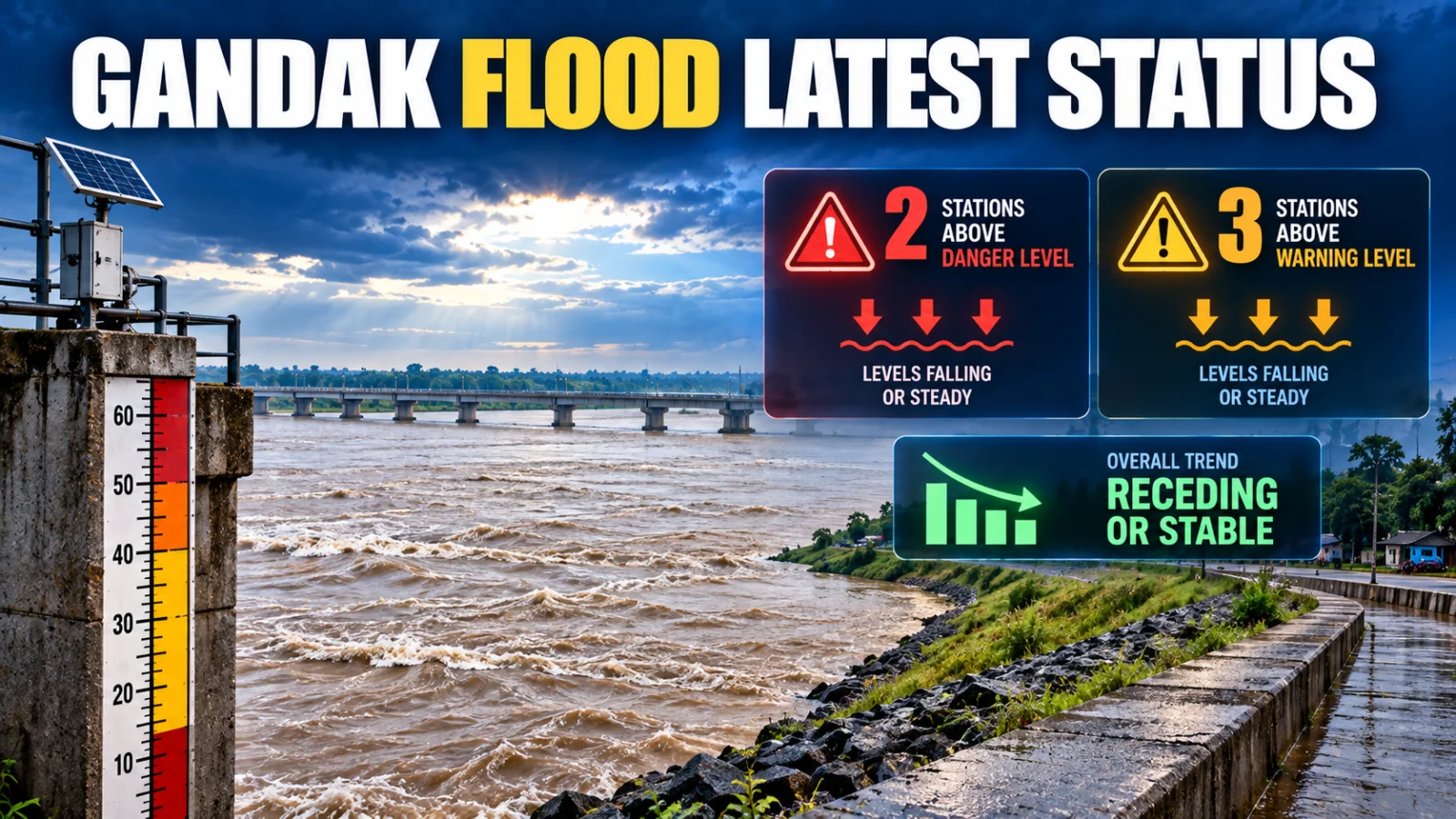





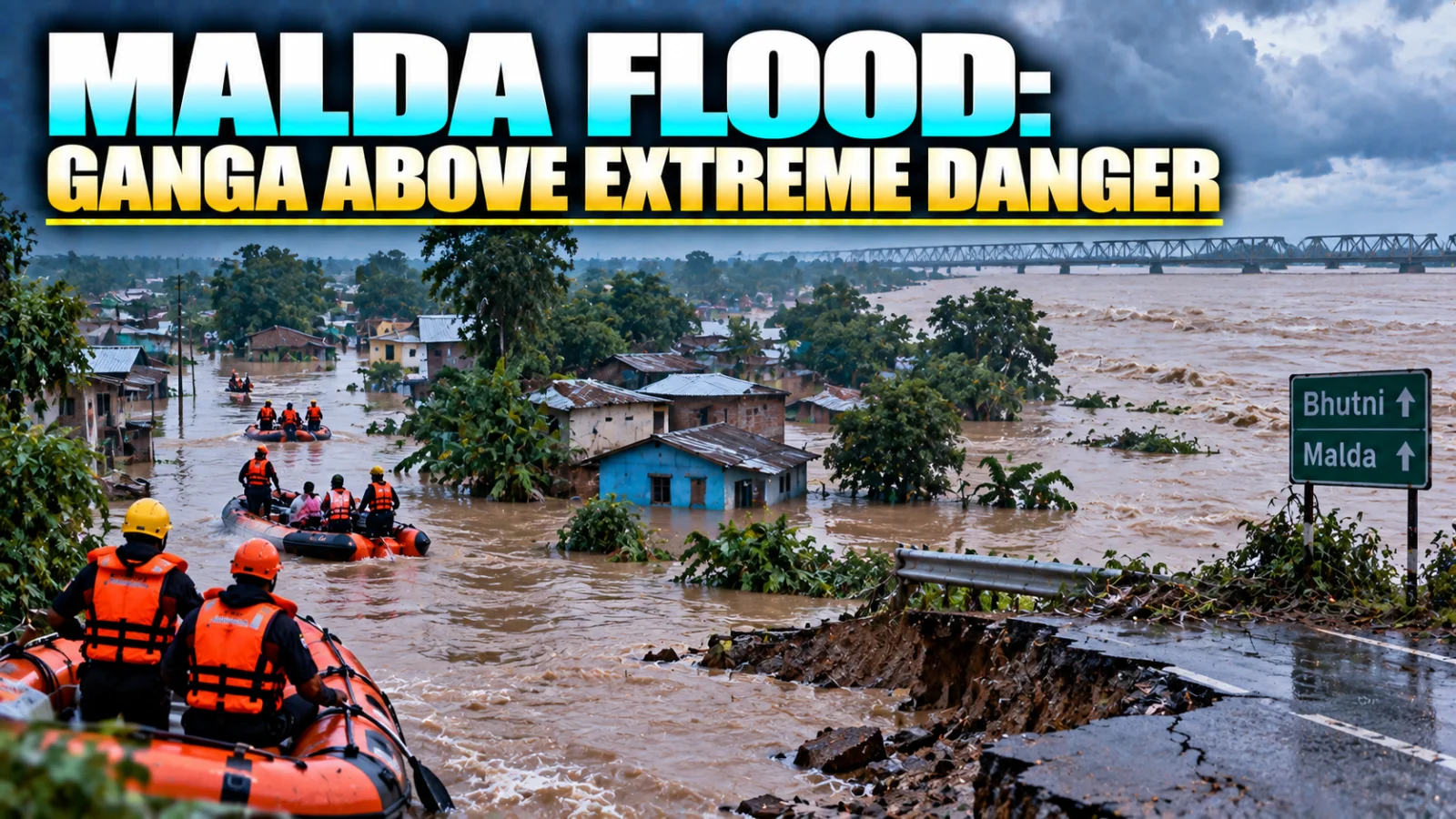
Malda flood today remains a life-safety issue in Bhutni and Manikchak, where the Ganga was still above the official extreme-danger threshold in the latest river-level report reviewed by ThePulseSignal. At 4 PM on September 13, 2026, the river at Manikchak Ghat was reported at 25.98 metres, compared with West Bengal Irrigation & Waterways’ official 25.30-metre extreme-danger level.
Bhutni Diara remained heavily inundated, relief and boat operations were continuing, and multiple flood-related deaths had been reported. However, readers should not treat any river level, death toll or affected-population figure in this article as a timeless live number. Current reports differ on some totals, and a newer official gauge reading can materially change the safety picture.
Direct answer: In the latest reviewed September 13 state, the Ganga at Manikchak remained above the official extreme-danger mark and large parts of Bhutni were still flooded. The 25.98-metre reading was recorded at 4 PM on September 13, not as a real-time September 14 reading. Current reports also differ on the districtwide death total and on how many people should be described as affected, marooned or displaced.
Is the Ganga still above the extreme-danger level at Manikchak?
In the latest reviewed river-level report, yes. The Ganga at Manikchak Ghat was reported at 25.98 metres at 4 PM on September 13. West Bengal Irrigation & Waterways lists the station’s extreme-danger level at 25.30 metres, putting that reported reading 68 centimetres above the threshold.
The river had been reported at 25.99 metres at 10 AM the same day, so the later reading represented a marginal one-centimetre fall over six hours. That is not enough evidence to say the flood is steadily receding or that submerged areas are safe again.
Why older Malda flood level figures should not be treated as current
Earlier in the flood lifecycle, the Ganga at Manikchak was reported at 26.05 metres at noon on September 10, around 75 centimetres above the extreme-danger threshold. That was a more severe reading, but it belongs to September 10 and should not be reused as the current river level.
Similarly, a lower or slightly falling gauge does not automatically mean roads, embankments, homes or village access have recovered. Water already spread across low-lying areas can continue to isolate communities even while the main river gauge begins to ease.
What is the current Bhutni flood situation?
Current reporting describes Bhutni Diara as one of the worst-affected parts of Malda, with large areas of Uttar Chandipur, South Chandipur and Hiranandapur among localities repeatedly reported as inundated during the current flood.
Boat movement, relief distribution and community support remained important because normal road access was disrupted in badly flooded areas. The precise number of villages, families or residents currently isolated can change as water levels and access conditions change.
How many people are affected or marooned?
The latest reviewed September 13 UNI report said around 30,000 families remained in heavily flooded Bhutni localities and nearly 2.5 lakh people were affected, citing Manikchak MLA Gour Chandra Mandal.
Those figures need careful wording. Earlier reports used roughly 2.5 lakh in a marooned or evacuation context, while later reporting used affected. Those are not necessarily the same population state. TPS therefore does not convert them into one unqualified current count.
How many flood-related deaths have been reported?
Current reports differ depending on geography and incident scope. Some current Bhutni and Malda flood reports describe three deaths, while another September 13 report describes four deaths across flood-affected Malda, including incidents outside the narrowest Bhutni framing.
TPS is therefore not presenting one districtwide death total as settled fact. The safe current conclusion is that multiple flood-related deaths have been reported, with the exact consolidated Malda total still needing authoritative reconciliation.
Are relief and boat operations continuing?
Yes. Current reports describe continued relief distribution, boats moving through flooded localities, community kitchens and assistance for residents unable to use normal road access.
The number of boats, shelters, relief camps or people receiving assistance can change quickly. Those operational numbers should only be used with a clear date, time and source.
What should residents and travellers check before moving through flood-affected areas?
Check the newest official river reading
Use the latest West Bengal Irrigation & Waterways or CWC river and flood-warning information rather than relying on a media number from an earlier day.
Check local access instructions
Use district administration, police or local authority guidance before entering a flooded road, embankment approach, ferry point or isolated village.
Do not equate a falling gauge with safe access
A small fall in river level does not prove that roads, homes or embankments have become safe or that floodwater has drained from low-lying areas.
Keep evacuation and relief instructions current
If authorities advise evacuation or restrict access, use the latest local instruction even when an older article or social post shows a different river level.
What would materially change the Malda flood status?
The most important next evidence is a newer official Manikchak gauge reading and trend. A sustained fall below the extreme-danger threshold would change the river-state assessment, while a fresh rise, embankment breach or wider inundation would increase the immediate risk.
Other material updates include a reconciled official death count, revised affected or displaced population figures, new evacuation or return-home instructions, reopening or closure of access routes and major changes to relief operations.
Verification note
ThePulseSignal checked West Bengal Irrigation & Waterways’ official Manikchak river-station thresholds and compared them with current reporting that attributed recent water-level and flood-impact figures to state, local and elected authorities. TPS also compared multiple current reports because death counts, affected-population descriptions and other dynamic figures differ by date and geographic scope.
Limitations and unresolved facts
A directly retrieved September 14 CWC or West Bengal live Manikchak reading was not available during preparation. The latest reviewed level is therefore explicitly timestamped to 4 PM on September 13. A single reconciled official Malda flood-death total was also not recovered. The exact current number of people marooned, displaced or affected, the current village and family count, boat deployment, relief-camp occupancy, access conditions and any new embankment failures remain subject to change.