






Mundra Port is operating, but the empty-container workflow is still not something exporters or importers should assume has returned to normal. CMA CGM’s current Mundra advisory continues to describe empty-container release for factory stuffing and empty-container gate-in at affected yards for import returns as temporarily unavailable, while CFS stuffing and CFS gate-in continue.
The important new development is that Adani Ports and Special Economic Zone has now announced dedicated Empty Container Yard operations inside the Mundra Port SEZ. APSEZ says the new facility will handle storage, maintenance, inspection and movement of empty containers to exporters and CFSs.
Direct answer: the September 1 operating model is now moving into a dedicated in-port Empty Container Yard structure, but that announcement does not prove that every booking-specific empty pickup or return has normalised. Before sending a truck, verify the shipping line, current nominated yard and actual equipment availability.
What has changed at Mundra since September 1?
Before September 1, the main verified issue was resistance by external empty-yard operators to the APSEZ directive requiring empty-container nominations to designated yards within the Port SEZ.
APSEZ has now publicly announced that it is starting a dedicated Empty Container Yard at Mundra with integrated warehousing. The facility is intended to cover the empty-container lifecycle inside the port ecosystem, including storage, maintenance, inspection and movement to exporters and container freight stations.
APSEZ says the dedicated yard may be operated by APSEZ and/or partners, including CFS operators and shipping lines.
Does the new APSEZ Empty Container Yard mean the disruption is over?
Not yet from the evidence available.
The APSEZ announcement establishes the new operating model and infrastructure direction. It does not provide a carrier-by-carrier declaration that all previously disrupted factory-stuffing empty releases and import-empty returns are restored.
CMA CGM’s current disruption advisory remains publicly available and still describes the affected movements as temporarily unavailable. No later CMA CGM Mundra advisory was identified in the current port-notice listing expressly saying that those empty-container movements have returned to normal.
Do not translate “dedicated yard launched” into “my container is ready for pickup.” Infrastructure availability and booking-specific equipment release are different states.
What is currently confirmed for CMA CGM customers?
| Movement | Latest verified state | What the shipper should do |
|---|---|---|
| Empty release for factory stuffing | CMA CGM’s disruption advisory describes it as temporarily unavailable in the affected workflow | Reconfirm the current pickup location and equipment availability before dispatch |
| Import empty gate-in at affected yards | CMA CGM’s disruption advisory describes it as temporarily unavailable | Verify the current return nomination before moving the truck |
| CFS stuffing | CMA CGM says it continues as usual | Still verify booking, CFS and vessel cutoffs |
| CFS gate-in | CMA CGM says it continues as usual | Follow the current carrier and CFS instruction |
| Mundra vessel operations | Continuing | Check the actual vessel schedule and terminal cutoff separately |
Is Mundra Port closed?
No port-wide closure is supported by the current evidence.
The APSEZ Mundra vessel schedule continues to show active container and other vessel movements. CMA CGM has also continued to publish Mundra vessel gate-opening and cutoff information after the empty-yard disruption began.
The operational issue should therefore be described as an empty-container workflow problem, not as a shutdown of Mundra Port.
What should factory-stuffing exporters verify now?
- Confirm the shipping line and booking. Do not use a general Mundra message as a substitute for the booking-specific instruction.
- Check the current empty-container nomination. Confirm whether the carrier is directing the pickup to the new in-SEZ arrangement, another nominated facility or a booking-specific location.
- Confirm equipment availability. A yard nomination does not guarantee that the required size and type of container is available for release.
- Confirm factory stuffing versus CFS stuffing. These continue to have different verified operating states in the CMA CGM advisory.
- Check the vessel cutoff separately. Equipment disruption does not automatically suspend the vessel’s shipping-bill, gate or documentation deadline.
- Get revised instructions before rerouting. Do not move the truck to another yard based only on informal information.
What should importers returning empty containers verify?
Importers should confirm the current return nomination for the specific shipping line and container before dispatching the truck.
The new APSEZ yard announcement does not establish that every empty return should automatically be sent to one universal location. Carrier-specific nomination remains important.
If the originally nominated yard does not accept the container, obtain a revised written carrier instruction where possible and preserve evidence of the failed or changed return arrangement.
What does APSEZ say the new Empty Container Yard will do?
APSEZ says the dedicated Mundra facility is designed to provide services across the empty-container lifecycle, including:
- empty-container storage;
- maintenance;
- inspection;
- movement to exporters;
- movement to CFSs;
- closer coordination between Customs, shipping lines, terminal operators and transporters; and
- reduced unnecessary empty-container movements.
APSEZ estimates that Mundra handles around 1.6 million TEUs of empty containers annually, which explains why a change in this workflow can materially affect shippers and transport operators.
Does the new yard guarantee faster pickup or lower cost for my shipment?
No. APSEZ says the new structure is intended to improve turnaround and optimise logistics costs, but that is an operating objective rather than a guarantee for an individual booking.
TPS did not verify a universal change in empty-container charges, detention, free time, trucking charges or equipment availability for every carrier.
Will detention or free-time relief apply?
No universal detention, free-time or disruption waiver was identified in the current evidence reviewed.
If a pickup or return fails because of the nominated-yard state, preserve the carrier nomination, gate or yard communication, truck records and timing evidence and request booking-specific guidance from the shipping line.
Has the old external-yard dispute been resolved?
The new APSEZ announcement confirms that the dedicated in-SEZ Empty Container Yard model is moving forward.
However, the sources reviewed do not establish a complete settlement with every external empty-yard operator or confirm that every previously suspended external yard has resumed its former role.
For the shipper, the operational answer remains simpler than the industry dispute: use the current carrier nomination rather than an older depot instruction.
What should you check before sending a truck today?
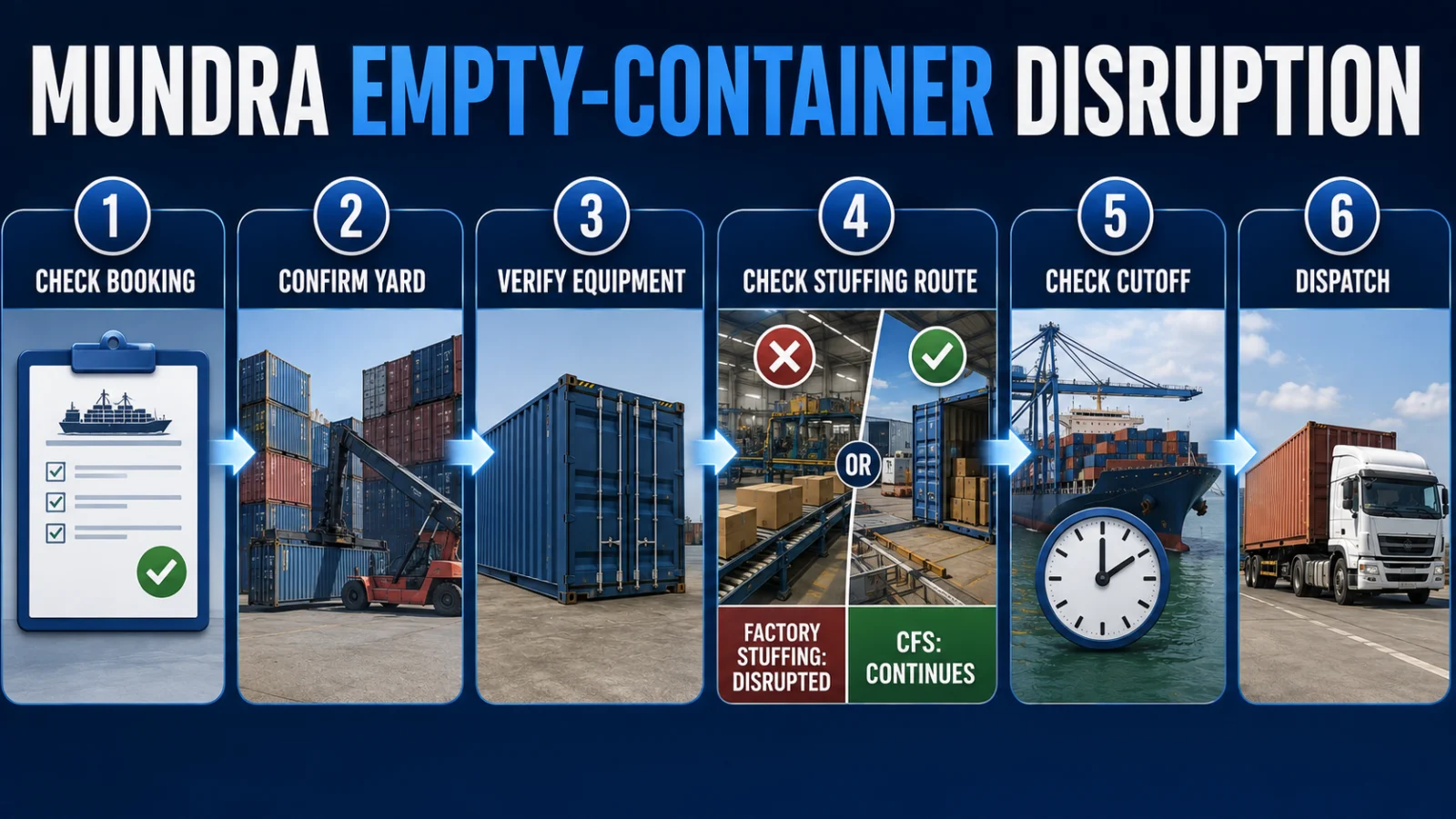
1. Booking
Confirm the shipping line, booking number and container requirement.
2. Current nomination
Verify the exact pickup or return location currently assigned by the carrier.
3. Equipment
Confirm the required empty container is actually available for release where relevant.
4. Stuffing route
Know whether the shipment is factory stuffed or using a CFS.
5. Cutoff
Check vessel, terminal, shipping-bill and documentation cutoffs separately.
6. Written revision
If the nominated location cannot serve the movement, obtain a revised carrier instruction before rerouting.
What remains unresolved?
- whether CMA CGM has fully restored every affected factory-stuffing empty pickup after the APSEZ ECY launch;
- whether every affected import-empty return has normalised;
- the complete carrier-neutral list of current designated yards;
- the status of every external empty-container yard around Mundra;
- carrier-specific equipment availability;
- universal detention, free-time or additional-cost treatment; and
- whether other shipping lines are using exactly the same operating workflow as CMA CGM.
Verification method
ThePulseSignal checked CMA CGM’s current Mundra empty-container disruption advisory and its current India ports-and-terminals notice listing for a later restoration notice. TPS also checked APSEZ’s September 3-4 announcement of dedicated Empty Container Yard operations at Mundra and the current Mundra vessel schedule. The evidence confirms the new in-SEZ ECY operating model and continuing port activity, but it does not establish universal restoration of every affected empty pickup or return workflow.
Limitations and unresolved facts
The public evidence does not expose booking-level carrier nominations or equipment availability. The APSEZ announcement describes the new ECY operating model but does not provide a universal carrier-by-carrier restoration table. CMA CGM’s earlier disruption notice remains the latest located direct carrier statement on the affected empty-yard workflow. Shippers should therefore verify the current booking-specific instruction immediately before dispatch.
Bottom line: APSEZ is starting a dedicated Empty Container Yard inside the Mundra Port SEZ, but shippers should not assume that this alone means every previously disrupted empty-container movement is restored. Mundra Port remains operational. Before dispatching a truck, confirm the carrier, current nominated yard and actual equipment or return availability for the specific booking.
Last verified: September 8, 2026.