




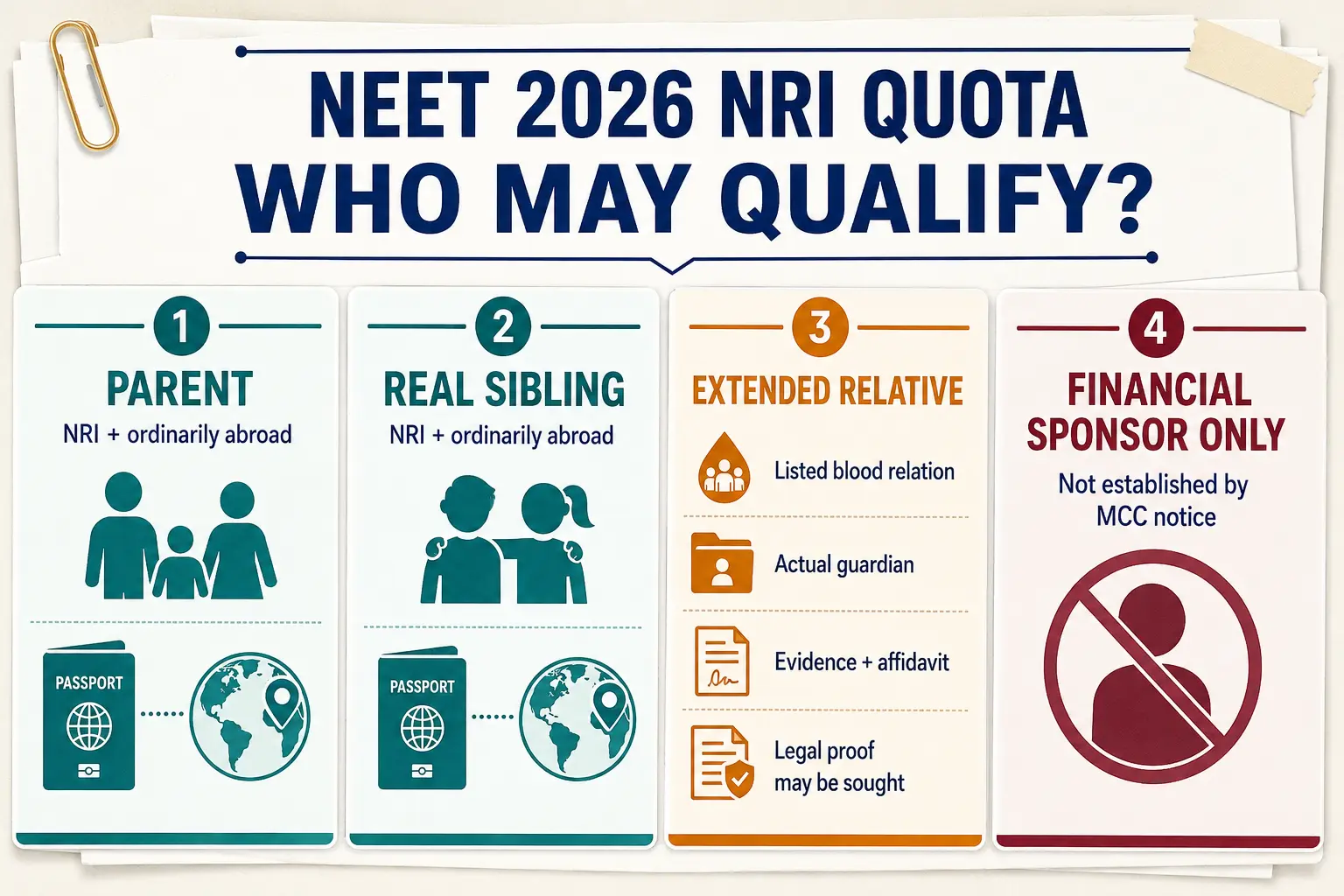
NEET 2026 NRI quota sponsor eligibility depends on which MCC route the candidate is using. An NRI parent or real sibling is treated differently from an uncle, aunt, grandparent or cousin claiming the candidate through the ward or legal-guardian route.
For an extended-relative claim, being related to the candidate or agreeing to pay the fees is not enough. MCC’s published criteria require the applicable relative to satisfy the NRI-residence and guardianship conditions and to provide the required documentary proof.
The direct answer
An NRI parent, real sibling or specified nearest blood relative may potentially support an NRI-quota claim, but the evidence required is not the same for every route.
An NRI mother or father ordinarily residing abroad can fall within the parent route. A real brother or sister who is an NRI and ordinarily resides abroad can fall within the applicable sibling route.
An uncle, aunt, grandparent or qualifying paternal or maternal cousin faces additional conditions. MCC’s extended-relative or legal-guardian route requires more than the family relationship: the guardian relationship and supporting legal documentation must also withstand MCC scrutiny.
A person is not established as an eligible NRI sponsor merely because that person lives abroad or is willing to pay the candidate’s fees.
UG 2026 document position
MCC’s August 1, 2026 NEET UG Information Bulletin publishes the mandatory NRI-document lists and the online Indian-to-NRI conversion process for UG counselling.
NEET 2026 NRI quota sponsor eligibility decision table
| Route | Potential position | Main conditions | UG 2026 document position |
|---|---|---|---|
| NRI mother or father | Potentially eligible | NRI status, ordinary residence abroad and parent-child relationship | MCC’s UG bulletin publishes the Category I mandatory-document checklist. |
| Real brother or sister | Potentially eligible | NRI status, ordinary residence abroad and real-sibling relationship | Included in the UG Category I route. |
| Uncle, aunt or grandparent | Conditional ward/legal-guardian route | Listed relationship, NRI status, ordinary residence abroad, guardianship and legal documentary proof | The UG Category II route sets out legal-guardian documents and verification. |
| First-degree paternal or maternal cousin | Conditional ward/legal-guardian route | Relationship must match MCC’s criteria plus NRI residence and guardianship requirements | Guardianship evidence remains subject to MCC scrutiny. |
| Unrelated financial sponsor | Not established | Foreign residence or willingness to pay fees is not enough by itself | No standalone financial-sponsor route is established in the MCC material reviewed. |
Can an uncle, aunt, grandparent or cousin sponsor the candidate?
Potentially, but not merely because the person is related or financially capable.
MCC’s published criteria identify specified nearest blood relatives, including real paternal or maternal uncles and aunts, paternal and maternal grandparents and first-degree paternal or maternal cousins.
For the extended-relative route, the applicable person must also meet the conditions attached to that route, including NRI status, ordinary residence abroad and the required guardianship evidence.
An uncle who lives abroad and pays college fees does not automatically satisfy MCC’s guardian test. The guardianship requirement must be established separately.
What documents does MCC require for NEET UG 2026?
MCC’s August 1 UG Information Bulletin separates the documentation into different NRI routes.
Category I: NRI candidate, NRI parent, real brother or real sister
- date-of-birth certificate;
- Class 10 marksheet and passing certificate;
- Class 12 marksheet and passing certificate;
- NEET UG scorecard issued by NTA;
- valid passport of the candidate;
- NRI certificate issued by the competent Embassy or Indian Consulate;
- the applicable notarised sponsorship affidavit supported by the required NRE bank-account evidence; and
- relationship verification where required for the applicable relative route.
Category II: Indian-to-NRI conversion through a legal guardian
- date-of-birth certificate;
- Class 10 and Class 12 qualifying documents;
- NEET UG scorecard;
- valid passport of the candidate;
- valid passport of the legal guardian;
- NRI certificate of the guardian from the competent Embassy or Indian Consulate;
- evidence of bona-fide guardianship and the relationship between the guardian and candidate;
- valid legal documentary proof establishing recognised guardianship; and
- the required notarised sponsorship affidavit and supporting NRE bank-account evidence.
MCC’s UG framework requires documentary proof supporting recognised guardianship. A statement that a relative has financially supported the candidate is not equivalent to proving legal guardianship.
How does Indian-to-NRI conversion work for NEET UG 2026?
- Select the NRI category during MCC counselling registration where applicable.
- Select the appropriate NRI subcategory.
- Upload the required supporting documents during MCC registration.
- MCC’s NRI Document Verification Committee reviews the documents online.
- If documents are deficient, MCC may raise a deficiency query.
- The candidate can be notified through the channels specified by MCC.
- Use the permitted correction window to replace or correct deficient documents.
- If MCC accepts the documents, the category can be converted online from Indian to NRI.
- After approved conversion, the candidate can use the NRI counselling route subject to the applicable seat and round rules.
How do the May 27 notice and August 1 bulletin fit together?
The May 27 notice sets out the core NRI candidature, relationship and guardianship principles for the 2026-27 counselling cycle.
The August 1 UG Information Bulletin supplies the UG operational layer: mandatory documents and the online conversion and verification process.
Does this exact checklist also apply to NEET PG 2026?
Do not assume so. MCC lists the 2026-27 NRI-candidature notice for both UG and PG counselling, but the detailed document checklist and conversion workflow described above were verified from the UG 2026 material.
PG candidates should check MCC’s PG counselling notices and the applicable PG information bulletin or round-specific NRI notice before treating every UG document or upload step as identical.
Do MCC and state NRI rules mean the same thing?
No. MCC governs the counselling routes assigned to it, while state authorities can apply their own prospectus, relationship definitions, document requirements, affidavits, conversion procedures, deadlines and court directions.
An MCC rule should therefore not be used automatically as proof of eligibility for a state-controlled NRI seat.
What should candidates do now?
- Identify whether the intended seat is controlled by MCC or a state counselling authority.
- Identify the correct claimant route: NRI candidate, NRI parent, real sibling or legal guardian.
- For MCC UG 2026, use the current mandatory-document list published by MCC.
- For an extended-relative route, verify that the guardianship evidence and legal documentation actually exist before relying on the relationship.
- Obtain the required NRI certificate from the competent authority.
- Prepare the applicable sponsorship affidavit and financial evidence.
- Upload the correct documents during MCC registration where Indian-to-NRI conversion is required.
- Monitor MCC communications and the counselling portal for any deficiency query.
- Use the applicable correction opportunity within the notified schedule.
- Keep original documents available for admission verification.
For the national counselling workflow, see ThePulseSignal’s NEET UG 2026 Round 1 choice filling guide. For saved, manually locked and system-locked choices, use the MCC choice filling and locking guide.
Frequently asked questions
Can an uncle sponsor a candidate?
A real paternal or maternal uncle may potentially fall within MCC’s extended-relative route, but relationship alone is not enough. The applicable NRI residence and guardianship conditions must also be met.
Can a grandparent sponsor the candidate?
A paternal or maternal grandparent is among the listed relative categories, but the extended-relative route still requires the applicable NRI and guardianship evidence.
Is a sponsorship affidavit enough?
No for the legal-guardian route. MCC’s UG framework requires guardianship evidence and valid legal documentary proof in addition to the required sponsorship affidavit.
Can a family friend qualify because they will pay the fees?
The MCC material reviewed does not establish a general unrelated financial-sponsor route. Financial support alone is not equivalent to satisfying the NRI relationship or legal-guardian criteria.
Has MCC published the NEET UG 2026 NRI document checklist?
Yes. MCC’s UG 2026 Information Bulletin publishes the mandatory document lists for the relevant NRI routes.
Are MCC and state NRI rules identical?
No. Candidates must separately check the prospectus and notices of the authority controlling the intended seat.
Official sources
- MCC Public Notice dated May 27, 2026 — NRI candidature eligibility
- MCC UG Medical Counselling
- MCC News and Events UG
- MCC PG Medical Counselling
- Medical Counselling Committee
Verification and editorial limitation
Confirmed: MCC’s current UG counselling surface continues to list the Public Notice for eligibility of NRI candidature for Academic Year 2026-27.
Confirmed: MCC distinguishes the parent or real-sibling routes from extended-relative or legal-guardian claims that require additional evidence.
Confirmed for UG 2026: MCC’s published UG framework provides the mandatory NRI-document and Indian-to-NRI conversion process.
PG boundary: The 2026-27 NRI candidature notice is also surfaced by MCC for PG counselling, but PG candidates should follow the applicable PG-specific operational notices rather than assuming every UG upload step is identical.
Last verified: September 1, 2026.
Limitation: This guide explains MCC’s published national counselling framework. It cannot determine whether MCC will accept a particular candidate’s relationship, guardianship document or NRI evidence without reviewing that candidate’s actual record.