






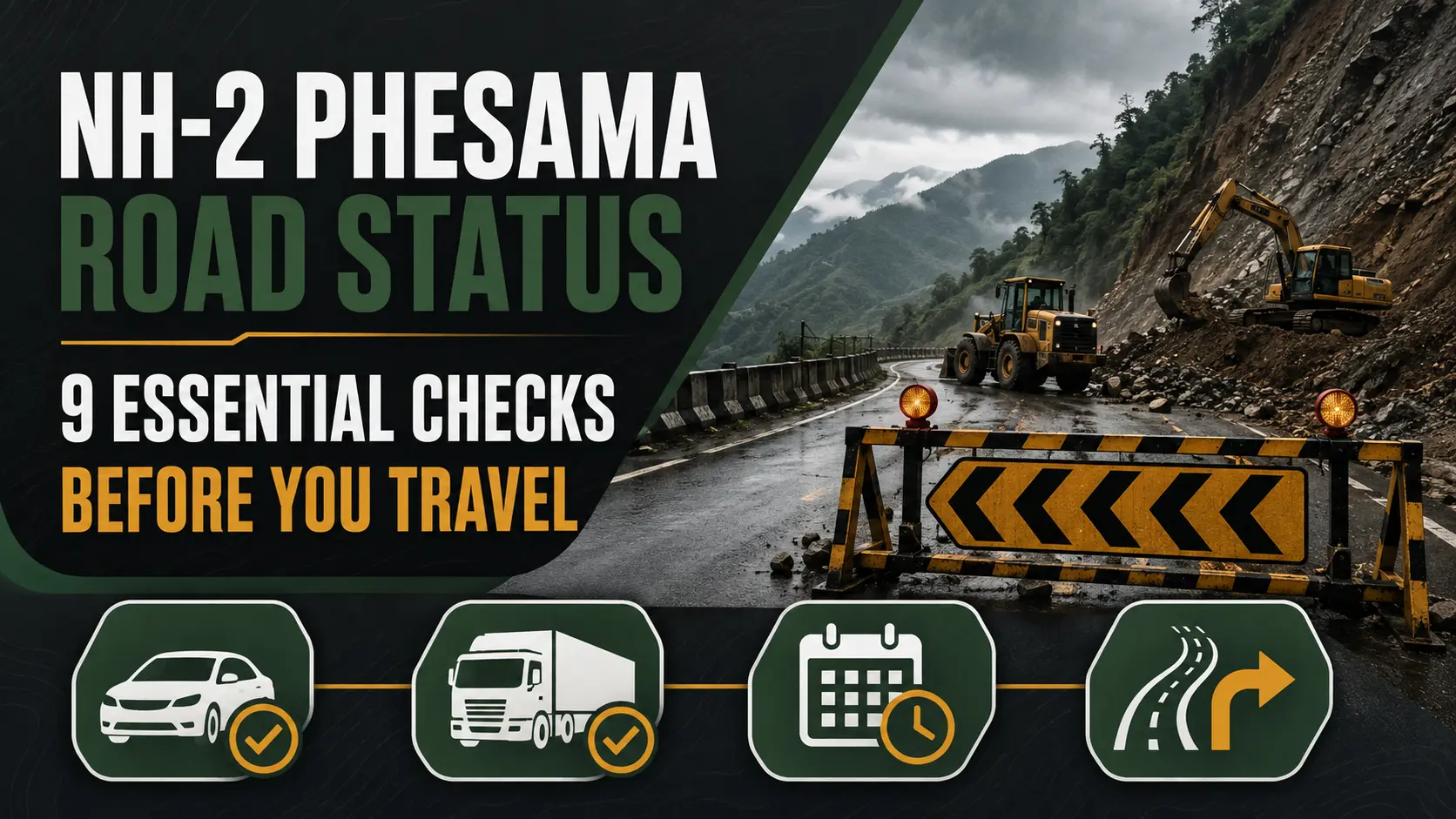
NH-2 Phesama road status cannot be determined from an old closure notice, a navigation app or the scheduled end time of an earlier traffic order.
Before travelling on the Kohima–Mao section, check the latest dated advisory, the actual travel window, your vehicle category and whether a later order has changed the diversion or reopening arrangement.
Latest dated article: For the August 4 restriction, see ThePulseSignal’s NH-2 Phesama closure timing and vehicle-diversion update.
This evergreen guide explains how to interpret any current or future Phesama road advisory. It does not claim that the August 4 operating arrangement remains active.
- How to determine the current NH-2 Phesama road status
- Where the Phesama Sinking Zone is located
- Nine checks before travelling
- How LMV diversions work
- How HMV and freight rules differ
- What partial restoration means
- Whether an expired order proves reopening
- Where to verify the latest status
- How previous traffic plans changed
- Verification method
- Limitations and unresolved facts
- Frequently asked questions
NH-2 Phesama road status: the direct answer
The Phesama section should not be treated as permanently open, permanently closed or permanently assigned to one diversion route. Its operating status has changed through complete closures, partial restoration, regulated movement, LMV diversions, HMV restrictions and weather-related controls.
The safest way to determine the current position is to identify the latest valid traffic order and answer four questions:
- Does the order cover the date and time of your journey?
- Does it apply to your vehicle category?
- Has a later order changed or cancelled it?
- Is reopening explicitly confirmed, or are you merely assuming it because an earlier closure window ended?
Evergreen rule: An older order may explain the type of restriction previously used, but it cannot establish today’s NH-2 Phesama road status.
Where is the Phesama Sinking Zone?
The Phesama Sinking Zone lies on the Kohima–Mao section of National Highway-2, a corridor used for movement between Kohima and the Manipur side.
Recent 2026 orders identified the affected stretch between Chainage Km 191+840 and Km 192+100. Historical notices have also regulated other points, approaches or alternative roads according to the road condition and restoration stage.
This means readers should not treat one historical chainage as the permanent boundary of every Phesama closure. Always read the exact chainage stated in the latest order.
9 essential checks before travelling through Phesama
-
Check the publication date.
An advisory published weeks or months earlier may describe a road condition that has already changed. -
Check the actual travel date.
Some orders apply only to one specified day, while others remain in force until further notice. -
Read the start and end time.
A road can be closed for restoration during part of the day and regulated differently outside that window. -
Match the order to your vehicle.
LMVs, HMVs, buses, freight vehicles and emergency movements may receive different instructions. -
Check whether traffic is one-way or two-way.
A route described as available does not automatically mean unrestricted movement in both directions. -
Check load, axle or vehicle-size restrictions.
An emergency alternative road may be unsuitable for a heavy, overloaded or multi-axle vehicle. -
Look for rainfall and night-travel conditions.
Previous advisories have warned that movement may be stopped during heavy rain or restricted at night. -
Check whether a newer order supersedes the one you found.
Search results may continue showing an older order even after authorities issue a revised traffic plan. -
Verify reopening instead of assuming it.
The end of a scheduled closure window does not independently prove that the road is fully restored or unrestricted.
How LMV diversions at Phesama work
The Phesama–Kisama/Kigwema route through Rhododendron Resort has appeared repeatedly in traffic advisories for light motor vehicles. However, its use has depended on the date, direction of travel, weather and condition of the alternative road.
A previous order may describe the route as:
- open to LMVs in both directions;
- available only in a specified direction;
- subject to regulated movement;
- unsafe or discouraged during heavy rain;
- unsuitable for heavy vehicles.
Do not make this assumption: The appearance of Rhododendron Resort in an older order does not prove that it remains open, two-way or suitable on the day you travel.
How HMV and freight restrictions differ
Heavy-vehicle instructions have generally been more restrictive because alternative hill roads may have limited width, load capacity or surface strength.
Depending on the applicable order, HMVs may be:
- completely suspended from the affected NH-2 stretch;
- allowed only within a limited operating window;
- restricted by axle, size or load;
- diverted through Peren district;
- sent through another route identified for that particular period.
Manipur-bound freight operators should not use an LMV instruction as authority to move a truck, bus or loaded commercial vehicle through the same road.
Historical heavy-vehicle diversions have also placed pressure on smaller roads and local infrastructure. That is another reason an older HMV route should not be treated as a permanent alternative.
What does partial restoration mean?
“Partial restoration” does not necessarily mean that NH-2 has returned to normal traffic.
| Phrase used in an update | What it may mean | What it does not prove |
|---|---|---|
| Partial traffic resumed | Some vehicles may be allowed under regulation. | That every vehicle can travel freely. |
| LMVs permitted | Cars and other light vehicles may use the route. | That HMVs, buses or freight vehicles are permitted. |
| Road opened for limited hours | Movement may be allowed during a defined window. | That the route is open throughout the day or night. |
| Restoration work continues | Traffic may coexist with machinery, debris clearance or regulated movement. | That the slope or road has been permanently stabilised. |
| Alternative route available | A specified category of vehicle may use another road. | That the route is suitable for every weight, direction or weather condition. |
Does an expired closure order prove that the road reopened?
No. The expiry of a closure window only establishes that the stated period has ended. It does not independently confirm that restoration work was completed, falling-rock risk ended or unrestricted traffic resumed.
After a closure window, authorities may:
- permit normal traffic;
- allow only LMVs;
- continue regulated movement;
- retain the diversion;
- extend the closure;
- issue a fresh restriction because of rain, debris or boulder falls.
Safe interpretation: Treat reopening as confirmed only when a fresh official or clearly attributable operating update says the affected stretch is open and explains which vehicle categories may use it.
Where to verify the latest Phesama road status
Use sources in this order:
- Kohima District Administration: District orders and traffic restrictions.
- DIPR Nagaland: Government notices and district updates.
- Kohima Police or traffic advisories: Current movement controls and enforcement information.
- NHIDCL-attributed updates: Restoration activity, engineering work or requests for temporary closure.
- Reliable local publishers: Useful when they quote or reproduce a fresh order that is not yet easily available on the government website.
- Field videos and social posts: Supplementary evidence only, not a replacement for an official operating instruction.
Check the body text of the notice, not only the page title or publication date. A government page can occasionally carry an old body under a newer page date, as occurred during the August 2026 source review.
Why Google Maps is not enough
Navigation applications can show the normal highway even when:
- a temporary closure is active;
- traffic is restricted by vehicle type;
- a route is one-way;
- a diversion has a load limit;
- police have erected a barricade;
- movement has stopped because of fresh rockfall or heavy rain.
Use navigation apps for orientation only after verifying the current traffic order.
How Phesama traffic arrangements have changed
Previous advisories show why no single historical route instruction should be treated as permanent.
| Period | Operating arrangement reported | Evergreen lesson |
|---|---|---|
| June 2025 | Complete highway disruption led to separate alternative arrangements and heavy-vehicle restrictions. | A major closure can produce different instructions for direction and vehicle type. |
| July 2025 | LMV movement used alternative roads while restoration continued and night travel was discouraged. | Alternative access does not mean normal highway operation. |
| September 2025 | Partial movement was permitted under defined windows, while restoration closures and rainfall controls remained possible. | Partial reopening can still include time and weather restrictions. |
| Later 2025 advisories | LMV and HMV diversions changed according to roadwork and alternative-route conditions. | A diversion used in one period may not remain the authorised route. |
| July–August 2026 | Renewed debris movement and boulder falls led to fresh closures at Chainage Km 191+840 to Km 192+100. | Restoration progress does not eliminate the need for new operating orders when the hazard changes. |
Verification method
Method used: ThePulseSignal compared official Nagaland traffic notices from different periods with attributable local reporting about restoration work, route conditions and vehicle restrictions.
The article uses historical orders only to demonstrate how the operating framework has changed. It does not present an older closure, diversion or reopening instruction as the current road status.
Primary government notices were prioritised for dates, chainages, vehicle rules and diversion instructions. Reliable local reporting was used where it provided attributable restoration or field-condition context not fully described in the official notice.
Where a source title, page date or body text appeared inconsistent, the conflicting page was not treated as sufficient proof of a current operating arrangement.
Sources reviewed
- DIPR Nagaland: August 2 closure, chainage and diversion instructions
- DIPR Nagaland: Phesama inspection, debris clearance and safety measures
- Eastern Mirror: August 4 closure and vehicle restrictions
- Eastern Mirror: restoration work and regulated partial movement
- Eastern Mirror: planned slope-stabilisation DPR and continuing rockfall monitoring
Limitations and unresolved facts
This is an evergreen verification guide, not a real-time road-control service. Readers must still check the latest official order before departure.
- ThePulseSignal does not physically inspect the Phesama road or its alternative routes in real time.
- The current width, congestion, surface condition and load capacity of a diversion may change after publication.
- Official notices may be published after a delay or may not expose an exact issuance time.
- A page title or publication date may not always match the visible body text.
- Navigation applications may not immediately reflect district restrictions.
- Historical chainages and diversion routes are examples, not permanent operating instructions.
- Weather, rockfall, debris movement and restoration activity can change the road status at short notice.
- This guide cannot guarantee safe passage or determine whether a particular commercial vehicle complies with a load restriction.
Frequently asked questions
What is the current NH-2 Phesama road status?
The current status must be checked against the latest dated district or traffic advisory. This evergreen guide does not treat an older closure or reopening notice as proof of today’s operating condition.
Is Phesama road open now?
Do not rely on the expiry of an older order. Look for a fresh official or attributable update confirming whether the main NH-2 stretch is open, regulated, diverted or restricted by vehicle type.
Can LMVs use the Rhododendron Resort route?
That route has been notified for LMVs under multiple earlier orders, but its current availability, direction and weather suitability must be verified from the latest advisory.
Can trucks travel through Phesama?
Heavy vehicles have faced suspensions, timing restrictions, load limits and long-distance diversions under different orders. A current LMV instruction should never be assumed to permit trucks.
Is Peren always the route for Manipur-bound HMVs?
No. Peren has been advised under particular orders, but the authorised HMV route can change. Freight operators should verify the latest district instruction before departure.
Does an expired closure order mean NH-2 reopened?
No. It only means the stated closure period ended. A fresh operating update is needed to confirm reopening and the vehicle categories permitted.
What does partial reopening mean?
It may mean that only certain vehicles can pass, movement is regulated, traffic is allowed only during defined hours or the route can close again during rain or restoration work.
Can Google Maps confirm the Phesama road is open?
No. Google Maps may not reflect temporary barricades, one-way movement, load limits, falling-rock restrictions or vehicle-specific district orders.
Where should travellers check the latest Phesama road status?
Prioritise the Kohima district administration, DIPR Nagaland and police traffic notices. Use attributable NHIDCL updates and reliable local reporting as supplementary confirmation.
Why do different advisories show different chainages or routes?
The affected work area, hazard and traffic plan can change. Each order should be read as applying to its own date, chainage, time window and vehicle instructions.