






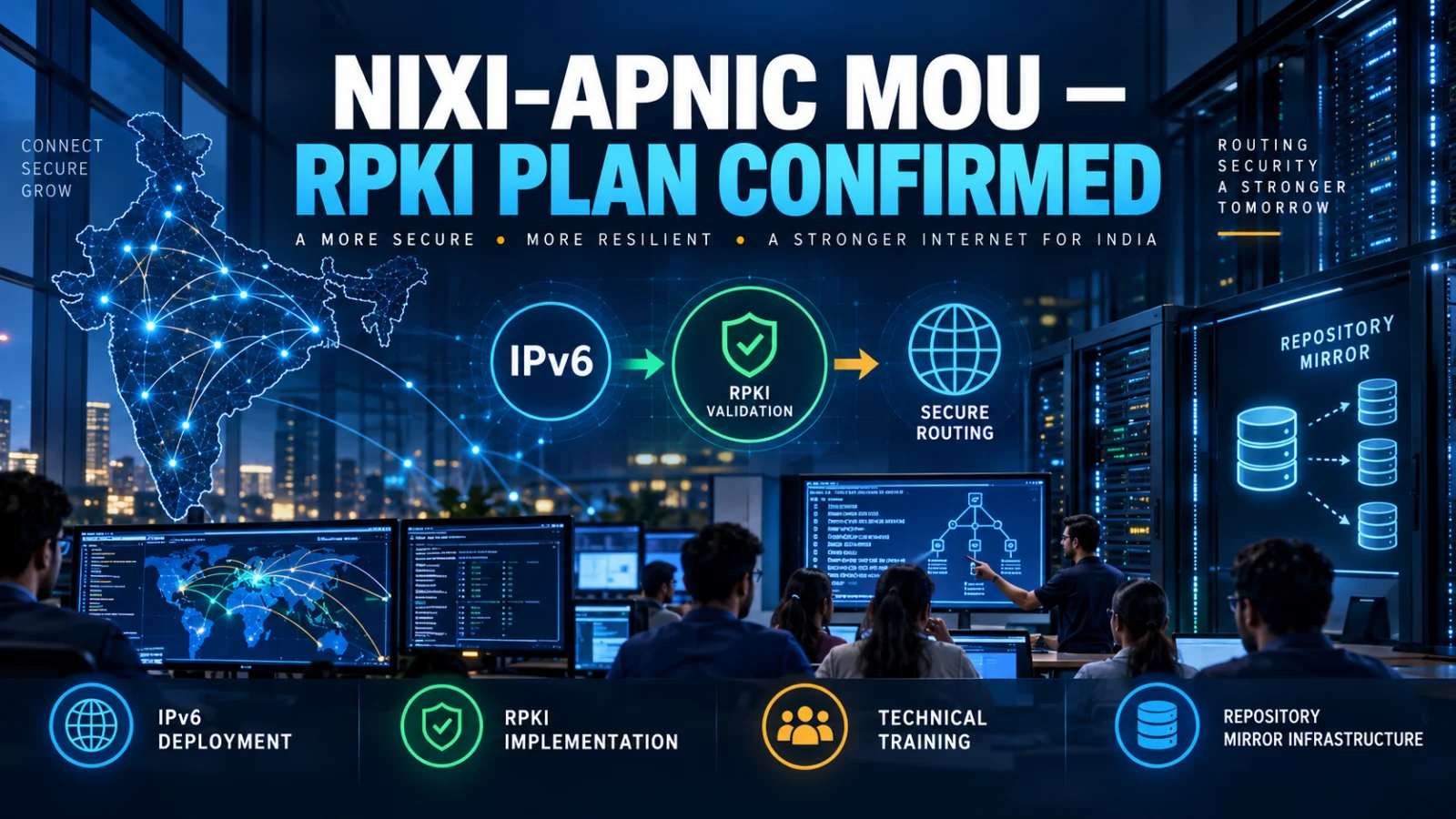
NIXI and APNIC signed their partnership agreement on September 8, 2026 during APNIC 62 in Mumbai, and APNIC’s detailed post-signing account now confirms Route Origin Validation as part of the routing-security work. The partnership covers further IPv6 and RPKI deployment, technical capacity building, local training and laboratory infrastructure, a Train-the-Trainer programme and a pilot RPKI Repository Mirror in India.
APNIC says it will work with NIXI, network operators and enterprises to deploy Route Origin Validation (ROV). That is more specific than simply encouraging RPKI adoption. It still does not create a universal legal requirement or compliance deadline requiring every Indian network to enable ROV.
What does the signed NIXI–APNIC agreement now confirm?
The partnership confirms work on IPv6 deployment, RPKI adoption, ROV deployment with network operators and enterprises, technical training, local laboratory infrastructure and an RPKI Repository Mirror pilot.
The important boundary remains: these are cooperation and deployment workstreams. The published material does not establish a blanket regulatory mandate, universal adoption deadline or penalty for Indian networks that have not deployed RPKI or ROV.
Is the NIXI–APNIC MoU signed?
Yes. NIXI and APNIC signed the Memorandum of Understanding on September 8 during APNIC 62 in Mumbai.
APNIC says the agreement reflects a shared commitment to strengthen the security, resilience and long-term development of India’s Internet infrastructure.
What technical workstreams are confirmed?
| Workstream | Current confirmed position |
|---|---|
| IPv6 deployment | Confirmed. APNIC and NIXI will collaborate to further increase IPv6 deployment by network operators and enterprises in India. |
| RPKI adoption | Confirmed. Increasing RPKI deployment and adoption is a key focus of the partnership. |
| Route Origin Validation | Confirmed as a deployment workstream. APNIC says the organisations will work with network operators and enterprises to deploy ROV. |
| Train-the-Trainer programme | Confirmed. The organisations plan to establish a Train-the-Trainer programme to build sustainable local expertise. |
| IPv6 and RPKI training | Confirmed. Expanded technical training is part of the agreement. |
| Local training and laboratory infrastructure | Confirmed. The organisations will develop local training and lab infrastructure. |
| RPKI Repository Mirror | Confirmed as a pilot. NIXI and APNIC will deploy a repository mirror and assess whether it improves local access to RPKI data and repository resilience. |
| Universal RPKI or ROV mandate | Not established. The published material does not impose a blanket requirement on every Indian network. |
| Compliance deadline or penalty | Not established. No universal deadline or penalty is identified. |
Does the agreement include Route Origin Validation?
Yes, as a technical deployment objective. APNIC’s September 9 account says APNIC and NIXI will work with network operators and enterprises to deploy Route Origin Validation.
ROV allows a network to compare BGP route announcements with RPKI data and identify route origins that are valid, invalid or not found. Networks can then apply routing policy to invalid announcements.
This resolves an important scope question about the partnership: ROV is not merely background context. It is explicitly part of the planned routing-security work.
However, the agreement does not establish that every Indian ISP, autonomous-system operator or enterprise is legally required to enable ROV by a particular date.
How are RPKI, ROA and ROV different?
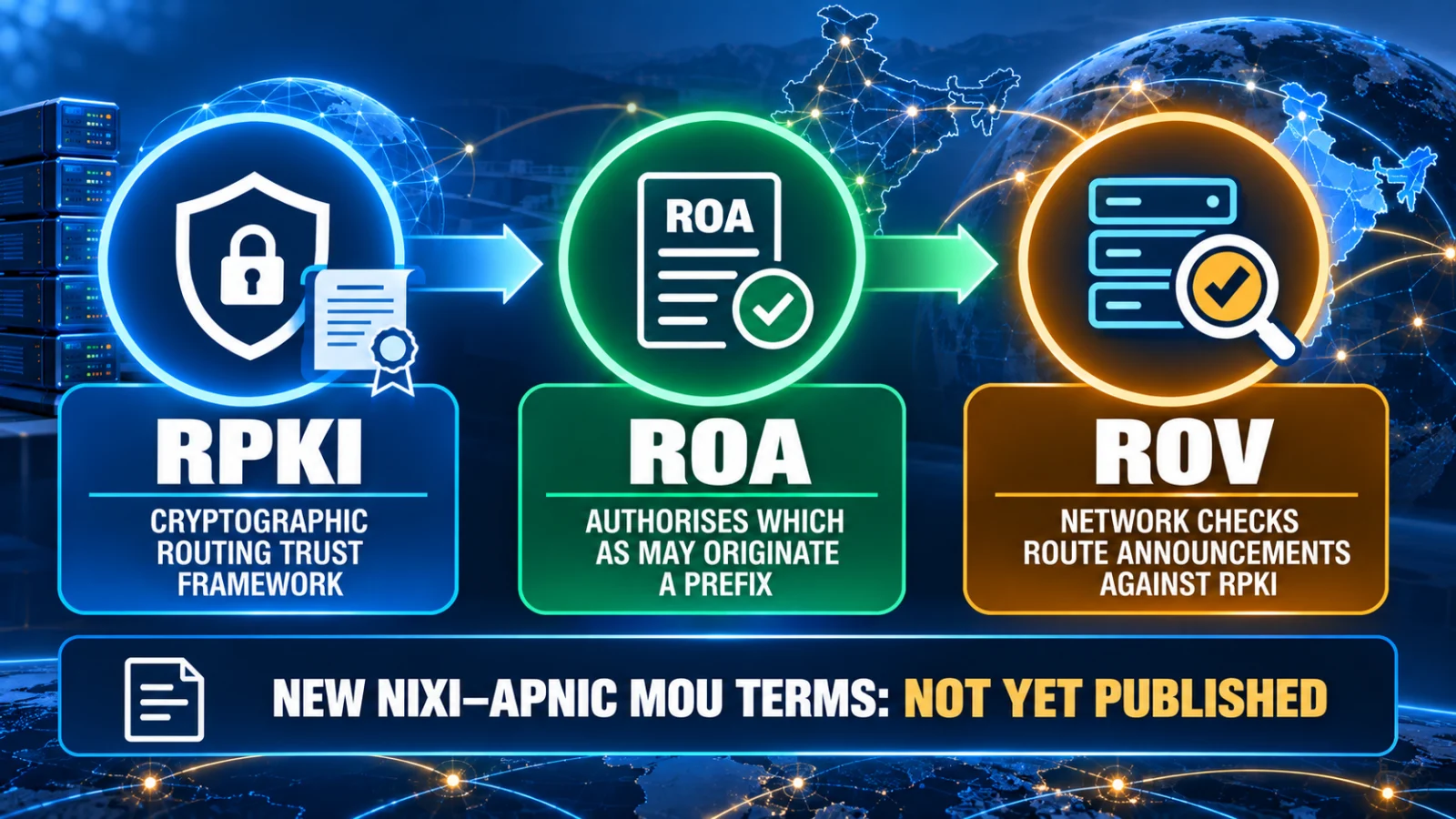
- RPKI is the cryptographic trust framework used to secure Internet routing information.
- ROA is a signed Route Origin Authorization identifying which autonomous system is authorised to originate a particular IP prefix.
- ROV is the network-side validation process that checks BGP announcements against RPKI data and enables routing policy based on the result.
High ROA coverage therefore does not automatically mean that networks are performing ROV or filtering invalid route announcements.
Why is ROV deployment important in India?
APNIC’s August 2026 analysis showed that India’s ROA coverage was already high while measured invalid-route filtering remained comparatively limited.
APNIC reported valid ROA coverage of approximately 88.04% for IPv4 and 97.91% for IPv6, while about 0.99% of measured networks were filtering invalid routes as of July 29.
Those figures are not targets in the MoU. They explain the operational gap the new ROV workstream is intended to address: publishing trusted route-origin information and actually validating routes are separate parts of routing security.
What is the RPKI Repository Mirror pilot?
NIXI and APNIC will deploy an RPKI Repository Mirror in India as a pilot project.
APNIC says the pilot will assess whether a local mirror can improve access to RPKI data and strengthen repository resilience. The agreement therefore goes beyond a general commitment to repository infrastructure: the mirror has a stated evaluation purpose.
The available public material does not provide the mirror’s location, technical architecture, deployment date, availability date, onboarding process or measurable success thresholds.
Who is expected to receive training?
APNIC says online and face-to-face training is anticipated for NIXI peering participants, IRINN affiliates and other stakeholders across India.
The partnership also establishes a framework for local training and laboratory infrastructure and a Train-the-Trainer programme designed to build sustainable local expertise in IPv6 and RPKI.
The current material does not provide a registration schedule, participant quotas, eligibility rules, training locations or a detailed curriculum.
Will NIXI and APNIC work directly with network operators?
Yes. APNIC explicitly says the organisations will work with network operators and enterprises to increase IPv6 and RPKI deployment and to deploy ROV.
APNIC also says the partners will promote routing-security best practices among network operators.
The public material does not establish compulsory participation or identify a complete list of networks that will take part.
Does the MoU make RPKI or ROV mandatory in India?
No universal mandate is established by the published agreement material.
The partnership now clearly includes RPKI and ROV deployment work, but a technical cooperation programme is not the same as a binding regulatory requirement.
A mandatory requirement for all or a defined class of Indian networks would need to be supported by the relevant controlling regulatory, licensing or other official instrument specifying who is covered, what must be deployed and when.
Does the agreement create a new IPv6 mandate?
No new universal IPv6 obligation is established.
Further IPv6 deployment is a confirmed workstream, and APNIC describes India as a global leader in IPv6 adoption. The MoU supports continued deployment and capacity building rather than establishing a new statutory deadline for every network.
Is ASPA part of the partnership?
In APNIC’s post-signing account, NIXI CEO Dr Devesh Tyagi said India is a frontrunner in Autonomous System Provider Authorization adoption.
That statement provides routing-security context, but the available description of the MoU does not identify ASPA as a specific partnership workstream. It should therefore not be treated as a confirmed programme commitment under this agreement unless further implementation material says so.
Is this the first NIXI–APNIC partnership?
No. APNIC documents an existing relationship with NIXI covering areas including IPv6 adoption, resource certification, workshops, training and participation in APNIC policy development.
The September 8 agreement is best understood as a new phase of cooperation with more concrete routing-security, ROV, training and infrastructure work rather than the organisations’ first collaboration.
What should Indian network operators do now?
The MoU itself is not a new compliance deadline.
Network operators and enterprises can usefully:
- monitor NIXI and APNIC for IPv6, RPKI and ROV programme announcements;
- check for online or face-to-face training available to NIXI peering participants, IRINN affiliates and other stakeholders;
- review current ROAs and existing ROV practices;
- watch for operational details and availability of the RPKI Repository Mirror pilot;
- distinguish partnership deployment programmes from any future binding regulatory requirement.
What remains unresolved?
- the full signed MoU text;
- specific IPv6, RPKI or ROV adoption targets;
- programme start dates and implementation milestones;
- which network operators and enterprises will participate in ROV deployment;
- whether participation in specific programmes will be voluntary or linked to another formal requirement;
- the RPKI Repository Mirror pilot’s location, architecture, launch date and success criteria;
- training registration dates, eligibility details and curriculum;
- whether ASPA will become a formal workstream under the partnership;
- whether NIXI or IRINN procedures will change for resource holders.
What should be watched next?
The next material evidence will be implementation details from NIXI or APNIC.
Watch for ROV deployment programmes, operator or enterprise participation information, training registration, Train-the-Trainer schedules, lab deployment, Repository Mirror pilot availability, measurable adoption targets and any formal implementation guidance.
Verification method
ThePulseSignal checked the September 8 MeitY/PIB post-signing announcement, APNIC’s September 9 detailed partnership account, the September 7 advance announcement, APNIC’s existing NIXI partnership information and APNIC’s current analysis of India’s routing-security state.
APNIC’s detailed post-signing account explicitly confirms that NIXI and APNIC will work with network operators and enterprises on ROV deployment, describes the RPKI Repository Mirror as a pilot project and identifies anticipated training audiences.
Limitations and unresolved facts
The full signed MoU text was not identified in the public material reviewed. No universal RPKI, ROV or IPv6 mandate, compulsory deployment deadline or penalty is established. Detailed programme dates, adoption targets and Repository Mirror pilot milestones remain unresolved.
Last verified: September 17, 2026.