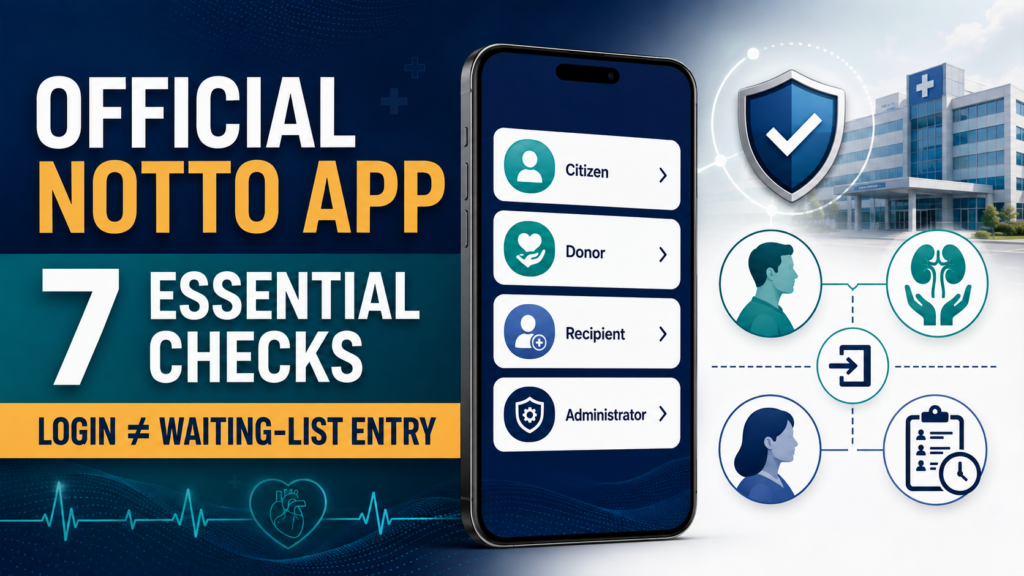





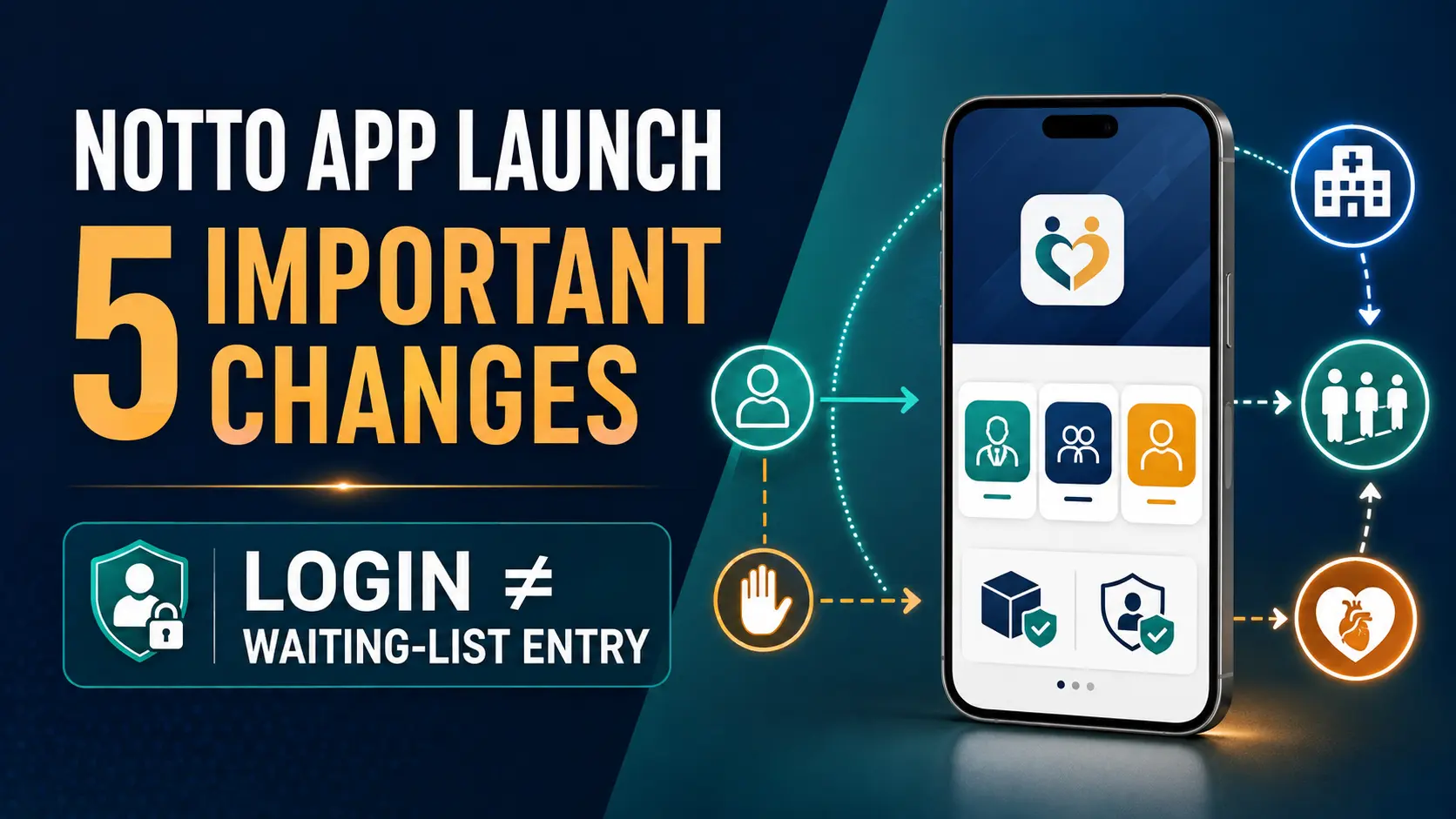
The NOTTO app launch introduces a new Android entry point to India’s e-प्रत्यारोपण organ-donation and transplantation platform for citizens, donors, recipients, hospitals and transplant authorities.
The launch is operationally important, but users should not assume that creating an account, receiving an OTP or seeing a recipient-login option automatically places a patient on a transplant waiting list or guarantees organ allocation.
Direct answer
The official NOTTO Android app is live under the package com.notto. It provides separate routes for administrators, donors or recipients, and citizens.
However, the visible login routes do not establish that a citizen can independently add themselves to a transplant waiting list. Recipient registration and allocation continue to involve hospitals and authorised transplant-system users.
What the NOTTO app launch changes
- India now has a new e-प्रत्यारोपण platform intended to connect transplant authorities, hospitals, donors, recipients and citizens.
- The official NOTTO Android app is available under package
com.notto. - The official portal showed the iPhone version as “Coming Soon” during the reviewed check.
- The app visibly separates Administrator, Donor/Recipient and Citizen access.
- The hospital interface includes waiting-list and transplant-management functions.
- Google Play currently says the app may collect personal information, messages, photographs, files and device identifiers.
- Google Play also displays the developer-submitted statement that data is not encrypted.
- An unrelated note-taking app with a similar name may appear in search results.
Contents
1. What was launched with the NOTTO app launch?
The Union Health Ministry announced e-प्रत्यारोपण as a national digital platform for organ and tissue donation and transplantation.
The official announcement says the platform is intended to consolidate functions such as:
- hospital and transplant-network registration;
- recipient waiting-list management;
- organ allocation;
- monitoring and reporting;
- public information;
- coordination between national, regional and state transplant authorities.
The launch also included a NOTTO mobile app, national brain-stem-death certification guidance and national swap-transplantation guidance.
The launch does not by itself prove that every state list, hospital record or existing recipient registration has already migrated into one fully unified public-facing system.
2. Who can access the official NOTTO app?
The official app screenshots reviewed by ThePulseSignal show three main access categories.
Administrator
The administrator route visibly covers NOTTO, ROTTO, SOTTO and hospital-level users.
Donor or recipient
The app provides separate donor and recipient login options using mobile-number and OTP access.
Citizen
The citizen route visibly distinguishes Indian and foreign citizens.
The hospital dashboard visible in the supplied screenshots contains modules relating to:
- waiting lists;
- super-urgent patients;
- recipient details;
- donor details;
- PM-JAY patient requests;
- tentative alerts;
- grievances;
- staff details;
- transplant and donor analytics.
This indicates that the app is not merely an organ-donation awareness or pledge application. It also serves authorised operational users within the transplant system.
3. Does NOTTO app login place a patient on the waiting list?
No such automatic effect has been established.
Several separate steps can be confused:
Creating a citizen account
This may provide access to public or citizen-facing services.
It does not automatically establish transplant-recipient registration.
Making an organ-donation pledge
This records a person’s intention to donate organs or tissues.
It does not place that person on a recipient waiting list or guarantee retrieval after death.
Recipient login
This may allow an already registered recipient to access authorised information.
It does not prove that any person can independently create a valid waiting-list record.
Hospital recipient registration
This begins or records the formal clinical and administrative process through an authorised transplant centre.
It does not guarantee approval, priority or allocation.
Waiting-list inclusion
This places an eligible patient within the applicable allocation system after required evaluation and registration.
It does not guarantee when or whether a compatible organ will become available.
Organ allocation
This is a separate medical and administrative decision based on applicable allocation criteria and availability.
Do not abandon an existing hospital or state registration.
No reviewed source established that patients already registered with a hospital, SOTTO or state system must cancel or replace their existing registration because the new platform has launched.
Our planned evergreen guide will explain these registration routes in greater detail:
Official NOTTO app and registration guide
4. How can users identify the official NOTTO app?
The official Android application can be checked using the following identifiers:
- Application name: NOTTO
- Package name:
com.notto - Developer: National Organ and Tissue Transplant Organisation
- Official website:
notto.mohfw.gov.in - Support email:
dir@notto.nic.in
Similar-name app warning: A separate application using package com.jktdeveloper.notto is a note-taking product. It is not the official Indian organ-transplant application.
There is no evidence reviewed by ThePulseSignal that the note-taking app is malicious or impersonating the government organisation. The verified problem is name collision and possible search-result confusion.
Users should preferably reach the official store listing through the official NOTTO government portal instead of installing an application solely because its title contains the word “notto.”
5. What does Google Play say about NOTTO app data safety?
The current Google Play Data Safety panel for the official app says the developer may collect categories including:
- name;
- email address;
- residential or contact address;
- phone number;
- email messages;
- SMS or MMS;
- other in-app messages;
- photos;
- files and documents;
- device or other identifiers.
The listing also says no data is shared with third parties.
Most significantly, Google Play currently displays the developer-submitted statement:
Data isn’t encrypted.
This declaration deserves clarification because the app visibly relates to donor, recipient, hospital and identity-linked workflows.
What this does not prove: The Play declaration does not by itself establish that every OTP, identity record, medical document or transplant record travels over an unencrypted internet connection.
It may describe a specific data flow, stored data, a developer disclosure choice or an inaccurate submission. A technical audit or official clarification would be needed to determine the exact scope.
Users should avoid uploading unnecessary identity or medical documents and should confirm that they are using the official app and portal before entering sensitive information.
What new transplant guidelines were released?
The Health Ministry said two national guidance documents were released with the platform:
- National Brain Stem Death Certification Guidelines;
- National Guidelines on Swap Transplantation.
The first is intended to support more consistent brain-stem-death certification practices. The second addresses paired or swap transplantation where a willing living donor is medically incompatible with the intended recipient.
The full detailed text of the newly issued documents was not independently reviewed line by line during this production check. Therefore, this article does not claim that:
- the statutory definition of brain-stem death has changed;
- the certification-board composition has changed;
- all inter-state swaps are automatically permitted;
- three-way or larger exchanges are universally available;
- swap approval can occur without medical, ethical and authorisation review.
What happened when the official portal was tested?
During one test, the official NOTTO homepage initially remained on its welcome screen and did not expose the full interface.
A later test loaded the complete portal successfully. The earlier result is therefore classified as a temporary partial-loading failure observed in one environment, with the cause unknown.
It should not be described as a nationwide NOTTO outage.
What should donors, patients and families do now?
Patients already registered
- Do not cancel an existing hospital or state registration.
- Ask the authorised transplant centre whether records have migrated.
- Do not assume that app login proves waiting-list status.
People making a donation pledge
- Use the official government portal or official app.
- Understand that a pledge records intention.
- Do not confuse a pledge certificate with recipient registration.
Living donors and recipients
- Continue through an authorised transplant hospital.
- Do not treat a donor or recipient login as clinical approval.
- Confirm required documents with the transplant coordinator.
App users
- Verify package
com.notto. - Check the official developer and government website.
- Avoid uploading unnecessary sensitive material.
Frequently asked questions
What is the official NOTTO app package name?
The official Android package is com.notto.
Is com.jktdeveloper.notto the official transplant app?
No. It is an unrelated note-taking application and is not connected with India’s National Organ and Tissue Transplant Organisation.
Does a citizen login put someone on the transplant waiting list?
No automatic waiting-list effect was established. Recipient registration involves authorised hospitals and transplant-system procedures.
Does a donation pledge guarantee organ retrieval after death?
No. A pledge records donation intention. Medical suitability, legal procedures and family involvement remain separate considerations.
Can patients see their waiting-list position in the app?
The reviewed public screenshots did not establish that every patient can view an exact national or state queue position.
Is the NOTTO app available on iPhone?
The official portal showed the App Store version as “Coming Soon” during the reviewed check.
Is data in the official NOTTO app encrypted?
Google Play currently displays the developer-submitted statement that data is not encrypted. The exact technical scope of that declaration has not been independently established.
Should existing patients register again?
No reviewed source established a universal requirement to register again. Patients should confirm migration or registration status with their authorised transplant hospital.
Official sources
- Press Information Bureau — Health Ministry organ-donation and transplantation announcement
- Official NOTTO portal
- Official NOTTO Android app listing
Verification notes to readers
ThePulseSignal reviewed the Health Ministry launch announcement, the official NOTTO portal, the official Android listing, Google Play Data Safety declarations and supplied screenshots of the app’s login routes and hospital dashboard.
The official app was identified through package com.notto, its developer identity, official government website and official support address.
The unrelated package com.jktdeveloper.notto was reviewed only to confirm that it is a separate note-taking application.
The official portal initially stalled on its welcome screen in one test and loaded successfully during a later check. No nationwide outage was established.
Article last verified: August 4, 2026.
Limitations and unresolved facts
- The full new brain-stem-death and swap-transplant guidelines were not independently reviewed line by line.
- Automatic migration of existing state and hospital records was not confirmed.
- Independent self-registration as a transplant recipient was not confirmed.
- Exact waiting-list visibility for patients was not confirmed.
- Aadhaar requirements for donors, recipients and citizens were not fully verified.
- The exact technical meaning of Google Play’s “Data isn’t encrypted” declaration remains unresolved.
- Account-deletion and data-retention controls were not independently verified.
- The number of users unable to find the official app through search is unknown.