




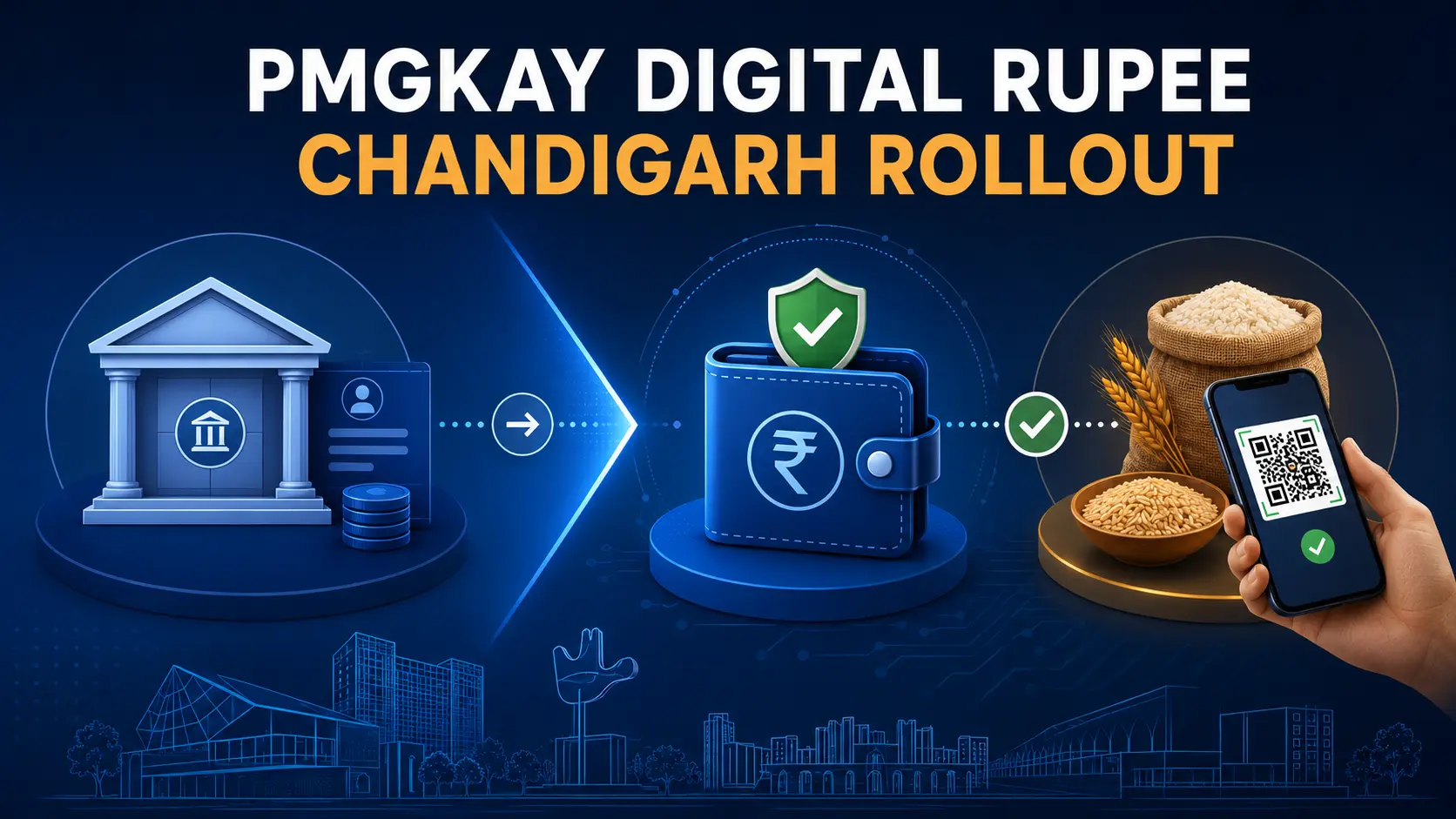
PMGKAY Digital Rupee subsidy delivery is reported to begin in Chandigarh on August 14, changing how eligible food-subsidy households receive and spend the benefit. The important distinction is that this is not evidence of PMGKAY ending, nor is it a nationwide replacement of free foodgrain distribution. Chandigarh already operates food subsidy in cash-transfer mode; the new step is to move eligible subsidy value from an ordinary bank-account transfer into a programmable Digital Rupee wallet.
That difference matters because programmable e₹ is not necessarily the same as unrestricted money sitting in a bank account. The Reserve Bank of India says programmable CBDC can be restricted by purpose, merchant category, location, expiry or other parameters. In the food-subsidy model already launched by the Centre in Puducherry, the tokens are intended for eligible food purchases at authorised merchants and Fair Price Shops.
What PMGKAY Digital Rupee subsidy changes in Chandigarh
Chandigarh is unusual in India’s food-security system because eligible households there have long received food subsidy through Direct Benefit Transfer rather than through the standard physical-grain distribution model used in most of the country.
The Department of Food and Public Distribution says direct cash transfer of food subsidy began in Chandigarh and Puducherry in September 2015. Under that arrangement, the cash equivalent of the subsidy is transferred to eligible households so they can buy foodgrains from the open market.
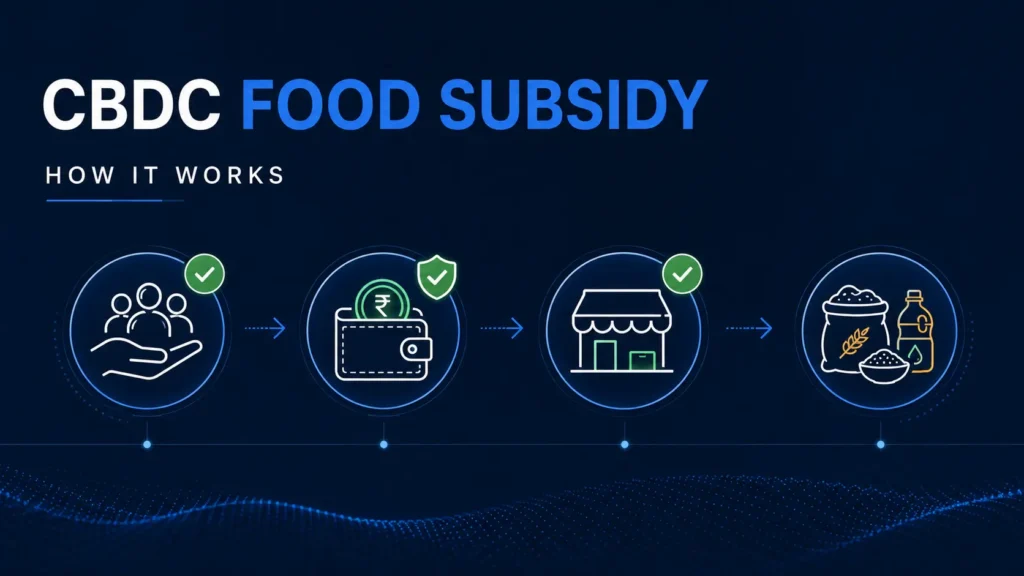
The CBDC model changes the payment rail. Instead of putting the food-subsidy value into a conventional bank account, identified beneficiaries can receive programmable Digital Rupee tokens in a CBDC wallet.
| Question | Existing Chandigarh DBT model | CBDC food-subsidy model |
|---|---|---|
| Where does the subsidy arrive? | Eligible household’s bank account. | CBDC wallet for identified beneficiaries. |
| What form does the value take? | Ordinary bank-account money. | Programmable Digital Rupee tokens. |
| Can use be restricted? | Ordinary bank funds are not inherently purpose-programmed. | CBDC can be programmed for specified purposes and authorised merchants. |
| Does the technology change PMGKAY entitlement by itself? | No official evidence reviewed by TPS shows the underlying PMGKAY entitlement being reduced merely because the delivery technology changes. | |
How the food-subsidy payment is supposed to work
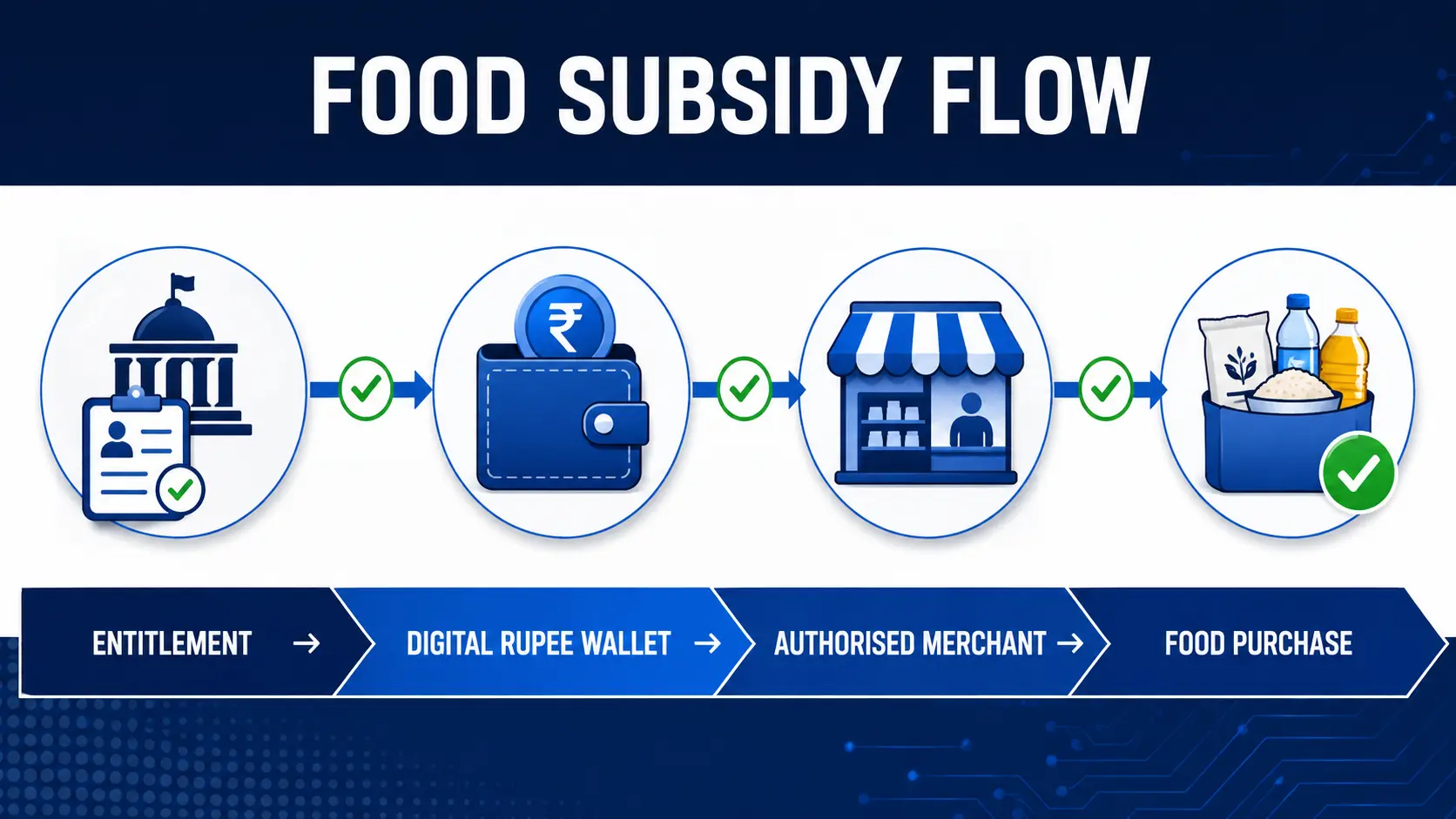
The February 2026 Puducherry launch gives the clearest official picture of the architecture Chandigarh is expected to follow. The Government’s PIB release says identified beneficiaries receive programmable CBDC tokens directly into CBDC wallets and redeem them for eligible food purchases at authorised merchants and Fair Price Shops.
This is technically different from UPI. UPI is a payment interface that moves money held in bank accounts. Digital Rupee is RBI-issued central bank digital currency held in a wallet.
The programmability feature is the part that matters most for welfare payments. The Reserve Bank of India’s Digital Rupee guidance says conditions can be attached to CBDC for a specified purpose, geography, merchant category or other defined use.
What does not appear to be changing
Nothing in the official material reviewed by TPS establishes that the Chandigarh CBDC rollout itself cancels PMGKAY eligibility, reduces the underlying food entitlement or converts the national PMGKAY scheme into a CBDC-only programme.
The Department of Food and Public Distribution continues to describe PMGKAY as the national free-foodgrain programme for eligible Antyodaya Anna Yojana and Priority Household beneficiaries. The CBDC project is a different layer: it changes how subsidy value is delivered in selected locations.
What beneficiaries need to know before the rollout
Will a beneficiary need a CBDC wallet?
That is how the existing official food-subsidy model has been designed: identified beneficiaries receive subsidy value into CBDC wallets. TPS has not yet recovered Chandigarh’s final beneficiary-onboarding instruction specifying the exact wallet provider, registration route or whether all existing food-DBT households enter the system at once.
Does a beneficiary need a smartphone?
During the Puducherry rollout, the Centre said provisions were being made with particular emphasis on feature-phone inclusion. That shows the programme was not designed on the assumption that every beneficiary owns a smartphone. It does not establish the exact Chandigarh feature-phone workflow.
Can the subsidy be spent anywhere?
Not under the programme architecture described by the Centre. The official model uses programmable tokens intended for eligible food purchases through authorised merchants and Fair Price Shops. RBI’s programmability framework also allows restrictions based on merchant category, location and other parameters.
Is this the same as UPI?
No. UPI is a payment interface linked to bank accounts. Digital Rupee is central bank digital currency held in a wallet. A merchant may still use a QR-based payment experience, but the underlying form of money is different.
The policy trade-off behind programmable subsidy
The government’s case for programmable food subsidy is that the transfer can become more traceable, purpose-bound and easier to monitor. In the Puducherry rollout, the Department of Food and Public Distribution said the model was intended to improve transparency, efficiency and accountability while reducing friction in accessing entitlements.
For beneficiaries, programmability changes something else: the flexibility attached to the transfer. Money credited to an ordinary bank account can normally be used for many purposes. A programmable food-subsidy token can be designed so that the particular transfer works only for approved purchases or merchants.
Why merchants and Fair Price Shops matter
A purpose-bound subsidy works only if beneficiaries can find participating merchants without unreasonable friction. During the Puducherry launch, the Centre said the application could help beneficiaries locate nearby authorised merchant establishments.
The Gujarat CBDC-enabled PDS model also used QR or coupon-code transactions and said Fair Price Shop operators could receive their commission in real time. This means merchant onboarding, settlement and transaction support are part of the programme’s operating infrastructure — not an afterthought.
For Chandigarh, TPS still needs a fresh local source establishing the final merchant network, wallet provider and grievance route for the reported August rollout.
What Chandigarh beneficiaries should do now
- Use only onboarding instructions issued through the Chandigarh Administration, Food Department or an officially designated bank/provider.
- Do not install a CBDC or subsidy app from an unsolicited link, WhatsApp message or third-party APK.
- Check that any instruction identifies the official wallet provider and authorised merchant network.
- Keep access to the mobile number linked with your beneficiary records where possible.
- Do not assume existing PMGKAY eligibility has ended merely because the payment mechanism changes.
- If a transaction or wallet credit fails after rollout, preserve the beneficiary ID, transaction reference and relevant screenshot before raising a complaint.
The final point becomes important once the system is live. A welfare-payment mechanism needs a way to resolve cases where entitlement exists but digital value does not appear, a wallet cannot be activated, or an authorised merchant cannot accept the payment. The Chandigarh-specific process for those failures has not yet been established in the primary material reviewed by TPS.
What happens next
The immediate item to watch is a formal Chandigarh implementation notice confirming the reported August 14 rollout and setting out the beneficiary cohort, wallet provider, merchant network, feature-phone process and grievance mechanism.
The Centre has already identified Chandigarh and Dadra and Nagar Haveli in the wider CBDC food-subsidy rollout sequence. Future geographic expansion, however, should be treated as completed only when the relevant authority confirms implementation.
Related TPS guides
For the wider CBDC system and beneficiary access questions, TPS has separate guides explaining how programmable food-subsidy payments work and how Digital Rupee subsidy wallets are set up and recovered.
Verification notes
Confirmed
The Government of India launched a CBDC-based food-subsidy model under PMGKAY in Puducherry in February 2026. The official description says identified beneficiaries receive programmable CBDC tokens in wallets for eligible food purchases through authorised merchants and Fair Price Shops. The same release identified Chandigarh among subsequent rollout locations.
The Department of Food and Public Distribution separately confirms that Chandigarh has operated food-subsidy DBT in cash-transfer mode since September 2015.
Reported
Times of India reported on August 13, 2026 that Chandigarh’s CBDC-based PMGKAY food-subsidy rollout is scheduled for August 14.
Unresolved
TPS has not located a fresh Chandigarh Administration or Department of Food and Public Distribution notice that independently confirms the August 14 date and sets out the complete local onboarding, wallet, merchant and grievance procedure.
Verification method
TPS reviewed the Department of Food and Public Distribution’s current description of NFSA implementation in cash-transfer mode, the Government of India’s February 2026 PIB release establishing the CBDC food-subsidy architecture and identifying Chandigarh as a subsequent rollout location, and the Reserve Bank of India’s Digital Rupee guidance explaining retail CBDC and programmability. The reported August 14 Chandigarh date was compared with fresh mainstream reporting but was not represented as independently confirmed by a newly recovered local implementation notice.
Where programme mechanics come from Puducherry or Gujarat implementation, this article uses them to explain the wider model rather than assuming that every operational detail will be identical in Chandigarh.
Sources checked
- PIB — CBDC-based Digital Food Currency pilot under PMGKAY
- Department of Food and Public Distribution — NFSA implementation and food-subsidy DBT
- Reserve Bank of India — Digital Rupee guidance and programmability
- Times of India — Chandigarh rollout reported for August 14
Limitations and unresolved facts
The current primary-source record establishes the programme architecture and Chandigarh’s place in the rollout sequence, but TPS has not recovered a new local implementation order confirming every August 14 operational detail. The number of Chandigarh beneficiaries included in the first CBDC cohort, designated wallet provider, exact feature-phone process, authorised merchant count, complaint channel and treatment of failed or inaccessible wallet transfers remain unresolved for this article.
No economic saving, leakage reduction, beneficiary satisfaction level, transaction-success rate or employment effect has been assumed. Those outcomes require implementation evidence after the system begins operating.
Last verified: August 13, 2026, 4:03 PM IST.