






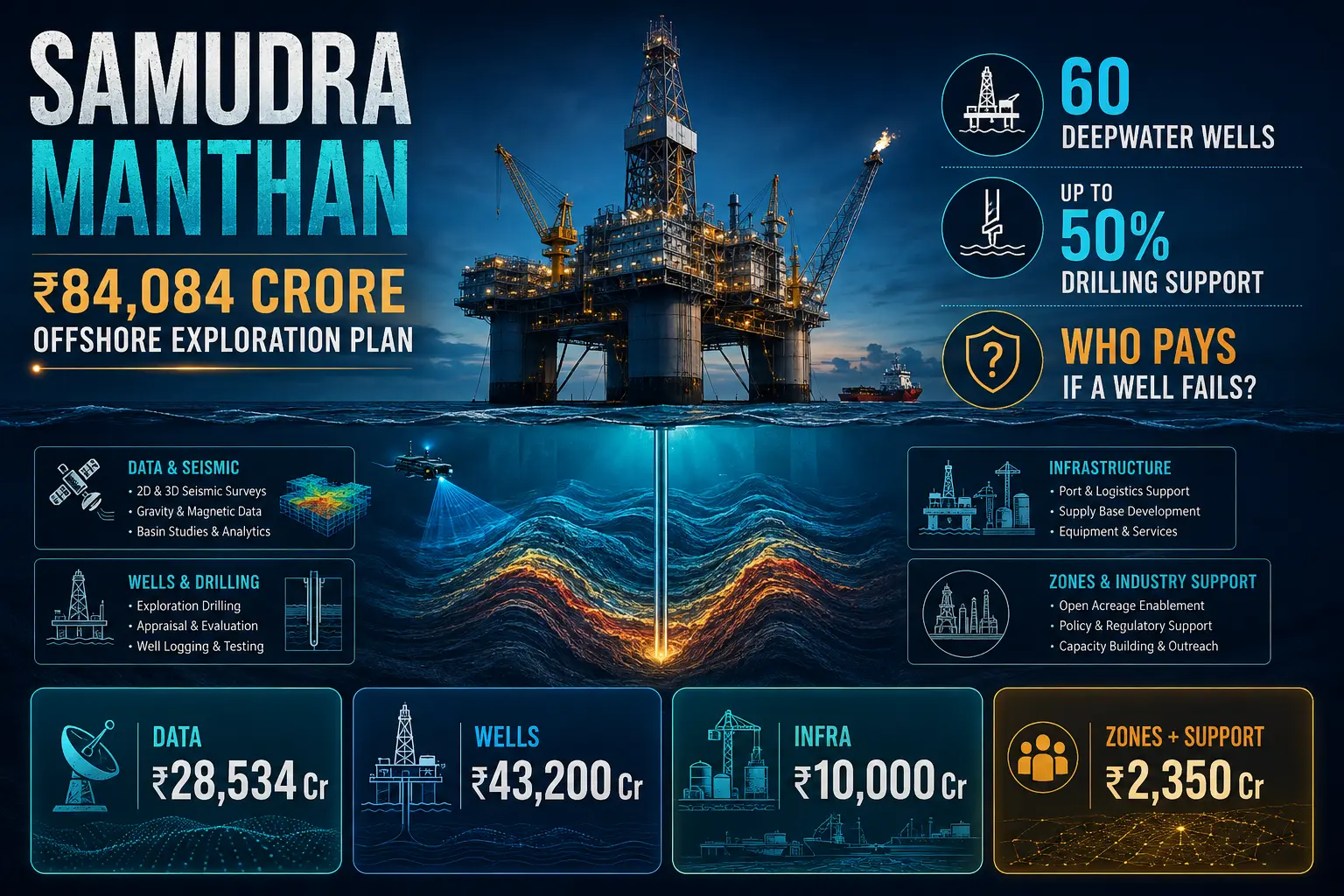
Samudra Manthan scheme explained: the Union Cabinet has approved an ₹84,084 crore Phase-I offshore exploration programme through March 31, 2031, but the approval does not mean India has already discovered new oil or gas.
The scheme funds seismic data, 60 deepwater exploration wells, shared offshore infrastructure, manufacturing and services capacity, and programme monitoring. Government support may cover up to 50% of eligible drilling cost or ₹675 crore per supported well, whichever is lower.
₹84,084 crore Phase I
60 exploration wells
Discovery not guaranteed
The direct answer
Samudra Manthan is a public-risk-sharing and offshore-capability programme, not a confirmed oil discovery.
Public money will fund national seismic data, shared infrastructure and part of eligible deepwater drilling costs. The official release does not yet identify which operators, blocks or wells will receive support, how successful projects repay or share benefits, or what project-level environmental and maritime conditions will apply.
Large portions fund public data acquisition, shared infrastructure, manufacturing capability and programme support. The drilling-support allocation is a programme envelope, not a published list of awarded payments.
In this guide
- What the Cabinet approved
- Where the money goes
- What 60 exploration wells means
- How drilling risk is shared
- Who pays when a well fails?
- Which offshore regions are named
- What must still be approved
- Environmental and fisheries oversight
- When production could begin
- Why import savings are conditional
- Will fuel prices fall?
- Public-risk accountability checklist
- Frequently asked questions
Samudra Manthan scheme explained: what exactly did the Cabinet approve?
This Samudra Manthan scheme explained guide separates the approved funding framework from future drilling, discoveries and commercial production. The Cabinet approved Samudra Manthan as a Central Sector Scheme of the Ministry of Petroleum and Natural Gas with a Phase-I outlay of ₹84,084 crore through financial year 2030–31.
The programme combines:
- large-scale 2D and 3D offshore seismic acquisition;
- reprocessing of National Data Repository information and AI tools;
- 60 deepwater exploration wells;
- shared production and evacuation infrastructure;
- oil-and-gas manufacturing and services zones;
- digital monitoring, evaluation, capacity building and outreach.
Where will the ₹84,084 crore go?
| Component | Approved outlay | What it is intended to fund |
|---|---|---|
| Offshore data acquisition | ₹28,534 crore | 2D seismic, 3D and other techniques, NDR reprocessing and AI tools |
| Offshore exploration acceleration | ₹43,200 crore | 60 deepwater exploration wells and eligible drilling support |
| Common offshore infrastructure | ₹10,000 crore | Shared infrastructure intended to help commercialise discoveries |
| Manufacturing and services zones | ₹2,000 crore | Domestic equipment, services and localisation capability |
| Monitoring and support | ₹350 crore | Digital interventions, monitoring, evaluation, human resources and outreach |
| Total | ₹84,084 crore | Phase-I programme envelope |
What does “60 deepwater exploration wells” mean?
An exploration well is drilled to test whether a geological structure contains commercially useful oil or gas.
It is not the same as:
- a proven reserve;
- a producing oil field;
- a completed production platform;
- guaranteed future revenue;
- an immediate increase in domestic fuel supply.
Some wells may find no commercially viable reserves. Others may identify hydrocarbons but still require appraisal drilling, development planning, financing, environmental permissions and infrastructure before production can begin.
How does the government’s cost support work?
The official release says government support may cover up to 50% of eligible drilling cost or ₹675 crore per well, whichever is lower.
That establishes the maximum support formula. It does not yet answer:
- which operators are eligible;
- how wells will be selected;
- which costs qualify;
- whether support is paid before or after expenditure;
- whether successful operators repay any amount;
- how cost overruns are treated;
- how dry or technically failed wells are audited;
- who owns the resulting seismic and well data.
Who pays if a deepwater exploration well fails?
The most important accountability issue in the Samudra Manthan scheme explained here is how public exploration risk will be audited when a supported well fails or succeeds. The scheme is explicitly designed to reduce exploration risk by sharing part of eligible drilling cost.
If a supported well fails to find commercially viable reserves, the public contribution could still have funded an eligible part of that drilling campaign. The official release does not publish a repayment rule for a dry well or a success-linked clawback for a profitable discovery.
Final guidelines should disclose the selection, cost verification, audit, data ownership, repayment and benefit-sharing rules before well-level support is awarded.
Is the entire scheme a subsidy to private companies?
No.
The approved outlay includes national seismic data, public data reprocessing, AI tools, shared infrastructure, manufacturing and services zones, monitoring and capacity building.
However, the drilling-support component is designed to reduce operator exploration risk. Whether the beneficiaries are public-sector companies, private companies or a combination will depend on future scheme guidelines and project selection.
Which offshore basins are named?
The official release identifies these deepwater and ultra-deepwater frontier regions:
- Krishna–Godavari;
- Cauvery;
- Mahanadi;
- Andaman.
The release does not publish a final Phase-I block list, drilling order, well coordinates or operator allocation.
Does Cabinet approval allow drilling to start everywhere?
No. Cabinet approval establishes the funding and programme framework.
Individual projects may still require:
- block and contract rights;
- technical approvals;
- environmental clearance;
- coastal or maritime permissions where applicable;
- shipping and navigation coordination;
- drilling and safety approvals;
- spill-response planning;
- project-specific financing and operator decisions.
The detailed public release does not state that these project-level processes are waived.
What about marine life, fisheries and coastal communities?
Seismic surveys, drilling, vessel movement, waste handling, noise and spill risk can raise project-specific environmental and livelihood questions.
The Cabinet release does not publish:
- a fisheries-consultation framework;
- marine-mammal monitoring rules;
- project-level exclusion zones;
- compensation standards for fishing disruption;
- well-specific environmental-clearance decisions;
- spill-liability and restoration rules for supported projects.
Those issues should be assessed through project-level environmental and maritime documents when blocks and wells are identified.
When could additional production begin?
The government says exploration-to-production generally takes five to ten years.
That period can include:
- data acquisition and interpretation;
- exploration drilling;
- appraisal of a discovery;
- commerciality assessment;
- development planning;
- environmental and technical approvals;
- platform, pipeline and evacuation infrastructure;
- commissioning and production ramp-up.
Therefore, the scheme is a long-term energy-security intervention, not a near-term fuel-supply measure.
Will India definitely save ₹1 lakh crore in oil imports?
No. The official release says the additional production has the potential to reduce crude-oil imports by nearly ₹1 lakh crore annually.
That estimate depends on:
- successful discoveries;
- commercially recoverable reserves;
- development timelines;
- production volumes;
- future crude prices;
- domestic demand;
- operational reliability.
Will petrol, diesel or LPG prices fall soon?
Cabinet approval does not create an immediate retail-price cut.
Retail fuel prices depend on global benchmarks, taxes, exchange rates, refining and marketing costs, product-specific pricing policies and actual domestic supply. Exploration success would also take years to reach commercial production.
Public-risk versus private-reward checklist
Operator selection
Publish the criteria, bidders, scores and selected wells.
Eligible costs
Define which drilling expenses qualify for public support.
Dry-well audit
Disclose technical results, audited cost and lessons from failed wells.
Successful discovery
Clarify repayment, benefit sharing or public return when a supported well succeeds.
Data ownership
State when seismic and well data enters the National Data Repository.
Environmental oversight
Publish clearances, marine-monitoring results and compliance breaches.
Fisheries safeguards
Document consultation, navigation restrictions and compensation arrangements.
Spill responsibility
Identify financial responsibility for response, restoration and third-party harm.
Samudra Manthan scheme explained: frequently asked questions
Has India discovered new oil under the scheme?
No. Cabinet approved an exploration programme. Exploration wells are intended to test geological prospects.
How much will the government spend?
The approved Phase-I outlay is ₹84,084 crore through March 31, 2031.
How many wells are planned?
The official release provides for 60 deepwater exploration wells.
Does government pay half of every well?
No. The release says support may cover up to 50% of eligible cost or ₹675 crore per supported well, whichever is lower. Eligibility rules are still required.
Which companies have been selected?
No final operator or supported-well list appears in the detailed official release.
Does Cabinet approval replace environmental clearance?
No such waiver is stated. Individual projects may still require project-specific environmental, technical and maritime permissions.
Will petrol prices fall because of the scheme?
Not automatically. Exploration success is uncertain, production can take years and retail prices depend on several other factors.
Reader takeaway: the Samudra Manthan scheme explained above is an approved exploration and infrastructure framework. It should not be read as proof of a discovery, an immediate drilling clearance or a guaranteed fall in fuel prices.
Official sources
- Detailed Ministry of Petroleum and Natural Gas release dated August 1, 2026
- Cabinet approval release dated July 31, 2026
Verification and editorial limitation
Confirmed: Cabinet approved an ₹84,084 crore Central Sector Scheme through FY 2030–31.
Confirmed: The scheme includes ₹28,534 crore for data, ₹43,200 crore for 60 wells, ₹10,000 crore for shared infrastructure, ₹2,000 crore for manufacturing and services zones, and ₹350 crore for support.
Confirmed: Government support may cover up to 50% of eligible drilling cost or ₹675 crore per well.
Conditional: Production growth, reserve addition and import savings depend on successful exploration and later commercial development.
Not yet published in the reviewed release: operator selection, supported wells, repayment or clawback rules, detailed cost audit, project-level environmental conditions, fisheries safeguards and well-level schedules.
Last verified: August 1, 2026, 2:20 PM IST.
Limitation: This article explains the approved programme framework. It does not treat future wells, discoveries, permissions or commercial outcomes as confirmed.