






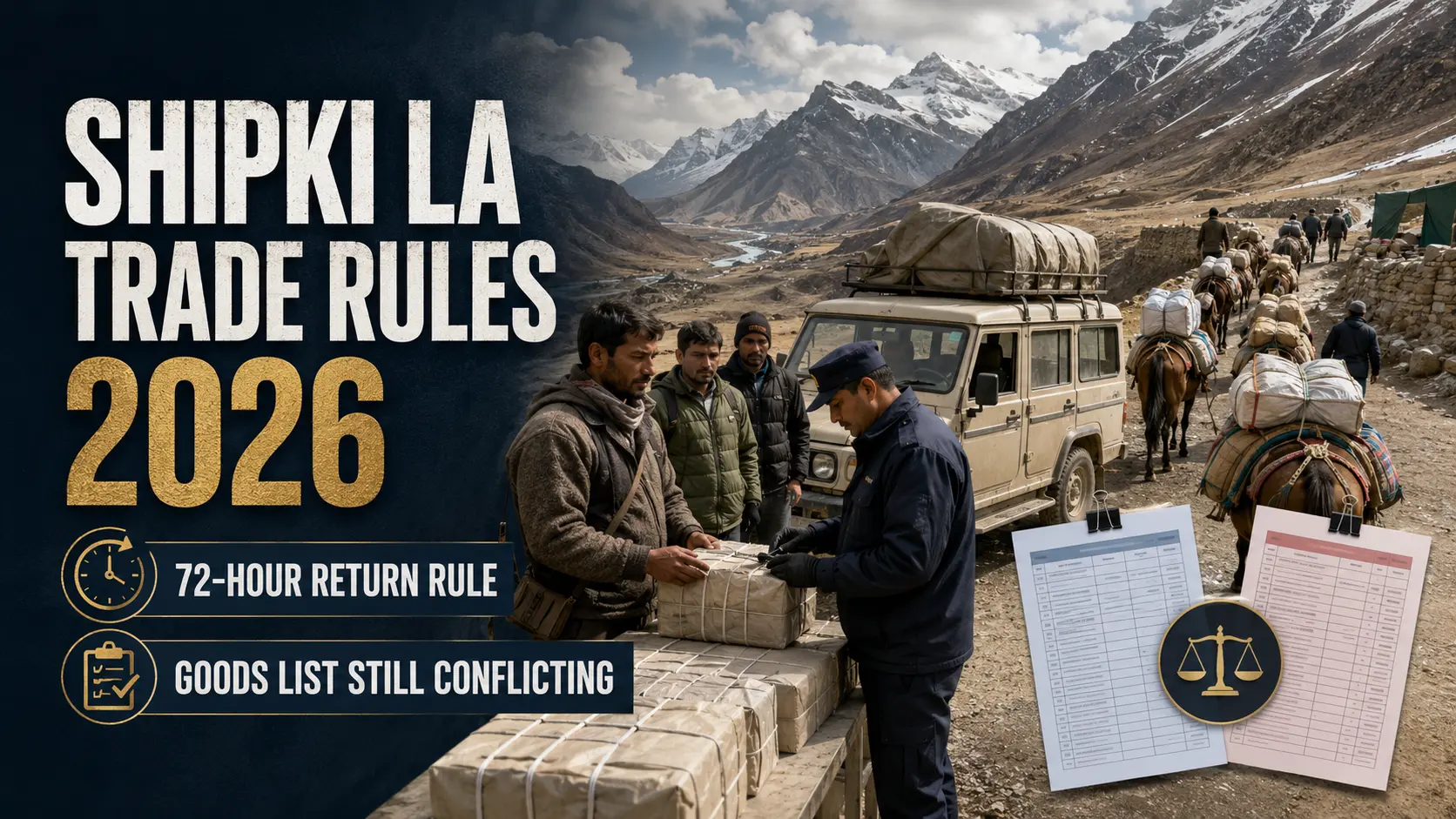
Shipki La border trade remains disrupted by an unresolved IGST dispute. Cross-border trade through the Himachal Pradesh route resumed on August 1, 2026, but the Kinnaur Indo-China Trade Association subsequently suspended further trading activity after the first group returned, saying the tax burden made the traditional trade commercially unviable.
The Himachal Pradesh government had said the issue would be raised with the Union Finance Minister on September 7. As of September 8, no public tax order, exemption, policy clarification or confirmed resumption of normal trader movement was identified in the evidence reviewed. The underlying trader-approval, customs, barter and 72-hour movement rules therefore remain relevant, but prospective traders should continue to treat the operating status as disrupted rather than normal.
Direct answer: Shipki La remains a regulated border-trade route, but normal trader participation is still suspended on the current evidence because the IGST dispute has not been publicly resolved. Tourist permission does not authorise cross-border commerce. Prospective traders should confirm the current operating position, trade approval, permitted goods and tax treatment before moving commercial goods toward the border.
What is the current Shipki La trade status?
Do not describe the route simply as “operating normally.” The physical trade route reopened, but the participating traders later suspended further operations because of the unresolved IGST issue.
Why did Shipki La traders suspend operations?
The Kinnaur Indo-China Trade Association says IGST on imported goods makes the small traditional barter trade commercially unviable because of the limited trade value, difficult terrain, mule transport and short seasonal window.
The association said registered traders would suspend participation until the issue was resolved through an exemption or appropriate policy clarification. Traders have also raised connected concerns involving quarantine facilities, road connectivity and revision of the permitted import-export list.
The reported suspension is a trader action arising from the tax dispute; it should not be confused with a new India-China decision formally closing the Shipki La route.
Did the September 7 government intervention resolve the IGST dispute?
No public resolution was identified in the evidence reviewed through September 8.
Earlier reporting said Himachal Pradesh Chief Minister Sukhvinder Singh Sukhu would raise the Shipki La IGST issue with Union Finance Minister Nirmala Sitharaman on September 7. The traders’ association had also said its further course of action would depend on that intervention.
However, TPS did not identify a fresh public Union Finance Ministry order, customs instruction, IGST exemption, state-government announcement or trader-association statement confirming that the tax issue had been resolved or that normal cross-border trading had restarted.
Practical treatment: until an authoritative tax clarification or confirmed trader resumption is published, traders should continue to verify the operating and IGST position directly before travelling with commercial goods.
Does customs-duty exemption mean IGST is also exempt?
No automatic conclusion should be drawn. Current reporting on the dispute says traders rely on an older customs-duty exemption for specified traditional border trade, while the present disagreement concerns IGST treatment.
A customs-duty exemption and an IGST exemption are not the same legal question. Traders should not assume that barter settlement, traditional-border-trade status or an older customs notification automatically removes the current IGST liability.
Current unresolved point: no fresh official tax order reviewed for this article establishes a new IGST exemption for the 2026 Shipki La trade.
What do the reported 88, 53, 20 and 16 or 17 trader numbers mean?
The numbers refer to different stages rather than one approval count.
Who can trade through Shipki La?
The available evidence supports a restricted system. Traders must go through the authorised registration and verification process and receive the applicable approvals before cross-border commercial movement.
The public material reviewed still does not provide a complete current rule for fresh applications, exact domicile conditions, application forms, pass validity, renewal or appeals.
Is tourist access the same as a trade pass?
No. Regulated domestic tourism on the Indian side is separate from cross-border trade authority.
How does the 72-hour rule work?
Current reports say participating Indian traders must complete their cross-border trading visit and return to Kinnaur within 72 hours.
The accessible current reports do not clearly establish when the 72-hour clock starts or the formal procedure for weather, customs or security delays. Traders should therefore follow the time condition written on their current permit rather than relying on older practice.
Is Shipki La trade still barter-based?
Yes, current reporting continues to describe the route as traditional goods-for-goods barter trade. Goods can still require monetary valuation for customs, records and tax purposes even when settlement occurs through exchange rather than ordinary cash payment.
The IGST dispute illustrates why “barter” should not be interpreted as “outside the tax system.”
Which goods are permitted?
The public record still contains conflicting counts.
36 exports and 20 imports
Pre-opening reporting describes 36 Indian export categories and 20 import categories. Reported exports include tea, coffee, grains, flour, dry fruits, spices, utensils, handloom goods and handicrafts. Reported imports include wool, pashmina, yak-related products, salt, shoes, blankets, carpets and herbal medicines.
72 Indian-side and 30 Chinese-side items
Other post-opening reports referred to 72 types of Indian-side items and 30 Chinese-side items. The full official 2026 schedule needed to reconcile these counts has not been located.
CONFLICTING: traders should obtain the current enforceable goods schedule from the responsible customs or trade authority rather than relying on a news article’s item count.
Is livestock permitted?
Current reporting says live-animal trade is not permitted because adequate quarantine facilities are unavailable. The traders’ association has also continued to raise the need for quarantine infrastructure.
How are goods transported and inspected?
Reports describe goods being transported by vehicle up to the border and then moved by mules or other pack animals to the trading point. Customs personnel inspect incoming and outgoing consignments.
Current public material still does not provide a complete vehicle, driver, load, unloading, mule-allocation or weather-delay procedure.
What is the Chhuppan Trade Mart?
The Chhuppan Trade Mart was inaugurated as part of the 2026 reopening arrangements and is intended to support the border-trade process. Its existence does not mean that walk-in registration or every customs and tax procedure can be completed there without prior approval.
What should a prospective trader verify before travelling?
- Check whether trader movement has actually resumed. Do not assume the August 1 reopening means traders are currently crossing normally.
- Confirm your trader approval. Verify registration, security clearance and cross-border permission.
- Obtain the current permitted-goods list. Ask which item schedule customs is enforcing.
- Confirm IGST and other tax treatment in writing. Do not assume the traditional barter format creates an exemption.
- Confirm the 72-hour rule. Ask when the period begins and what happens during unavoidable delays.
- Verify vehicle and mule arrangements. Confirm where commercial vehicles stop and how goods move beyond that point.
- Keep written records. Preserve permits, customs documents, tax records, goods schedules and official correspondence.
How this was verified
The August 1 reopening was checked against Akashvani and multiple current reports. Later reporting from The Tribune and The New Indian Express confirms that the Kinnaur Indo-China Trade Association suspended further participation over IGST and that the Himachal Pradesh government planned to raise the matter with the Union Finance Minister on September 7.
A fresh search through September 8 did not identify a public tax order, exemption, confirmed policy resolution or trader announcement establishing that normal Shipki La trade had resumed after that expected intervention.
The available sources continue to conflict on the first operational trader count and permitted-goods counts, so those points remain explicitly unresolved.
Last verified: September 8, 2026.
Limitations and unresolved facts
- whether normal trader movement will resume after the IGST dispute;
- whether the Union government will grant, reject or modify the requested IGST treatment;
- whether any September 7 government discussion occurred without a public outcome;
- the definitive record resolving 16 versus 17 traders;
- the official 2026 goods schedule resolving 36/20 versus 72/30;
- whether fresh trader applications or renewals remain open;
- the exact eligibility, domicile and pass-validity rules;
- the complete customs, valuation, IGST, IEC and filing workflow;
- the current trade-value ceiling;
- the exact start and exception handling for the 72-hour period.
Frequently asked questions
Is Shipki La border trade currently operating normally?
No. The route reopened on August 1, but traders subsequently suspended further operations over the IGST dispute, and no confirmed normal resumption was identified through September 8.
Why did traders stop after the reopening?
The association says the IGST burden makes the traditional low-volume barter trade economically unviable.
Did the September 7 intervention resolve the dispute?
No public tax order, IGST exemption or confirmed trader-resumption announcement was identified in the evidence reviewed through September 8.
Has the Shipki La route itself been officially closed again?
The current evidence reviewed establishes a trader suspension over the tax dispute, not a new bilateral decision formally closing the route.
What is the 72-hour rule?
Current reporting says participating traders must complete the cross-border visit and return to Kinnaur within 72 hours.
Does barter mean GST does not apply?
No such automatic exemption has been established. The current dispute specifically concerns IGST on the traditional barter trade.
How many traders crossed in the first group?
Reports conflict: Akashvani reported 17 while several other reports reported 16.
How many goods are allowed?
The public reports remain inconsistent, with one framework describing 36 exports and 20 imports and others referring to 72 Indian-side and 30 Chinese-side items.
Can a tourist cross for commercial trade?
No. Tourist permission is not a substitute for trader registration and cross-border commercial approval.