






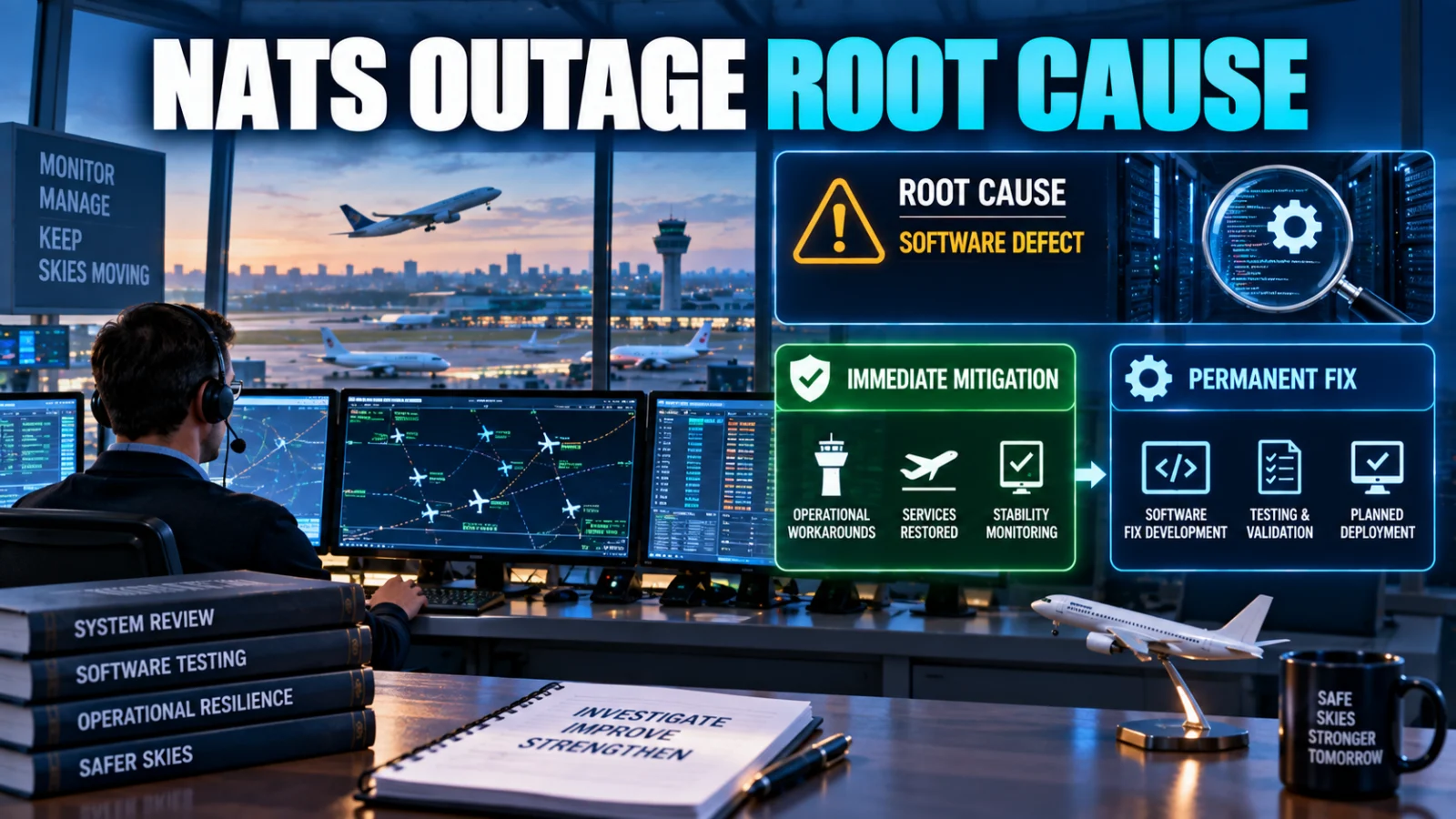
The NATS outage root cause is now more specific than the earlier description of a general technical failure. NATS says a software defect in part of its flight-data system caused the September 8, 2026 UK air-traffic-control disruption. The operator says a mitigation is already in place, but the permanent software fix is still undergoing safety testing before deployment.
The distinction matters because root cause identified, temporary mitigation applied and permanent remediation completed are three different states. The Civil Aviation Authority’s independent review is also still open, so NATS’ preliminary technical conclusion should not be presented as a final regulator-validated finding.
What caused the NATS outage?
NATS says the September 8 outage was caused by a previously unknown software defect in a specific part of its flight-data system. Current reporting on NATS’ preliminary findings describes an unusual timing sequence involving flight-data or aircraft-code requests that exposed the defect.
NATS says the problem was not caused by a cyberattack, sabotage or military activity. Those conclusions remain operator findings while the CAA’s independent review continues.
What is fixed now, and what is not?
NATS says mitigation is already in place. That means the operator has introduced a measure intended to prevent the same failure mode from causing another outage while the full permanent correction is being prepared.
The permanent software fix is not yet confirmed as deployed. NATS says the permanent fix is undergoing safety testing before it can be introduced into the live air-traffic-control environment.
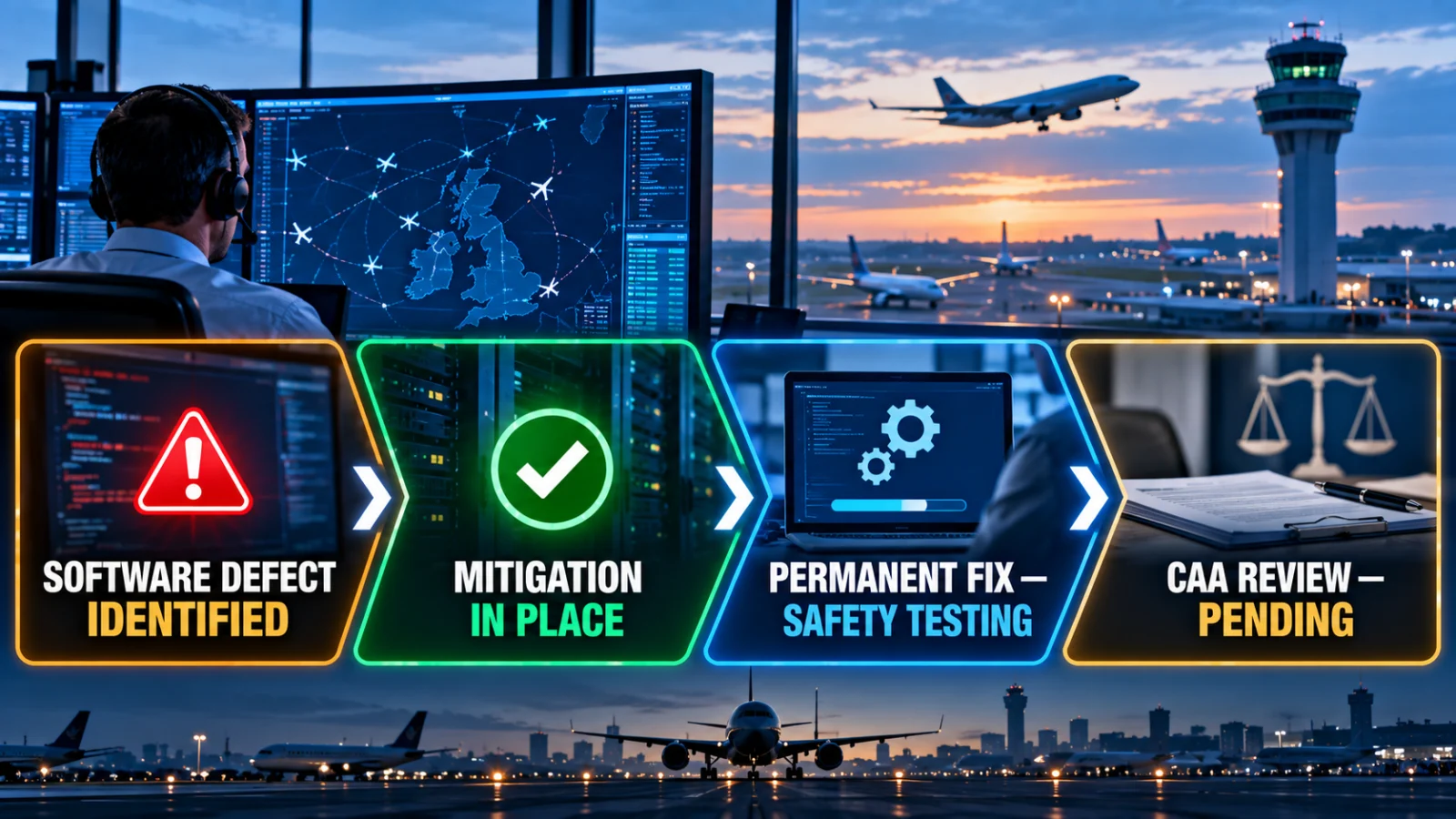
For readers following the incident, this is the current state to keep separate:
- Root cause: NATS attributes the failure to a software defect.
- Immediate protection: NATS says mitigation is in place.
- Permanent correction: still being safety-tested before deployment.
- Independent assessment: the CAA review remains open.
What did the software defect affect?
The reported defect was in part of NATS’ flight-data processing system. That system helps air-traffic-control operations process information needed to manage aircraft movements safely and efficiently.
Current reporting on the preliminary findings says a rare timing sequence exposed a defect in a small section of the software. The complete direct NATS technical report was not independently recovered during this research, so the detailed mechanism should remain attributed to NATS and the reporting that describes its preliminary findings.
Was the outage a cyberattack?
NATS says no. Current reporting says the operator ruled out a cyberattack, sabotage and military activity as causes of the September 8 incident.
That distinction is important because a serious operational outage can result from an internal software failure without evidence of hostile external activity.
Was this the same problem as the 2023 NATS outage?
NATS says the September 2026 software defect was not the same technical problem that caused the major August 2023 disruption.
The two incidents belong to the broader issue of air-traffic-system resilience, but they should not be merged into one root cause. The 2026 incident requires its own technical and regulatory assessment.
Has the CAA confirmed the NATS root-cause finding?
Not yet. The CAA commissioned an independent review of the September 8 disruption and had already required NATS to provide a technical report on the incident.
The current NATS software-defect explanation therefore represents the operator’s preliminary root-cause finding. A final CAA assessment could confirm it, refine it, identify additional resilience failures or make recommendations about technology, procedures, investment or regulatory compliance.
Did the outage compromise aviation safety?
NATS says safety was not compromised during the incident. The disruption nevertheless had a large operational effect because restrictions on air-traffic flow can propagate through airline and airport schedules even when safety systems continue to protect aircraft movements.
How large was the disruption?
The September 8 failure caused major disruption across UK and connecting aviation. Reuters reported roughly 2,000 cancellations in connection with the incident, while other coverage uses different measures such as flights affected or disrupted.
Those figures should not be treated as interchangeable. Cancellation totals, affected-flight counts and passenger-impact estimates measure different aspects of the disruption.
What does mitigation mean if a permanent fix is still pending?
A mitigation is an interim control designed to reduce the chance or consequence of the known failure mode. It can be operationally important without being the final software correction.
A permanent fix changes the underlying software or system behaviour that produced the defect. In safety-critical aviation infrastructure, that change must be tested before deployment so that correcting one fault does not introduce another risk.
This is why the current NATS state should not be simplified to either “nothing has been fixed” or “the problem is permanently solved.” NATS says the immediate risk has been mitigated while the permanent software change remains under safety testing.
What should passengers do now?
There is no general technical action passengers need to take because of the software root cause itself. Anyone travelling should continue to check their airline and airport for current flight status and follow airline instructions if a journey is delayed or cancelled.
Passenger compensation and reimbursement are a separate reader problem from the technical root-cause investigation and depend on the circumstances of the individual disruption and applicable aviation rules.
What should aviation and infrastructure readers watch next?
The next material developments are whether NATS completes safety testing and deploys the permanent software fix, whether it publishes additional technical detail, and what the CAA concludes in its independent review.
A later CAA finding could also clarify whether the incident reveals broader resilience, governance, investment or regulatory issues beyond the specific software defect identified by NATS.
Verification note
ThePulseSignal reviewed current reporting directly attributing the root-cause explanation and remediation status to NATS, alongside the CAA’s primary statement confirming its independent review of the September 8 disruption. The full direct NATS preliminary technical report was not independently recovered, so detailed technical findings remain attributed rather than presented as independently verified regulator conclusions.
Limitations and unresolved facts
The exact direct NATS technical report text, the permanent-fix deployment date, the CAA’s final assessment, any regulatory consequences and the final reconciled disruption count remain unresolved. NATS may also refine the technical explanation as testing and independent review continue.